


Prime made for students and young adults
- Fast, free delivery for dorm and study essentials
- Prime Video and Amazon Music included
- Member-only deals
Key Takeaways
- The EUDAX kit offers the clearest path into electricity and magnetism experiments, while Snap Circuits favors quick, guided circuit building.
- The PalliPartners microscope supports open-ended observation; it suits learners who want to choose their own specimens more than follow a fixed project sequence.
- The ELEGOO robot car and LewanSoul robotic arm add coding and mechanical troubleshooting, making them more involved than the mostly guided electronics kits.
- The National Geographic rock tumbler teaches through a slower process: polishing takes time, so it fits patient learners better than anyone seeking a same-day result.
- The V8 engine and electromagnetic coil accelerator prioritize visually engaging demonstrations; buyers seeking broader experiment variety may prefer EUDAX or Snap Circuits.
| Snap Circuits Classic SC-300 STEM Electronics Kit, 300+ Projects, Ages 8+ |  | Best for Building Electronics Fundamentals | Model: SC-300 | Recommended age: 8 years and up | Number of projects: 300+ | VIEW LATEST PRICE | See Our Full Breakdown |
| National Geographic Hobby Rock Tumbler Kit | 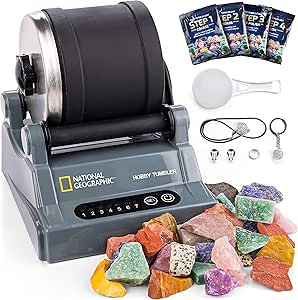 | Best for Hands-On Geology | Brand: Blue Marble | Model number: NGHOBBYTUMBLER | Age range: 8 years and up | VIEW LATEST PRICE | See Our Full Breakdown |
| PalliPartners Compound Microscope for Adults and Students |  | Best for Specimen Observation | Brand and model: PalliPartners SWXWJ-1 | Microscope type: Compound light microscope | Magnification: 100X–2000X | VIEW LATEST PRICE | See Our Full Breakdown |
| ELEGOO UNO R3 Smart Robot Car Kit V4 with Camera |  | Best for Coding and Robotics | Brand and model: ELEGOO US-EL-KIT-012 | Controller: ELEGOO UNO R3 | Camera and Wi-Fi module: ESP32-WROVER-based | VIEW LATEST PRICE | See Our Full Breakdown |
| NikolaToy High Tech Electromagnetic Coil Accelerator STEM Kit |  | Best for Advanced Physics Demonstration | Brand: NikolaToy | Manufacturer part number: NIKOLA00501-1P | Recommended age: 15 years and up | VIEW LATEST PRICE | See Our Full Breakdown |
| EUDAX School Physics Lab Basic Electricity and Magnetism Experiment Kit for High School Students |  | Best for Electricity and Magnetism | Brand: EUDAX | Model: EUDAX-FC-80PCS | Components: 79 | VIEW LATEST PRICE | See Our Full Breakdown |
| Playz Working V8 Engine Model Kit |  | Best for Mechanical Engineering | Brand: Playz | Model: v8engine | Age guidance: 8+; recommended age 12 years | VIEW LATEST PRICE | See Our Full Breakdown |
| LewanSoul miniArm 5-DOF Arduino Robotic Arm Starter Kit |  | Best for Advanced Programmable Learning | Brand: LewanSoul | Model: miniArm Starter | Degrees of freedom: 5 | VIEW LATEST PRICE | See Our Full Breakdown |
| educational science kits for adult | Brand | Model | Weight |
|---|---|---|---|
| Snap Circuits Classic SC-300 S | — | SC-300 | — |
| National Geographic Hobby Rock | Blue Marble | — | 5.1 pounds |
| PalliPartners Compound Microsc | — | — | — |
| ELEGOO UNO R3 Smart Robot Car | — | — | — |
| NikolaToy High Tech Electromag | NikolaToy | — | 1165 g |
| EUDAX School Physics Lab Basic | EUDAX | EUDAX-FC-80PCS | 1.43 kg |
| Playz Working V8 Engine Model | Playz | v8engine | 1.8 kg |
| LewanSoul miniArm 5-DOF Arduin | LewanSoul | miniArm Starter | — |
More Details on Our Top Picks
Snap Circuits Classic SC-300 STEM Electronics Kit, 300+ Projects, Ages 8+
Snap Circuits Classic SC-300 is the most approachable choice here for learning how basic electronic components work together. Numbered, color-coded parts snap onto a grid, so a learner can focus on circuit behavior instead of soldering or tool skills. Its illustrated project sequence builds from simple setups toward more involved experiments, giving it a broader practice path than the NikolaToy Electromagnetic Coil Accelerator, which focuses on a narrower physics demonstration. The tradeoff is that this kit is designed around guided projects rather than adult-level electronics design, and its age recommendation starts at eight. Also, the printed manual covers only projects 1–8; later projects require online or downloaded instructions, and four AA batteries are not included. I’d choose it for structured circuit exploration, not for advanced engineering work.
Pros:- Color-coded, numbered components make circuit parts easier to identify.
- Snap-together assembly avoids soldering and tools.
- Progressively challenging illustrated projects support guided learning.
- More than 300 project options offer a longer activity path than a single-concept demonstration kit.
Cons:- Four AA batteries are required and sold separately.
- The included manual covers only projects 1–8; later instructions must be accessed online or downloaded.
- Its child-oriented structure may feel basic to adults with prior electronics experience.
Best for: Adult beginners who want a tool-free, step-by-step introduction to circuits and are comfortable using digital instructions for most projects.
Not ideal for: Experienced electronics hobbyists seeking open-ended design challenges, or buyers who want every project in a complete printed manual.
- Model:SC-300
- Recommended age:8 years and up
- Number of projects:300+
- Included components:Plastic snap-grid, 47 electrical parts, project manual
- Power source:4 AA batteries, not included
- Assembly:Snap-together; no soldering or tools required
- Manual coverage:Projects 1–8 included; projects 9–318 available online or as a download
Our verdict“Choose this kit for a low-barrier, guided introduction to electronics, but skip it if you want advanced circuit design or a fully printed project library.”
National Geographic Hobby Rock Tumbler Kit
National Geographic Hobby Rock Tumbler Kit makes geology tangible by turning rough stones into polished specimens through a multi-stage process. The package includes nine types of rough gemstones, four polishing grits, a sifter, and a full-color learning guide, so the activity has a clear material-and-result arc rather than the coding and assembly emphasis of the ELEGOO UNO R3 Smart Robot Car Kit. A one-touch timer and automatic shutoff reduce the amount of attention needed during operation, while the rubber barrel is designed to limit noise and leaks. The main tradeoff is time: rock polishing is a gradual process, not an immediate experiment, and this kit offers less direct control over the science than a microscope or electronics set. It is also aimed at ages eight and up, and the manufacturer provides no warranty.
Pros:- Includes rough gemstones, four polishing grits, a sifter, and a learning guide.
- One-touch timer and automatic shutoff simplify operation.
- Leakproof rubber barrel is designed to reduce noise during tumbling.
- The polishing process provides a visible connection between geology and material change.
Cons:- Polishing takes time, so results are not available in a single short session.
- No manufacturer warranty is provided.
- The age recommendation and activity format may be less suited to adults seeking advanced geological analysis.
Best for: Adult geology newcomers, educators, or hobbyists who want a guided specimen-polishing project with rocks and supplies included.
Not ideal for: Buyers looking for fast experiments, microscope-based observation, or a product backed by a manufacturer warranty.
- Brand:Blue Marble
- Model number:NGHOBBYTUMBLER
- Age range:8 years and up
- Included components:Rock tumbler, four polishing grits, sifter, nine types of rough gemstones, full-color learning guide
- Barrel:Leakproof rubber
- Operation features:One-touch timer and automatic shutoff
- Dimensions:13.81 x 4.88 x 8.06 inches
- Weight:5.1 pounds
- Warranty:No manufacturer warranty
Our verdict“Pick this for a patient, tactile introduction to rocks and minerals, but choose a microscope or electronics kit for more direct, repeatable investigation.”
PalliPartners Compound Microscope for Adults and Students
For adults who want to inspect prepared or self-made slides, the PalliPartners Compound Microscope offers the most direct observation experience in this group. Its 4X, 10X, and 40X objective lenses, WF25X eyepiece, and added 2X lens support a stated range of 100X–2000X magnification; adjustable upper and lower LEDs let users work with opaque as well as translucent samples. The 10 prepared and 18 blank slides provide a starting point while leaving room for independent sample preparation. Compared with the National Geographic Hobby Rock Tumbler, this kit is better for close visual study than for a process with a polished physical result. Its phone adapter and Bluetooth shutter support image capture, though the stated use is basic to intermediate education—not complex professional research.
Pros:- Multiple objective lenses and a stated 100X–2000X range allow varied levels of magnification.
- Adjustable upper and lower LED lights accommodate opaque and translucent specimens.
- Includes 10 prepared slides and 18 blank slides for guided and self-directed study.
- Phone adapter and Bluetooth camera shutter support image capture.
Cons:- Intended for basic to intermediate education rather than complex professional research.
- The product description recommends adult supervision for children, so it is not a fully independent family activity for younger users.
Best for: Adult learners who want to examine prepared slides, make their own basic slides, and document observations with a phone.
Not ideal for: Professional researchers who need advanced laboratory capabilities, or buyers who want a project that produces a physical object rather than microscope observations.
- Brand and model:PalliPartners SWXWJ-1
- Microscope type:Compound light microscope
- Magnification:100X–2000X
- Objective lenses:4X, 10X, 40X
- Eyepiece and additional lens:WF25X eyepiece; 2X magnification lens
- Illumination:Adjustable upper and lower LED lights
- Focus:Coaxial coarse and fine focus knobs
- Included slides:10 prepared slides and 18 blank slides
- Included accessories:Phone clip adapter, Bluetooth camera shutter, power adapter
Our verdict“Choose this microscope for visual specimen study and phone documentation, but look elsewhere for professional lab work or a build-and-program project.”
ELEGOO UNO R3 Smart Robot Car Kit V4 with Camera
The ELEGOO UNO R3 Smart Robot Car Kit V4 with Camera suits adults who want science learning to include building, programming, and motion. Its UNO R3 controller, sensors, camera, and Arduino IDE support connect software decisions to visible outcomes such as line tracking and obstacle avoidance. App and IR remote control make it possible to explore the car’s behavior both manually and through its programmed functions. That gives it a broader engineering workflow than the Snap Circuits Classic SC-300, which is easier to assemble but focuses on guided electronic circuits rather than code-driven robotics. In return, the ELEGOO kit asks more of the builder: assembly and programming are required, and first-time builders are advised to have guidance. The included rechargeable battery avoids a separate battery purchase, but this is not a ready-to-run activity straight out of the box.
Pros:- Combines Arduino IDE programming with a mobile robot build.
- Supports FPV video, line tracking, obstacle avoidance, and auto follow.
- Offers app and IR remote control for different ways to operate the car.
- Includes an illustrated tutorial, guided wiring, example programs, and a rechargeable battery.
Cons:- Assembly and programming are required before the full feature set can be explored.
- First-time builders are advised to have adult guidance.
- The camera and multiple functions create a more involved setup than the simpler Snap Circuits kit.
Best for: Adult beginners in Arduino robotics who want to assemble a mobile platform, write or adapt programs, and explore camera-based features.
Not ideal for: Buyers seeking a quick, tool-free science activity or a project that needs no programming and assembly.
- Brand and model:ELEGOO US-EL-KIT-012
- Controller:ELEGOO UNO R3
- Camera and Wi-Fi module:ESP32-WROVER-based
- Control methods:App and IR remote
- Features:FPV video, line tracking, obstacle avoidance, auto follow
- Battery:2000 mAh rechargeable lithium-ion
- Programming platform:Arduino IDE
- Recommended age:12 years and up
- Dimensions and weight:8 x 7 x 6 inches; 1.23 kg
Our verdict“Choose this for a hands-on Arduino robotics project with coding and camera features, but skip it if you want a simple experiment with little setup.”
NikolaToy High Tech Electromagnetic Coil Accelerator STEM Kit
NikolaToy High Tech Electromagnetic Coil Accelerator STEM Kit is the most specialized option here: it is intended to make particle acceleration and electromagnetism visible through an interactive ring-accelerator demonstration. Its focus gives it a different role from the PalliPartners Compound Microscope, which supports broad specimen observation, and the ELEGOO UNO R3 Smart Robot Car, which teaches through coding and mechanical behavior. The metal-and-acrylic construction and compact footprint suit a desk or classroom display, while the stated age recommendation of 15 years and up signals a more advanced audience than the Snap Circuits kit. The tradeoff is narrow scope: the provided product information does not list a project count, power details, or a broader set of experiments, so it is best treated as a focused physics teaching aid rather than a general-purpose science kit. Its 1165 g weight also limits portability.
Pros:- Provides an interactive way to visualize particle-acceleration principles.
- Metal and acrylic construction is suited to a durable display or teaching setup.
- Compact 24 x 24 x 6 cm footprint fits home and classroom environments.
- Its physics focus complements broader circuit, microscopy, and robotics kits.
Cons:- The 1165 g weight may make transport less convenient.
- Recommended for ages 15 and up, limiting its fit for younger learners.
- The supplied product details describe a specialized demonstration rather than a wide range of experiments.
Best for: Older teens, adult physics learners, and educators seeking a focused visual demonstration of electromagnetic acceleration concepts.
Not ideal for: Younger learners, buyers wanting a broad set of experiments, or anyone who needs a lightweight kit to carry between locations.
- Brand:NikolaToy
- Manufacturer part number:NIKOLA00501-1P
- Recommended age:15 years and up
- Educational objective:STEM
- Dimensions:24 x 24 x 6 cm (9.5 x 9.5 x 2.5 inches)
- Weight:1165 g
- Materials:Metal and acrylic
Our verdict“Pick this for a focused, interactive electromagnetism demonstration for older learners, but choose a broader kit for varied experiments or younger users.”
EUDAX School Physics Lab Basic Electricity and Magnetism Experiment Kit for High School Students
The EUDAX kit earns its place by pairing circuit building with magnetism experiments, so I’d choose it for an adult learner who wants to explore several connected physics ideas in one set. Its 79 components support series and parallel circuits, fruit batteries, and electromagnets; that range gives it a broader electricity focus than the Playz Working V8 Engine Model Kit, which concentrates on mechanical motion. A full-color manual and storage bag help make the many parts easier to follow and keep together. The tradeoff is that this is a component-driven learning kit rather than a single polished model, and the number of small pieces may feel like a lot to sort through. It also needs three AA batteries, which are not included.
Pros:- 79 components support a range of electricity and magnetism projects.
- Covers series and parallel circuits, fruit batteries, and electromagnets.
- Full-color manual provides project guidance.
- Storage bag helps keep the small parts together.
Cons:- Requires three AA batteries, which are not included.
- The number of small components may be challenging to organize.
- Its listed age range and school focus may make it feel less adult-oriented than the Arduino robotic arm.
Best for: Adult beginners who want guided, hands-on practice with circuits and basic magnetism experiments.
Not ideal for: Buyers seeking a programmable project or a ready-to-run mechanical model, or anyone who wants to avoid sorting many small components.
- Brand:EUDAX
- Model:EUDAX-FC-80PCS
- Components:79
- Age range:8–18 years
- Weight:1.43 kg
- Size:Medium
- Power requirement:Three AA batteries, not included
Our verdict“Choose EUDAX if you want a guided assortment of circuit and magnetism experiments and are comfortable organizing small parts.”
Playz Working V8 Engine Model Kit
For an adult who learns best by watching mechanisms move, the Playz V8 model makes engine motion the main lesson. Its moving pistons, cranks, pulleys, belts, exhaust valves, and motorized fans turn mechanical concepts into something visible, while engine sounds add a layer of feedback during operation. Compared with the EUDAX physics kit, Playz offers a more unified build with a clear mechanical theme; EUDAX covers more separate electricity and magnetism experiments. This is the better fit when the goal is to assemble and observe one working model, rather than move among different experiments. The tradeoff is that its learning scope centers on engine mechanics and spatial reasoning, and the kit requires three AA batteries that are not included.
Pros:- Moving pistons, cranks, pulleys, belts, valves, and fans make engine motion observable.
- Engine sounds add feedback during operation.
- Build-and-operate format supports spatial reasoning and mechanical problem-solving.
- Clear vehicle-engine theme gives the project a focused learning goal.
Cons:- Requires three AA batteries, which are not included.
- Focuses on a single mechanical theme rather than varied experiments.
- Plastic construction may be less appealing to buyers seeking a metal engineering model.
Best for: Adults and older teens who want to assemble a moving model and learn mechanical concepts through visible engine parts.
Not ideal for: Learners looking for circuit experiments, coding, or a broad range of science topics instead of one engine-focused build.
- Brand:Playz
- Model:v8engine
- Age guidance:8+; recommended age 12 years
- Material:Plastic
- Theme:Vehicle / V8 engine
- Power source:Three AA batteries, not included
- Weight:1.8 kg
- Learning objectives:STEM, spatial reasoning, problem-solving, mechanical engineering
Our verdict“Pick Playz if a moving, sound-producing engine model is more appealing than a kit of separate physics experiments.”
LewanSoul miniArm 5-DOF Arduino Robotic Arm Starter Kit
The LewanSoul miniArm is the most development-oriented choice in this group: it combines a five-degree-of-freedom arm with Arduino compatibility, open-source programs, tutorials, and examples. App, Bluetooth, and six-channel knob control give a learner different ways to operate it, while sensor expansion ports leave room to build on the starter setup. That makes it a stronger fit for programming and robotics practice than the Playz V8, whose appeal is watching a fixed mechanical system run. The tradeoff is a steeper learning curve and a higher age recommendation of 17 years and up. The Starter Kit also excludes the optional sensors and ESP32-CAM module, so buyers should not expect those capabilities out of the box.
Pros:- Arduino compatibility and open-source examples support programming practice.
- Five degrees of freedom allow varied arm movement.
- App, Bluetooth, and six-channel knob control offer different operating methods.
- Sensor expansion ports support future projects.
Cons:- Optional sensors and the ESP32-CAM module are not included in the Starter Kit.
- Recommended for ages 17 and up, reflecting a more advanced learning path.
- Programming and setup may be demanding for learners seeking a quick, low-complexity project.
Best for: Adult learners aged 17 and up who want to program a robotic arm and explore Arduino-compatible control.
Not ideal for: Beginners seeking a simple guided science activity, or buyers expecting sensors or an ESP32-CAM module in the Starter Kit.
- Brand:LewanSoul
- Model:miniArm Starter
- Degrees of freedom:5
- Controller platform:ATmega328
- Programming compatibility:Arduino
- Control options:App, Bluetooth, six-channel knob controller
- Servo type:High-precision digital servos
- Material:Aluminum
- Dimensions and weight:13 × 5 × 8 inches; 1.28 kg
Our verdict“Choose the miniArm if you want a programmable robotics project with room to expand and are ready for a more involved setup.”

How We Picked
I compared these kits by what an adult can learn through building or observing, how clearly the activity connects to a scientific idea, and how much setup and troubleshooting it asks of the buyer. I also weighed project variety, the opportunity to revisit or extend an activity, and whether the kit appears suited to independent exploration or guided learning.
The ranking favors kits that pair a clear learning path with repeatable activities and useful hands-on feedback. EUDAX leads for its concentrated electricity and magnetism experiments; PalliPartners and ELEGOO follow for distinct, reusable approaches to observation and robotics. More specialized or slower projects rank lower for general use, even when they may be the better fit for a particular interest. Adult suitability here means the kit can hold an adult learner’s interest, not that every product is designed exclusively for adults.
| educational science kits for adult | Model | Brand |
|---|---|---|
| Snap Circuits Classic SC-300 S | SC-300 | — |
| National Geographic Hobby Rock | — | Blue Marble |
| PalliPartners Compound Microsc | — | — |
| ELEGOO UNO R3 Smart Robot Car | — | — |
| NikolaToy High Tech Electromag | — | NikolaToy |
| EUDAX School Physics Lab Basic | EUDAX-FC-80PCS | EUDAX |
| Playz Working V8 Engine Model | v8engine | Playz |
| LewanSoul miniArm 5-DOF Arduin | miniArm Starter | LewanSoul |
Factors to Consider When Choosing Educational Science Kits For Adults
The best choice depends on what kind of learning keeps you engaged: following a sequence, testing your own ideas, or building a machine that needs debugging. I’d decide how much guidance, setup, and patience you want before choosing by topic alone.Choose the learning style before the subject
A science kit can teach through a set of repeatable experiments, a build with a working result, or observation that you direct yourself. Those formats suit different habits: guided steps help when you want a clear route, while open-ended work rewards curiosity and self-direction. A common mistake is choosing a subject you like without checking whether the kit’s activity format appeals to you. Think about whether you want to read instructions, assemble a mechanism, write or adjust code, or supply your own questions. The more closely the activity matches how you like to learn, the more likely you are to return to it. Use the product descriptions to identify the actual activity, not just the science topic on the box.
Account for setup and troubleshooting
Assembly is part of the learning in robotics and model kits, but it can also take time away from the concept you hoped to study. Check whether the project depends on coding, careful wiring, calibration, or a suitable work surface before buying. Beginners often underestimate how much small setup decisions affect whether a project works. If you enjoy debugging, that challenge can be valuable; if you want a smooth first session, a more guided kit may be a better fit. Also check what tools, batteries, devices, or consumables are needed, since included parts do not always cover every practical requirement. Choose a challenge level that leaves room to learn without making every session a repair session.
Match the time scale to your expectations
Some experiments produce feedback quickly, while others unfold over repeated sessions or require waiting between steps. That difference shapes whether a kit fits a weekend activity, a regular hobby, or a longer learning project. Buyers can mistake a slow process for a lack of substance when the real payoff comes from observing change over time. Before choosing, ask whether you want a visible result right away or are happy to maintain a project and check on it later. Longer activities can encourage patience and observation, but they need a place and schedule where the work can continue. A kit that fits your available time is more useful than one with an impressive concept you rarely get to pursue.
Look for room to repeat and extend
A first successful build is satisfying, but repeatable experiments often offer more lasting learning. Consider whether you can change one variable, compare outcomes, or create a new question using the kit’s parts. A fixed demonstration can be a good introduction, yet it may feel limited once you understand the basic effect. Conversely, an open-ended instrument may offer many directions but provide little structure for deciding what to try. Buyers should balance built-in guidance against the freedom to explore. If you want a continuing hobby, favor a kit that invites new trials or can connect to other projects you already have.
Decide what kind of support you need
Instructions can range from a set of build steps to explanations that connect each action to a scientific principle. Those are not interchangeable: a project may work as shown without explaining why it works. Look for the kind of learning support you value, such as diagrams, experiment prompts, background reading, or coding examples. If you plan to learn independently, unclear instructions can make a technically interesting kit frustrating. More support may help a beginner get started, while experienced hobbyists may prefer fewer guardrails and more room to adapt. Consider whether you have access to a book, class, or online learning resource to fill gaps when the kit’s own guidance is brief.
Frequently Asked Questions
Which kit makes the most sense if I have no electronics experience?
I’d start with a kit that presents a guided sequence and lets you see a circuit respond to each change. That structure helps connect an action to its result without requiring you to begin by designing a system from scratch. The EUDAX kit is a stronger fit if your goal is to explore electricity and magnetism through experiments, while Snap Circuits leans toward accessible project building. Check the instructions and included experiment material before deciding, since those shape the learning experience as much as the components. If you want to move on to coding or robotics later, a guided electronics project can help build useful confidence first.
Do I need programming experience for the robot car or robotic arm?
These robotics kits are better choices if you are willing to spend time assembling and troubleshooting, and coding may be part of that process. Prior programming knowledge can help, but the bigger question is whether you are comfortable learning software alongside the mechanical build. Check the current kit documentation for supported platforms, examples, and any computer or phone requirements before purchase. If you want to focus on physical science without software setup, the EUDAX experiments or microscope offer a different route. A robot is most rewarding when you want the finished machine to be a starting point for further adjustments.
Should I choose a microscope or a kit with a defined experiment sequence?
Choose a microscope if you want to bring your own specimens and questions to the activity. It offers a different kind of flexibility from a kit organized around a set of experiments, but that freedom also means you may need to decide what to observe and how to interpret it. A defined sequence can be easier when you want instructions to set the pace and explain the learning goal. Consider how much you enjoy independent exploration and whether you have likely samples or reference material available. The best match is the one whose activity format you’ll actually use, not simply the one with the broader-sounding subject.
Are these kits suitable as gifts for adults?
They can be, especially when the recipient has a clear interest in the subject and enjoys making or investigating things. Match the gift to the person’s preferred pace: a rock tumbler involves waiting, while robotics asks for more active assembly and troubleshooting. Also check age guidance, included supplies, workspace needs, and whether any device or tools are required. A kit that seems impressive but depends on equipment the recipient lacks can become an incomplete project. If you do not know their experience level, a guided activity with a clear first result is usually an easier introduction than an open-ended build.
When is a more involved kit worth choosing over a guided one?
A more involved kit makes sense when the building and problem-solving are part of what you want from the experience. Robotics and engine models can give you a tangible system to assemble and investigate, but they may require more time, patience, and attention to instructions. A guided kit is often the better choice when you want the science to be the main focus and prefer a shorter route to an experiment. Think about whether you would enjoy diagnosing a build issue as much as seeing the final result. The added challenge is useful when it matches your interests; complexity by itself does not make a kit more educational.
Conclusion
For the broadest guided exploration of electricity and magnetism, I’d choose the EUDAX kit as my best overall pick; Snap Circuits is my best value for approachable, repeatable circuit projects. The PalliPartners microscope is my best choice for beginners who prefer observing real specimens, while the ELEGOO robot car is the best premium style of project for learners who want a more involved build with robotics and coding. For a specific interest, I’d pick National Geographic’s tumbler for patient geology exploration, the V8 model for a mechanical build, or the LewanSoul arm for hands-on robotics. The NikolaToy accelerator suits buyers drawn to a focused electromagnetic demonstration. Choose by the activity you want to repeat, and by how much setup and open-ended problem-solving you want along the way.