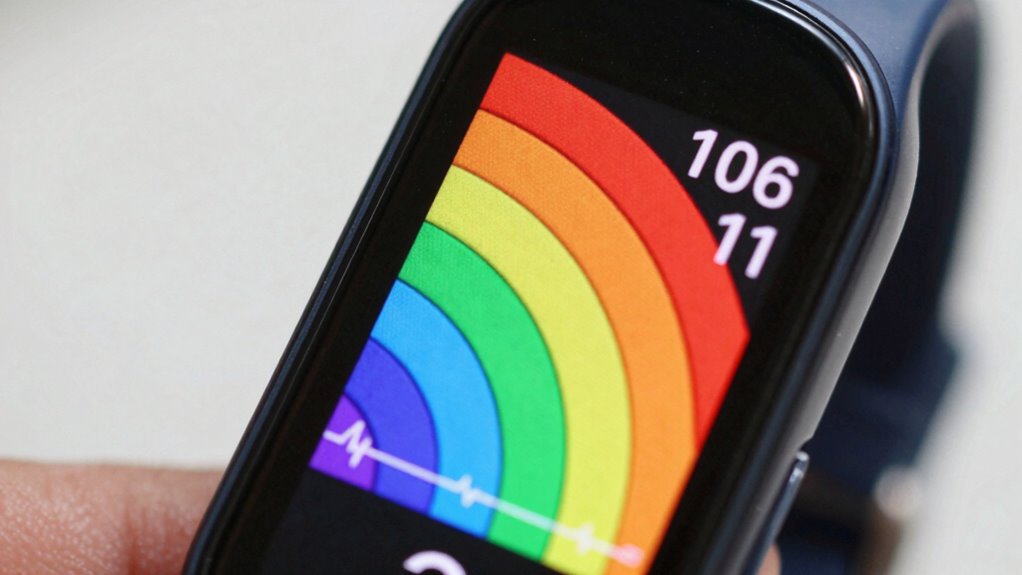

You can easily monitor your heart rate zones during workouts without a lab by using wearable devices like fitness trackers or smartwatches. These tools track your real-time heart rate and automatically calculate your current zone, such as fat burning or cardio. By staying within these zones, you optimize your workout, prevent overexertion, and see progress faster. If you want to learn how to use these devices effectively for better results, keep exploring these simple techniques.

Prime made for students and young adults
- Fast, free delivery for dorm and study essentials
- Prime Video and Amazon Music included
- Member-only deals
Key Takeaways
- You can estimate your max heart rate using age-based formulas like 220 minus your age.
- Wearable devices automatically calculate and display your heart rate zones during exercise.
- Heart rate zones are percentages of your max heart rate, such as 50-60% for fat burning.
- Real-time data helps you stay within target zones without needing lab tests.
- Using fitness trackers or smartwatches simplifies monitoring and adjusting workout intensity on your own.

Monitoring your heart rate zones can considerably boost your workout effectiveness, even without access to a lab or specialized equipment. The key lies in understanding how to track and interpret your heart rate using simple methods and accessible tools like wearable devices. These devices, which include fitness trackers, smartwatches, and chest straps, have made it easier than ever to monitor your heart rate in real time. Rather than relying solely on guesswork, you can now use these tools to stay within specific zones that optimize your training. This approach helps you target fat burning, improve aerobic capacity, or boost anaerobic performance depending on your goals.
Training methods based on heart rate zones are designed to help you work smarter, not harder. By knowing your maximum heart rate—generally estimated as 220 minus your age—you can set personalized zones. For example, staying between 50-60% of your max heart rate typically promotes fat burning, while 70-80% enhances cardiovascular endurance. Using wearable devices, you can see your heart rate fluctuate during exercise and adjust your intensity accordingly. This real-time feedback prevents you from overexerting or underperforming, ensuring each workout is efficient and tailored to your needs.
Knowing your max heart rate helps you tailor workouts for optimal fat burn and endurance.
The beauty of wearable devices is their simplicity. Many devices sync with apps that automatically calculate your heart rate zones, taking the guesswork out of training. Some even offer guided workouts designed around specific zones, making it easier to stay on track. For instance, if your goal is to improve your stamina, you might aim to stay in the aerobic zone for longer periods. These tools eliminate the need for complicated calculations or lab visits, giving you immediate insights into how hard your body is working and whether you’re hitting your target zones.
You can also incorporate interval training, alternating between different heart rate zones to maximize benefits. For example, after warming up, push yourself into a higher zone for a short burst, then recover in a lower zone. Wearable devices make it simple to track these changes without constantly checking your pulse manually. This flexibility allows you to experiment with different training methods and find what works best for your fitness level. Plus, with consistent use, you’ll develop a better sense of your body’s responses, helping you fine-tune your workouts over time.
Additionally, understanding heart rate zones can help you prevent burnout and reduce the risk of injury by training at appropriate intensities for your fitness level. In short, monitoring your heart rate zones with accessible wearable devices and straightforward training methods allows you to optimize your workouts and reach your fitness goals more effectively. You don’t need a lab or fancy equipment—just a reliable device and a bit of knowledge about your heart rate zones. This approach empowers you to train smarter, stay motivated, and make meaningful progress without unnecessary complications.
best fitness tracker for heart rate zones
As an affiliate, we earn on qualifying purchases.
As an affiliate, we earn on qualifying purchases.
Frequently Asked Questions
Can I Determine My Heart Rate Zones Without Wearing a Device?
Yes, you can determine your heart rate zones without a device by using pulse palpation and perceived exertion. To do this, find your pulse on your wrist or neck and count beats for 15 seconds, then multiply by four for your heart rate. Use perceived exertion to gauge intensity — moderate effort feels like a brisk walk, while high effort is hard to talk. This helps you estimate your zones effectively.
How Accurate Are Manual Methods for Measuring Heart Rate Zones?
Manual methods for measuring heart rate zones can offer decent fitness accuracy, but measurement reliability varies. You might get a general idea of your zones by checking your pulse, but factors like timing and technique can impact precision. For better consistency, consider combining manual checks with other methods, and remember that professional tools provide more reliable data. Still, with careful technique, manual methods can be a useful, accessible way to monitor your training.
Is It Necessary to Know My Exact Maximum Heart Rate?
You don’t need your exact maximum heart rate to effectively train, but knowing your estimated max helps tailor your workouts. Heart rate variability and your fitness level influence how your heart responds to exercise, making personalized zones more meaningful. As you track these factors, you’ll better understand your body’s signals, allowing you to optimize your training without precise max data. Focus on consistency and listening to your body’s cues for best results.
Can Heart Rate Zones Change Over Time Without a Lab Test?
Yes, your heart rate zones can change over time even without a lab test. As you train, your heart rate variability and training adaptation improve, which can shift your zones. Consistent exercise makes your heart more efficient, often lowering your resting and maximum heart rates. Monitoring how you feel during workouts and tracking your recovery can help you notice these changes and adjust your training zones accordingly.
What Are the Signs I’M Training in the Right Heart Rate Zone?
You’ll know you’re in the right heart rate zone when your perceived exertion feels challenging but sustainable, usually around a 5-7 out of 10. Pay attention to your breathing pattern—if you’re breathing steadily but deeply without gasping, you’re likely in the right zone. If your breathing feels labored or you’re gasping, you might be pushing too hard. Adjust your effort until your perceived exertion and breathing feel balanced.
smartwatch with heart rate monitor
As an affiliate, we earn on qualifying purchases.
As an affiliate, we earn on qualifying purchases.
Conclusion
You might think you need fancy equipment to find your heart rate zones, but that’s not true. With a simple method like measuring your max effort or using a basic formula, you can confidently train without a lab. Don’t worry if it’s not perfect—what matters is consistency. Over time, you’ll better understand your body’s signals, making your workouts more effective and enjoyable. So, skip the lab and start tuning into your own heart today.
As an affiliate, we earn on qualifying purchases.
wearable device for workout heart rate tracking
As an affiliate, we earn on qualifying purchases.
As an affiliate, we earn on qualifying purchases.
Halloween Picks
halloween
As an affiliate, we earn on qualifying purchases.

![The Early History Of The Singular Value Decomposition (1993) [Pdf]](https://haltmal.com/wp-content/uploads/2026/07/the-early-history-of-the-singular-value-decomposition-1993-pdf-featured-560x300.jpg)