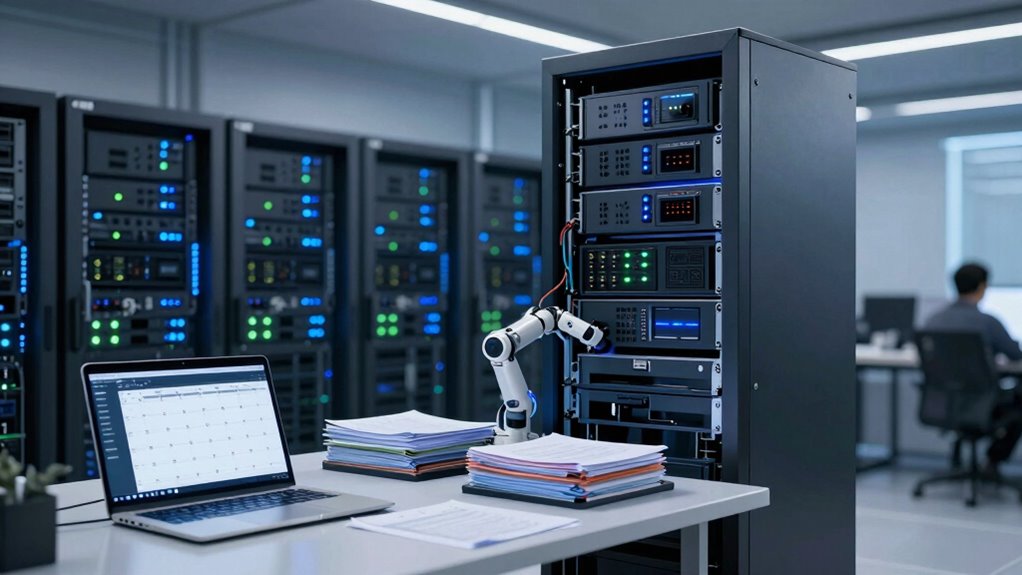

You’ll find that AI is much better at organizing data because it can process large amounts quickly and accurately, sorting information without fatigue or bias. It excels at categorizing, prioritizing, and retrieving data efficiently, streamlining workflows with ease. However, when it comes to decisions involving ethics, emotions, or cultural nuances, AI struggles because it lacks human understanding, empathy, and moral judgment. Keep exploring, and you’ll discover how AI’s strengths complement human skills in ways that matter most.

Get school and study supplies delivered free — and shop member deals
- Fast, free delivery on millions of items
- Access to Prime Big Deal Days deals on October 6–7
- Prime Video, Amazon Music and more included
Key Takeaways
- AI processes and categorizes large datasets rapidly and accurately, enhancing organizational efficiency.
- It consistently applies predefined rules, reducing errors in data sorting and management.
- AI can prioritize tasks based on objective criteria without emotional bias.
- It handles repetitive organizational tasks continuously without fatigue.
- Unlike humans, AI lacks emotional and moral considerations, making it more effective for neutral, data-driven organization.

Have you ever wondered if AI is better at organizing information than making complex decisions? It’s a question many people are asking as AI continues to evolve. When it comes to sorting and managing data, AI excels because it can process vast amounts of information quickly and accurately. It can categorize, prioritize, and retrieve data with a level of efficiency that humans simply can’t match. This makes AI incredibly useful in scenarios where quick organization is essential, like managing large datasets or streamlining workflows. However, when it comes to making decisions that involve ethical dilemmas or emotional intelligence, AI hits significant limitations.
Decisions rooted in ethical dilemmas require a deep understanding of human values, societal norms, and moral considerations—areas where AI struggles. Algorithms are built on patterns and rules, but ethical choices often involve nuance, context, and empathy. For example, deciding whether to prioritize one person’s safety over another’s in a complex situation isn’t just about data; it’s about understanding human emotions and moral principles. AI lacks the moral compass and emotional intelligence necessary to navigate these grey areas. It might optimize for efficiency or fairness based on predefined parameters, but it can’t truly grasp the moral weight of a decision or the emotional impact it has on individuals involved.
Furthermore, emotional intelligence plays a crucial role in decision-making, especially in leadership, counseling, or any context where human connection matters. Recognizing feelings, empathizing, and responding with compassion are uniquely human skills that AI has yet to replicate convincingly. While AI can analyze sentiment or recognize emotional cues to some extent, it doesn’t experience emotions or genuinely understand human suffering. As a result, AI’s capacity to make empathetic decisions is limited, and relying solely on it for such roles could lead to cold, impersonal outcomes that overlook the human element. Additionally, AI’s ability to adapt to complex social contexts remains limited because it cannot fully comprehend the subtleties of human interactions and cultural differences. The importance of context-aware decision-making highlights the gap between human intuition and AI’s current capabilities. Understanding the nuances of cultural differences is essential for truly effective decision-making in diverse social environments. Moreover, ongoing advancements in emotional intelligence research continue to explore how AI might better recognize and respond to human emotions, but genuine empathy remains a uniquely human trait. Recognizing and respecting individual differences is vital for making nuanced decisions that truly serve people’s needs.
As an affiliate, we earn on qualifying purchases.
Frequently Asked Questions
Can AI Develop Genuine Emotional Intelligence?
AI can’t develop genuine emotional intelligence because it lacks true emotional awareness and empathy development. While AI can simulate understanding emotions and respond accordingly, it doesn’t feel or experience emotions itself. You might see AI improve in recognizing patterns related to human feelings, but genuine emotional intelligence requires consciousness and subjective experience, which AI doesn’t possess. So, AI will continue to mimic empathy but won’t truly understand or feel emotions.
How Does AI Handle Complex Moral Dilemmas?
Ever wonder if AI can truly handle complex moral dilemmas? It struggles because of algorithm bias and limited ethical programming. While AI can analyze data and suggest options, it can’t fully grasp human values or moral nuances. You might ask, “Can machines really make moral decisions?” The truth is, AI’s decision-making is shaped by its programming, and without careful ethical guidelines, it risks poor judgment in complex moral situations.
Is AI Capable of Creative Decision-Making?
Yes, AI is capable of creative decision-making. You leverage algorithmic intuition, enabling AI to generate innovative ideas based on patterns it recognizes, and data-driven creativity, allowing it to craft solutions from vast amounts of information. By analyzing data in new ways, AI can make creative choices that might surprise you, helping in fields like art, design, and problem-solving, where original thinking is essential.
What Are Ai’s Limitations in Understanding Human Context?
AI struggles to fully grasp human context because it can’t interpret cultural nuances or personal biases accurately. You might find that AI misses the subtle signs, emotions, or social cues that shape decisions. While it processes data efficiently, it lacks the deep understanding of individual experiences and societal intricacies. This limits its ability to make truly nuanced decisions, especially in complex human interactions where context is essential.
Can AI Replace Human Intuition Completely?
You might think AI can replace human intuition, but it can’t entirely. Machine bias and data dependency create blind spots, making decisions unpredictable in nuanced situations. While AI can analyze vast data quickly, your intuition considers emotions, context, and morality—elements machines miss. So, no, AI won’t fully replace your intuition because it lacks the human touch needed for complex, subjective decisions that require understanding beyond data.
As an affiliate, we earn on qualifying purchases.
Conclusion
Think of AI as a skilled librarian, effortlessly organizing countless books into perfect order. But when it comes to choosing the *next* book, the librarian hesitates, unsure of your unique taste. You see, AI excels at arranging data, creating harmony from chaos. Yet, decision-making requires a human touch—intuition and emotion—that AI can’t replicate. So, embrace AI’s organizational strength, but trust your instincts for the choices only you can make.
As an affiliate, we earn on qualifying purchases.
As an affiliate, we earn on qualifying purchases.
Halloween Picks
halloween
As an affiliate, we earn on qualifying purchases.