
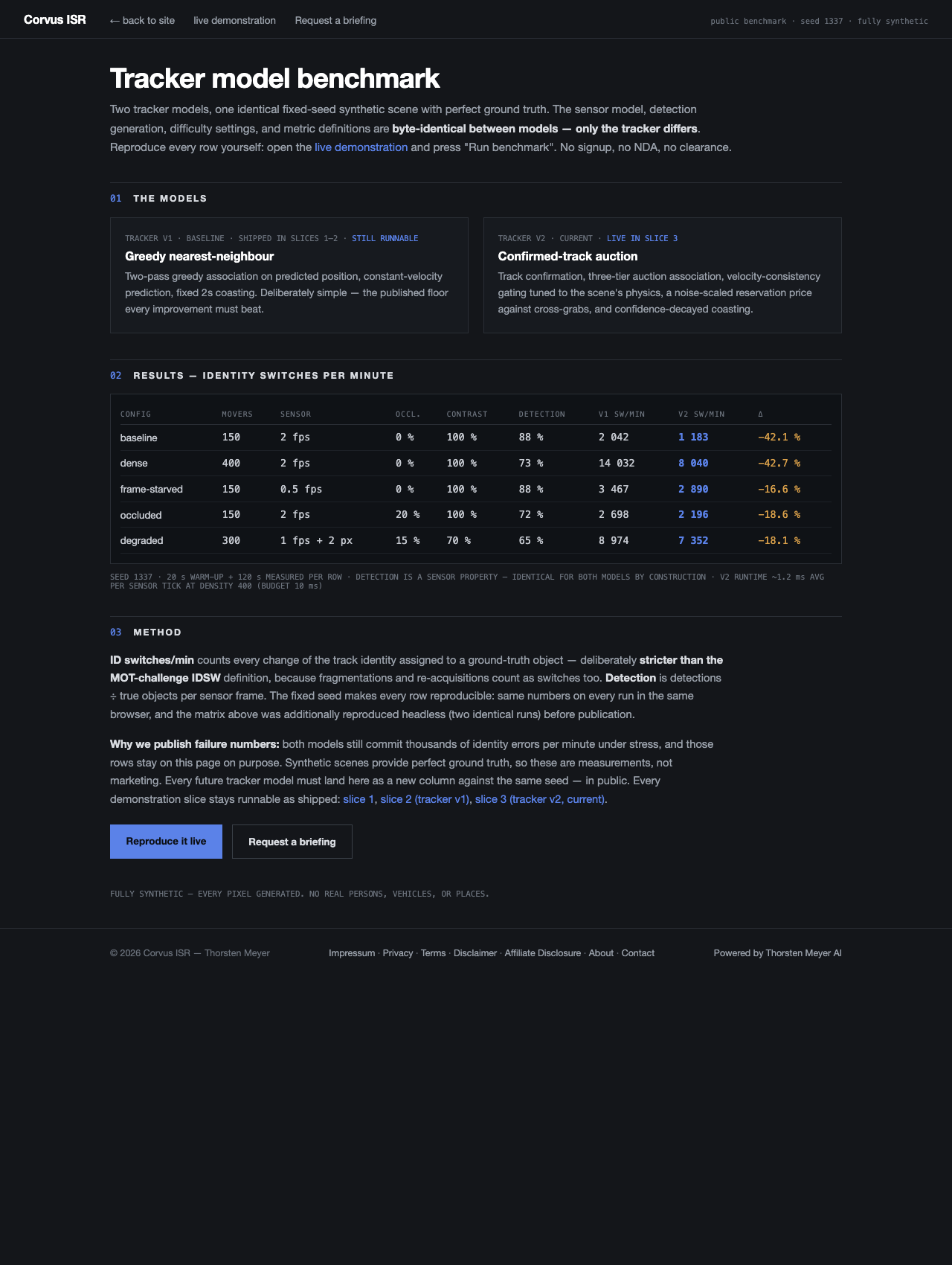
Corvus ISR, a developer of wide-area motion imagery (WAMI) exploitation products, has released a public track benchmark that provides critical insights into tracker performance under controlled conditions. This benchmark compares two models using an identical fixed-seed synthetic scene, ensuring a perfect ground truth baseline that eliminates uncertainties present in real-world data. Such synthetic environments allow for precise measurement of tracking errors, including identity switches, which are often masked or underestimated in operational settings.

Prime made for students and young adults
- Fast, free delivery for dorm and study essentials
- Prime Video and Amazon Music included
- Member-only deals
The benchmark pits a baseline tracker, v1, labeled “greedy nearest-neighbour”, against a more sophisticated v2, called “confirmed-track auction”. The v1 model employs a simple two-pass greedy association, constant-velocity prediction, and fixed 2-second coasting—deliberately minimal in complexity to establish a performance floor. In contrast, v2 introduces advanced features such as three-tier auction association, velocity-consistency gating, and confidence-decayed coasting, reflecting current state-of-the-art tracking strategies. Both models were tested under identical detection and sensor parameters, making their comparison statistically meaningful.
Results vividly demonstrate the challenges of persistent tracking errors. For a typical scenario with 150 movers at 2 fps, the baseline model exhibited 2,042 ID switches per minute, which the improved v2 reduced to 1,183—a 42.1% reduction. Similar improvements were observed with denser scenes, decreasing from 14,032 to 8,040 ID switches, marking a 42.7% improvement. The benchmark also included stress conditions such as frame rate starvation, occlusion, and degraded imaging, with ID switch reductions averaging around 18% across these scenarios. Importantly, detection rates remained identical, confirming that errors stem from association algorithms rather than sensor performance.
From a methodological perspective, the benchmark’s rigorous measurement approach counts every change in the assigned ground-truth identity, including re-acquisitions and fragmentations—making it a strict metric that emphasizes the importance of continuous tracking. Publishing these failure numbers, even for a synthetic scene, underscores the transparency of the evaluation process. The synthetic environment ensures perfect ground truth, thus providing an unbiased measure of tracker robustness without the confounding factors of real-world noise. As the site notes, “vendors who show only successes ask for faith; a published failure matrix asks for measurement.”
Engineering efficiency is also highlighted by the real-time performance of v2, which averages approximately 1.2 milliseconds per sensor tick at a density of 400 objects—well within typical processing budgets. Worst-case processing takes around 5 milliseconds, demonstrating the model’s suitability for live deployment. The entire benchmarking process is fully transparent: anyone can reproduce the results by visiting the live demo and clicking “Run benchmark”—with no signup or NDA required. This openness exemplifies a commitment to scientific transparency and accountability in performance evaluation.
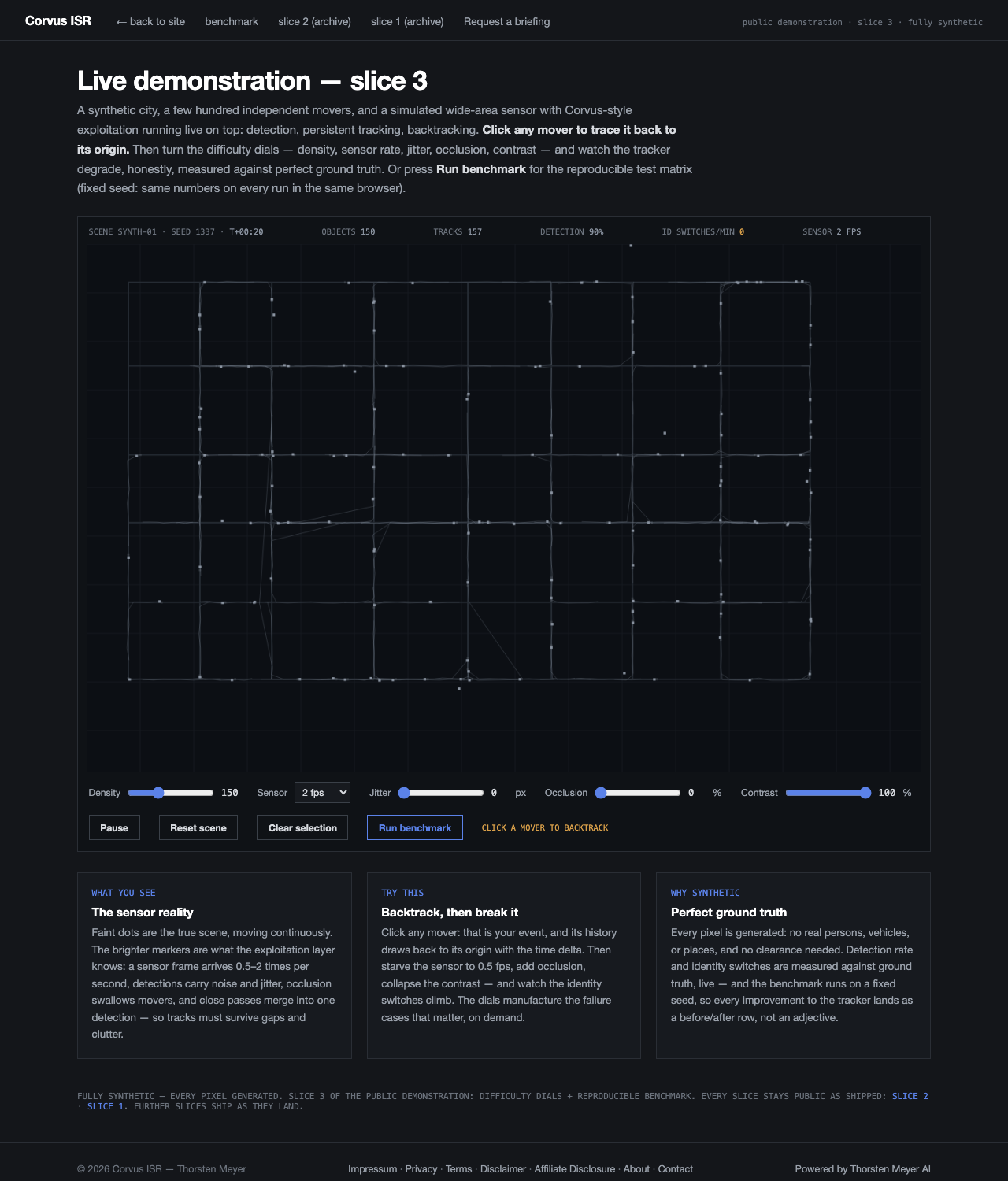
Ultimately, Corvus ISR’s approach leverages perfect synthetic ground truth to assess tracker failure modes, revealing that even the best models still produce thousands of identity errors per minute under stress. Publishing these numbers not only highlights current limitations but also encourages the development of more robust algorithms. For science-minded readers, understanding the significance of a fixed-seed benchmark matrix is key: it ensures reproducibility, comparability, and transparency in the evaluation process. You can explore these results firsthand and see how your own tracker might perform against a known, repeatable scenario by trying out the benchmark yourself.
real-time object tracking software
As an affiliate, we earn on qualifying purchases.
As an affiliate, we earn on qualifying purchases.
wide-area motion imagery (WAMI) surveillance camera
As an affiliate, we earn on qualifying purchases.
As an affiliate, we earn on qualifying purchases.
synthetic benchmark testing tools
As an affiliate, we earn on qualifying purchases.
As an affiliate, we earn on qualifying purchases.
As an affiliate, we earn on qualifying purchases.
Halloween Picks
halloween
As an affiliate, we earn on qualifying purchases.