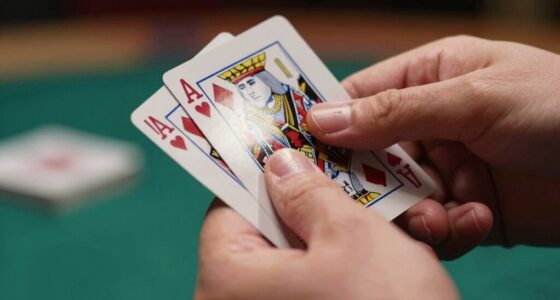

The illusion of control happens when you mistakenly believe your skill or decisions influence luck-driven events. You may think your choices impact outcomes like gambling or stock trading, which aren’t truly under your control. This overconfidence skews your risk perception, making you underestimate dangers or overestimate your abilities. Recognizing this bias helps you make smarter decisions and avoid unnecessary risks. If you want to understand how this belief shapes your choices, there’s more to explore.

Prime made for students and young adults
- Fast, free delivery for dorm and study essentials
- Prime Video and Amazon Music included
- Member-only deals
Key Takeaways
- The illusion of control causes people to believe their decisions influence luck-driven events, overestimating their skill.
- Cognitive biases lead individuals to focus on factors supporting their perceived control while ignoring randomness.
- Overconfidence from this illusion prompts risky behaviors like gambling or impulsive investments.
- Recognizing the role of luck helps correct misjudgments and promotes more realistic risk assessments.
- Strategies such as awareness and balancing confidence can reduce overestimating control over unpredictable outcomes.

Have you ever felt confident that your actions could influence outcomes beyond your control? That feeling is often rooted in an illusion of control, a common psychological phenomenon where you mistakenly believe your skill or decisions can shape events driven largely by luck. This misperception profoundly affects your risk perception, leading you to overestimate your influence in uncertain situations. It’s easy to fall into this trap, especially when your decision bias nudges you toward believing that your choices can steer the course of events, even when chance plays the dominant role.
Believing your actions influence outcomes driven by luck is an illusion of control.
When you experience the illusion of control, you tend to see yourself as more capable than you truly are. For example, in gambling or stock trading, you might think that your strategy or intuition directly impacts the outcome, ignoring the element of randomness involved. Your overconfidence skews your risk perception, making risks appear smaller or more manageable than they are. This often results in taking unnecessary or overly risky actions because you believe your skill can mitigate the inherent uncertainty. Your decision bias encourages this view, as it pushes you to interpret random fluctuations as signs of your control or mastery.
This bias can distort your judgment, causing you to focus on the factors that seem to support your sense of control while ignoring evidence to the contrary. For instance, if you win a game, you might attribute it to your skill rather than luck, reinforcing the illusion. Conversely, losing may be rationalized as a temporary setback or due to external factors, further fueling your belief that your influence is greater than reality suggests. This selective perception feeds the cycle, making you more confident in your abilities and less cautious about the real risks involved.
Your tendency to overestimate your control often leads to poor decision-making. You might chase risky investments, participate in gambling, or make impulsive choices because you believe your skill can overcome randomness. Recognizing this decision bias is essential; it can help you step back and assess situations more objectively. Understanding that luck plays a notable role in many outcomes can temper your overconfidence and improve your risk perception. Instead of assuming control where there is none, you can develop more realistic expectations and healthier decision-making habits.
Additionally, awareness of the contrast ratio of your environment can influence how you perceive and manage risk, helping you to balance confidence with caution. Ultimately, the illusion of control can be a double-edged sword. While it might boost confidence temporarily, it often blinds you to the true nature of chance and risk. Being aware of this tendency allows you to make smarter choices, acknowledge the limits of your influence, and avoid the pitfalls of overestimating your power over unpredictable circumstances. Recognizing the role of decision bias in fueling this illusion is a crucial step toward more rational, balanced decision-making in uncertain situations.
Frequently Asked Questions
How Does the Illusion of Control Affect Financial Decision-Making?
The illusion of control skews your risk perception, making you believe you have more influence over outcomes than you actually do. This boosts your confidence bias, leading you to take bigger financial risks based on overconfidence. As a result, you might ignore important warning signs or underestimate the role of luck, which can cause poor investment choices and increase your chances of financial loss.
Can Training Reduce the Illusion of Control in High-Stakes Situations?
Training can help reduce the illusion of control in high-stakes situations by improving your understanding of risk perception and cognitive biases. When you become aware of how these biases influence your judgments, you’re less likely to overestimate your skills and mistake luck for mastery. Through targeted exercises and education, you develop a more realistic view, making better decisions and avoiding overconfidence that can lead to costly errors.
What Psychological Factors Contribute to Overestimating Personal Skill?
You overestimate personal skill due to perceived competence, where you believe you’re more capable than you actually are. Confidence bias also plays a role, boosting your belief in your abilities despite evidence to the contrary. These psychological factors make you think your success is primarily due to skill, not luck. Recognizing these biases helps you stay more objective, reducing the illusion of control and improving decision-making in high-stakes situations.
How Does the Illusion of Control Influence Gambling Behavior?
The illusion of control makes you believe your skill influences gambling outcomes more than it actually does, skewing your risk perception. You might think you can control the game, boosting your confidence bias, leading you to gamble more despite the randomness involved. This false sense of mastery encourages riskier bets, making you overestimate your chances of winning and possibly increasing losses over time.
Are Certain Personality Types More Prone to the Illusion of Control?
You’re more likely to fall for the illusion of control if you have certain personality traits like high optimism or impulsiveness. These cognitive biases make you overestimate your ability, believing skill influences outcomes more than it really does. Recognizing this tendency can help you stay grounded, especially in risky situations like gambling, where luck plays a bigger role than your confidence might suggest.
Conclusion
Remember, thinking you can control every outcome is like trying to steer a boat through a storm—you might think you’re in charge, but luck often plays a bigger role. The illusion of control can make you overestimate your skills, leading to risky decisions. Stay humble and recognize the role of chance. After all, as the saying goes, “You can lead a horse to water, but you can’t make it drink.” Embrace the luck, and stay grounded.
Halloween Picks
halloween
As an affiliate, we earn on qualifying purchases.