
TL;DR

Prime made for students and young adults
- Fast, free delivery for dorm and study essentials
- Prime Video and Amazon Music included
- Member-only deals
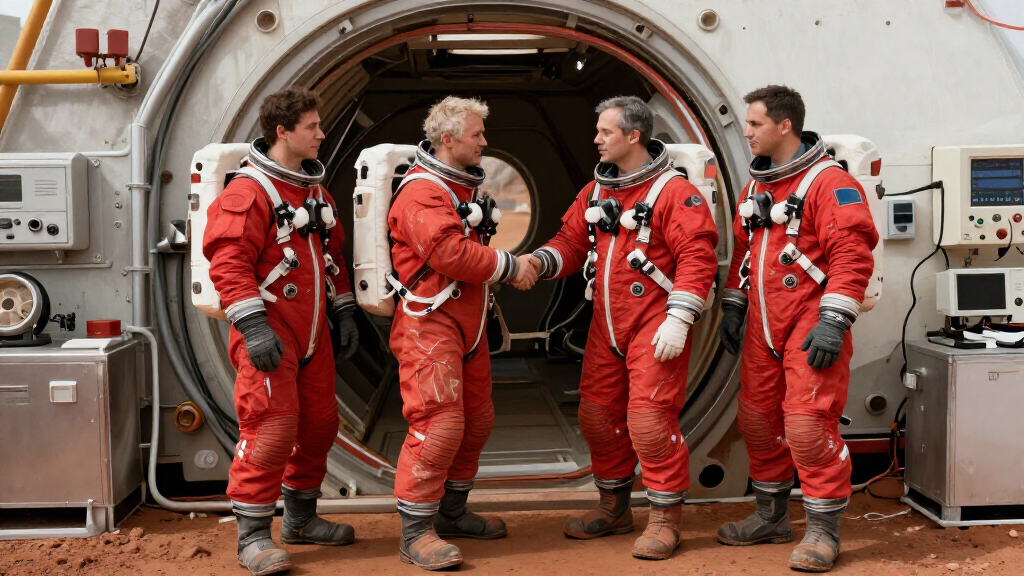
Four volunteers exited NASA’s CHAPEA Mars habitat on Oct. 31 after spending 378 days in isolation as the agency’s second yearlong Mars surface simulation crew. The team conducted simulated spacewalks, robotic operations and research to help NASA study human health and performance; the simulation was conducted on Earth, not on Mars.
Four volunteers left NASA’s Mars Dune Alpha habitat at Johnson Space Center in Houston on Oct. 31, completing 378 days in a simulated Mars mission. The crew’s yearlong isolation and research activities are intended to help NASA study the health, performance and operational demands of future human exploration; the habitat was an Earth-based simulation, not a mission to Mars.
The CHAPEA Mission 2 crew consisted of Ross Elder, Ellen Ellis, James Spicer and Matthew Montgomery. They entered the roughly 1,700-square-foot, 3D-printed habitat on Oct. 19, 2025. During the simulation, they carried out Marswalk exercises, robotic operations, habitat maintenance, exercise and crop cultivation while living with limited resources and communication delays of as much as 22 minutes each way.
NASA said the volunteers collected health and performance data with support from researchers and ground teams across the agency. Activities included remotely operating a drone and rover to survey terrain and identify or collect rock samples. The crew also managed supplies, followed research procedures and conducted experiments, including Montgomery’s seed-germination work using a control and simulated Martian soil.
The crew’s reflections emphasized the practical demands of the work as well as the value of teamwork. Elder said preparing suits, completing airlock procedures and making long traverses required time and stamina. Ellis described her medical-officer duties, including coordinating biological sample collections, while Spicer handled habitat systems and consumables. Montgomery worked on technical problems, rock-sample identification and 3D-printing capabilities.
Lessons for Long Mars Missions
The simulation gives NASA a way to examine how people and support teams perform during a prolonged Mars-like mission without sending a crew into space. Researchers can study health, workload, resource management and team dynamics under controlled conditions, including the effect of delayed communications and restricted living space.
The crew’s accounts point to operational issues that could matter on an actual expedition. Elder stressed the physical preparation needed for repeated simulated Marswalks, while Ellis said the mission highlighted the need for a highly integrated ground team. Spicer described tracking everyday supplies, from dish soap to respirator filters. These are observations from the crew and mission, not proof that the same conditions or results will apply to a Mars expedition.
NASA Johnson Space Center Director Vanessa Wyche said the work is intended to build knowledge needed to protect crew health and performance and support future exploration. The research could inform planning for missions beyond Earth, but the source does not report specific study findings or conclusions released from the collected data.
Popular right now

Roborock RockMow X130H Wire-Free 4WD Robot Lawn Mower

Roborock RockNeo Q110H Wire-Free Robot Lawn Mower

DREAME A3 AWD 1000 LiDAR Robot Lawn Mower
As an affiliate, we earn on qualifying purchases.
Inside the CHAPEA Habitat
CHAPEA stands for Crew Health and Performance Exploration Analog. NASA designed Mars Dune Alpha as a ground-based habitat for studying the demands of extended surface missions. Mission 2 was the agency’s second yearlong Mars surface simulation, according to NASA’s report.
The crew’s experience coincided with other human-spaceflight milestones. NASA astronaut Jack Hathaway noted that he completed a 237-day International Space Station mission during the period the volunteers were in the habitat. NASA also said Artemis II astronauts traveled around the Moon during that time, and the agency marked 25 years of continuous human presence aboard the space station on Nov. 2, 2025. Those events provide a comparison in duration and exploration activity, but the CHAPEA crew remained on Earth throughout its simulation.
““The real magic has been the privilege and pleasure of seeing everyone come together, with the makings of one of the finest teams I’ve ever been a part of.””
— Ross Elder, CHAPEA Mission 2 crew member
Research Findings Still Pending
NASA’s report describes the mission and the crew’s experiences but does not provide results from the collected health and performance data. It is not clear when the agency will publish analyses, which measurements will produce findings, or how those findings might change mission plans.
The source also does not specify the full schedule for post-mission medical assessments or whether the reported 22-minute communication delay applied uniformly to all exchanges. The simulation reproduced selected Mars-like constraints on Earth; it cannot establish exactly how a crew would respond to the physical, environmental and operational conditions of an actual Mars mission.
NASA’s Analysis of Crew Data
The next step is for NASA researchers and supporting teams to analyze the health, performance and operational data gathered during Mission 2. NASA’s report does not give a publication date or name a specific forthcoming results release, so the timing and form of any findings remain unknown.
For now, the mission’s completion marks the end of the crew’s 378-day confinement, not the end of the research. Future reporting will depend on what NASA publishes about the data and how the agency applies those findings to planning for longer human missions.
Key Questions
What was CHAPEA Mission 2?
CHAPEA Mission 2 was NASA’s second yearlong Mars surface simulation. Four volunteers lived in the Mars Dune Alpha habitat at Johnson Space Center and carried out research and mission-like activities on Earth.
Who was on the crew?
The four volunteers were Ross Elder, Ellen Ellis, James Spicer and Matthew Montgomery. Their backgrounds included test piloting, military operations, systems engineering, spacecraft work, robotics and agriculture.
What did the crew do during the simulation?
The crew took part in simulated Marswalks, robotic operations, habitat maintenance, exercise and crop cultivation. They also collected health and performance data and managed limited supplies and delayed communications.
Did the crew travel to Mars?
No. The crew spent the mission in a ground-based habitat in Houston. CHAPEA simulates selected conditions of a Mars mission so NASA can study people and operations without sending the crew into space.
Have NASA’s research results been released?
The supplied NASA report describes the mission but does not provide analysis of the data or a date for results. When findings will be published and how they may affect future mission planning are not yet clear.
Source: nasa.gov