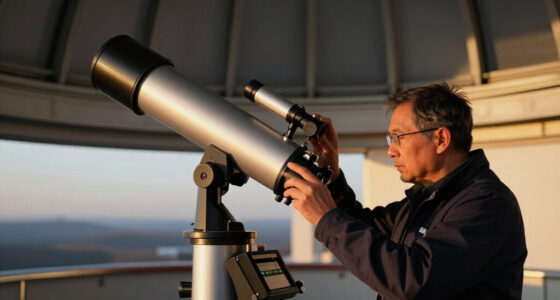
When exploring telescope basics, know that the aperture is your main light-gathering power, determining how faint objects you can see clearly. Focal length affects magnification and field of view, but don’t fall for the myth that bigger magnification always means better images—too much can blur details. Focus on choosing the right aperture and eyepiece for clear, sharp views. Keep learning to understand how these components work together for ideal stargazing results.

Prime made for students and young adults
- Fast, free delivery for dorm and study essentials
- Prime Video and Amazon Music included
- Member-only deals
Key Takeaways
- Larger aperture allows for brighter, sharper images and better detection of faint objects.
- Focal length determines telescope magnification and field of view; longer focal lengths provide higher magnification.
- Magnification depends on both telescope focal length and eyepiece focal length; excessive magnification can cause blurry images.
- Higher magnification isn’t always better; optimal viewing occurs within a practical range (about 50x to 150x).
- Understanding these fundamentals helps avoid common myths and enhances overall stargazing experience.
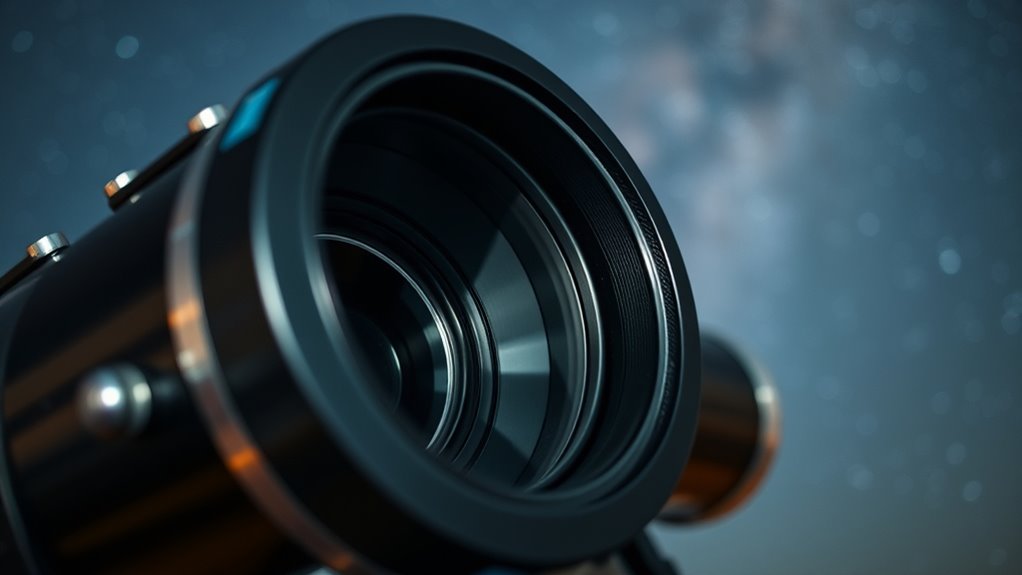
Have you ever wondered how astronomers observe distant stars and planets? It all begins with understanding the basics of telescopes. One of the key factors to consider is the aperture, which is the diameter of the main lens or mirror. A larger aperture allows you to gather more light, revealing fainter objects and providing sharper images. But to make the most of your telescope’s aperture, you need to pay attention to other components, especially your eyepiece selection. Different eyepieces offer varying fields of view and magnifications, so choosing the right ones is vital. A high-quality eyepiece with the proper focal length can enhance your viewing experience, making objects brighter and clearer. Many beginners overlook this, but the combination of the right eyepiece and mount type can drastically improve your observations.
Choosing the right eyepiece and mount enhances your telescope’s performance and viewing experience.
Speaking of mounts, they are the foundation of any telescope setup. There are two primary types: altazimuth and equatorial mounts. An altazimuth mount moves vertically and horizontally, making it simple to track objects across the sky for casual stargazing. Conversely, an equatorial mount aligns with Earth’s axis, allowing you to follow celestial objects as they move due to Earth’s rotation, which is especially beneficial for astrophotography or detailed observation. Your choice of mount impacts not just stability and ease of use but also how effectively you can track objects over time. If you’re contemplating long observation sessions or astrophotography, an equatorial mount might be worth the investment.
Many newcomers get caught up in the misconception that higher magnification always equals better viewing. This is a myth. Magnification depends on both your telescope’s focal length and the eyepiece you choose, but higher isn’t always better. Excessive magnification can lead to blurry images, especially if your telescope’s aperture isn’t large enough to support it. Instead, focus on selecting an eyepiece that provides a comfortable, practical magnification for your telescope, often around 50x to 150x for most amateur setups. Remember, the goal is clarity, not just maximum zoom.
Ultimately, understanding how eyepiece selection and mount types work together helps you get the most out of your telescope. A well-chosen mount ensures stability and smooth tracking, while the right eyepiece lets you see more detail without distortion. Additionally, paying attention to aperture size can significantly influence your viewing capabilities. By dispelling common myths about magnification and focusing on these foundational elements, you’ll be better prepared to explore the night sky with confidence. Whether you’re gazing at planets or distant galaxies, these basics will make your stargazing experience far more rewarding.
telescope eyepieces for beginners
As an affiliate, we earn on qualifying purchases.
As an affiliate, we earn on qualifying purchases.
Frequently Asked Questions
How Does Atmospheric Turbulence Affect Telescope Viewing Quality?
Atmospheric turbulence causes air turbulence that affects your telescope viewing quality by creating image distortion. As hot and cold air layers move, they bend light unpredictably, resulting in blurry or shimmering images. This turbulence is especially noticeable on clear nights when viewing planets or stars. To minimize its impact, you can choose observation times when the atmosphere is stable, use adaptive optics, or position your telescope in a location with less air turbulence.
Can Small Telescopes Outperform Larger Ones in Certain Conditions?
Imagine you’re a Jedi, and sometimes, a small but well-crafted lightsaber outshines a massive one. Small telescopes can outperform larger ones in certain conditions if they have superior optical quality and a well-chosen aperture size. When atmospheric turbulence is high, a smaller, high-quality scope can be steadier and clearer, making it easier to see details. So, don’t dismiss a compact scope; it might just be your perfect star-gazing sidekick.
What Is the Best Way to Clean Telescope Lenses Safely?
To clean your telescope lenses safely, start with gentle lens cleaning and optical maintenance. Use a soft, lint-free cloth or microfiber specifically designed for optics. Dampen it slightly with lens cleaning solution or distilled water—never use harsh chemicals. Gently wipe the lens in a circular motion, avoiding excessive pressure. Regular lens cleaning prevents dust buildup and maintains clear images, ensuring your telescope performs at its best during your stargazing sessions.
Do Telescope Mounts Impact Image Stability and Clarity?
Yes, your telescope mount considerably impacts image stability and clarity. A stable mount reduces vibrations, giving you sharper images, especially at high magnifications. If your mount isn’t sturdy, your observations may shake or blur. Also, consider mount portability—lighter mounts are easier to transport but might sacrifice stability. Balancing portability with mount stability ensures you enjoy clear, steady views whether you’re at home or in the field.
How Do Different Eyepieces Influence Magnification and Field of View?
Imagine exploring the universe with the perfect eyepiece; your view enhances dramatically. Different eyepiece selection influences both magnification and field of view, allowing you to choose wider vistas or detailed close-ups. A wider field of view offers a broader perspective, ideal for scanning the sky, while higher magnification reveals finer details. By selecting the right eyepiece, you tailor your experience, making stargazing more engaging and personalized.
large aperture telescope for astrophotography
As an affiliate, we earn on qualifying purchases.
As an affiliate, we earn on qualifying purchases.
Conclusion
Understanding telescope basics like aperture, focal length, and magnification helps you choose the right instrument. Remember, a common myth is that bigger is always better—you’ll get clearer images with the right balance. Did you know that the Hubble Space Telescope has an aperture of 2.4 meters, allowing it to capture stunning images of distant galaxies? Now, with this knowledge, you’re better equipped to explore the night sky and avoid misconceptions. Happy stargazing!
As an affiliate, we earn on qualifying purchases.
high magnification telescope eyepiece
As an affiliate, we earn on qualifying purchases.
As an affiliate, we earn on qualifying purchases.
Halloween Picks
halloween
As an affiliate, we earn on qualifying purchases.