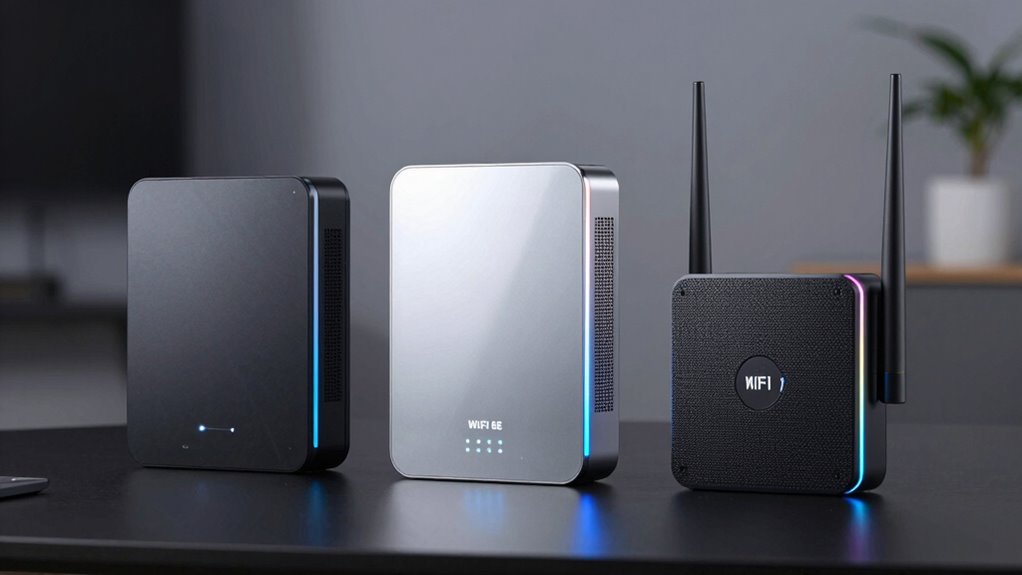

Wi-Fi 6, 6E, and 7 all improve your internet experience by offering faster speeds, lower latency, and better performance in crowded areas. Wi-Fi 6 supports 2.4 and 5 GHz bands, while 6E adds the new 6 GHz band for even less interference. Wi-Fi 7 aims for even higher speeds and lower delays with advanced features like wider channels. To stay ahead, understanding these differences can help you select the right upgrade, and there’s more to contemplate below.

Prime made for students and young adults
- Fast, free delivery for dorm and study essentials
- Prime Video and Amazon Music included
- Member-only deals
Key Takeaways
- Wi-Fi 6 improves speed, latency, and capacity; Wi-Fi 6E adds support for the less crowded 6 GHz band.
- Wi-Fi 7 offers even faster speeds and lower latency with advanced features like 320 MHz channels.
- All standards enhance security, with WPA3 encryption protecting networks across versions.
- Wi-Fi 6 and 6E work on 2.4 GHz, 5 GHz, and 6 GHz bands, while Wi-Fi 7 introduces new channels and multi-link operation.
- Upgrading devices ensures access to the latest speeds, security, and compatibility with newer Wi-Fi standards.

As Wi-Fi technology continues to evolve rapidly, understanding the differences between Wi-Fi 6, 6E, and 7 is essential for choosing the right network for your needs. Each new version brings improvements that can substantially impact your internet experience, especially when it comes to security and device compatibility. Wi-Fi 6 introduced a major upgrade over previous standards, focusing on faster speeds, lower latency, and the ability to handle multiple devices simultaneously. This means you can stream, game, or work online without your network slowing down, even when many devices are connected. Its security enhancements, including WPA3 encryption, make your network safer from hacking attempts and unauthorized access, giving you peace of mind about your personal data.
Moving to Wi-Fi 6E, the “E” stands for Extended, which indicates its support for the 6 GHz band alongside the traditional 2.4 GHz and 5 GHz bands. This addition provides a broader spectrum, less interference, and faster speeds, especially in crowded environments like apartments or offices where many networks overlap. Device compatibility is a key point here; not all devices support the 6 GHz band yet, so you’ll want to check whether your existing gadgets can connect to Wi-Fi 6E. If they can, you’ll enjoy improved performance, reduced lag, and a more reliable connection. For new devices, many manufacturers are already incorporating Wi-Fi 6E compatibility, making it easier to future-proof your network. Security enhancements continue to improve with WPA3, ensuring that your expanded network remains protected against threats, even as new frequencies open up.
Wi-Fi 7 pushes the boundaries further by promising even higher speeds, lower latency, and more efficient data transmission through innovations like 320 MHz channels and multi-link operation. These advancements are designed to support demanding applications such as 8K streaming, virtual reality, and large data transfers. Device compatibility is a critical consideration here; Wi-Fi 7 requires new hardware, so upgrading your devices might be necessary to take full advantage of its capabilities. As for security, Wi-Fi 7 is expected to build on the WPA3 framework, providing stronger protections against evolving cyber threats. This means your network’s security enhancements will keep pace with the increased performance, ensuring your data stays safe even as speeds increase. Additionally, the development of high-performance projectors that can leverage faster Wi-Fi standards can significantly enhance your home entertainment setup.
As an affiliate, we earn on qualifying purchases.
Frequently Asked Questions
How Do Wi-Fi 6, 6E, and 7 Compare in Speed?
You’ll notice Wi-Fi 7 offers the fastest speeds, with significant bandwidth improvements over Wi-Fi 6 and 6E, allowing for higher data transfer rates. Wi-Fi 6E extends this by adding more channels in the 6 GHz band, reducing latency. Wi-Fi 6, while still fast, has lower speeds and higher latency compared to the newer standards. Overall, Wi-Fi 7 gives you the best speed, bandwidth, and latency reductions for smoother connections.
Are Wi-Fi 7 Devices Backward Compatible With Wi-Fi 6 and 6E?
Imagine you’re in the early days of the internet—Wi-Fi 7 devices are designed for future-proofing, but they’re backward compatible with Wi-Fi 6 and 6E. You’ll find great device interoperability and legacy compatibility, meaning your older devices will still work smoothly. This guarantees you won’t need to upgrade everything at once. So, yes, Wi-Fi 7 devices support older standards, making your network more flexible and ready for the future.
What Are the Real-World Benefits of Upgrading to Wi-Fi 7?
Upgrading to Wi-Fi 7 boosts your experience with faster speeds and lower latency, making your smart home devices work more seamlessly. You’ll notice better streaming quality, even with multiple devices connected, reducing buffering and lag. Plus, it enhances smart home integration, allowing your gadgets to communicate more reliably. Overall, Wi-Fi 7 delivers a more responsive, efficient network that keeps all your devices running smoothly.
Do Wi-Fi 6E and 7 Require New Routers or Hardware?
It’s no coincidence that upgrading your Wi-Fi can feel overwhelming, but the truth is, Wi-Fi 6E and 7 often need new routers due to hardware compatibility. While some devices may work with older routers, to fully enjoy the benefits, you’ll likely require newer router models that support the latest standards. Check your device specifications and guarantee your hardware meets the new router requirements for peak performance.
How Do These Wi-Fi Standards Impact Network Security?
Wi-Fi standards like 6, 6E, and 7 improve network security by adopting advanced encryption protocols, making it harder for hackers to access your data. They also address network vulnerabilities by supporting stronger authentication methods and faster security updates. However, upgrading to these standards requires compatible routers and devices, ensuring your network stays protected against evolving threats while enjoying better overall security.
As an affiliate, we earn on qualifying purchases.
Conclusion
So, now you’re equipped with the scoop on Wi-Fi 6, 6E, and 7. Think of Wi-Fi 6 as the reliable old trusty bike, Wi-Fi 6E as the upgraded turbocharged model, and Wi-Fi 7 as the jet-powered rocket soaring through the digital sky. With each upgrade, your internet speeds and connections get faster and smoother—like upgrading from a trickling stream to a roaring river. Get ready to surf at lightning speed, leaving lag in the dust!
As an affiliate, we earn on qualifying purchases.
As an affiliate, we earn on qualifying purchases.
Fall Picks
fall essentials
As an affiliate, we earn on qualifying purchases.