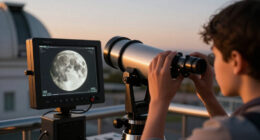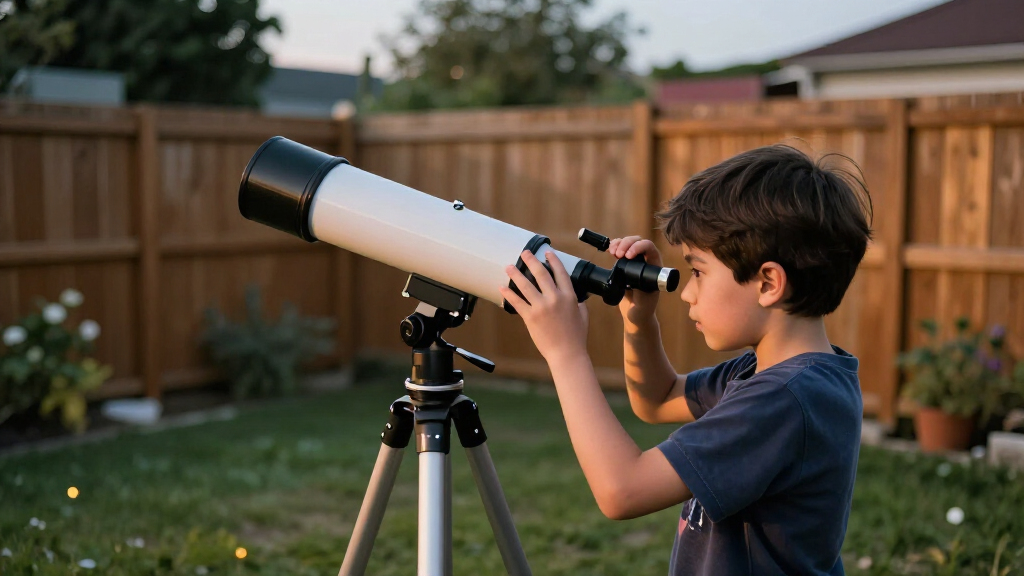
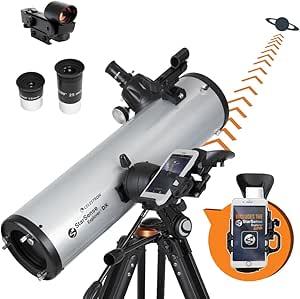
For most new stargazers, I’d start with the Celestron StarSense Explorer DX 130AZ: its smartphone-guided locating system can make finding objects less frustrating than with a basic finder. If a simpler, more portable refractor matters more, the Celestron Travel Scope 70mm stands out for its carry-ready design, while the MEEZAA 90mm offers a larger aperture for brighter views of the Moon and planets. Beginner telescopes trade light-gathering power and steadiness against portability, setup effort, and ease of aiming. This roundup compares those tradeoffs across 15 models, so keep reading for the full breakdown and a pick matched to how you plan to observe.

Prime made for students and young adults
- Fast, free delivery for dorm and study essentials
- Prime Video and Amazon Music included
- Member-only deals
Key Takeaways
- The Celestron StarSense Explorer DX 130AZ is the standout for locating targets: smartphone guidance and a 130mm reflector make it different from the largely manual 70mm–90mm refractors in this lineup.
- Aperture separates the viewing potential: the 90mm and 80mm refractors gather more light than the 70mm models, but a larger tube does not automatically mean a steadier or simpler observing setup.
- Portability is a real tradeoff, not a bonus feature: the Travel Scope 70mm and EACONN 80mm pair telescope designs with backpacks, while longer 800mm and 900mm refractors are less travel-oriented.
- Phone accessories do different jobs: adapters and remotes can help capture or control a phone, but they do not replace a stable mount or help locate objects as directly as StarSense guidance.
- Beginner suitability depends on setup and expectations: compact refractors suit straightforward Moon viewing, while claims of very high magnification should not outweigh aperture, mount steadiness, or practical ease of aiming.





| astronomy telescopes for beginner | Focal length | Eyepieces | Aperture | Magnification |
|---|---|---|---|---|
| 70mm Refractor Telescope for B | 300 mm | 20 mm and 6 mm | — | 15x–150x |
| ToyerBee 70mm Refractor Telesc | 300 mm | 20 mm and 6 mm | 70 mm | 15x–150x |
| Fuoibl 70mm Refracting Telesco | 300 mm | 6 mm and 20 mm | — | 15x–150x |
| NASA Lunar Telescope for Kids | — | Low-power and high-power | — | 90x |
| Celestron Travel Scope 70mm Be | 400 mm | — | 70 mm | — |
| MEEZAA 90mm Refractor Telescop | 800 mm | 10 mm and 25 mm | 90 mm | — |
| WOSPORTS 90mm Refractor Telesc | 600 mm | 25 mm and 10 mm | 90 mm | — |
| Gskyer 70mm Aperture | 400 mm | — | 70 mm | — |
| Dianfan 90mm Aperture 800mm Re | 800 mm | — | — | — |
| Celestron AstroMaster 70AZ Ref | 900 mm | 20 mm and 10 mm | — | — |
| EACONN 80mm Aperture 600mm Ref | 600 mm | K20mm and K9mm | 80 mm | 30x–66x |
| Celticbird 80mm Aperture Refra | 600 mm | 20 mm and 9 mm | 80 mm | 30x and 66x |
| Koolpte 80mm Aperture Refracto | 600 mm | 25 mm and 10 mm | 80 mm | 24x and 60x; up to 72x and 180x with 3× Barlow |
| Celestron StarSense Explorer D | 650 mm | 10 mm and 25 mm | 130 mm | — |
| Hawkko 90mm Aperture Refractor | 900 mm | 10 mm and 25 mm | 90 mm | 36x–270x |
More Details on Our Top Picks
70mm Refractor Telescope for Beginners with Phone Adapter
For a beginner who wants to record what they see, this Jvcla pairs a 70mm aperture with a smartphone adapter and wireless remote. Its 300mm focal length and included 20mm and 6mm eyepieces cover a useful range for broad views and closer looks at the Moon; the 3x Barlow extends magnification, though the highest settings can make tracking harder. Compared with the Celestron Travel Scope 70, this package prioritizes phone capture, while the Celestron offers a longer 400mm focal length and a backpack. Fully multi-coated optics and tool-free setup suit first observing sessions, but the inverted finder view can take practice, and manual focusing still requires patient adjustment. I’d choose it for casual lunar viewing and phone snapshots, not for steady high-power planetary detail.
Pros:- 70mm aperture and fully multi-coated optics support bright views of the Moon and daytime scenery.
- 20mm and 6mm eyepieces plus a 3x Barlow provide several viewing magnifications.
- Phone adapter and wireless remote make smartphone image capture possible.
- Tool-free setup and included tripod lower the barrier to a first session.
Cons:- High magnification can make objects difficult to keep centered.
- The 5×24 finder shows an inverted image that may slow initial aiming.
- Manual focus requires adjustment when changing targets or eyepieces.
Best for: First-time observers who want a simple 70mm telescope and an included phone adapter and remote for lunar snapshots.
Not ideal for: Beginners seeking stable high-magnification planetary views or an easier-to-orient finder; the high-power range is harder to track and the finder image is inverted.
- Telescope type:Refractor
- Objective lens diameter:70 mm
- Focal length:300 mm
- Magnification:15x–150x
- Eyepieces:20 mm and 6 mm
- Additional lens:3x Barlow lens
- Finderscope:5×24
- Included accessories:Tripod, phone adapter, wireless remote
Our verdict“Choose the Jvcla if phone capture matters more than a longer focal length or easier high-power tracking.”
ToyerBee 70mm Refractor Telescope for Beginners, 15x–150x Magnification
The ToyerBee is a practical starter kit for someone who wants the basics in one box: a 70mm refractor, two eyepieces, a 3x Barlow, smartphone accessories, and a star chart. The chart gives a new observer a starting point for finding targets, while its 3.5-pound weight makes it easier to take outside than a larger, longer-tube setup. Like the Jvcla 70mm Refractor, it has a 300mm focal length and a stated 15x–150x range; neither should be chosen for consistently steady viewing at the top of that range. The included phone remote adds a simple way to capture views, but the manual focus and tripod may call for a light touch. I rank it ahead of the Jvcla for learning-oriented accessories, though buyers should not mistake a high magnification figure for extra optical detail.
Pros:- Star chart gives beginners a basic aid for planning and locating observations.
- 70mm aperture, two eyepieces, and 3x Barlow offer flexible introductory viewing.
- Smartphone adapter and wireless remote support casual image capture.
- At 3.5 pounds, it is easy to carry for outdoor and travel use.
Cons:- The included tripod may wobble during high-magnification viewing.
- Manual focusing requires hands-on adjustment for each target.
- The 150x upper limit can be difficult to use steadily with this lightweight setup.
Best for: New observers, including families, who want a lightweight kit with a star chart, phone accessories, and interchangeable eyepieces.
Not ideal for: Buyers who prioritize a rigid mount for high-power viewing or want automatic focusing; this telescope has manual focus and a tripod noted as less stable at high magnification.
- Telescope type:Refractor
- Aperture:70 mm
- Focal length:300 mm
- Magnification:15x–150x
- Eyepieces:20 mm and 6 mm
- Barlow lens:3x
- Finderscope:5×24
- Item weight:3.5 lb
- Included accessories:Tripod, smartphone adapter, wireless camera remote, star chart
Our verdict“Pick the ToyerBee as a lightweight first kit if a star chart and phone accessories matter more than a sturdier high-power mount.”
Fuoibl 70mm Refracting Telescope with Phone Adapter
The Fuoibl’s clearest distinction in this group is its tripod height of up to 45 inches, which can offer more flexible positioning than the NASA Lunar Telescope’s tabletop tripod. That makes it a more adaptable choice for observing outdoors, especially when a low table is unavailable. Its 70mm aperture, 300mm focal length, two eyepieces, and 3x Barlow resemble the Jvcla and ToyerBee 70mm kits, so the core viewing proposition is similar: accessible views of the Moon and scenery, with phone capture as an extra. The altazimuth mount supports straightforward up-and-down and side-to-side aiming, but manual focus and the inverted finder image still demand practice. I’d favor it for buyers who value standing-height setup, not for those expecting its 15x–150x range to deliver effortless tracking at maximum power.
Pros:- Tripod extends up to 45 inches, offering more flexible setup than a tabletop telescope.
- 70mm aperture and fully multi-coated optics suit lunar and daytime viewing.
- Two eyepieces and a 3x Barlow allow several magnification choices.
- Phone adapter and wireless remote add a straightforward capture option.
Cons:- The 5×24 finderscope image is inverted, which can complicate target acquisition.
- Manual focus requires adjustment by the observer.
- The high end of the stated magnification range can be challenging to track steadily.
Best for: Beginners who want a 70mm refractor with a tripod that can extend to 45 inches for outdoor observing without a tabletop.
Not ideal for: Observers who want a finder that matches the view orientation or steady tracking at maximum magnification; the finder image is inverted and aiming remains manual.
- Telescope type:Refracting
- Objective lens diameter:70 mm
- Focal length:300 mm
- Magnification:15x–150x
- Eyepieces:6 mm and 20 mm
- Barlow lens:3x
- Mount:Altazimuth
- Finderscope:5×24
- Tripod height:Up to 45 inches
Our verdict“Choose the Fuoibl over the tabletop NASA Lunar Telescope if you want a taller, more flexible beginner setup with phone capture.”
NASA Lunar Telescope for Kids with Tripod and Finder Scope
This Blue Marble telescope is the most focused choice here: it is designed for children aged 8 years and up to explore the Moon, rather than serving as a general-purpose astronomy starter. Its tabletop tripod and smooth mount keep the setup compact, and the included learning guide gives families a way to connect observing with basic astronomy. Compared with the ToyerBee 70mm Refractor, it gives up aperture and phone accessories in exchange for a simpler, lunar-centered package. The 25mm objective and 0.85-degree field of view set narrower limits on what it can show, so buyers should not expect the brighter, broader versatility of the 70mm options. Low- and high-power eyepieces help with locating and examining lunar views, but a tabletop position can restrict where a child can comfortably observe.
Pros:- Designed for children aged 8 years and up, with an educational learning guide.
- Tabletop tripod and smooth mount support a compact, simple setup.
- Two eyepieces provide low- and high-power options for lunar viewing.
- Straight-through finder helps with locating targets.
Cons:- The 25mm objective is much smaller than the 70mm apertures on the other beginner refractors here.
- Its lunar focus limits usefulness for broader observing interests.
- The tabletop tripod restricts viewing positions and may require a suitable surface.
Best for: Families buying a first telescope for a child aged 8 or older whose main interest is guided Moon viewing.
Not ideal for: Adults or children who want one telescope for varied celestial and daytime targets; its 25mm objective and lunar-focused design are less versatile than the 70mm refractors.
- Recommended age:8 years and up
- Objective lens diameter:25 mm
- Magnification:90x
- Field of view:0.85 degrees
- Eyepieces:Low-power and high-power
- Focus type:Manual focus
- Finderscope:Straight-through
- Included items:Telescope, tabletop tripod, two eyepieces, lens dust cap
Our verdict“Choose this model for a child’s Moon-focused introduction, but choose a 70mm refractor for broader observing flexibility.”
Celestron Travel Scope 70mm Beginner Portable Telescope with Backpack
The Celestron Travel Scope 70 is the strongest fit for beginners who expect to carry their telescope between home, campsites, and daytime viewing spots. At 4.2 pounds, it comes with a padded backpack and full-height tripod, making transport and setup a more central part of the package than with the Jvcla 70mm Refractor, which instead includes phone-capture accessories. Its 70mm aperture is suited to the Moon, planets, and scenery, while the 400mm focal length is longer than the 300mm ToyerBee and Fuoibl models. Two eyepieces and a star diagonal round out a straightforward manual setup. The tradeoff is still a modest aperture for deep-sky targets, and the basic eyepiece range may leave detail-focused observers wanting more. I’d pick it for portability, not as a route to ambitious faint-object observing.
Pros:- Padded backpack and 4.2-pound weight make it convenient to transport.
- Full-height tripod suits outdoor use without relying on a table.
- 70mm aperture and fully coated optics support beginner views of the Moon and scenery.
- 20mm and 10mm eyepieces, star diagonal, and finderscope provide a useful starter setup.
Cons:- The 70mm aperture limits views of faint deep-sky objects.
- The included eyepiece selection is basic for observers seeking more detailed views.
- Manual focus requires hands-on adjustment as targets change.
Best for: Families and beginners who want a lightweight telescope with a backpack and full-height tripod for trips and mixed daytime and night-sky viewing.
Not ideal for: Observers focused on faint deep-sky objects or detailed high-power work; the 70mm aperture and basic included eyepieces limit those ambitions.
- Aperture:70 mm
- Focal length:400 mm
- Optical tube length:17 inches
- Mount type:Altazimuth
- Eyepieces included:20 mm and 10 mm
- Optical coating:Fully coated
- Weight:4.2 pounds
- Warranty:2 years
- Included accessories:Full-height tripod, star diagonal, finderscope, padded backpack
Our verdict“Choose the Travel Scope 70 if easy transport and a full-height tripod matter more than phone photography or deep-sky reach.”
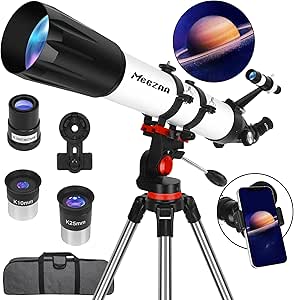
MEEZAA 90mm Refractor Telescope, 800mm Focal Length, with Tripod, Phone Adapter, and Carry Bag
The 90mm aperture and 800mm focal length make this a more astronomy-focused choice than the compact Gskyer 70mm, 400mm refractor: the longer focal length supports higher magnification with the included eyepieces, while the larger objective gathers more light. Its fully multi-coated optics and bundled 10mm and 25mm eyepieces give beginners a useful starting range, and the 3× Barlow adds flexibility. The tradeoff is that the advertised 32×–240× span describes combinations of the supplied eyepieces and Barlow, not equally useful views at every setting. The altazimuth mount and manual focus keep operation straightforward, but require hands-on tracking and focusing. Compared with the WOSPORTS 90mm, this model has a longer 800mm focal length, while the WOSPORTS includes a finderscope and lists a two-year warranty.
Pros:- 90mm aperture gathers more light than the 70mm Gskyer and Celestron AstroMaster models in this batch.
- 800mm focal length suits higher-magnification viewing better than shorter 400mm and 600mm designs.
- Includes two eyepieces, a 3× Barlow, phone adapter, and carry bag.
- Fully multi-coated optics are designed to improve light transmission.
Cons:- Manual focus and altazimuth movement require continuous hands-on adjustments.
- The 240× maximum depends on combining the supplied optics and should not be mistaken for a guarantee of clear, useful views at that power.
- No finderscope is listed in the supplied product data.
Best for: Beginners prioritizing Moon and planet viewing who want a 90mm refractor, longer focal length, and phone adapter in the included kit.
Not ideal for: Travelers seeking the lightest setup or anyone wanting motorized tracking; its manual altazimuth operation requires moving and focusing the telescope by hand.
- Telescope type:Refractor
- Aperture:90 mm
- Focal length:800 mm
- Focal ratio:f/8.88
- Magnification range:32×–240×
- Eyepieces:10 mm and 25 mm
- Mount and focus:Manual altazimuth
- Tripod height:28–46 inches
Our verdict“Choose the MEEZAA if lunar and planetary viewing matter more than compact travel or automated tracking.”
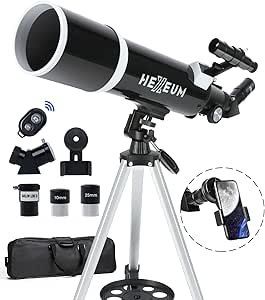
WOSPORTS 90mm Refractor Telescope with Adjustable Tripod
The WOSPORTS is the most complete-feeling starter package in this group: its 90mm aperture is paired with a 3×24 reflex finderscope, two eyepieces, a Barlow lens, an erect-image diagonal, phone adapter, and carrying case. That finder gives a novice a practical aid for aiming, while the diagonal makes daytime landscapes easier to view upright. Against the MEEZAA 90mm, the WOSPORTS has a shorter 600mm focal length, so it favors a wider, more flexible viewing experience over the MEEZAA’s longer-focal-length emphasis. Its 5-pound listed weight also makes it easier to carry than the 4.7kg Dianfan, though the provided specs do not establish how steady either tripod feels at high magnification. Manual focus and an altazimuth mount keep the controls simple, but neither tracks objects automatically.
Pros:- 90mm aperture paired with fully multi-coated optics.
- Includes a reflex finderscope, two eyepieces, 3× Barlow, and erect-image diagonal.
- Phone adapter and carrying case support basic imaging and transport.
- Listed weight of 5 pounds is lower than the Dianfan’s 4.7kg.
Cons:- 600mm focal length is shorter than the MEEZAA and Dianfan 800mm models.
- Manual focus and altazimuth movement mean users must reposition the scope by hand.
- The supplied product data does not specify the optical coating details beyond the description.
Best for: First-time observers who want an all-in-one kit with a finder, upright-viewing diagonal, phone adapter, and carry case for both sky and daytime use.
Not ideal for: Buyers focused on higher-magnification lunar and planetary viewing who would favor the longer 800mm focal length of the MEEZAA or Dianfan instead.
- Telescope type:Refractor
- Aperture:90 mm
- Focal length:600 mm
- Magnification range:24×–180×
- Eyepieces:25 mm and 10 mm
- Finderscope:3×24 reflex
- Mount and focus:Manual altazimuth
- Weight:5 lb
- Warranty:2 years
Our verdict“Pick the WOSPORTS for a beginner-friendly accessory bundle and easier carrying, rather than the longer focal length offered by the MEEZAA or Dianfan.”
Gskyer 70mm Aperture, 400mm Refractor Telescope with Carry Bag, Phone Adapter, and Wireless Remote
Portability is the Gskyer’s clearest advantage: its 70mm aperture and short 400mm focal length form a compact package with a carry bag, adjustable aluminum tripod, and phone adapter. The wireless camera remote can trigger a phone without touching it, which may help reduce movement during simple Moon photos. Compared with the larger-aperture MEEZAA and WOSPORTS 90mm refractors, this scope gathers less light, so it is the more convenient option for casual sessions rather than the strongest pick for faint objects or detailed planetary viewing. Two eyepieces and a 3× Barlow offer changing magnification, but the short focal length and beginner-oriented design set a limit on what those combinations can deliver. Its 5×24 finder helps with aiming, although the listed specs do not give a magnification range.
Pros:- Compact 400mm design includes a carry bag for transport and storage.
- Wireless camera remote can help take phone pictures without touching the screen.
- Includes two eyepieces, a 3× Barlow, and a 5×24 finder scope.
- Adjustable aluminum tripod supports different viewing positions.
Cons:- 70mm aperture gathers less light than the 90mm models in this batch.
- Short 400mm focal length makes it less suited to high-magnification planetary viewing than the MEEZAA or Dianfan.
- The product description positions it for beginners, not advanced observing.
Best for: Families and beginners who want a light, packable telescope for casual Moon viewing, travel, and phone snapshots.
Not ideal for: Observers prioritizing brighter views and greater lunar or planetary detail; the 70mm aperture is smaller than the 90mm MEEZAA and WOSPORTS.
- Optical design:Refracting telescope
- Aperture:70 mm
- Focal length:400 mm
- Focal ratio:f/5.7
- Mount:AZ mount
- Finder scope:5×24
- Eyepieces and Barlow:Two eyepieces and 3× Barlow
- Tripod:Adjustable aluminum alloy
- Included accessories:Smartphone adapter, wireless camera remote, carry bag
Our verdict“Choose the Gskyer when easy packing and simple phone photography matter more than aperture or magnification potential.”
Dianfan 90mm Aperture 800mm Refractor Telescope with Stainless Steel Tripod, Phone Adapter and Carry Bag
The Dianfan combines a 90mm aperture and 800mm focal length with a 45° zenith mirror, making it useful for beginners who want one scope for night-sky sessions and upright daytime viewing. Like the MEEZAA, it includes two eyepieces and a 3× Barlow for a stated 32×–240× range; the listed Kellner eyepieces clarify the type supplied. The package also includes a phone adapter, carry bag, and stainless-steel tripod. That tripod material may appeal to buyers who prefer a metal support, but the listed 4.7kg weight makes this a less appealing carry than the 5-pound WOSPORTS. Manual focusing keeps the setup simple, yet fine adjustments and object tracking remain user-controlled. Its combination of aperture and viewing modes is versatile, but its weight is a real cost for frequent outings.
Pros:- 90mm aperture and 800mm focal length suit beginner Moon and planet viewing.
- 45° zenith mirror supports upright terrestrial views.
- Includes Kellner eyepieces, 3× Barlow, phone adapter, and carry bag.
- Stainless-steel tripod is included with the package.
Cons:- Listed 4.7kg weight makes it less portable than the 5-pound WOSPORTS.
- Manual focusing and altazimuth operation require hands-on adjustment.
- The 32×–240× range depends on eyepiece and Barlow combinations, not uniformly useful viewing power.
Best for: Backyard observers who also want upright terrestrial viewing and do not mind carrying a heavier 90mm setup to occasional observing spots.
Not ideal for: Frequent travelers or children carrying their own telescope; at 4.7kg, it is heavier than the WOSPORTS 90mm and compact Gskyer.
- Optical design:Refractor
- Objective diameter:90 mm
- Focal length:800 mm
- Magnification range:32×–240×
- Eyepiece type:Kellner
- Mount and focus:Manual altazimuth
- Field of view:1.56°
- Item weight:4.7 kg
- Included accessories:45° zenith mirror, phone adapter, carry bag
Our verdict“Choose the Dianfan for a versatile 90mm scope that can serve daytime viewing too, provided its heavier carry is acceptable.”
Celestron AstroMaster 70AZ Refractor Telescope for Moon & Planet Viewing
The AstroMaster 70AZ prioritizes a familiar, no-frills start: its tool-free assembly, manual altazimuth mount, and StarPointer red-dot finder give newcomers a direct route from setup to locating bright targets. The 900mm focal length is longer than the Gskyer’s 400mm and the WOSPORTS’ 600mm, which suits lunar and planetary viewing with its included 20mm and 10mm eyepieces. Its 70mm aperture, however, collects less light than the MEEZAA, WOSPORTS, and Dianfan 90mm models, so it is not the strongest choice for squeezing more detail from dimmer targets. Free astronomy software adds orientation help, but the mount does not track objects, and the 10.8-pound weight is less convenient to carry than the Gskyer. This is a recognizable starter format, not a portable powerhouse.
Pros:- Tool-free assembly reduces setup friction for first-time telescope owners.
- 900mm focal length is longer than those of the Gskyer and WOSPORTS.
- StarPointer red-dot finder and free astronomy software support target locating.
- Manual operation needs no batteries for the telescope itself.
Cons:- 70mm objective gathers less light than the 90mm models in this batch.
- Manual altazimuth mount does not track moving sky objects automatically.
- At 10.8 pounds, it is heavier than the Gskyer and WOSPORTS options.
Best for: New observers who value straightforward, tool-free assembly, a red-dot finder, and guided help locating bright targets.
Not ideal for: Buyers seeking a light travel telescope or the greater light-gathering ability of a 90mm aperture; the Gskyer is more compact and the larger refractors gather more light.
- Objective diameter:70 mm
- Focal length:900 mm
- Eyepieces:20 mm and 10 mm
- Mount:Manual altazimuth
- Finderscope:StarPointer red dot
- Optics:Fully coated
- Weight:10.8 lb
- Warranty:2-year US warranty
Our verdict“Pick the AstroMaster 70AZ for simple assembly and an established beginner layout, but choose a 90mm model for more light-gathering capacity.”
EACONN 80mm Aperture 600mm Refractor Telescope
The EACONN combines an 80mm aperture with a 600mm focal length, giving beginners a portable setup for the Moon, planets, and brighter deep-sky targets. Its backpack, adjustable tripod, finder scope, and two eyepieces make it a more complete travel kit than the simpler Celestron AstroMaster 70AZ. The listed 30x–66x range is straightforward to start with, but it offers less room to experiment with magnification than the Koolpte, which includes a Barlow lens. The tradeoff is a relatively light, compact package rather than more viewing power: deep-sky details will remain limited, and the manual focus and aiming call for patience. Setup instructions and video guides may help new owners get started, though this is still a hands-on telescope rather than an automated one.
Pros:- 80mm aperture gathers more light than the 70mm beginner refractors in the roundup.
- Backpack and adjustable tripod suit travel and outdoor observing.
- Includes two eyepieces, a finder scope, and a smartphone adapter.
- Setup manual and video guides offer extra help for first-time assembly.
Cons:- The listed 30x–66x magnification range limits attempts to see finer detail or explore higher power.
- Manual focusing and a manually aimed mount require practice.
- The included 5×24 finder is a basic aid for locating targets.
Best for: Beginners and families who want an 80mm telescope they can carry to a darker-sky location in its included backpack.
Not ideal for: Buyers seeking high magnification, automated object finding, or a setup that needs little hands-on focusing and aiming.
- Aperture:80 mm
- Focal length:600 mm
- Mount:Altazimuth gimbal with rough adjustment scale
- Magnification:30x–66x
- Eyepieces:K20mm and K9mm
- Finder scope:5×24 with crosshair
- Focus:Manual
- Weight:840 g
Our verdict“Choose the EACONN if portability and a complete 80mm starter kit matter more than high magnification or automated guidance.”
Celticbird 80mm Aperture Refractor Telescope with Backpack, Phone Adapter, and Moon Filter
The Celticbird is a practical pick for new observers who expect the Moon to be their first regular target. Alongside its 80mm aperture and two eyepieces, it includes a moon filter with a listed 13% transmission, giving buyers a dedicated accessory for reducing lunar brightness. Like the EACONN, it pairs an 80mm, 600mm refractor with a backpack and smartphone adapter; its standout advantage is tool-free assembly and the filter, while the EACONN provides setup videos and guidance. The 30x and 66x options are easy to understand, but that modest ceiling is a real limit for viewers hoping to push magnification. Manual focus and aiming also remain part of the learning process. This is a simpler lunar-and-planet starter kit, not a high-power or automated observing system.
Pros:- 80mm aperture and 600mm focal length provide a capable basic platform for lunar and planetary observing.
- Included moon filter is intended to reduce brightness when viewing the Moon.
- Tool-free assembly lowers the barrier for new owners.
- Backpack, smartphone adapter, finder scope, and adjustable tripod are included.
Cons:- The listed magnifications stop at 66x, limiting high-power viewing.
- Manual focus and an altazimuth mount require hands-on adjustment and tracking.
- At 5.8 lb, it is heavier than the EACONN’s listed 840 g telescope weight.
Best for: First-time observers, including families, who want a portable telescope with a moon filter and straightforward tool-free setup.
Not ideal for: Buyers who want higher magnification, motorized tracking, or an app to guide them to celestial objects.
- Aperture:80 mm
- Focal length:600 mm
- Focal ratio:f/6.7
- Mount:Altazimuth
- Magnification:30x and 66x
- Eyepieces:20 mm and 9 mm
- Moon filter transmission:13%
- Tripod height:17.7–52 in
- Weight:5.8 lb
Our verdict“Pick the Celticbird for a portable first telescope centered on easy assembly and Moon viewing, rather than high magnification.”
Koolpte 80mm Aperture Refractor Telescope with 600mm Focal Length
The Koolpte gives beginners more room to experiment than the EACONN or Celticbird, thanks to its 25mm and 10mm eyepieces plus a 3× Barlow lens. The listed combinations reach 180x, but a higher advertised figure does not guarantee sharper views; atmospheric conditions, alignment, and mount stability all affect what remains useful at the eyepiece. Its 80mm aperture matches those two portable refractors, so the extra magnification options do not mean it gathers more light. A phone adapter, wireless remote, carrying bag, and tool-free setup make it an accessory-rich kit, particularly for beginners curious about smartphone photos. Compared with the Celestron StarSense Explorer DX 130AZ, however, it lacks app-based target guidance and has a smaller aperture. The manual mount and unspecified tripod stability make careful setup and expectations especially important.
Pros:- Two eyepieces and a 3× Barlow offer more magnification combinations than the EACONN and Celticbird.
- Includes a phone adapter and wireless remote for smartphone photography.
- Tool-free setup and a carrying bag support travel and first-time assembly.
- Fully multi-coated optics are specified.
Cons:- Manual focusing and a manually aimed altazimuth mount require hands-on adjustments.
- The 80mm aperture gathers less light than the Celestron StarSense Explorer DX 130AZ’s 130mm reflector.
- Tripod stability and tracking features are not specified.
Best for: Beginners who want to experiment with eyepieces, a Barlow lens, and smartphone photography in a portable refractor kit.
Not ideal for: Observers prioritizing guided object finding, a larger aperture, or clearly specified mount tracking and stability.
- Aperture:80 mm
- Focal length:600 mm
- Focal ratio:f/6.7
- Eyepieces:25 mm and 10 mm
- Magnification:24x and 60x; up to 72x and 180x with 3× Barlow
- Finder scope:5×24
- Mount:Altazimuth
- Focus:Manual
- Warranty:1 year
Our verdict“Choose the Koolpte if accessory variety and magnification experiments appeal more than app-guided aiming or a larger aperture.”
Celestron StarSense Explorer DX 130AZ Smartphone-Guided Newtonian Telescope
The StarSense Explorer DX 130AZ stands apart from the smaller refractors here by pairing a 130mm reflector with smartphone-guided sky recognition. The app uses the observer’s time and location to suggest targets and help point the telescope, addressing a common beginner hurdle that the EACONN, Celticbird, and Koolpte leave to a basic finder and manual searching. Its larger aperture also gives it more light-gathering potential than their 80mm optics, making it the strongest choice in this batch for exploring beyond the Moon and bright planets. The tradeoffs are meaningful: at 18 lb, it is less convenient to carry than the compact backpack kits, and it still uses a manual altazimuth mount that must be moved to track objects. App guidance also depends on a compatible smartphone.
Pros:- 130mm aperture offers greater light-gathering potential than the 80mm refractors in this batch.
- StarSense sky recognition guides users toward objects based on time and location.
- Two eyepieces and a red dot finder provide additional ways to observe and aim.
- Dual-axis slow-motion controls support finer manual adjustments.
Cons:- The 18 lb weight makes it less convenient to carry than the EACONN, Celticbird, and Koolpte kits.
- StarSense guidance requires a compatible Android or iOS smartphone.
- The manual mount still needs hands-on aiming and tracking.
Best for: Beginners who want app-assisted help locating a range of celestial targets and can manage a heavier telescope.
Not ideal for: Travel-focused buyers seeking a light, backpack-ready refractor, or anyone without a compatible smartphone.
- Optical design:Newtonian reflector
- Aperture:130 mm
- Focal length:650 mm
- Mount:Manual altazimuth with dual-axis slow-motion controls
- Eyepieces:10 mm and 25 mm
- Finderscope:StarPointer red dot
- Weight:18 lb
- Smartphone compatibility:Android 12 and later; iOS 18 and newer, including iPhone XR and newer
- Warranty:2-year US warranty
Our verdict“Choose the StarSense Explorer DX 130AZ if finding targets and gaining aperture matter more than light weight or phone-free operation.”
Hawkko 90mm Aperture Refractor Telescope
The Hawkko offers the largest refractor aperture in this five-product group: its 90mm objective is a step up from the 80mm EACONN, Celticbird, and Koolpte. That extra aperture can gather more light, while the 900mm focal length and included 10mm and 25mm eyepieces provide a different viewing setup from the shorter 600mm models. A 3× Barlow expands the advertised magnification range, but beginners should not treat 270x as a promise of clear detail; image quality depends on conditions and the mount’s ability to hold a steady view. The tripod adjusts from 28 to 46 inches and rotates 360 degrees, and a phone adapter and carry bag are included. In exchange for the larger, longer tube, it is less compact than the EACONN, and assembly may take up to 15 minutes.
Pros:- 90mm aperture is larger than the 80mm objectives on the EACONN, Celticbird, and Koolpte.
- 900mm focal length, two eyepieces, and a 3× Barlow provide several viewing configurations.
- Includes a smartphone adapter, finder scope, and carry bag.
- Adjustable tripod height and 360-degree rotation offer flexible positioning.
Cons:- Manual focus and altazimuth aiming require the user to find and track targets.
- The 90cm optical tube is less compact than the 600mm EACONN, Celticbird, and Koolpte tubes.
- Assembly may take up to 15 minutes.
Best for: Beginners who prefer a refractor with a larger aperture than the 80mm travel kits and want included eyepieces and a Barlow.
Not ideal for: Buyers who need the lightest grab-and-go setup or expect high advertised magnification to deliver clear views in all conditions.
- Optical design:Refractor
- Aperture:90 mm
- Focal length:900 mm
- Magnification:36x–270x
- Mount:Altazimuth
- Eyepieces:10 mm and 25 mm
- Barlow lens:3×
- Tripod height:28–46 in
- Weight:5 kg
Our verdict“Choose the Hawkko if you want a larger-aperture refractor with a longer focal length and can accept a less compact, manually operated setup.”

How We Picked
I compared the 15 telescopes through the needs of a first-time observer: how easy each design is to set up and aim, how aperture and optical layout shape likely observing use, and whether the included mount and accessories support a stable, manageable session. I also weighed portability, included carrying gear, and features such as phone adapters, remotes, finder scopes, and smartphone-guided locating. Those details matter because accessories only help when they solve a real beginner problem.
The order favors a useful balance of viewing potential and beginner usability rather than the biggest magnification claim or longest accessory list. The StarSense Explorer DX 130AZ ranks first for its guided aiming and larger aperture; the Celestron travel and AstroMaster models earn attention for recognizable, focused use cases. The remaining picks are distinguished by aperture, portability, focal length, or included accessories, with tradeoffs called out so a compact 70mm scope is not treated as interchangeable with a larger, longer-tube option.
| astronomy telescopes for beginner | Mount |
|---|---|
| 70mm Refractor Telescope for B | — |
| ToyerBee 70mm Refractor Telesc | — |
| Fuoibl 70mm Refracting Telesco | Altazimuth |
| NASA Lunar Telescope for Kids | — |
| Celestron Travel Scope 70mm Be | — |
| MEEZAA 90mm Refractor Telescop | — |
| WOSPORTS 90mm Refractor Telesc | — |
| Gskyer 70mm Aperture | AZ mount |
| Dianfan 90mm Aperture 800mm Re | — |
| Celestron AstroMaster 70AZ Ref | Manual altazimuth |
| EACONN 80mm Aperture 600mm Ref | Altazimuth gimbal with rough adjustment scale |
| Celticbird 80mm Aperture Refra | Altazimuth |
| Koolpte 80mm Aperture Refracto | Altazimuth |
| Celestron StarSense Explorer D | Manual altazimuth with dual-axis slow-motion controls |
| Hawkko 90mm Aperture Refractor | Altazimuth |
Factors to Consider When Choosing Astronomy Telescopes For Beginners
Before choosing, I’d decide where the telescope will be used and what you want to see most often. A beginner-friendly setup is not simply the one with the most accessories: observing comfort, a mount that behaves predictably, and realistic expectations can matter more than a high magnification number.
Choose Aperture for the Views You Want
Aperture is the diameter of the objective lens or primary mirror, and it affects how much light the telescope collects. In this lineup, 90mm refractors and the 130mm Newtonian have more light-gathering potential than the 70mm refractors, but they may bring more bulk or setup demands. For the Moon and bright planets, a modest refractor can still be a sensible first instrument. If faint deep-sky objects are your main goal, don’t assume a small portable scope will show them with the detail seen in photos. Match aperture to realistic viewing conditions and storage space, not just a larger number.
Treat Magnification Claims as a Starting Point
Magnification depends on both the telescope’s focal length and the eyepiece; a large advertised maximum does not promise a sharp view. Atmospheric turbulence, optics, focus, and mount vibration can all limit useful magnification on a given night. Beginners often get more satisfying results at moderate power, where the target is easier to locate and the image is steadier. Compare the optical aperture and focal length before letting a maximum-magnification range decide the purchase. A clear, stable view is more useful than a dim, shaky image enlarged beyond what conditions support.
Prioritize the Mount You Can Learn to Aim
The mount shapes the learning curve as much as the optical tube. A manual alt-azimuth mount moves up and down and side to side, which can feel intuitive, but a lightweight tripod may shake when touched or adjusted. Smartphone-guided systems can help locate targets, while a traditional finder scope asks the observer to learn the sky and align the finder with the telescope. Neither approach eliminates the need to focus carefully or track objects as Earth rotates. If possible, favor a stable-feeling mount and simple controls over a long accessory list.
Plan Around Portability and Setup Location
A telescope that is easy to carry is more likely to get used, especially if you observe away from home or need to store gear between sessions. Backpacks and carry bags help with transport, but they do not guarantee that a tripod is compact, quick to assemble, or comfortable on uneven ground. Longer focal-length refractors can be useful for lunar and planetary viewing, yet their tubes may be less convenient in tight spaces. Think about the entire kit, including tripod and accessories, rather than the optical tube alone. Also check whether you can set up where you have a clear view and enough room to move around the tripod.
Buy Accessories for a Specific Problem
Phone adapters, wireless remotes, filters, and finders serve different purposes. An adapter can hold a phone over an eyepiece for snapshots, but phone imaging through a telescope takes alignment and patience. A remote can reduce phone movement during a photo; it does not steady the telescope itself. A Moon filter may make a bright lunar view more comfortable for some observers, but it is not required to start observing. Before choosing a bundle, ask which accessory you will use and whether it solves a problem you actually expect to face. Clear setup instructions and a steady mount may matter more on a first night.
Set Expectations for Refractors and Reflectors
Refractors and reflectors involve different handling tradeoffs. Refractors are enclosed tubes that are often straightforward to use and maintain, making them appealing for beginners focused on the Moon and planets. A Newtonian reflector can offer more aperture for its tube size, but its open optical path can call for occasional alignment checks and a different storage routine. Neither design is universally better: choose based on what you want to observe and how much upkeep feels acceptable. If you want a low-fuss first scope, simpler handling may beat extra light gathering. If you want more aperture and are willing to learn basic care, a reflector may be worth exploring.
Frequently Asked Questions
Is a 70mm telescope enough for a first astronomy telescope?
Yes, a 70mm telescope can be a reasonable first choice if your main interests are the Moon and bright targets and you value a compact setup. Its smaller aperture gathers less light than the 80mm, 90mm, and 130mm options in this roundup, so it is less suited to dim objects. It can also help keep the tube easier to carry and manage. The mount still matters: a small telescope on a shaky tripod can be frustrating regardless of its optics. Choose 70mm for simple, portable observing rather than expecting it to cover every type of astronomy.
Should I choose a larger-aperture refractor or the 130mm Newtonian?
Choose based on your tolerance for setup and upkeep, not aperture alone. The 130mm Newtonian has more light-gathering potential than the refractors listed here, and its StarSense system can make locating targets easier. Refractors may feel more straightforward to handle and maintain, especially for someone focused on bright lunar and planetary views. A reflector’s optics may need occasional alignment checks, while the larger telescope can also take up more room. If you want guidance and more aperture, the Newtonian has a strong case; if simplicity is your priority, a refractor may be a better fit.
Do I need smartphone guidance, or is a finder scope enough?
A finder scope can be enough if you are willing to learn basic sky orientation and align the finder before observing. Smartphone guidance offers a more direct way to identify and locate targets, which may reduce early frustration, but it depends on using a compatible phone and following the system’s setup process. A phone adapter is different: it holds a phone for imaging rather than guiding the telescope toward objects. If finding targets is the part that worries you most, guidance is useful; if you prefer learning by star-hopping, a conventional finder may suit you. Either way, practice on the Moon before trying less obvious targets.
Will a phone adapter let me take clear astronomy photos?
A phone adapter can help align a camera with an eyepiece, but it does not turn a beginner telescope into a dedicated astrophotography setup. The phone must be positioned carefully, and slight movement can blur an image, which is where a remote may help. Bright, easy targets such as the Moon are a more realistic starting point than faint deep-sky objects. Results depend on the telescope, mount stability, phone camera, focus, and observing conditions. If photography is your main goal, treat an included adapter as a basic convenience rather than a guarantee of detailed images.
Should I choose portability or more aperture if I live in a city?
For city observing, portability and convenience may matter more than a modest increase in aperture if you mainly plan to view the Moon and planets from a balcony or nearby site. More aperture can gather more light, but urban skyglow limits many faint-object views and cannot be fixed by magnification. A portable scope can make it easier to travel to darker skies, where extra aperture may become more useful. Consider whether you can store and carry the full setup, including tripod, before choosing a larger model. The best fit is the scope you can take to an observing spot with a clear view.
Conclusion
For the best overall balance, I’d choose the Celestron StarSense Explorer DX 130AZ, especially if help locating objects and greater aperture are priorities. For portability and a straightforward first setup, the Celestron Travel Scope 70mm is the best fit; for a larger refractor option, the MEEZAA 90mm is a compelling choice among the listed models. The AstroMaster 70AZ suits buyers who want a focused Moon-and-planet refractor, while the EACONN 80mm is worth a look for those who want a portable middle ground. If you are buying for a child, the NASA Lunar Telescope is the most explicitly kid-oriented option, but adults seeking broader capability should compare it with the larger-aperture models. My final advice: choose guidance if finding targets is your main concern, portability if you will travel to observe, and aperture if you have space and want more light-gathering potential.
Columbus Day / Indigenous Peoples' Day Picks
long weekend sales
As an affiliate, we earn on qualifying purchases.
![Terence Tao: Math 2.0 [Pdf]](https://haltmal.com/wp-content/uploads/2026/10/terence-tao-math-2-0-pdf-featured-260x140.jpg)