Educational board games for families work best when learning feels like part of the play, not a separate lesson. My best overall pick is Scholastic Race Across the USA for its geography focus and shared race format; Scrabble Junior is a strong choice for younger readers, while Number Hunter suits families keen to practice math. The main tradeoffs are age range, how much a game depends on reading or subject knowledge, and whether your family prefers quick wordplay, trivia, or a more structured board game. Continue reading for a comparison of all eight options and guidance on choosing the right fit.

Prime made for students and young adults
- Fast, free delivery for dorm and study essentials
- Prime Video and Amazon Music included
- Member-only deals
Key Takeaways
- Race Across the USA stands out for making geography the central goal, while trivia games rely more on players already knowing facts.
- Scrabble Junior offers a gentler entry to word play for young children; Bananagrams asks players to build words independently and at a quicker pace.
- Number Hunter is the clearest math-focused option, so it fits families seeking number practice better than broad subject variety.
- Tapple and Hedbanz emphasize fast recall and verbal clues, making them more about flexible thinking and conversation than formal curriculum practice.
- I Should Have Known That! and Trivial Pursuit Family Edition both use trivia, but families should choose based on whether they want surprising fact prompts or a more familiar category-based quiz format.
| Tapple: The Original Fast-Paced Family Word Game |  | Best for Quick Wordplay | Players: 2–8 | Recommended age: 8 years and up | Playing time: 15 minutes | VIEW LATEST PRICE | See Our Full Breakdown |
| Hasbro Gaming Scrabble Junior Board Game, Ages 5+ |  | Best for Beginner Readers | Players: 2–4 | Recommended age: 5 years and up | Playing time: 15 minutes | VIEW LATEST PRICE | See Our Full Breakdown |
| I Should Have Known That! Trivia Game |  | Best for Teen-and-Adult Trivia | Players: More than 2 | Recommended age: 14 years and up | Number of questions: Over 400 | VIEW LATEST PRICE | See Our Full Breakdown |
| Bananagrams Classic Word Game with 144 Tiles and Banana Pouch |  | Best for Portable, Simultaneous Play | Players: 1–8 | Recommended age: 7 years and up | Tiles: 144 letter tiles | VIEW LATEST PRICE | See Our Full Breakdown |
| Scholastic Race Across the USA Geography Board Game for Kids, Ages 8+ |  | Best for U.S. Geography Learning | Players: 2–4 | Recommended age: 8 years and up | Estimated playing time: 20 minutes | VIEW LATEST PRICE | See Our Full Breakdown |
| Hasbro Gaming Trivial Pursuit Family Edition Board Game | 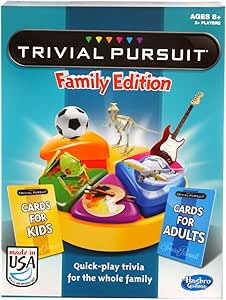 | Best for Mixed-Age Trivia Teams | Brand: Hasbro Gaming | Edition: Family Edition | Players: 2 or more | VIEW LATEST PRICE | See Our Full Breakdown |
| Number Hunter Math Board Game for Kids |  | Best for Early Math Practice | Brand: Clever Fox Play | Game type: Math board game | Players: 2 or more | VIEW LATEST PRICE | See Our Full Breakdown |
| Spin Master Games Hedbanz Classic Edition Picture Guessing Game |  | Best for Question-Asking Skills | Brand: Spin Master Games | Model name: Hedbanz Classic Edition | Edition: 2029 Edition | VIEW LATEST PRICE | See Our Full Breakdown |
| educational board games for familie | Players | Recommended age | Included components | Game type |
|---|---|---|---|---|
| Tapple: The Original Fast-Pace | 2–8 | 8 years and up | Portable Tapple wheel with built-in timer, 36 cards with 144 categories, and instructions | Party word game |
| Hasbro Gaming Scrabble Junior | 2–4 | 5 years and up | Double-sided gameboard, 4 tokens, 105 letter tiles, and game guide | Word-building |
| I Should Have Known That! Triv | More than 2 | 14 years and up | — | Trivia |
| Bananagrams Classic Word Game | 1–8 | 7 years and up | Letter tiles and banana-shaped pouch | Word, spelling, and anagram game |
| Scholastic Race Across the USA | 2–4 | 8 years and up | Game board, cards, and airplane pawns | Educational board game |
| Hasbro Gaming Trivial Pursuit | 2 or more | 8 years and up | Gameboard, 100 blue adult cards, 100 yellow kids’ cards, 2 cardholders, 6 scoring tokens, 36 scoring wedges, die, and instructions | — |
| Number Hunter Math Board Game | 2 or more | 5 years and up | Game board, 5 game pieces, 2 number dice, 1 operation die, 50 challenge cards, and game rules | Math board game |
| Spin Master Games Hedbanz Clas | 2–6 | — | 6 headbands, 6 headplates, 16 scoring badges, 1 timer, 69 picture cards, 3 sample question cards, and instructions | — |
More Details on Our Top Picks
Tapple: The Original Fast-Paced Family Word Game
Tapple turns vocabulary practice into a race: players name a word that fits the category and press an available letter before the 10-second timer runs out. That pressure keeps rounds lively and gives it a different feel from Scrabble Junior, where players have more time to build words and practice spelling. Its portable wheel stores the cards, so it suits family gatherings as well as home game nights, and 144 categories offer variety across repeat plays. The tradeoff is that speed is part of the challenge: children or adults who need extra thinking time may feel rushed rather than supported. I’d choose Tapple for families who enjoy quick verbal play, not as the gentlest option for early readers.
Pros:- 144 categories provide a wide range of word-association prompts.
- Built-in timer gives rounds a brisk pace without requiring a separate device.
- Portable wheel stores the cards for easier carrying and storage.
- Supports 2–8 players, accommodating larger family groups.
Cons:- The 10-second limit can disadvantage slower thinkers or younger players.
- Focuses on quick word recall rather than spelling words or building them on a board.
Best for: Families with school-age children and adults who enjoy fast vocabulary challenges and can comfortably think under a short timer.
Not ideal for: Families with early readers, players who need extra response time, or anyone seeking a calm spelling lesson without time pressure.
- Players:2–8
- Recommended age:8 years and up
- Playing time:15 minutes
- Game type:Party word game
- Educational objective:Vocabulary and word association
- Included components:Portable Tapple wheel with built-in timer, 36 cards with 144 categories, and instructions
- Material:Paper and plastic
- Language:English
Our verdict“Choose Tapple for lively group vocabulary play; pick Scrabble Junior instead if children need a more guided path into spelling.”
Hasbro Gaming Scrabble Junior Board Game, Ages 5+
Scrabble Junior is the most scaffolded word-learning choice here: one side pairs letters with pictures, while the reverse asks children to form words themselves. That gives families a gradual step from letter matching to spelling, unlike Tapple’s timed word recall or Bananagrams’ free-form grid building. The two-sided board can make a single game useful across different stages of early literacy, and four tokens give children a simple way to track play. The main limitation is that the advanced side may be a stretch for younger players, so families may need to stick with the matching side at first. It also accommodates only 2–4 players, making it less suitable for a large gathering than Tapple.
Pros:- Two-sided board offers both picture-and-letter matching and independent word building.
- Provides a clear progression from recognizing letters to practicing spelling.
- Includes 105 letter tiles and four tokens for a complete shared game.
- Short listed playing time suits family sessions with young children.
Cons:- The advanced side can be difficult for younger children without adult support.
- The 2–4 player limit excludes larger groups from playing together.
- The fixed board format offers less free-form word creation than Bananagrams.
Best for: Families with children beginning to recognize letters and spell simple words who want a game that can grow with their skills.
Not ideal for: Large families or groups, and children who are not ready to create words independently on the advanced side.
- Players:2–4
- Recommended age:5 years and up
- Playing time:15 minutes
- Game type:Word-building
- Gameboard:Double-sided
- Educational objectives:Spelling and vocabulary
- Included components:Double-sided gameboard, 4 tokens, 105 letter tiles, and game guide
- Batteries:Not required
- Language:English
Our verdict“Pick Scrabble Junior for a guided early-literacy game that can advance with a child, rather than for large-group or free-form play.”
I Should Have Known That! Trivia Game
I Should Have Known That! suits families whose children are old enough to enjoy general-knowledge questions, with over 400 prompts covering everyday facts. Its distinctive scoring subtracts points for wrong answers, which makes guesses feel risky and can prompt plenty of playful debate. Compared with Scholastic Race Across the USA, it offers broader trivia rather than a focused geography journey, but it lacks Race’s grade-level tailoring for mixed-age children. The stated age recommendation of 14 and up is a real boundary: younger players may find both the questions and penalty system discouraging. It also needs more than two players, so it is a poor fit for a small family looking for a two-player game.
Pros:- More than 400 questions offer varied everyday trivia prompts.
- Point deductions for incorrect answers create a clear risk-and-reward choice.
- Designed for group play and can prompt discussion beyond the question itself.
Cons:- Recommended for ages 14 and up, leaving younger family members out.
- Losing points for wrong answers may frustrate players who are learning or guessing.
- Requires more than two players, limiting its usefulness for smaller households.
Best for: Families with teenagers and adults who want a general-knowledge game for a group of at least three players.
Not ideal for: Families with younger children, players who prefer supportive scoring, or households that often play with only two people.
- Players:More than 2
- Recommended age:14 years and up
- Number of questions:Over 400
- Number of cards:110
- Game type:Trivia
- Language:English
- Usage:Indoor
- Material:Paper
Our verdict“Choose this for teen-and-adult trivia nights, but select Race Across the USA for a more child-focused, grade-tailored learning game.”
Bananagrams Classic Word Game with 144 Tiles and Banana Pouch
Bananagrams makes spelling a hands-on race: everyone builds a crossword-style grid at once, so there is no waiting for turns. That simultaneous format sets it apart from Scrabble Junior, whose board and letter-matching side provide more guidance for beginners. The 144 tiles and pouch make it easy to pack, while the lack of a board, pencils, or paper keeps setup simple for travel and family visits. The tradeoff is that players must create their own words without the picture cues or structured progression found in Scrabble Junior. It also contains small parts and is not suitable for children under 3. I’d pick it for families ready for independent spelling practice, rather than for children who still need letter-by-letter support.
Pros:- All players build word grids at once, avoiding turn-by-turn waits.
- 144 letter tiles support repeated rounds of spelling and word construction.
- Banana-shaped pouch makes the game easy to carry and store.
- Needs no board, pencils, or paper to play.
Cons:- Offers less beginner guidance than Scrabble Junior’s picture-and-letter side.
- Small tiles make it unsuitable for children under 3.
- Free-form word building may be difficult for children who are not yet confident spellers.
Best for: Families with children aged 7 and up who can form words independently and want a portable game where everyone plays at once.
Not ideal for: Beginning readers who need picture or board guidance, and households with children under 3 because of the small tiles.
- Players:1–8
- Recommended age:7 years and up
- Tiles:144 letter tiles
- Included components:Letter tiles and banana-shaped pouch
- Game type:Word, spelling, and anagram game
- Material:Rubber and wood
- Model number:1295
Our verdict“Choose Bananagrams for portable, simultaneous spelling play once children can make words on their own.”
Scholastic Race Across the USA Geography Board Game for Kids, Ages 8+
Race Across the USA turns geography questions into a route-planning race: players visit six states and return home, with questions adjusted to each player’s grade level. That tailoring gives it an advantage for mixed-grade families over I Should Have Known That!, which is aimed at older players and uses general trivia. It also provides a clearer subject-learning focus than word games such as Tapple or Bananagrams. The tradeoff is its narrow scope: the questions center on U.S. geography, so families seeking broad subject coverage may want a different game. Play is limited to 2–4 people, too. Its board, cards, and airplane pawns make the lesson interactive, but it is less portable than the pouch-based Bananagrams.
Pros:- Grade-level questions help children at different school stages play together.
- The race format connects geography questions to progress across the board.
- Includes a board, cards, and airplane pawns for interactive play.
- Short estimated play time fits a family game session.
Cons:- Focuses on U.S. geography rather than a wide range of subjects.
- Supports only 2–4 players, so larger groups cannot all play at once.
- Board-based play is less compact than Bananagrams’ pouch format.
Best for: Families with children in different school grades who want a shared game focused on U.S. states and geography.
Not ideal for: Groups larger than four, families seeking international or broad-subject learning, or buyers prioritizing compact travel play.
- Players:2–4
- Recommended age:8 years and up
- Estimated playing time:20 minutes
- Game type:Educational board game
- Edition:Standard Edition
- Language:English
- Included components:Game board, cards, and airplane pawns
- Unit count:1
Our verdict“Choose Race Across the USA when grade-tailored U.S. geography is the learning goal; skip it if your family wants broader trivia or a larger-player game.”
Hasbro Gaming Trivial Pursuit Family Edition Board Game
Separate adult and kids’ decks make this a better fit for families with a wide age range than a trivia game that asks everyone the same questions. Its 1,200 questions across six categories give repeat plays variety, while team play lets younger players contribute alongside adults. The colored spaces offer a quicker route through the board than a traditional, longer trivia session, though winning still depends on answering questions correctly. Compared with I Should Have Known That!, this edition offers a more structured race to collect wedges and a child-specific deck; it is less suited to casual, rapid-fire questions. Choose it for family trivia nights, but skip it if a child would rather learn by solving puzzles or practicing a specific school skill.
Pros:- Separate adult and kids’ question cards help balance different knowledge levels.
- Team play allows younger children to join in with adult support.
- Six categories and 1,200 questions provide variety across repeat games.
- Quick-play spaces can shorten the route to a winner.
Cons:- Progress depends on recalling trivia, which may frustrate players who struggle with general-knowledge questions.
- The game is designed for indoor play.
- The wedge-collection and final-question format may feel more involved than a simple question-and-answer game.
Best for: Families with children aged eight and up who want age-adjusted trivia and the option to play in teams.
Not ideal for: Families seeking a hands-on math or geography learning activity, or players who dislike answering trivia questions to advance.
- Brand:Hasbro Gaming
- Edition:Family Edition
- Players:2 or more
- Recommended age:8 years and up
- Trivia:1,200 questions across 6 categories
- Play options:Individual or team play
- Included components:Gameboard, 100 blue adult cards, 100 yellow kids’ cards, 2 cardholders, 6 scoring tokens, 36 scoring wedges, die, and instructions
- Language and use:English; indoor use
- Dimensions and weight:10.51 x 7.87 x 2.24 inches; 1.5 pounds
Our verdict“Choose this for mixed-age families who enjoy team trivia and age-specific questions, rather than focused practice in a school subject.”
Number Hunter Math Board Game for Kids
Addition, subtraction, and even-or-odd challenges give this game a clear learning focus, making it more targeted than Trivial Pursuit Family Edition, which tests broad trivia knowledge instead. Players roll dice, work through math problems, and move around the board; the 50 challenge cards add tasks beyond a basic roll-and-count routine. A roughly 20-minute playing time suits families looking for a contained screen-free activity, and the listed age range starts at five. The tradeoff is that the educational value centers on early number skills, so older children may outgrow the challenge. It also needs at least two players, unlike a solo worksheet or app. I’d pick it for practicing core arithmetic together, not for families wanting broad subject coverage or a game that works alone.
Pros:- Practices addition, subtraction, and even and odd numbers through play.
- Challenge cards add variety to dice-based movement.
- A listed 20-minute playing time fits shorter family or classroom sessions.
- Screen-free format supports shared play at home or in class.
Cons:- Requires at least two players.
- The listed math focus may offer too little challenge for older or more advanced children.
- Children younger than five may not be ready for the math activities.
Best for: Families or classrooms with children aged five and up who want a short, shared activity to practice basic arithmetic and number classification.
Not ideal for: Older children seeking more advanced math, or families needing a game that can be played by one child alone.
- Brand:Clever Fox Play
- Game type:Math board game
- Players:2 or more
- Edition:Addition and subtraction
- Recommended age:5 years and up
- Estimated playing time:20 minutes
- Included components:Game board, 5 game pieces, 2 number dice, 1 operation die, 50 challenge cards, and game rules
- Language:English
- Material safety:Non-toxic, child-safe materials
Our verdict“Pick Number Hunter for a short, cooperative-feeling way to rehearse early arithmetic, provided a second player is available.”
Spin Master Games Hedbanz Classic Edition Picture Guessing Game
Yes-or-no questions and picture clues make Hedbanz an accessible way for younger players to practice describing, categorizing, and narrowing possibilities. Unlike Number Hunter, it does not teach a specific school subject; its learning comes through spoken questions and deductive reasoning. The six headbands and 69 picture cards support a lively group format for 2–6 players ages six and up, while the timer adds pace. That speed can make turns exciting, but it may put pressure on children who need more time to find words or feel comfortable speaking aloud. The six-player limit also makes it less flexible for larger gatherings than games listed for two or more without a stated cap. I’d choose it for conversation-focused play, not for quiet learners or direct academic practice.
Pros:- Simple yes-or-no questions make the core rules accessible to younger players.
- Picture cards support descriptive language and deductive reasoning.
- Six headbands allow several family members to play together.
- A timer creates a brisk pace for short rounds.
Cons:- Players need to ask and answer questions aloud, which may not suit shy or quiet children.
- The timer can pressure players who need more thinking or speaking time.
- The game is limited to six players.
Best for: Families with children aged six and up who want a social game that encourages spoken questions, descriptive language, and deduction.
Not ideal for: Children who are uncomfortable asking questions aloud, need extra time to respond, or families with more than six players.
- Brand:Spin Master Games
- Model name:Hedbanz Classic Edition
- Edition:2029 Edition
- Players:2–6
- Age range:6 years and up
- Included components:6 headbands, 6 headplates, 16 scoring badges, 1 timer, 69 picture cards, 3 sample question cards, and instructions
- Model year:2023
- UPC:778988463406
Our verdict“Choose Hedbanz for lively family conversation and deduction practice, but look elsewhere for quiet play or explicit subject learning.”
How We Picked
I compared these games by the kind of learning they invite, how clearly the activity fits family play, and how much prior knowledge or reading ability it asks from players. I also weighed age suitability, pace, opportunities for mixed-age participation, and whether the game’s format supports repeat sessions without feeling like a worksheet. A game can be educational without teaching a school subject directly: word retrieval, clue-making, reasoning, and recall all count, but they suit different households.
The ranking gives priority to games with a clear learning focus and a format that can bring different ages into the same session. That places Race Across the USA first for its specific geography theme and family race structure, with Scrabble Junior and Number Hunter close behind for focused early literacy and math practice. Fast word and guessing games rank lower for subject instruction, though they may be a better match for families who value quick rounds and verbal interaction. Trivia choices depend more heavily on age mix and players’ existing knowledge.
| educational board games for familie | Game type |
|---|---|
| Tapple: The Original Fast-Pace | Party word game |
| Hasbro Gaming Scrabble Junior | Word-building |
| I Should Have Known That! Triv | Trivia |
| Bananagrams Classic Word Game | Word, spelling, and anagram game |
| Scholastic Race Across the USA | Educational board game |
| Hasbro Gaming Trivial Pursuit | — |
| Number Hunter Math Board Game | Math board game |
| Spin Master Games Hedbanz Clas | — |
Factors to Consider When Choosing Educational Board Games For Families
Before choosing a game, decide what kind of learning your family will actually enjoy repeating. The best fit depends less on a broad “educational” label and more on the players’ ages, confidence, patience, and appetite for competition.
Match the skill to your goal
Start with the learning outcome you want to encourage rather than the game’s educational label. A child who needs comfortable word practice may benefit from letter recognition and simple spelling, while a confident reader may prefer word-building challenges. Math games can reinforce number fluency, but they may feel like extra homework if a child already resists calculation. Geography and trivia broaden knowledge, though they often reward recall more than step-by-step understanding. For family play, choose one main skill to emphasize instead of expecting a single game to teach everything.
Check whether the youngest player can participate
Age guidance is a starting point, not a guarantee that every player can join on equal terms. Look at reading demands, vocabulary, turn complexity, and whether younger players need an adult to translate clues or rules. If one child needs frequent help, the game can quietly become an adult-led lesson rather than a shared activity. A simpler version or a team format can help mixed ages play together without removing challenge for older players. Avoid buying a game solely because an older child meets its suggested age if the youngest regular player will be left waiting.
Choose a pace your family will stick with
Fast rounds can make a game easy to bring out on busy evenings, but speed can put slower thinkers or shy players at a disadvantage. Longer turns allow discussion and reasoning, though they demand more patience from children with limited attention spans. Ask whether your family enjoys racing against a timer, taking turns to think, or working through a shared board objective. A game that fits your usual evening is more likely to get played than one that sounds academically ambitious but requires a long setup. If players vary widely in confidence, favor formats that let them contribute in different ways.
Separate learning from prior-knowledge advantage
Trivia can spark curiosity, but a player who already knows the answers may dominate without learning much during the game. Word and number challenges can have a similar gap when one person has much stronger skills. Look for ways to soften that difference, such as teams, cooperative turns, hints, or allowing players to explain how they reached an answer. If your goal is learning together, discussion after a question may matter more than keeping a strict score. For a more even contest, choose a game where quick observation or creative clues count alongside stored knowledge.
Think about replayability and setup
Game-night practicality can matter as much as educational content. Compact word games may be easier to store and start, while a board game with more pieces can create a fuller shared activity but require more setup and table space. Consider whether the prompts or challenges are varied enough for repeat plays and whether players can adjust difficulty as skills grow. A game that becomes too easy after a few sessions may need an adult to add new rules or goals. Check the household’s tolerance for sorting pieces and packing them away before favoring a more involved format.
Decide how much structure you want
Some families want a clear curriculum-adjacent focus; others want a lively game that happens to build useful skills. A structured subject game can make the learning goal obvious, but it may feel narrow if players want variety. Open-ended word and clue games leave more room for conversation and creativity, though the educational benefit is less tied to a single topic. Neither approach is automatically better: the right choice depends on whether you want targeted practice or a flexible social activity. When paying more for a game, look for a meaningful gain in replay value, adaptability, or shared play rather than assuming a higher cost means stronger learning.
Frequently Asked Questions
Which kind of educational game works best when children and adults have different skill levels?
Look for a format where players can contribute through different strengths, such as clue-making, discussion, or teamwork, rather than relying only on speed or advanced knowledge. Team play can reduce the gap between a confident adult and a younger child without making the game feel like tutoring. You can also agree on a small handicap, such as giving younger players extra thinking time or a hint. Avoid treating every game as a strict competition if one player is still learning the basic skill. The best choice is one where everyone gets meaningful turns.
Is a trivia game educational if players already know many of the answers?
It can still prompt recall, introduce unfamiliar facts, and encourage conversation, but a strong knowledge advantage may limit learning for experienced players. Check whether the game offers varied prompts and whether players can discuss answers rather than simply score points. For a family with a wide age range, a team format can help balance different experience levels. If your main goal is practicing a specific skill, a dedicated word, math, or geography game may provide more focused repetition. Trivia is often the better fit when variety and shared discussion matter most.
Should I choose a game marked for my child’s age or one they can grow into?
A game they can grow into may offer longer use, but only if they can take part now without constant adult assistance. Check the reading level, rule complexity, and how much background knowledge the game assumes. A slightly challenging game can be rewarding when players can learn the rules together, while a large skill gap can turn play into frustration. For younger children, a simpler first game may build confidence and make later challenges more enjoyable. Think about who will play with the child regularly, not just the age printed on the box.
How can I tell whether a game teaches a skill or just tests what players already know?
Look at what players do during a turn: do they practice forming words, calculating, giving clues, or reasoning through a choice, or do they mainly recall facts? Games that repeat an action can support skill-building, while trivia formats more often reveal existing knowledge and add new facts through discussion. Neither type is inherently less educational, but they serve different goals. If practice is your priority, choose an activity with frequent turns using the target skill. If curiosity and conversation matter more, a recall-based game may be a better match.
Is it better to buy one subject-focused game or a broad family game?
Choose a subject-focused game when your family has a clear goal, such as more geography exposure or math practice, and the players are willing to revisit that topic. A broader word or guessing game can be easier to share across ages and may suit families who want flexible, social play. The tradeoff is that a broad game may offer less direct practice in any one school subject. Consider how often the game will come out and whether players enjoy focused repetition. If you are unsure, prioritize the format your family is most likely to play regularly.
Conclusion
For the strongest balance of a clear learning theme and shared family play, I recommend Scholastic Race Across the USA as the best overall pick. Number Hunter is my choice for focused math practice, while Scrabble Junior makes the most sense for beginners building early word skills. Families seeking a quick, flexible word challenge can look to Bananagrams or Tapple; those who prefer social guessing may favor Hedbanz. For trivia, choose I Should Have Known That! or Trivial Pursuit Family Edition based on the kind of quiz play your group prefers. The best value depends on your household’s needs: a focused game earns its place when it gets regular play, while a versatile option suits families with changing players and moods. I would reserve a premium choice for a game whose format, replay variety, and age fit clearly justify the added commitment.