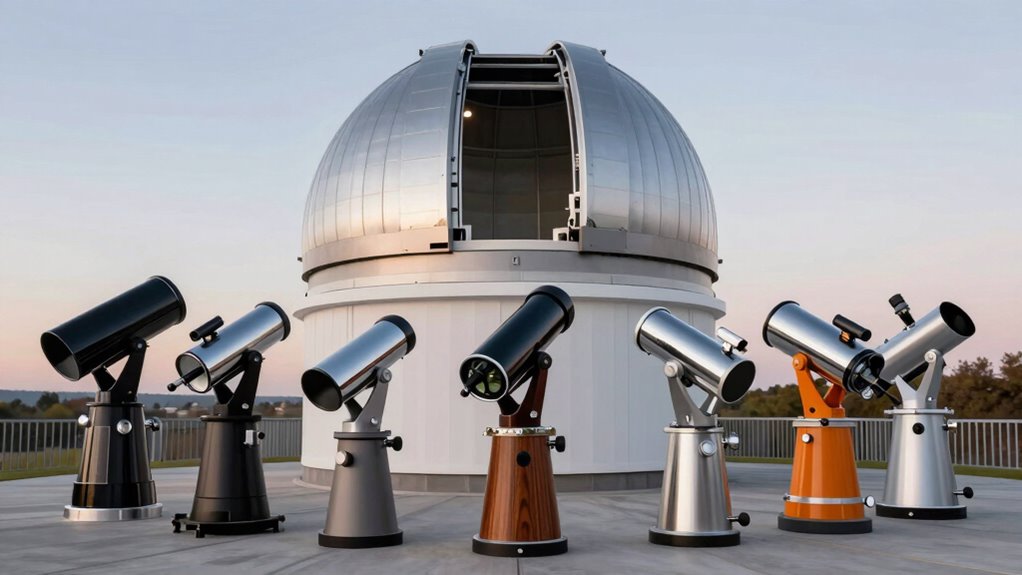

Finding the right dobsonian telescope as a beginner can be challenging, given the variety of sizes, features, and price points. The Sky-Watcher Flextube 200 stands out as the best overall choice for its large aperture and easy setup, ideal for those ready to explore deep-sky objects. The Sky-Watcher Heritage 150 offers a compact, budget-friendly option perfect for casual stargazing or first-time buyers, while the Celestron AstroMaster 130 provides straightforward operation for newcomers. Each option balances performance, ease of use, and affordability, but tradeoffs include size, portability, or complexity. Keep reading for a detailed breakdown to find your perfect match.

Prime made for students and young adults
- Fast, free delivery for dorm and study essentials
- Prime Video and Amazon Music included
- Member-only deals
Key Takeaways
- The best overall dobsonian for beginners combines ease of use with a decent aperture, which is why the Sky-Watcher Flextube 200 ranks highest.
- Portability matters; smaller tabletop models like the Heritage 150 are easier to carry but limit viewing potential compared to larger, full-sized Dobsonians.
- Budget constraints influence features; entry-level options like the Celestron FirstScope are affordable but lack advanced stability and magnification capacity.
- Build quality and stability significantly impact the user experience, especially for beginners unfamiliar with fine adjustments.
- Size and storage should align with your space and transportation needs; larger telescopes often require dedicated storage space.
| Sky-Watcher Flextube 200 Dobsonian 8-inch Collapsible Large Aperture Telescope |  | Best Overall for Serious Star Gazers | Aperture: 8 inches | Weight: 40 pounds | Mirror Coating: 94% reflective, fully multi-coated borosilicate | VIEW ON AMAZON | See Our Full Breakdown |
| Sky-Watcher Heritage 150 Tabletop Dobsonian Telescope |  | Best Value for Portability and Clarity | Aperture: 150mm | Focal Ratio: f/5 | Focal Length: 750mm | VIEW ON AMAZON | See Our Full Breakdown |
| Sky-Watcher Heritage 130mm Tabletop Dobsonian Telescope |  | Best Compact for Beginners on a Budget | Aperture: 130mm | Type: Dobsonian | Design: Tabletop, collapsible | VIEW ON AMAZON | See Our Full Breakdown |
| Sky-Watcher Classic 200 Dobsonian 8-inch Telescope |  | Best Traditional Beginner Dobsonian | Aperture: 8 inches | Focal Length: 1200mm | Weight: 45 pounds | VIEW ON AMAZON | See Our Full Breakdown |
| Celestron NPF FirstScope 76 Tabletop Dobsonian Telescope for Beginners |  | Best Budget for Entry-Level Astronomy | Focal Length: 300mm | Mirror Type: Spherical | Eyepiece/Magnification: 2mm / 30x | VIEW ON AMAZON | See Our Full Breakdown |
| Celestron AstroMaster 130EQ Telescope for Beginners |  | Best for Beginners Seeking Stability and Clear Views | Aperture: 130mm (5.1 inches) | Mount Type: German equatorial | Weight: 17 lbs | VIEW ON AMAZON | See Our Full Breakdown |
| dobsonian telescope for beginner | Aperture | Weight | Design | Focal Length |
|---|---|---|---|---|
| Sky-Watcher Flextube 200 Dobso | 8 inches | 40 pounds | Collapsible, lightweight, portable | — |
| Sky-Watcher Heritage 150 Table | 150mm | — | Collapsible, tabletop | 750mm |
| Sky-Watcher Heritage 130mm Tab | 130mm | — | Tabletop, collapsible | — |
| Sky-Watcher Classic 200 Dobson | 8 inches | 45 pounds | — | 1200mm |
| Celestron NPF FirstScope 76 Ta | — | — | — | 300mm |
| Celestron AstroMaster 130EQ Te | 130mm (5.1 inches) | 17 lbs | — | — |
More Details on Our Top Picks
Sky-Watcher Flextube 200 Dobsonian 8-inch Collapsible Large Aperture Telescope
The Sky-Watcher Flextube 200 stands out for its impressive 8-inch aperture, delivering bright and detailed views that surpass smaller models like the Celestron NPF FirstScope 76. Its collapsible design makes it easier to transport and store, a major advantage over traditional large Dobsonians, though it adds some setup time and requires occasional collimation. While the weight of 40 pounds is manageable for dedicated hobbyists, it might be cumbersome for casual users seeking portability. This model is perfect for beginners who want to upgrade from smaller scopes without sacrificing image quality or viewing experience. It includes essential accessories, making it a comprehensive choice for those willing to handle its setup complexity.
Pros:- Large 8-inch aperture for bright, detailed views of deep-sky objects
- Collapsible design for easier transport and storage
- Includes essential accessories for immediate use
Cons:- Weight of 40 pounds can be burdensome for portability
- Requires setup and collimation for optimal performance
Best for: Beginners eager to experience deep-sky objects with a large aperture and willing to manage some weight and setup effort.
Not ideal for: Casual stargazers or those seeking a lightweight, grab-and-go telescope for quick observations.
- Aperture:8 inches
- Weight:40 pounds
- Mirror Coating:94% reflective, fully multi-coated borosilicate
- Included Accessories:2-inch Crayford-style focuser, 25mm and 10mm eyepieces, 8×50 finder scope
- Design:Collapsible, lightweight, portable
Our verdict“This telescope is best suited for beginners who want a powerful, portable option and are comfortable with some setup work.”
Sky-Watcher Heritage 150 Tabletop Dobsonian Telescope
The Sky-Watcher Heritage 150 excels at combining portability with decent aperture, providing crisp views comparable to larger scopes like the Sky-Watcher Classic 200, but in a more manageable package. Its collapsible tube and tabletop design make setup quick and storage simple, ideal for beginners on the go. The 150mm aperture is sufficient for detailed lunar and planetary observations, though it can’t match the deep-sky performance of larger 8-inch models. The manual azimuth mount keeps costs down but makes tracking fast-moving objects more challenging. This scope is a smart pick for those prioritizing portability and ease of use, with a slight tradeoff in viewing depth and tracking precision.
Pros:- Portable and lightweight for easy transport
- High-quality 150mm aperture delivers bright, sharp images
- Collapsible tube simplifies storage and maintains collimation
Cons:- Manual mount limits tracking capabilities
- Tabletop use restricts viewing flexibility
Best for: Beginners who want a portable, easy-to-setup telescope for Moon and planet observation without sacrificing optical quality.
Not ideal for: Users looking for advanced deep-sky viewing or motorized tracking features.
- Aperture:150mm
- Focal Ratio:f/5
- Focal Length:750mm
- Mirror Type:Borosilicate parabolic
- Focuser:1.25-inch helical
- Design:Collapsible, tabletop
Our verdict“This scope makes the most sense for beginners seeking a portable, high-quality telescope for lunar and planetary viewing.”
Sky-Watcher Heritage 130mm Tabletop Dobsonian Telescope
The Sky-Watcher Heritage 130 offers a well-sized 130mm aperture in a compact, ready-to-go tabletop design, making it ideal for beginners who want quality without complexity. Its fully assembled, portable form allows for quick setup, unlike larger models like the Sky-Watcher Classic 200 that require more space and effort. While it provides bright, detailed views of the Moon and planets, its smaller aperture means less deep-sky performance. The lack of motorized tracking and limited mobility restricts extended observations, but for casual stargazing, it’s highly accessible. This telescope is perfect for newcomers who prefer simplicity and portability over long-term deep-sky pursuits.
Pros:- Compact, all-in-one design for portability
- Large 130mm aperture provides bright, detailed images
- Fully assembled and ready to use
Cons:- Limited to tabletop use, less flexible for outdoor observations
- No motorized tracking features
Best for: Beginners wanting a compact, easy-to-use scope for casual planetary and lunar viewing at home or on short trips.
Not ideal for: Serious amateur astronomers seeking deep-sky object detail or motorized tracking for extended sessions.
- Aperture:130mm
- Type:Dobsonian
- Design:Tabletop, collapsible
- Included Accessories:Two 1.25-inch eyepieces, starpointer
- Warranty:2 years
Our verdict“This scope is best suited for beginners seeking a simple, portable telescope for quick lunar and planetary views.”
Sky-Watcher Classic 200 Dobsonian 8-inch Telescope
The Sky-Watcher Classic 200 offers a robust 8-inch aperture with a straightforward, traditional Dobsonian design, making it an excellent choice for beginners ready to explore deep-sky objects. Its large mirrors provide bright, detailed views similar to the Sky-Watcher Flextube 200 but without the collapsible feature, resulting in a heavier, more stable setup. The manual operation favors star-hopping and learning the night sky, but it lacks motorized tracking, which can make prolonged observation sessions more demanding. Its simple construction and included accessories make it accessible, though transport and setup require some effort due to its weight. This telescope fits those who value straightforward operation over portability.
Pros:- Large 8-inch aperture for bright views of deep-sky objects
- Easy-to-use Dobsonian mount with smooth movement
- Includes essential eyepieces and finderscope
Cons:- Weight of 45 pounds makes transportation cumbersome
- Manual star-hopping without tracking increases complexity for beginners
Best for: Beginners interested in deep-sky observing who prefer a traditional, no-frills telescope with a proven design.
Not ideal for: Casual users seeking lightweight, quick-setup scopes for spontaneous viewing sessions.
- Aperture:8 inches
- Focal Length:1200mm
- Weight:45 pounds
- Eyepieces Included:25mm and 10mm
- Finderscope:9×50 straight-through
Our verdict“This classic telescope is ideal for beginners who want a reliable, traditional deep-sky scope and are prepared for its weight and manual operation.”
Celestron NPF FirstScope 76 Tabletop Dobsonian Telescope for Beginners
The Celestron NPF FirstScope 76 provides an ultra-light, very affordable entry point into astronomy, making it perfect for absolute beginners or casual stargazers. Its compact size at just 4.3 pounds allows for quick setup and easy transport, especially compared to larger scopes like the Sky-Watcher Heritage 150. However, its limited 76mm aperture restricts detailed views, especially of deep-sky objects, and the spherical mirror can introduce optical distortions, reducing image quality at higher magnifications. The fixed, simple design makes it straightforward to use but less adaptable for long-term or serious observing. This is the best choice for newcomers seeking a lightweight, affordable scope for basic lunar and planetary observation.
Pros:- Extremely lightweight and compact for portability
- Very affordable for entry-level users
- Simple setup perfect for quick observations
Cons:- Limited aperture restricts detailed views
- Optical distortions from spherical mirror at higher magnifications
Best for: Beginners with limited space or budget who want a straightforward, lightweight scope for casual sky viewing.
Not ideal for: Hobbyists planning to pursue detailed deep-sky observation or advanced astronomy with tracking features.
- Focal Length:300mm
- Mirror Type:Spherical
- Eyepiece/Magnification:2mm / 30x
- Optical Tube Length:10 inches
- Total Weight:4.3 lbs
Our verdict“This telescope is best suited for absolute beginners seeking an inexpensive, easy-to-use device for basic lunar and planetary viewing.”
Celestron AstroMaster 130EQ Telescope for Beginners
The Celestron AstroMaster 130EQ stands out for its sturdy German equatorial mount, which provides smooth manual tracking, making it an excellent choice over more portable tabletop options like the Celestron NPF FirstScope. While its 130mm aperture delivers bright, detailed images of the Moon, planets, and some deep-sky objects, the added weight of 17 lbs makes it less ideal for quick setup or transport. The inclusion of quality optics and helpful accessories makes it suitable for beginners who want a reliable, straightforward telescope, but its manual tracking can be challenging for absolute newcomers without prior experience. It excels in providing a stable viewing experience but lacks motorized tracking, limiting long-exposure or sustained observations.
Pros:- Sturdy German equatorial mount with smooth manual controls
- Bright, high-contrast optics with coatings for clear images
- Includes useful accessories and astronomy software
- Easy to assemble without tools
Cons:- Heavier than typical beginner telescopes, making transport and setup more cumbersome
- Manual tracking may be difficult for absolute beginners
- Limited to visual observations without motorized tracking
Best for: Beginners who prioritize stable, high-quality views and are willing to handle a heavier, more setup-intensive telescope.
Not ideal for: Individuals seeking a lightweight, portable telescope or those expecting motorized tracking for effortless object tracking.
- Aperture:130mm (5.1 inches)
- Mount Type:German equatorial
- Weight:17 lbs
- Eyepieces Included:20mm, 10mm
- Finderscope:StarPointer red dot
- Warranty:2 years
Our verdict“This telescope makes the most sense for beginners who want stable, detailed views and don’t mind a heavier setup with manual operation.”

How We Picked
To determine the best dobsonian telescopes for beginners, I evaluated each model based on key factors that matter most to new stargazers. Performance parameters like aperture size and optical quality were prioritized because they directly influence viewing clarity and brightness. Ease of setup and operation also played a critical role, ensuring the telescopes are accessible for novices. Construction quality and stability were assessed to prevent frustration during use, while value for money helped distinguish whether a higher-priced model justified its features. The rankings reflect a balance between affordability, usability, and performance, with a focus on models that offer real usability for beginners without overwhelming them with complexity or cost.| dobsonian telescope for beginner | Design |
|---|---|
| Sky-Watcher Flextube 200 Dobso | Collapsible, lightweight, portable |
| Sky-Watcher Heritage 150 Table | Collapsible, tabletop |
| Sky-Watcher Heritage 130mm Tab | Tabletop, collapsible |
| Sky-Watcher Classic 200 Dobson | — |
| Celestron NPF FirstScope 76 Ta | — |
| Celestron AstroMaster 130EQ Te | — |
Factors to Consider When Choosing Dobsonian Telescope For Beginners
Selecting a dobsonian telescope as a beginner involves understanding several critical factors that affect usability, viewing experience, and long-term satisfaction. Beyond just choosing the largest aperture, you need to consider how portable the telescope is, how easy it is to set up and operate, and whether the build quality will support steady viewing. This guide will outline these considerations and help you avoid common pitfalls, such as over-investing in a feature you won’t use or choosing a size that is impractical for your space or transport options.Aperture Size and Optical Quality
The aperture size is a key factor because it determines how much light the telescope can gather, directly impacting image brightness and detail. For beginners, an 8-inch aperture like the Sky-Watcher Flextube 200 provides a solid balance of light-gathering power and manageable size. Smaller apertures, such as 130mm or 150mm, are more portable and easier to handle but may limit deep-sky viewing. Higher optical quality also improves image clarity, so look for models with good reviews on mirror quality and coatings—these can make a noticeable difference in your experience.
Portability and Size
Portability is often overlooked but is critical for beginners who may want to take their telescope to different viewing spots. Compact tabletop models like the Heritage 150 are lightweight and easy to store, making them perfect for casual use or those with limited space. Larger, full-sized Dobsonians offer better performance but are heavier and require more effort to transport and set up. Assess your available space and whether you’ll need to move the telescope frequently—this will guide your size choice and help prevent frustration or neglect of your new hobby.
Ease of Assembly and Use
Beginners should prioritize models that are straightforward to set up and operate without extensive adjustments. Telescopes with simple altitude and azimuth controls, such as the Heritage series, reduce initial learning curves. Collapsible designs, like the Flextube, offer a good balance by providing a large aperture while still being manageable to assemble. Avoid overly complex mounts or models that require tools or extensive calibration, as these can discourage new users and slow down your learning progress.
Build Quality and Stability
Sturdy construction prevents vibrations and shaky images, which can frustrate new stargazers. Entry-level models with flimsy mounts might wobble or drift, making it hard to focus or track objects. Look for well-reviewed materials and stable bases, especially for larger telescopes like the 8-inch Dobsonians. Investing in a model with solid stability offers a more satisfying viewing experience and helps build confidence as you learn to navigate the night sky.
Budget and Value
While it can be tempting to go for the most affordable option, consider the long-term value. Cheaper models may lack durability or optimal optics, leading to frustration. Conversely, spending a bit more on a well-built, beginner-friendly telescope can provide better images and easier handling, encouraging continued interest. Look for a balance: invest in a model that offers good optical performance and stability without overspending on features you won’t use initially. This way, you get the best experience for your budget.
Frequently Asked Questions
Is a larger aperture always better for beginners?
Generally, yes, because a larger aperture gathers more light, revealing fainter objects and providing clearer images. However, size also affects portability and ease of setup. An 8-inch Dobsonian like the Sky-Watcher Flextube 200 strikes a good balance, offering significant light-gathering power without becoming cumbersome. For absolute beginners with limited space or transport options, smaller apertures like 130mm or 150mm models may still provide satisfying views while being easier to handle.
Do I need to buy additional accessories with my dobsonian telescope?
Yes, some accessories can enhance your experience, such as a good eyepiece set, a star chart or app for locating objects, and a collimation tool for maintaining optical alignment. Many beginner models come with basic eyepieces, but upgrading to higher-quality ones can improve clarity. Additionally, a sturdy mount or tripod, especially for larger telescopes, helps keep images stable. Budgeting for these extras ensures you get the most out of your telescope and can enjoy observing without frustration.
Can I use a dobsonian telescope in the city with light pollution?
While light pollution can limit visibility of some faint deep-sky objects, a dobsonian telescope with a larger aperture still provides excellent views of brighter objects like the Moon, planets, and some brighter nebulae and star clusters. Choosing a location with less ambient light, even nearby in a backyard or park, will significantly improve your experience. Additionally, using filters designed for light pollution can help you see more detail in the night sky from urban areas.
How long will it take to learn how to use a dobsonian telescope effectively?
Most beginners can start enjoying basic observations within a few sessions, especially if they follow simple star charts or apps. Mastering finer skills like collimation and tracking may take longer, but these are manageable with practice and patience. The key is to start with easy-to-find objects and gradually learn the night sky. Many users find that their confidence and enjoyment grow rapidly once they become familiar with setting up and pointing their telescope.
Should I buy a telescope with computerized features?
For absolute beginners, manual dobsonians are often simpler and more affordable, helping you learn the night sky without relying on technology. However, models with computerized mounts can assist in locating objects more quickly, which can be beneficial if you prefer a more guided experience or have difficulty with star-hopping. Keep in mind that adding electronics increases complexity and cost, so consider whether you want to focus on learning the sky or prefer a more automated approach. Starting with a manual model is usually recommended for beginners to build foundational skills.
Conclusion
For newcomers seeking an all-around solid choice, the Sky-Watcher Flextube 200 offers impressive performance and ease of use, making it ideal for those ready to explore deep-sky objects. Budget-conscious beginners will find the Celestron FirstScope 76 a practical entry-level option, while those prioritizing portability should consider the Sky-Watcher Heritage 150. If you desire a more guided experience, models with computerized mounts are worth exploring once you’re comfortable with the basics. Tailoring your choice to your space, experience level, and long-term goals will ensure your stargazing journey starts on the right foot.
Fall Picks
fall essentials
As an affiliate, we earn on qualifying purchases.