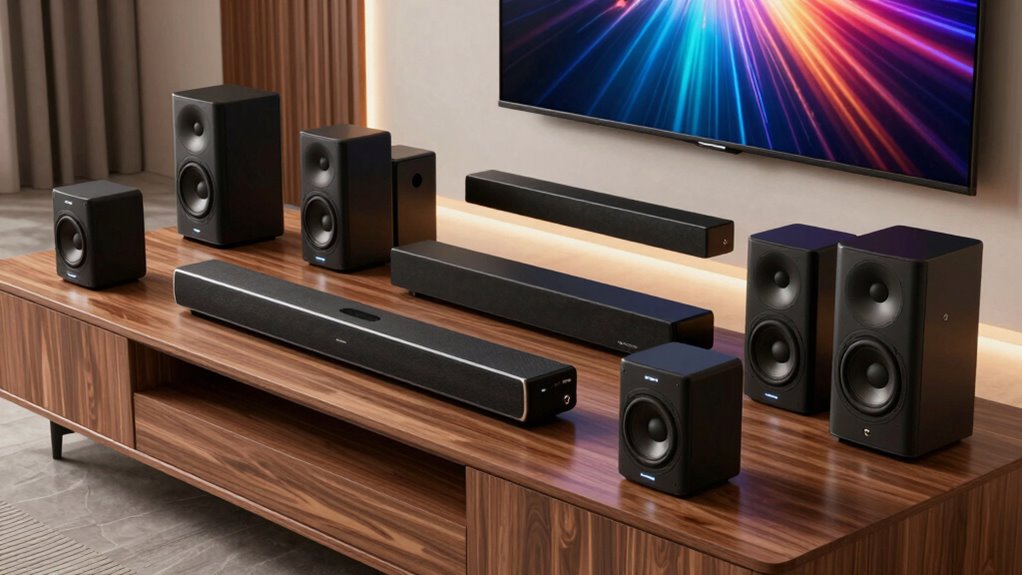

A soundbar with a subwoofer can add fuller bass and clearer TV audio, but the right setup depends on your room and how much surround sound you want. I’d put the JBL Bar 500MK2 first for its 5.1-channel design and wireless subwoofer, while the Samsung HW-B550F is a simpler 2.1-channel alternative and the Samsung Q990F suits buyers seeking a more complete surround system. The main tradeoffs are system size, placement needs, dialogue clarity, and how much you gain from rear speakers or room calibration. Some models have a separate subwoofer, while the Samsung HW-B400F uses a built-in one, so they do not offer the same bass flexibility. Read on for the full comparison, buying advice, and picks by listener and room.

Prime made for students and young adults
- Fast, free delivery for dorm and study essentials
- Prime Video and Amazon Music included
- Member-only deals
Key Takeaways
- The JBL Bar 500MK2 is the strongest all-round fit for buyers who want a separate wireless subwoofer and a more immersive 5.1-channel layout without moving up to a rear-speaker bundle.
- The Samsung HW-B550F is a straightforward 2.1-channel pick for TV owners who want a separate subwoofer and virtual surround features with less system complexity than the multichannel options.
- The Samsung Q990F is the most complete surround package here, pairing an 11.1.4-channel layout with a wireless subwoofer and rear speakers; it also needs more space and setup than a basic bar.
- Channel count changes the experience more than a subwoofer label alone: the LG S40TR includes rear speakers, while the JBL Bar 2.1 Deep Bass MK2 focuses on front sound and bass.
- Not every listed model has a separate subwoofer: the Samsung HW-B400F has a built-in subwoofer, making it a more compact choice with different bass-placement options from the wireless-subwoofer systems.


| soundbar with subwoofer | Subwoofer | Channels |
|---|---|---|
| JBL Bar 2.1 Deep Bass | Wireless, 6.5 inches | 2.1 |
| JBL Bar 700MK2 Soundbar with S | Wireless, 10 inches | 7.1 |
| 120W Bluetooth Sound Bar with | Wired, included | — |
| ULTIMEA Sound Bar with Wireles | Wireless | 2.1 |
| LG S60T 3.1 Channel Soundbar w | Wireless | 3.1 |
| TCL S60K S Series 3.1 Channel | Wireless, 6.5-inch driver | 3.1 |
| Polk Audio Signa S2 Ultra-Slim | Wireless, included | — |
| Samsung B-Series Soundbar HW-B | Wireless, included | 2.1 |
| Samsung B-Series Soundbar HW B | Built-in | 2.0 |
| Sound Bar with Subwoofer | Wired | — |
| Ultimea 5.1CH Surround Sound B | Wired wooden enclosure | 5.1 |
| TCL S55H 2.1 Sound Bar with Wi | Wireless | 2.1 |
| LG S40TR 4.1 Channel Home Thea | Wireless | 4.1 |
| Samsung Q990F 11.1.4ch Q Serie | — | 11.1.4 |
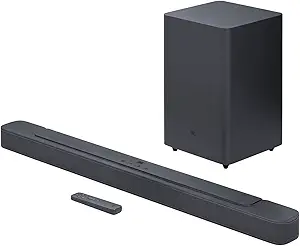
| JBL Bar 500MK2 5.1 Channel Sou | Wireless, 10 inches | 5.1 |
More Details on Our Top Picks
JBL Bar 2.1 Deep Bass (MK2) – 2.1 Channel Soundbar with Wireless Subwoofer (6.5’’), 300W Max Output, Bluetooth (Black)
The JBL Bar 2.1 Deep Bass makes sense for a buyer who wants a dedicated subwoofer and a simple TV connection without adding rear speakers or app setup. Its 300W output and wireless 6.5-inch subwoofer give movies and sports more low-end weight than the LG S60T’s 3.1-channel arrangement, while keeping the system focused on a compact 2.1 layout. Bluetooth, HDMI, and optical cover everyday TV and music connections. The tradeoff is that this model lacks the JBL Bar 700MK2’s detachable surrounds and Dolby Atmos, so its presentation is less enveloping. The separate subwoofer also needs floor space, and the listed details don’t specify extra sound modes or dialogue tools. I’d pick it for uncomplicated bass rather than surround expansion.
Pros:- 300W maximum output paired with a dedicated subwoofer
- Wireless 6.5-inch subwoofer avoids a cable running from the bar
- HDMI and optical connections support straightforward TV setup
- Bluetooth allows music streaming from a phone or tablet
Cons:- 2.1-channel configuration offers less surround immersion than the JBL Bar 700MK2
- Separate subwoofer requires room for placement
- Provided details do not identify additional sound modes or dialogue enhancement
Best for: TV viewers who want stronger movie and sports bass, a wireless subwoofer, and familiar HDMI or optical setup
Not ideal for: Buyers seeking Dolby Atmos, detachable rear speakers, or a compact system without a separate subwoofer
- Channels:2.1
- Maximum output:300W
- Subwoofer:Wireless, 6.5 inches
- Connectivity:Bluetooth, HDMI, optical
- Color:Black
- Audio format:Dolby Digital
Our verdict“Choose the JBL Bar 2.1 Deep Bass if a simple setup with substantial bass matters more than immersive surround formats.”
JBL Bar 700MK2 Soundbar with Subwoofer, Dolby Atmos Surround – Black
For buyers who want a subwoofer-led system to fill a larger room, the JBL Bar 700MK2 is the most ambitious choice in this group. Its 780W system, 10-inch wireless subwoofer, and detachable surround speakers aim for a broader, more cinematic presentation than the JBL Bar 2.1 Deep Bass, which stays with a conventional 2.1 setup. Dolby Atmos and DTS Virtual:X add height and spatial effects, while PureVoice 2.0 is intended to keep dialogue clear. Streaming options include Bluetooth, Spotify Connect, AirPlay, and Google Cast. That flexibility comes with more pieces to place, and the large system may overwhelm a small room. The supplied connectivity details also don’t mention HDMI ARC or eARC, a point to check against a TV setup before choosing it.
Pros:- 10-inch wireless subwoofer provides substantial dedicated bass
- Detachable surround speakers can extend the soundstage
- Dolby Atmos and DTS Virtual:X support spatial audio
- Bluetooth, Spotify Connect, AirPlay, and Google Cast offer several streaming paths
Cons:- Large system and detachable speakers need placement space
- Wireless surround speakers may not suit every room arrangement
- Provided details do not mention HDMI ARC or eARC
Best for: Home theater viewers with a larger room who want detachable surrounds, spatial audio, and a powerful wireless subwoofer
Not ideal for: Small-room users or buyers who prefer a minimal setup and need confirmed HDMI ARC or eARC support
- Channels:7.1
- Power:780W
- Subwoofer:Wireless, 10 inches
- Surround speakers:Detachable wireless
- Audio formats:Dolby Atmos, DTS Virtual:X
- Connectivity:Bluetooth, Spotify Connect, AirPlay, Google Cast
- Dialogue feature:PureVoice 2.0
- Color:Black
Our verdict“Choose the Bar 700MK2 when room-filling surround and a large subwoofer matter more than a simple, compact setup.”
120W Bluetooth Sound Bar with Subwoofer, Surround Sound System, Remote, Optical/AUX/ARC Connections
This 120W soundbar suits buyers who value connection choices and a slim bar over wireless subwoofer placement. It includes Bluetooth 5.3, ARC, optical, and AUX, giving it more specified input options than the ULTIMEA Sound Bar with Wireless Subwoofer, whose supplied details don’t list HDMI or optical inputs. The wired subwoofer can add bass for films and games, but its cable ties placement to the bar and nearby power or connection points. That makes this a more practical fit for a fixed TV setup than for a room where furniture changes often. A remote and space-saving design keep daily use approachable; there are no listed smart features or app-based EQ to shape the sound as on the ULTIMEA. I’d favor it when wired compatibility takes priority over flexible bass placement.
Pros:- ARC, optical, AUX, and Bluetooth 5.3 cover common device connections
- Included wired subwoofer adds dedicated bass
- Remote control supports simple day-to-day operation
- Slim design is intended to fit a range of spaces
Cons:- Wired subwoofer placement is constrained by its cable
- No built-in smart features are listed
- Sound results may depend on placement and room acoustics
Best for: Buyers with a fixed TV or gaming setup who want ARC, optical, AUX, and Bluetooth in a slim system
Not ideal for: People who need a wireless subwoofer for flexible placement or want app-based sound customization
- Power output:120W
- Subwoofer:Wired, included
- Bluetooth:Version 5.3
- Connectivity:ARC, optical, AUX, Bluetooth
- Remote control:Yes
- Design:Slim, space-saving
Our verdict“Choose this model for a slim soundbar with several specified wired inputs and a subwoofer in a fixed setup.”
ULTIMEA Sound Bar with Wireless Subwoofer, App Control, for Home Theater
The ULTIMEA is a strong fit for listeners who want to adjust bass and tone from an app instead of settling for one fixed profile. Its 10-band equalizer and 121 preset matrices offer far more stated tuning control than the JBL Bar 2.1 Deep Bass, whose supplied details focus on power and connections. A wireless subwoofer gives more placement freedom than the wired subwoofer in the 120W Bluetooth Sound Bar, while the listed 240W peak power and 45 Hz–18 kHz response describe its output range. App dependence is the main catch: buyers who prefer physical controls may find deeper adjustment less convenient. The provided product data also doesn’t list HDMI or optical inputs, so I’d verify TV connectivity before buying. This is the customization pick, not the safest choice for a no-fuss hookup.
Pros:- Wireless subwoofer allows flexible placement
- 10-band EQ and 121 preset matrices provide extensive sound adjustment
- 240W peak power and listed 45 Hz–18 kHz response
- Bluetooth 6.0 supports wireless streaming
Cons:- Provided details do not list HDMI or optical inputs
- Full customization depends on app control
- 2.1-channel setup does not include separate rear speakers
Best for: Listeners who enjoy shaping sound profiles in an app and want to place the subwoofer away from the bar
Not ideal for: Buyers who want confirmed HDMI or optical TV inputs, or prefer to avoid app-based setup and adjustment
- Channels:2.1
- Peak power:240W
- Subwoofer:Wireless
- Frequency response:45 Hz–18 kHz
- Bluetooth:Version 6.0
- Equalizer:10-band, 121 preset matrices
- Driver:18 mm high-excursion driver
- Maximum SPL:95 dB
Our verdict“Choose the ULTIMEA if app-based EQ and wireless subwoofer placement are priorities and its TV inputs suit your setup.”
LG S60T 3.1 Channel Soundbar with Wireless Subwoofer, Dolby Audio, TV Synergy, AI Sound Pro – Black
The LG S60T brings a center channel to the soundbar-and-subwoofer formula, making it a sensible choice for viewers who want dialogue to stand out without moving up to the JBL Bar 700MK2’s larger surround system. Its 3.1-channel layout, Dolby Audio, and AI Sound Pro are aimed at TV and movie listening, with the wireless subwoofer adding low-end impact. TV synergy and app-based sound settings may appeal to households already using compatible LG gear. Compared with the JBL Bar 2.1 Deep Bass, the LG adds a center channel but the provided data gives less detail about its power and subwoofer size. It is also a substantial 33.5 inches wide and weighs 18.2 pounds. The listed USB provision is limited to one port, and corded power means it needs a fixed indoor spot.
Pros:- 3.1-channel layout includes a center channel for dialogue-focused listening
- Wireless subwoofer adds bass without a direct cable to the bar
- Dolby Audio and AI Sound Pro are included
- LG Soundbar App and TV synergy provide sound-setting options
Cons:- At 33.5 inches wide and 18.2 pounds, it needs a stable, roomy placement
- Corded power limits placement and prevents battery operation
- Only one USB 2.0 port is listed
Best for: TV and movie viewers who prioritize dialogue intelligibility and want a center channel with a wireless subwoofer
Not ideal for: Buyers seeking a compact, lightweight bar, outdoor use, or a detailed power and subwoofer specification
- Channels:3.1
- Subwoofer:Wireless
- Audio:Dolby Audio, AI Sound Pro
- Dimensions:3.5 × 33.5 × 2.5 inches
- Weight:18.2 pounds
- USB ports:1 USB 2.0
- Power source:Corded electric
- Mounting:Wall mount
Our verdict“Choose the LG S60T if a center channel for clearer TV dialogue matters more than a compact footprint or detailed output specifications.”
TCL S60K S Series 3.1 Channel Sound Bar with Dolby Atmos, DTS:X, Wireless Subwoofer, Bluetooth, and AI Sonic Auto Room Calibration
The TCL S60K suits viewers who want Dolby Atmos and DTS:X support without moving to a larger multi-speaker package. Its 3.1-channel layout adds a center channel for dialogue, while the wireless subwoofer supplies bass without requiring a cable across the room. Compared with the Samsung HW-B550F, which relies on DTS Virtual:X from a 2.1 setup, the S60K has more dedicated channels and room calibration to adapt its sound to placement. That makes it a stronger fit for varied rooms and movie formats, though the supplied details don’t establish how convincing its height effects are. The extra connections and calibration also mean more setup than a basic bar, and buyers with non-TCL TVs may need to check compatibility before choosing it.
Pros:- 3.1 channels include a dedicated center channel for dialogue
- Supports Dolby Atmos and DTS:X formats
- Wireless subwoofer helps keep the room free of a long subwoofer cable
- AI Sonic room calibration adapts sound to the listening space
Cons:- Room calibration and multiple connections add setup steps
- Product details provide limited guidance on compatibility with non-TCL TVs
- The listed features alone do not establish the strength of its height effects
Best for: Movie viewers who want a center channel, a wireless subwoofer, and support for Dolby Atmos and DTS:X in one soundbar system
Not ideal for: Buyers seeking a simple plug-in upgrade or confirmed compatibility guidance for a non-TCL TV
- Channels:3.1
- Dolby Atmos:Yes
- DTS:X:Yes
- Subwoofer:Wireless, 6.5-inch driver
- Room calibration:AI Sonic
- Bluetooth:Yes
- Connections:HDMI eARC, HDMI input
Our verdict“Choose the TCL S60K if you want format support and a dedicated dialogue channel, and are comfortable checking TV compatibility and setting up calibration.”
Polk Audio Signa S2 Ultra-Slim Sound Bar with Subwoofer
The Polk Audio Signa S2 makes the most sense when the TV stand or wall space is tight but you still want a separate subwoofer. At just over two inches high, its slim bar is easier to place than the more involved TCL S60K, whose 3.1-channel design and room calibration suit buyers prioritizing format features. Polk instead focuses on a straightforward connection mix—HDMI, optical, AUX, and Bluetooth—and includes HDMI and optical cables, which can reduce the number of setup pieces to source. Its wireless subwoofer adds bass while allowing flexible placement. The tradeoff is that the supplied details describe performance as mid- to high-range and don’t list Dolby Atmos or DTS:X support, so buyers seeking expanded movie formats should compare it with the TCL or Samsung options.
Pros:- Bar height of just over two inches fits many low-clearance spaces
- Wireless subwoofer adds bass with flexible placement
- HDMI, optical, AUX, and Bluetooth connections support varied sources
- HDMI and optical cables are included
Cons:- Product information describes sound quality as limited to the mid- to high-range
- No Dolby Atmos or DTS:X support is listed
- Initial connection still requires cable setup
Best for: Apartment dwellers and TV owners with low clearance who want a slim bar, wireless bass, and several connection choices
Not ideal for: Movie viewers prioritizing Dolby Atmos or DTS:X support, or shoppers seeking detailed performance specifications
- Drivers:5 full-range drivers
- Bar height:Just over 2 inches
- Subwoofer:Wireless, included
- Connections:HDMI, ARC optical input, AUX
- Bluetooth:Yes
- Included cables:HDMI and optical
Our verdict“Pick the Signa S2 when a slim footprint and practical connections matter more than the format support offered by the TCL S60K.”
Samsung B-Series Soundbar HW-B550F 2.1 ch DTS Virtual:X with Subwoofer (2025 Model)
The Samsung HW-B550F is aimed at households that move between shows, films, music, and games and want the soundbar to adjust along with them. Its 2.1-channel system includes a wireless subwoofer, and DTS Virtual:X adds a sense of surround without the rear speakers that a full surround package would need. Adaptive audio and dialogue enhancement also target everyday listening, where content can shift from quiet speech to louder scenes. Compared with the TCL S60K, it has fewer listed channels and virtual rather than listed Dolby Atmos or DTS:X support; the TCL is the more format-focused choice. The Samsung can expand with optional rear speakers, but that adds equipment, and its current specification details say little about the additional sound modes.
Pros:- Wireless subwoofer is included for added bass
- DTS Virtual:X provides virtual surround processing
- Adaptive audio adjusts for different content
- Dialogue enhancement targets clearer speech
Cons:- 2.1 channels do not include dedicated rear speakers
- Optional rear speakers are needed to expand the setup toward physical surround
- Available details provide limited information on additional sound modes
Best for: Samsung TV owners who want wireless bass, clearer dialogue, and sound settings suited to a mix of everyday content
Not ideal for: Buyers who want dedicated rear speakers included or the listed Dolby Atmos and DTS:X support of the TCL S60K
- Model:HW-B550F
- Channels:2.1
- Virtual surround:DTS Virtual:X
- Subwoofer:Wireless, included
- Audio features:Adaptive audio, dialogue enhancement
- Optional expansion:Rear speakers
- Model year:2025
Our verdict“Choose the HW-B550F for adaptable TV, movie, and music listening with wireless bass, provided virtual surround meets your needs.”
Samsung B-Series Soundbar HW B400F 2.0 Ch with Built-in Subwoofer (2025 Model)
The Samsung HW-B400F suits buyers who want to avoid placing a separate subwoofer. Its 2.0-channel bar has a built-in subwoofer, so the main setup stays in one unit; by comparison, the Samsung HW-B550F includes a separate wireless subwoofer for more flexible placement. The B400F also lists voice enhancement and single-remote control, features that can make ordinary TV dialogue and day-to-day operation easier, especially with a compatible Samsung TV. However, its stated 2.0 channels don’t match the B550F’s 2.1 layout, and no separate subwoofer is included. The supplied specifications don’t clarify its TV connections or explain how the built-in bass compares with a standalone unit, so this is a space-saving choice rather than a clear pick for bass-focused movie watching.
Pros:- Built-in subwoofer keeps the system to one main unit
- Voice enhancement is listed for dialogue
- Can be controlled with a compatible Samsung TV remote
- Wall mounting is supported
Cons:- No separate subwoofer is included for flexible placement
- 2.0-channel layout has fewer listed channels than the HW-B550F
- Full remote-control features are limited to compatible Samsung TVs
Best for: Viewers with limited floor space who want a single soundbar unit and use a compatible Samsung TV
Not ideal for: Bass-focused movie viewers or owners of non-Samsung TVs who depend on the listed Samsung remote features
- Model:HW-B400F
- Channels:2.0
- Subwoofer:Built-in
- Control:Remote control
- Voice feature:Voice enhancement
- Mounting:Wall mount
- Model year:2025
Our verdict“Pick the HW-B400F if a single bar and Samsung TV integration matter more than the separate subwoofer in the HW-B550F.”
Sound Bar with Subwoofer, 110W Bluetooth/ARC/Opt/AUX Connection, Adjustable Deep Bass & 3 EQ Modes for Smart TV
This 110W soundbar stands out for connection flexibility and hands-on sound adjustment rather than a named surround format. It pairs a wired subwoofer with Bluetooth 5.3, ARC, optical, and AUX, giving owners several ways to connect a TV or stream from another device. Three EQ modes for movies, music, and news offer an accessible way to shift the sound for different content. Compared with the Polk Signa S2, which includes a wireless subwoofer and HDMI cable, this model’s subwoofer requires a cable, though the listed power and EQ controls give it a distinct setup and tuning angle. Buyers should expect to check TV settings: ARC needs the dedicated ARC port, and the product details call out manual configuration to get compatibility right.
Pros:- 110W listed output with adjustable bass
- Bluetooth 5.3, ARC, optical, and AUX connections
- Movie, music, and news EQ modes
- 18-month warranty and listed online support
Cons:- Wired subwoofer constrains placement and requires cable routing
- ARC mode requires use of the TV’s dedicated ARC port
- Manual TV settings may be needed for compatibility
Best for: TV owners who want several wired input choices, Bluetooth streaming, and simple EQ presets for different content
Not ideal for: Anyone who needs a wireless subwoofer or wants to minimize TV configuration and cable routing
- Power:110W
- Subwoofer:Wired
- Bluetooth:5.3
- Connections:ARC, optical, AUX
- EQ modes:Movie, Music, News
- Warranty:18 months
- Support:24/7 online support
Our verdict“Choose this soundbar if you value input choices and EQ presets and can accommodate a wired subwoofer and some setup.”
Ultimea 5.1CH Surround Sound Bar System with Dolby Atmos, Poseidon M60
The Poseidon M60 suits buyers who want a 5.1-channel layout and hands-on control over how their system sounds. Its app presets and equalizer let listeners adjust the presentation, while voice clarity enhancement can help keep dialogue distinct during busy scenes. The 300W system pairs the bar with a wired wooden subwoofer, so bass support comes with a cable and some placement planning. Compared with the TCL S55H, which uses a wireless subwoofer and adds auto room calibration, the Poseidon puts more emphasis on manual tuning and includes a 5.1-channel configuration. Its listed Dolby Atmos support aims for a more enveloping presentation, though channel count alone cannot guarantee the same effect as dedicated rear speakers. Choose it for a customizable home theater setup; skip it if a tidy, low-cable installation matters most.
Pros:- App control includes customizable sound presets and equalizer settings
- 5.1-channel configuration with Dolby Atmos support
- Voice clarity enhancement is aimed at making dialogue easier to follow
- 300W output and a wooden subwoofer provide dedicated bass support
Cons:- Wired subwoofer requires cable routing and limits placement flexibility
- No room calibration feature is listed
- The tabletop or wall-mount system still needs space for its subwoofer
Best for: Home theater buyers who want app-based EQ and a 5.1-channel system and can accommodate a wired subwoofer
Not ideal for: Apartment dwellers or anyone seeking a simple, cable-light setup, since the subwoofer is wired and the system needs room for placement
- Channels:5.1
- Sound technology:Dolby Atmos
- Output:300W
- Subwoofer:Wired wooden enclosure
- Subwoofer diameter:5.25 inches
- Controls:App and remote
- Mounting:Tabletop or wall mount
- Weight:12.6 pounds
Our verdict“Pick the Poseidon M60 if app-based sound adjustments and a wired 5.1-channel setup fit your room better than the TCL S55H’s wireless, auto-calibrated approach.”
TCL S55H 2.1 Sound Bar with Wireless Subwoofer for Smart TV, Dolby Atmos, DTS:X, 220W, App & Remote Control
The TCL S55H is a practical fit for buyers who want a compact bar, a separate bass unit, and several ways to connect a TV. Its wireless subwoofer is easier to position than the wired unit on the Ultimea Poseidon M60, while auto room calibration can help balance sound for the space. Dolby Atmos, DTS:X, and DTS Virtual:X broaden its format support, but this remains a 2.1-channel system; buyers seeking physical rear speakers should look to the LG S40TR instead. HDMI eARC/ARC, optical, Bluetooth 5.2, and AUX give it useful flexibility across TVs and other sources. The tradeoff is that it offers less channel separation than the LG, and TCL says the calibration process runs through the app. Its listed power may also be more than very small rooms need.
Pros:- Wireless subwoofer allows more flexible placement than a wired bass unit
- Auto room calibration can help tailor playback to the room
- HDMI eARC/ARC, optical, Bluetooth 5.2, and AUX support varied connections
- Supports Dolby Atmos, DTS:X, and DTS Virtual:X
Cons:- 2.1 channels do not provide the separate rear speakers included with the LG S40TR
- Optimal calibration requires app setup
- The system may be more powerful than needed for very small rooms
Best for: Smart TV owners in small or medium rooms who want wireless bass, broad input choices, and guided room calibration
Not ideal for: Buyers who want separate rear speakers or a system focused on physical surround placement, since this is a 2.1-channel setup
- Channels:2.1
- Power:220W
- Sound technology:Dolby Atmos, DTS:X, DTS Virtual:X
- Subwoofer:Wireless
- Connectivity:HDMI eARC/ARC, optical, Bluetooth 5.2, AUX
- Soundbar dimensions:31.89 × 2.36 × 3.86 inches
- Subwoofer dimensions:7.68 × 12.60 × 7.68 inches
- Calibration:Auto room calibration
Our verdict“Choose the TCL S55H for a compact, wireless-subwoofer TV setup with broad connectivity, but choose the LG S40TR if rear speakers matter more.”
LG S40TR 4.1 Channel Home Theater Soundbar with Wireless Subwoofer and Rear Speakers
The LG S40TR is the pick here for buyers who want actual rear speakers in the room rather than relying on a soundbar to create a wider impression from the front. Its 4.1-channel arrangement includes wireless rear speakers and a wireless subwoofer, adding more physical separation than the TCL S55H’s 2.1-channel design. The rear units still need wired connections and AC power, so “wireless” does not mean a cable-free setup. Dolby Audio and DTS Digital are listed, while the WOW Interface lets compatible LG TV owners use their TV remote for control. That TV synergy is a convenience advantage over the JBL Bar 500MK2, but it depends on owning compatible LG equipment. Buyers after Dolby Atmos support should compare the TCL or JBL instead, since Atmos is not listed for this model.
Pros:- 4.1-channel system includes rear surround speakers
- Wireless subwoofer and rear speaker signal connections simplify some cable runs
- WOW Interface supports control with a compatible LG TV remote
- LG Soundbar App provides sound customization
Cons:- Rear speakers still require wired connections and AC power
- Some control features depend on LG TV compatibility
- Dolby Atmos support is not listed
Best for: LG TV owners who want rear speakers for more distinct surround placement and can power them near their seating area
Not ideal for: People with limited floor or outlet access around the listening area, or buyers specifically seeking Dolby Atmos
- Channels:4.1
- Subwoofer:Wireless
- Rear speakers:Wireless signal; wired connection and AC power required
- Audio formats:Dolby Audio, DTS Digital
- Soundbar dimensions:28.4 × 2.5 × 3.4 inches
- Subwoofer dimensions:6.7 × 12.6 × 9.9 inches
- TV control:LG TV remote via WOW Interface
- Design:Crest style with metal grill
Our verdict“Choose the S40TR if physical rear speakers and LG TV integration matter more than Atmos formats or a cable-light room.”
Samsung Q990F 11.1.4ch Q Series Soundbar with Wireless Dolby Atmos and Rear Speakers
The Samsung Q990F targets buyers building a more elaborate surround system around a TV: its 11.1.4 channels include rear speakers and a subwoofer, giving it a more extensive speaker layout than the 5.1 JBL Bar 500MK2. Automatic room calibration and dialogue clarity features address two common setup concerns, while Wi-Fi, Bluetooth, HDMI, AirPlay 2, and Google Cast provide a broad range of ways to stream or connect devices. That breadth also means more components and configuration than a straightforward 2.1 system such as the TCL S55H. The product data does not specify subwoofer dimensions or power output, so buyers comparing physical fit or amplifier figures have less to go on here. Choose it for a feature-rich room setup; skip it if you want a compact, simple installation.
Pros:- 11.1.4-channel system includes rear speakers and a subwoofer
- Wireless Dolby Atmos is listed
- Auto room calibration uses the soundbar microphone
- Wi-Fi, Bluetooth, HDMI, AirPlay 2, and Google Cast support multiple connection and streaming paths
Cons:- Multiple speakers and smart features can make setup more involved
- Requires space to place the rear speakers and subwoofer
- Power output and subwoofer dimensions are not provided in the supplied specifications
Best for: Home theater buyers who want a multi-speaker Dolby Atmos setup, rear channels, and built-in streaming options
Not ideal for: People who want a compact plug-in upgrade or prefer a straightforward setup with fewer speakers and configuration steps
- Channels:11.1.4
- Audio:Wireless Dolby Atmos
- Speakers:Rear speakers and subwoofer included
- Connectivity:Wi-Fi, Bluetooth, HDMI
- Streaming:AirPlay 2, Google Cast
- Voice assistants:Alexa, Google Assistant
- Calibration:Auto room calibration with soundbar microphone
- Dialogue feature:Enhanced dialogue clarity
Our verdict“Pick the Q990F for its extensive rear-speaker and Atmos layout if your room can accommodate the system and its more involved setup.”
JBL Bar 500MK2 5.1 Channel Soundbar System with Dolby Atmos, Wireless Subwoofer, and Voice Assistant Compatibility
The JBL Bar 500MK2 makes sense for listeners who want a substantial bass presence without adding rear speakers. Its 10-inch wireless subwoofer and listed 750W output give it a more bass-focused spec sheet than the TCL S55H, whose wireless subwoofer is part of a lower-output 2.1 system. JBL’s MultiBeam 3.0 is designed to widen the front soundstage, while PureVoice 2.0 targets clearer dialogue; these features suit film watching when space behind the seating area is limited. Compared with the Samsung Q990F, however, the JBL is a 5.1-channel system rather than an 11.1.4 package with rear speakers, so it is the simpler layout, not the more extensive surround setup. Room calibration and JBL ONE app support aid adjustment, but the bar and subwoofer still need room to breathe.
Pros:- 10-inch wireless subwoofer provides dedicated low-frequency support
- MultiBeam 3.0 is designed to widen the front soundstage
- PureVoice 2.0 targets dialogue clarity
- JBL ONE app and room calibration support sound adjustments
Cons:- 5.1 channels do not include the rear speakers supplied with the Samsung Q990F
- The large subwoofer and wider soundstage need placement space
- Setup and room calibration may take more effort than a basic 2.1 system
Best for: Movie and sports viewers who want strong bass, a wide front soundstage, and no separate rear speakers
Not ideal for: Small-room listeners or buyers who want dedicated rear speakers and a more elaborate surround layout like the Samsung Q990F
- Channels:5.1
- Power output:750W
- Subwoofer:Wireless, 10 inches
- Audio:Dolby Atmos
- Soundstage feature:MultiBeam 3.0
- Dialogue feature:PureVoice 2.0
- Connectivity:HDMI eARC, 4K Dolby Vision passthrough
- App:JBL ONE App
Our verdict“Choose the JBL Bar 500MK2 for bass-forward, app-adjustable 5.1 sound when you have room for its large wireless subwoofer.”

How We Picked
I compared the 15 options by how well their soundbar-and-subwoofer configurations serve different TV setups: bass delivery, channel layout, dialogue and surround features, connection and control options, and the practical demands of placing the bar, subwoofer, and any rear speakers. I gave more weight to a clearly useful combination of sound expansion and manageable setup than to a long feature list on its own. A dedicated subwoofer can add placement flexibility and low-frequency impact, while built-in bass favors a smaller footprint.
The order reflects the breadth of the fit for typical living-room use, then the strength of each model for a specific buyer. The JBL Bar 500MK2 leads for its 5.1-channel design and separate wireless subwoofer; simpler 2.1 systems rank as accessible alternatives, while bundles with rear speakers rank higher for buyers prioritizing surround coverage. Premium feature sets do not automatically suit every room, so compactness, setup demands, and whether a product actually includes a separate subwoofer shape the recommendations.
Factors to Consider When Choosing Soundbar With Subwoofer
I’d start with the room and listening habits, then decide how much equipment you want to place around the TV. These broader checks can help you avoid paying for channels or features that your setup cannot use.
Choose the channel layout for your room
Channel numbers describe the system’s speaker arrangement, but they do not guarantee the same surround effect in every room. A 2.1 setup keeps sound in front and adds a subwoofer; a system with rear speakers can place effects behind you if you have space and suitable seating. Virtual surround processing can widen the presentation without adding speakers, though it depends on the room and your position. Before choosing a high-channel-count package, check whether your sofa faces the TV and whether rear speakers can sit behind or beside it. An open-plan room or seating against a wall may limit the benefit of rear channels. If you mainly watch news and dialogue-heavy shows, prioritize clear voices and easy controls over channel count.
Plan where the subwoofer will go
A separate subwoofer needs a stable spot near an outlet, and its bass can sound different depending on its position in the room. Wireless connection removes the audio cable to the bar, but it does not remove the power cord or the need to place the unit sensibly. Corners can make bass sound stronger, while placing the sub too far from the seating area may make it feel disconnected from the rest of the audio. Measure the available floor space before ordering and account for furniture, doors, and walkways. A built-in subwoofer avoids a separate box but gives you fewer placement choices. Buyers in apartments may also want to check whether bass adjustment is easy to reach.
Check TV connections and control before buying
Look at the ports on both the TV and soundbar, then confirm how you plan to connect them. HDMI ARC or eARC can simplify TV audio and remote control, while optical can be useful on older sets; Bluetooth is handy for music but is not a substitute for checking TV compatibility. Features such as Dolby Atmos or DTS:X only help when the source, connection, and system support the format. Do not assume that a format name on the product listing means every app or TV will send it through. Also check whether settings live on the remote, an app, or both. A setup that lets you adjust dialogue and bass quickly can matter more day to day than an extra format badge.
Decide whether rear speakers are worth the space
Rear speakers can add a stronger sense of movement and sound around the seating position, but they bring placement and power requirements. Check whether they are included in the system or sold separately, and find out how they connect and where their power comes from. Wireless rear audio can reduce cable runs, though speakers still may need nearby outlets. If you cannot place speakers behind or beside the main seat, a simpler bar may give a cleaner setup with more consistent results. Account for other listeners too: a surround mix can be most convincing from the central seat. Choose a rear-speaker system when your layout supports it, rather than relying on the channel count alone.
Match bass control to your household
Subwoofer output that suits action films can overwhelm dialogue or travel through shared walls, so bass adjustment is a practical feature rather than a minor extra. Check whether the system offers separate subwoofer level control, night listening modes, or presets that are easy to change. Automatic room calibration can help tune playback to a space, but it cannot fix poor placement or block sound from reaching another room. If you watch at different times of day, simple controls make it easier to adapt without reconfiguring the system. People who mostly stream music may also care about Bluetooth and app access. Choose a system you can adjust comfortably, not just one with the biggest stated output.
Spend on features your setup can use
More channels, room calibration, and immersive audio formats can add value when the TV, room, and content support them. They add less when you sit close to a small screen, rarely watch compatible material, or cannot place the extra speakers. A separate subwoofer may be a more noticeable upgrade than a virtual surround mode for viewers moving up from weak TV speakers. On the other hand, if clean floor space is the priority, a compact system with built-in bass can be the better fit. Compare what is included in the box, especially rear speakers and required cables. I’d pay for a feature when it improves a regular use case, not just because it appears higher on a specification list.
Frequently Asked Questions
Should I choose a soundbar with a separate subwoofer or one with built-in bass?
A separate subwoofer can give you more placement flexibility and a fuller low end, but it occupies floor space and needs power. A built-in subwoofer keeps the setup compact and avoids placing another box in the room. The Samsung HW-B400F is the built-in-bass example in this roundup, while most of the other options list a separate subwoofer. Consider your room layout and how much bass you want before deciding. If you cannot spare floor space, compactness may matter more than the potential bass advantage of a separate unit.
Will a soundbar with Dolby Atmos sound immersive without rear speakers?
It can create a wider or more elevated impression through processing and the soundbar’s drivers, but the result depends on the model, room, and source audio. Rear speakers place sound behind the listener more directly, which a front-only bar may not reproduce as convincingly. Check whether a specific package includes rear speakers rather than assuming the format label means they are in the box. Your TV and connection also need to pass compatible audio. If surround effects are a priority, compare the full speaker layout as well as the supported formats.
Is a 2.1-channel system enough for dialogue and movies?
For many viewers, a 2.1 setup is a meaningful step up from TV speakers: the bar handles front audio and a separate subwoofer adds bass. It can suit smaller rooms and listeners who want a simple installation. A 3.1 system adds a center channel, which can help keep dialogue distinct from effects, while rear-speaker packages add more surround coverage. The right choice depends on what you watch and where you sit. If speech clarity is your main concern, look for dialogue controls and a dedicated center channel rather than judging by bass output alone.
Do I need the same brand of soundbar and TV to use TV control features?
Some manufacturers offer brand-specific integrations, but many basic functions depend on standard connections such as HDMI ARC or eARC. Check your TV’s available ports and the soundbar’s supported connection before relying on one-remote control or automatic power behavior. Brand pairing may add conveniences, yet it should not outweigh sound, room fit, or included speakers. Older TVs may rely on optical, which can change which control features are available. Verify compatibility for your exact TV model if seamless control is a deciding factor.
How much space should I leave for a wireless subwoofer?
Measure the subwoofer itself and leave room for its power cable, airflow, and access to nearby outlets. Wireless describes its audio connection to the bar; it does not mean the unit can sit anywhere without power. Avoid spots where it blocks a walkway or is likely to be bumped, and try to keep it near the listening area. Bass can vary with placement, so a little flexibility to move it may help you find a better balance. If your room has no suitable floor space, a built-in-bass model may be easier to live with.
Conclusion
I’d choose the JBL Bar 500MK2 as the best overall for a broad mix of TV and movie use, with its 5.1-channel design and wireless subwoofer. For a simpler setup with a separate subwoofer, the Samsung HW-B550F is my value-minded pick, while the Samsung Q990F is the best premium choice for buyers who can accommodate a larger system with rear speakers. Beginners who want a more direct 2.1-channel arrangement can start with the JBL Bar 2.1 Deep Bass MK2. For compact placement, the Samsung HW-B400F keeps bass built into the bar; for surround coverage with included rear speakers, consider the LG S40TR. Match the system to your room and listening habits, then check your TV connections before choosing.