Finding the right telescope for astrophotography involves balancing image quality, ease of use, and budget. The Celestron NexStar 8SE stands out as the best overall choice thanks to its reliable Schmidt-Cassegrain design and computerized mount. For those prioritizing portability, the ZWO Seestar S30 Pro offers excellent app-controlled imaging in a compact form. Meanwhile, the Celestron CGX 11″ EdgeHD is ideal for advanced users seeking professional-grade imaging capabilities. These options illustrate the key tradeoffs: more advanced models deliver better images but often come with higher complexity and cost. Keep reading for a detailed breakdown to help you find the perfect match for your astrophotography ambitions.
Open a free Amazon Business account
Business pricing, bulk buying and tax-exempt orders.
Create a free accountAs an affiliate, we earn on qualifying purchases.
Key Takeaways
- The top-ranked telescopes balance aperture size with ease of use, favoring models like the Celestron NexStar 8SE for overall performance.
- Smart, app-controlled telescopes like the ZWO Seestar S30 Pro simplify astrophotography setup, especially for beginners or portable use.
- Higher-end options such as the Celestron CGX 11″ EdgeHD deliver superior image quality but require more technical knowledge and investment.
- Budget-friendly models still offer decent astrophotography capabilities, but they often lack advanced features like auto-guiding or high-precision mounts.
- The choice between refractors and Schmidt-Cassegrain designs hinges on user experience preferences, with refractors often being more straightforward for beginners.
| Celestron StarSense Explorer 10″ App-Enabled Dobsonian Telescope |  | Best for Large, High-Detail Deep-Sky Imaging | Size: 10 inches | Type: Dobsonian reflector | Aperture: 254mm | VIEW ON AMAZON | See Our Full Breakdown |
| Celestron StarSense Explorer LT 114AZ Newtonian Smartphone Guided Telescope |  | Best Budget-Friendly Entry-Level Astrophotography Scope | Aperture: 114mm | Type: Newtonian reflector | Mount: Manual altazimuth | VIEW ON AMAZON | See Our Full Breakdown |
| DWARFLAB Dwarf 3 Smart Telescope, App-Controlled Astrophotography Camera |  | Best Ultra-Portable, All-in-One Astrophotography Solution | Focus Type: Auto Focus | Finderscope: Straight-Through | Compatible Devices: Smartphone, Laptop, Personal Computer | VIEW ON AMAZON | See Our Full Breakdown |
| Celestron NexStar 8SE Computerized Telescope – Schmidt-Cassegrain |  | Best for Automated, High-Precision Astrophotography | Aperture: 8 inches | Optical Design: Schmidt-Cassegrain | Mount Type: Computerized GoTo | VIEW ON AMAZON | See Our Full Breakdown |
| ZWO Seestar S30 Pro Smart Telescope, App-Controlled Astrophotography |  | Best for Beginner Urban Astronomers and Light Pollution Conditions | Weight: 3.64 lbs | Type: Smart Telescope | Camera Resolution: 4K | VIEW ON AMAZON | See Our Full Breakdown |
| Celestron CGX 11″ EdgeHD Computerized German Equatorial Telescope |  | Best Overall for Serious Astrophotographers | Optical System: EdgeHD Schmidt-Cassegrain | Aperture: 11 inches | Weight: 28 lbs | VIEW ON AMAZON | See Our Full Breakdown |
| SVBONY SV503 Telescope for Adults, 102mm Aperture, F7 ED |  | Best Value for High-Quality Optical Performance | Aperture: 102mm | Focal Length: 714mm | Focal Ratio: F7 | VIEW ON AMAZON | See Our Full Breakdown |
| Celestron StarSense Explorer DX 130AZ Smartphone Guided Newtonian Telescope | 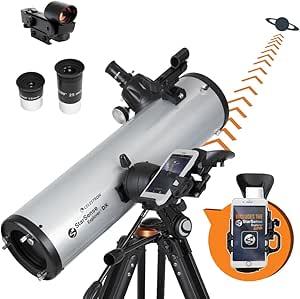 | Best for Beginners and Casual Observers | Telescope Type: Newtonian reflector | Aperture: 130mm | Mount Type: Altazimuth | VIEW ON AMAZON | See Our Full Breakdown |
| Dwarflab Dwarf Mini Smart Telescope – Portable Astronomy Telescope with App Control and Auto GOTO |  | Best Portable Auto-GOTO for Travelers | Mount: Altazimuth and Equatorial | Focal Length: 150 mm | Objective Lens Diameter: 30 mm | VIEW ON AMAZON | See Our Full Breakdown |
| Smart Refractor Telescope with Auto-Focus and Digital Features |  | Best All-in-One Digital Refractor for Versatile Use | Aperture: 80mm | Focal Length: 300mm | Magnification: up to 350X | VIEW ON AMAZON | See Our Full Breakdown |
| Celestron Advanced VX 8” EdgeHD Computerized GEM Telescope |  | Best Overall for Versatile Astrophotography | Optical Design: EdgeHD | Aperture: 8 inches | Mount Type: German equatorial | VIEW ON AMAZON | See Our Full Breakdown |
| SVBONY SV555 APO Astrophotography Refractor Telescope |  | Best for Portable Wide-Field Astrophotography | Lens Type: Petzval triplet | Aperture Range: F4.5 to F22 | Weight: less than previous models | VIEW ON AMAZON | See Our Full Breakdown |
| Celestron Advanced VX 9.25″ Schmidt-Cassegrain EQ Computerized Telescope |  | Best for Bright, Detailed Visual and Imaging Performance | Optical Tube Diameter: 9.25 inches | Aperture: 235mm | Highest Useful Magnification: 555x | VIEW ON AMAZON | See Our Full Breakdown |
| Celestron CGEM II 11″ Schmidt-Cassegrain Telescope with GoTo EQ Mount |  | Best for Large Aperture Deep-Sky Imaging | Aperture: 11 inches | Optical Design: Schmidt-Cassegrain | Magnification: up to 660x | VIEW ON AMAZON | See Our Full Breakdown |
| telescope for astrophotography | Aperture |
|---|---|
| Celestron StarSense Explorer 1 | 254mm |
| Celestron StarSense Explorer L | 114mm |
| DWARFLAB Dwarf 3 Smart Telesco | — |
| Celestron NexStar 8SE Computer | 8 inches |
| ZWO Seestar S30 Pro Smart Tele | — |
| Celestron CGX 11" EdgeHD Compu | 11 inches |
| SVBONY SV503 Telescope for Adu | 102mm |
| Celestron StarSense Explorer D | 130mm |
| Dwarflab Dwarf Mini Smart Tele | — |
| Smart Refractor Telescope with | 80mm |
| Celestron Advanced VX 8” EdgeH | 8 inches |
| SVBONY SV555 APO Astrophotogra | — |
| Celestron Advanced VX 9.25" Sc | 235mm |
| Celestron CGEM II 11" Schmidt- | 11 inches |
More Details on Our Top Picks
Celestron StarSense Explorer 10″ App-Enabled Dobsonian Telescope
This 10-inch Dobsonian stands out for its massive aperture, offering incredibly detailed views of faint deep-sky objects that smaller telescopes like the StarSense Explorer LT 114AZ can’t match. Its integration with the StarSense app simplifies locating objects, making it ideal for enthusiasts aiming to explore beyond planets and the Moon. However, the manual tracking and larger size mean it’s less suited for those seeking portability or automated astrophotography. Compared to the NexStar 8SE, it provides a broader, more detailed view at the expense of some automation. Its simple setup on a stable Dobsonian base makes long observations easier, but users must handle manual adjustments for tracking. This pick makes the most sense for dedicated astrophotographers who prioritize aperture and image quality over convenience.
Pros:- Massive 10-inch aperture for deep-sky detail
- Smartphone integration simplifies object location
- Stable tracking on an ultra-smooth Dobsonian base
- High-reflectivity XLT coatings for bright, sharp images
Cons:- Requires a smartphone for full functionality
- Larger, less portable design complicates transport and quick setups
Best for: Amateur astronomers focusing on deep-sky astrophotography with a preference for large apertures and detailed views
Not ideal for: Casual observers or those needing a portable, automated system for quick setups and astrophotography
- Size:10 inches
- Type:Dobsonian reflector
- Aperture:254mm
- Coatings:XLT high-reflectivity coatings
- Technology:StarSense sky recognition
Our verdict“This telescope is best suited for experienced astrophotographers who want high-detail deep-sky images and can manage its size and manual operation.”
Celestron StarSense Explorer LT 114AZ Newtonian Smartphone Guided Telescope
Compared with the 10-inch Dobsonian, the StarSense Explorer LT 114AZ offers a more approachable size and price point, making it ideal for beginners or casual astronomers. Its 114mm aperture provides clear views of the Moon and planets, with smartphone-guided navigation simplifying object location. The manual altazimuth mount is straightforward but requires adjustments for precise tracking during longer exposures, limiting its astrophotography potential. While it doesn’t match the deep-sky detail of larger scopes like the Celestron CGX 11″ EdgeHD, it offers a solid foundation for learning basic astrophotography and observation. Its lightweight design and included smartphone app make it particularly appealing for newcomers who want to explore the night sky without a hefty investment. However, its manual mount and smaller aperture mean it’s best for casual observing rather than serious astrophotography.
Pros:- Affordable price point for entry-level users
- Easy smartphone-guided sky navigation
- High-quality 114mm aperture for bright, crisp images
- Lightweight and portable for quick setup
Cons:- Manual mount requires adjustments for long exposures
- Limited to beginner and casual observing capabilities
Best for: Beginners or casual astronomers interested in trying astrophotography without a large upfront investment
Not ideal for: Advanced astrophotographers seeking high-detail deep-sky imaging or automated tracking systems
- Aperture:114mm
- Type:Newtonian reflector
- Mount:Manual altazimuth
- Connectivity:Smartphone app
- Warranty:2 years
Our verdict“This scope offers a practical, budget-friendly way for beginners to enjoy astrophotography, though it lacks advanced features for detailed deep-sky imaging.”
DWARFLAB Dwarf 3 Smart Telescope, App-Controlled Astrophotography Camera
The Dwarf 3 shines in portability and versatility, making it a top choice for travelers and outdoor enthusiasts who want a compact device capable of daytime and nighttime imaging. Its dual-lens system and lightweight design set it apart from bulkier scopes like the NexStar 8SE, especially for those valuing convenience and quick setup. The smart auto-tracking and 4K imaging produce professional-quality photos, but limited aperture and focal length mean it’s less suited for capturing faint, distant deep-sky objects. Its compatibility with smartphones and PCs simplifies use, yet the reliance on a single lithium-ion battery can be a downside for extended sessions. This pick is ideal for hobbyists who want a portable, all-in-one device for casual astrophotography and landscape shots, rather than those seeking detailed deep-sky imaging.
Pros:- Extremely lightweight and portable for travel
- Dual lenses enable both daytime and nighttime imaging
- Smart auto-tracking with 4K clarity for professional results
- Easy-to-use interface suitable for all skill levels
Cons:- Limited battery life with only one lithium-ion battery
- Less suitable for capturing faint, distant deep-sky objects
Best for: Travelers and outdoor lovers looking for a lightweight, all-in-one astrophotography camera
Not ideal for: Dedicated astrophotographers aiming for deep-sky imaging or high-magnification planetary photography
- Focus Type:Auto Focus
- Finderscope:Straight-Through
- Compatible Devices:Smartphone, Laptop, Personal Computer
- Number of Batteries:1 Lithium Ion
- Additional Features:4K Tracking, Auto GOTO, EQ Mode
- Objective Lens Diameter:35 millimeters
Our verdict“This compact, versatile device is perfect for outdoor enthusiasts seeking easy, on-the-go astrophotography, but it doesn’t replace larger scopes for detailed deep-sky work.”
Celestron NexStar 8SE Computerized Telescope – Schmidt-Cassegrain
The NexStar 8SE offers a powerful 8-inch Schmidt-Cassegrain system with automated GOTO capabilities, making it a top choice for those who want precise object tracking with minimal effort. It surpasses smaller, manual scopes like the StarSense Explorer LT 114AZ in terms of image detail and ease of locating faint deep-sky objects thanks to its computerized database of over 40,000 objects. Its SkyAlign technology simplifies setup, but initial alignment and weight can be drawbacks for portable use. While it’s not as large as the 10-inch Dobsonian, its automation features make it a more practical choice for astrophotographers who prefer hands-off operation and detailed imaging. The higher price and weight are tradeoffs for advanced functionality, making it better suited to dedicated amateurs rather than casual stargazers.
Pros:- Large 8-inch aperture for detailed lunar and planetary imaging
- Automated GoTo system simplifies object locating
- Extensive object database for deep-sky exploration
- Compact and portable for its class
Cons:- Requires initial setup and alignment
- Heavier and more expensive than smaller, manual scopes
Best for: Intermediate to advanced astrophotographers seeking automated, high-precision deep-sky imaging
Not ideal for: Beginners or those prioritizing portability over detailed, automated imaging capabilities
- Aperture:8 inches
- Optical Design:Schmidt-Cassegrain
- Mount Type:Computerized GoTo
- Hand Control:NexStar+
- Object Database:40,000+ objects
- Warranty:2 years
Our verdict“This telescope is ideal for dedicated astrophotographers who want a balanced combination of automation and high-quality imaging in a portable package.”
ZWO Seestar S30 Pro Smart Telescope, App-Controlled Astrophotography
The Seestar S30 Pro emphasizes portability and ease, making it an excellent choice for city dwellers and beginners who want to dive into astrophotography without heavy gear. Its high-resolution 4K imaging and automatic GOTO system enable capturing detailed celestial images in urban environments where light pollution often hampers traditional telescopes. While its specifications on aperture size and focal length are less detailed, its AI-enhanced imaging and built-in light pollution filters compensate for less light-gathering power. Compared with the larger, more traditional scopes like the Celestron NexStar 8SE, the Seestar offers a simplified, app-controlled experience suited for quick setup and casual astrophotography. It’s less appropriate for serious deep-sky work but excels in urban settings and for those new to astrophotography who value convenience.
Pros:- Compact, lightweight design for outdoor portability
- High-resolution 4K imaging with AI enhancements
- Automatic GOTO simplifies object targeting
- Built-in filters optimize imaging in light-polluted environments
Cons:- Limited details on aperture and focal length
- Dependent on smartphone app, which may involve a learning curve
Best for: Beginners and urban astronomers seeking portable, easy-to-use astrophotography in light-polluted areas
Not ideal for: Experienced astrophotographers aiming for detailed, deep-sky astrophotography with larger apertures
- Weight:3.64 lbs
- Type:Smart Telescope
- Camera Resolution:4K
- Features:Automatic GOTO, AI Smart Imaging
- Additional:Built-in light pollution filters, Anti-dew protection
Our verdict“This device offers an accessible, portable solution for urban astrophotography beginners but isn’t suited for detailed deep-sky imaging or advanced users.”
Celestron CGX 11″ EdgeHD Computerized German Equatorial Telescope
The Celestron CGX 11″ EdgeHD excels in delivering sharp, flat-field images thanks to its advanced Schmidt-Cassegrain optics, making it the ideal choice for those prioritizing image quality on a large aperture platform. Compared with the SVBONY SV503, which offers excellent optics at a more affordable price, this model compensates with a sturdier mount and a vast celestial database for precise tracking and efficient object acquisition. Its 28-pound weight and complex setup might deter casual users, but for dedicated astrophotographers seeking high-resolution captures, the tradeoff in portability and complexity pays off. The robust mount supports a 55 lbs load, ensuring stability during long exposures, while the extensive database simplifies locating faint deep-sky objects. However, its weight and learning curve could challenge beginners or those with limited setup space.
Pros:- Outstanding flat-field optics for crisp astrophotography images
- Heavy-duty mount with high load capacity ensures stable long exposures
- Extensive celestial database and straightforward alignment process
Cons:- Heavy and requires a sturdy, well-supported setup
- Steep learning curve for users new to advanced telescopes
Best for: Advanced amateur astronomers who want high-quality images and are comfortable with complex setups
Not ideal for: Beginners or casual stargazers due to its weight, complexity, and learning curve
- Optical System:EdgeHD Schmidt-Cassegrain
- Aperture:11 inches
- Weight:28 lbs
- Mount Load Capacity:55 lbs
- Tripod:2-inch steel
- Tracking Modes:Sidereal, Solar, Lunar
- Database:Over 40,000 objects
Our verdict“This telescope makes the most sense for dedicated astrophotographers willing to handle its weight and complexity for top-tier image quality.”
SVBONY SV503 Telescope for Adults, 102mm Aperture, F7 ED
The SVBONY SV503 stands out for its combination of high-quality FMC coatings and ED glass, which minimize chromatic aberration and produce bright, high-contrast images suitable for both astrophotography and visual use. Compared to the Celestron StarSense Explorer DX 130AZ, which offers beginner-friendly setup, the SV503 targets users seeking sharper images with more control, thanks to its dual-speed focuser and 360° field rotator. Its 102mm aperture and F7 focal ratio strike a good balance for capturing detailed planetary and lunar images, though it lacks the larger aperture and tracking sophistication of premium mounts. The retractable hood helps block stray light and dew, but the weight and assembly needs may challenge some users. This model offers a fantastic middle ground for enthusiasts who want quality without the expense of top-tier mounts.
Pros:- High-contrast, sharp images thanks to FMC coating and ED glass
- Includes dual-speed focuser and 360° field rotator for precise imaging
- Retractable hood for stray light and dew prevention
Cons:- Relatively heavy and may require a sturdy mount for best results
- Assembly can be time-consuming for new users
Best for: Intermediate astrophotographers wanting a versatile, high-quality optical system with good control features
Not ideal for: Beginners or those seeking a portable, quick-setup scope for casual viewing, due to assembly and weight
- Aperture:102mm
- Focal Length:714mm
- Focal Ratio:F7
- Focus Travel:90mm
- Coating:FMC
- Glass Type:S-FPL51 ED
- Focus Mechanism:Dual-speed (1:10)
Our verdict“This telescope provides excellent optical control for enthusiasts looking for sharp images and manageable complexity.”
Celestron StarSense Explorer DX 130AZ Smartphone Guided Newtonian Telescope
The StarSense Explorer DX 130AZ simplifies celestial navigation with its smartphone app and sky recognition technology, making it accessible for new stargazers. Its 130mm Newtonian reflector provides bright, detailed views of the Moon, planets, and some deep-sky objects, comparable in brightness to more advanced scopes like the Celestron NexStar 8SE, but with easier setup. The altazimuth mount and included full-height tripod support straightforward manual tracking, ideal for casual users or families. However, the reliance on a smartphone app means full functionality depends on compatibility, and manual tracking can be less precise for astrophotography or extended imaging sessions. If you want a simple, engaging way to explore the night sky, this scope delivers.
Pros:- Smartphone app with sky recognition simplifies object location
- Bright views of Moon, planets, and some deep-sky objects
- Full-height tripod and multiple eyepieces for versatile viewing
Cons:- Limited tracking precision for astrophotography
- Dependent on a compatible smartphone for full operation
Best for: Beginners or families interested in easy, guided stargazing with smartphone integration
Not ideal for: Serious astrophotographers or users seeking precise tracking for long exposures, because of its basic mount
- Telescope Type:Newtonian reflector
- Aperture:130mm
- Mount Type:Altazimuth
- Included Eyepieces:10mm and 25mm
- Finderscope:Red dot
- Compatibility:Android 12+, iOS 18+
Our verdict“This scope offers a straightforward, tech-assisted experience perfect for beginners eager to explore the sky with minimal fuss.”
Dwarflab Dwarf Mini Smart Telescope – Portable Astronomy Telescope with App Control and Auto GOTO
The Dwarflab Dwarf Mini combines ultra-light portability with advanced features like auto GOTO and app control, making it an attractive choice for travelers and outdoor enthusiasts. Weighing just 1.9 lbs, it’s significantly more portable than the Celestron CGX 11″, yet still offers long exposure support and cloud processing capabilities. Its 150mm focal length provides decent magnification for planetary and lunar observations, though it’s limited for deep-sky imaging compared to larger scopes. The dual mount options—altazimuth and equatorial—add flexibility, but the small objective lens restricts its effectiveness for faint objects. Its compact size and auto GOTO make it ideal for quick setups in remote locations, but it’s best suited for casual use rather than detailed astrophotography.
Pros:- Extremely lightweight and portable for travel
- App-controlled with auto GOTO and 360° pivot for easy object acquisition
- Supports long exposure imaging and cloud processing
Cons:- Limited focal length and aperture reduce deep-sky imaging capability
- Battery life and long-term use details are unspecified
Best for: Travelers or outdoor lovers seeking a lightweight, auto-GOTO scope for quick star observations
Not ideal for: Serious deep-sky astrophotographers who require large apertures and long exposures, due to its small lens and limited focal length
- Mount:Altazimuth and Equatorial
- Focal Length:150 mm
- Objective Lens Diameter:30 mm
- Field Of View:2.45 degrees
- Power Source:Battery
- Item Dimensions:2.39″D x 3.95″W x 7.23″H
Our verdict“This mini telescope is perfect for those wanting quick, automated star tracking during outdoor adventures without the bulk of larger scopes.”
Smart Refractor Telescope with Auto-Focus and Digital Features
The Smart Refractor with Auto-Focus offers a compact, digital approach to astronomy, blending high-resolution images with digital photo and video capabilities. Its 80mm aperture and 300mm focal length produce bright, detailed images suitable for moon, planets, and even terrestrial targets. Unlike traditional manual scopes, this model’s dual-screen display and external storage support make it appealing to tech-savvy users who want instant image capture and sharing. While setup can be more involved, its versatility extends beyond astronomy to birdwatching and target shooting. Its 6-hour battery life and digital controls make it ideal for extended outings, but its weight and complexity may challenge beginners looking for a simpler experience.
Pros:- Bright, high-resolution images with digital photo/video capture
- Dual-screen display for real-time viewing and recording
- Supports external storage for long-term data collection
Cons:- Complex setup for new users
- Relatively heavy for portable use during outdoor excursions
Best for: Enthusiasts seeking a multi-function digital scope for astronomy and outdoor activities
Not ideal for: Beginners or users preferring purely optical scopes without digital features, due to its setup complexity
- Aperture:80mm
- Focal Length:300mm
- Magnification:up to 350X
- Sensor:Starlight-grade
- Display:Dual-screen
- Battery Capacity:4500mAh
- Battery Life:up to 6 hours
Our verdict“This digital refractor suits tech-oriented users who want versatile imaging and sharing capabilities during extended outdoor sessions.”
Celestron Advanced VX 8” EdgeHD Computerized GEM Telescope
This telescope stands out for its high-quality EdgeHD optics that deliver flat, coma-free images, making it an excellent choice for astrophotographers seeking sharp, detailed results. Compared to the Celestron Advanced VX 9.25″, it offers slightly smaller aperture but benefits from more portable design and versatile focal ratios, including fast options like f/2 with Hyperstar. The complex setup might challenge beginners, and the price could be steep for those just starting out, but its advanced features like PPEC and autoguider port justify the investment for serious imaging. It strikes a balance between performance and portability, making it suitable for those who want high-quality imaging without lugging around a bulky setup.
Pros:- High-quality EdgeHD optics for flat, coma-free images
- Multiple focal ratios for versatile imaging and visual use
- Compact and portable for easy transport and field use
Cons:- Setup can be complex and time-consuming for newcomers
- Higher cost compared to entry-level telescopes
- Requires additional accessories for full functionality
Best for: Intermediate to advanced amateur astrophotographers who want versatile imaging capabilities in a portable package
Not ideal for: Beginners who prefer simple, plug-and-play setups or those with limited space for equipment
- Optical Design:EdgeHD
- Aperture:8 inches
- Mount Type:German equatorial
- Payload Capacity:Under 30 lbs
- Focal Ratios:f/10, f/7 (with reducer), f/2 (Fastar/Hyperstar)
- Features:PPEC, autoguider port, All-Star Polar Alignment, CPWI software
Our verdict“This pick is ideal for dedicated astrophotographers who need versatile, high-quality imaging in a portable form.”
SVBONY SV555 APO Astrophotography Refractor Telescope
The SVBONY SV555 APO stands out for its Petzval triplet lens, which provides exceptional image clarity and flatness, making it ideal for capturing expansive deep-sky objects. Unlike the larger aperture of the Celestron CGEM II 11″, it offers a lightweight, travel-friendly profile that appeals to astrophotographers on the go. The adjustable aperture from F4.5 to F22 offers flexibility under different sky conditions, while its full-frame compatibility ensures broad field coverage. The setup can be intricate for newcomers, especially with the focus system and EAF integration, but the precision optics justify its price for serious wide-field imaging. This model excels for those who prioritize portability and wide-field views with high optical quality.
Pros:- Petzval triplet lens for flat, detailed images
- Adjustable aperture for versatile conditions
- Full-frame sensor compatibility for wide-field imaging
- Lightweight and portable for travel
Cons:- Setup can be complex for beginners
- Weight details are not explicitly specified
- Requires compatible EAF for autofocus control
Best for: Travelers and astrophotographers seeking a lightweight, high-quality APO for wide-field deep-sky imaging
Not ideal for: Beginners or those needing a larger aperture for faint object capture without prior experience with complex setups
- Lens Type:Petzval triplet
- Aperture Range:F4.5 to F22
- Weight:less than previous models
- Compatibility:Full-frame sensors, DSLR, mirrorless
- Focus System:Precision focus with 2.67mm-3.22mm travel
- Included Accessories:EAF adapter, 2″ filter holder, M72 thread
Our verdict“This telescope best suits advanced users who want portable, high-quality wide-field astrophotography with flexible aperture control.”
Celestron Advanced VX 9.25″ Schmidt-Cassegrain EQ Computerized Telescope
This 9.25-inch Schmidt-Cassegrain offers a robust mix of brightness and detail, making it well-suited for both visual observation and astrophotography. Its larger aperture provides brighter images than smaller models like the SVBONY SV555 APO, with the added benefit of a computerized mount that tracks objects accurately. The setup may feel complex for beginners and its weight demands a sturdy setup, but the result is a reliable platform for capturing deep-sky objects or planetary details. Compared to smaller scopes, this model emphasizes image brightness and tracking stability, which are key for serious imaging sessions, though it may be less portable for fieldwork.
Pros:- Large 9.25-inch aperture for bright, detailed images
- Advanced computerized mount with accurate tracking and GoTo
- Suitable for both visual and astroimaging use
Cons:- Heavy and requires a sturdy, stable setup
- Complex assembly process for newcomers
- Higher price point compared to entry-level scopes
Best for: Intermediate to advanced astrophotographers seeking a balance of brightness and tracking accuracy for deep-sky imaging
Not ideal for: Beginners or travel-focused users who need lightweight, easy-to-set-up gear
- Optical Tube Diameter:9.25 inches
- Aperture:235mm
- Highest Useful Magnification:555x
- Mount Type:German equatorial, computerized
- Included Accessories:25mm Eyepiece, 90° diagonal, 6×30 finderscope
- Warranty:2 years
Our verdict“This telescope is a solid choice for dedicated amateurs wanting a balance of aperture, tracking, and image quality for serious astrophotography.”
Celestron CGEM II 11″ Schmidt-Cassegrain Telescope with GoTo EQ Mount
The Celestron CGEM II 11″ Schmidt-Cassegrain excels in providing bright, detailed images thanks to its massive 11-inch aperture. Its extensive object database and stable GoTo mount make it a favorite for deep-sky astrophotography, especially when compared to smaller scopes like the Celestron Advanced VX 8” EdgeHD. The setup is heavy and requires a sturdy tripod, which might be daunting for newcomers, but the high-quality StarBright XLT coatings and vibration-resistant mount support long, detailed imaging sessions. This model prioritizes aperture and advanced tracking, often at the expense of portability, making it suitable for dedicated observatories or serious hobbyists who have space and experience.
Pros:- Largest aperture among the lineup for extremely bright images
- Extensive object database with advanced GoTo capabilities
- Sturdy, vibration-free mount enhances image stability
Cons:- Heavy and difficult to transport
- Setup complexity may challenge beginners
- Higher purchase price reflects its advanced features
Best for: Experienced astrophotographers with space and a desire for high-resolution deep-sky images
Not ideal for: Beginners or those needing portable, lightweight setups for field use
- Aperture:11 inches
- Optical Design:Schmidt-Cassegrain
- Magnification:up to 660x
- Mount Type:Equatorial GoTo
- Tripod Material:Steel
- Object Database:40,000+ objects
Our verdict“This telescope is best suited for serious hobbyists aiming for high-resolution deep-sky imaging with ample space and experience.”

How We Picked
These telescopes were selected based on a combination of performance, usability, build quality, and value. Priority was given to models with proven astrophotography capabilities, including stable mounts, sufficient aperture, and compatibility with imaging accessories. We also considered versatility—whether the telescope could serve both visual observation and imaging—and ease of setup, especially for newcomers. Cost was a factor, but only when it aligned with delivering meaningful improvements in image quality or user experience. The ranking reflects a balance between beginner-friendly options and professional-grade systems, ensuring a range of needs and budgets are addressed.Factors to Consider When Choosing Telescope For Astrophotography
Choosing the right telescope for astrophotography involves understanding several key factors that impact your imaging results and overall experience. While initial costs are important, focusing on features like aperture size, mount stability, and camera compatibility will lead to better long-term satisfaction. Additionally, consider your level of expertise; some models are more user-friendly, while others demand advanced knowledge. This guide highlights critical factors to weigh before making your decision, helping you avoid common pitfalls and select a telescope that matches your goals and budget.Aperture Size and Optical Quality
The aperture determines how much light your telescope can gather, directly affecting image brightness and clarity. Larger apertures capture more detail, crucial for deep-sky astrophotography. However, bigger telescopes are often heavier and less portable. Optical quality, including lens or mirror coatings, also influences sharpness and contrast. Investing in a telescope with high-quality optics ensures clearer images, especially when imaging faint objects like distant galaxies or nebulae.
Mount Type and Stability
A stable, precise mount is essential for capturing sharp astrophotos. Equatorial mounts are preferred for long exposures because they compensate for Earth’s rotation. Computerized or GoTo mounts simplify object tracking, reducing star trails and blurring. Cheaper mounts may lack the stability or accuracy needed for high-quality astrophotography, leading to frustration and subpar images. Balancing mount capability with your target objects and imaging plans is key to successful results.
Camera Compatibility and Autofocus
Your choice of telescope should align with your camera system, whether DSLR, specialized astrophotography cameras, or smartphone adapters. Compatibility ensures straightforward setup and reduces troubleshooting. Autofocus features can streamline focusing, particularly for beginners, but may require additional accessories or software. Be aware that some telescopes are optimized for astrophotography, offering features like cooling fans and precise focus mechanisms that improve image quality.
Portability and Ease of Use
If you plan to travel or set up in different locations, portability becomes a significant factor. Lightweight, compact models with quick setup features save time and effort. Conversely, larger, more complex systems may deliver better images but demand more technical expertise and physical effort. Consider your experience level and how much time you’re willing to dedicate to assembly and calibration when choosing a model.
Budget and Long-Term Value
While it’s tempting to opt for the most affordable option, investing in a slightly higher-priced telescope often yields better optics, more stable mounts, and future upgrade paths. Low-cost models may work for casual use or beginners but can limit your imaging quality and expandability. Assess your long-term goals—if you aim to pursue serious astrophotography, spending more initially could save money and frustration later on.
Frequently Asked Questions
Can I use a beginner telescope for astrophotography?
Many beginner telescopes can be used for basic astrophotography, especially if they have stable mounts and decent optics. However, they might lack features like auto-guiding or precise focus mechanisms, which are important for longer exposures. For casual or short-exposure imaging, entry-level models can work well, but upgrading to a dedicated astrophotography telescope or mount will improve results as your skills develop.
What is the best aperture size for astrophotography?
The ideal aperture depends on your targets and mobility needs. Generally, an aperture of 8-10 inches provides a good balance between light-gathering power and manageable size. Larger apertures capture more detail but are heavier, more expensive, and require sturdier mounts. For planetary imaging, smaller apertures with high-quality optics often suffice, while deep-sky imaging benefits from larger apertures to reveal faint objects.
Are computerized mounts necessary for astrophotography?
While not strictly necessary, computerized mounts significantly simplify the process of locating and tracking celestial objects. They reduce setup time and improve tracking accuracy during long exposures, resulting in sharper images. Manual mounts can work if you’re skilled at star hopping and manual calibration, but for most users aiming for high-quality astrophotos, a computerized mount offers clear advantages and reduces frustration.
How much should I expect to spend on a good astrophotography telescope?
Entry-level systems suitable for beginners often start around $500 to $1,000, offering decent optics and mounts for casual imaging. Mid-range setups, with better optics and more stable mounts, typically range from $1,500 to $3,000. Professional-grade telescopes with large apertures and advanced features can exceed $5,000, but they are best suited for experienced astrophotographers. Consider your goals and budget carefully to avoid overspending on features you won’t use right away.
What accessories are essential for astrophotography with a telescope?
Key accessories include a sturdy equatorial mount or tracking system, a quality camera compatible with your telescope, and adapters for attaching your camera securely. A reliable focusing device, such as a Bahtinov mask or motorized focuser, helps achieve sharp images. Additionally, light pollution filters and guiding systems can greatly improve image quality, especially for deep-sky objects. Investing in these accessories enhances your ability to capture clear, detailed astrophotos.
Conclusion
For most newcomers or casual hobbyists, the Celestron NexStar 8SE offers a reliable all-around performance with user-friendly features. Those seeking the best value can consider models like the SVBONY SV503 for decent imaging at a lower cost. If your goal is high-end astrophotography, the Celestron CGX 11″ EdgeHD delivers professional results but demands more experience and investment. Beginners will benefit from simple, portable systems, while advanced users should prioritize stability and optical quality. Carefully matching your goals and experience level will help you select the ideal telescope for your astrophotography journey.
College move-in / dorm season Picks
dorm essentials
As an affiliate, we earn on qualifying purchases.