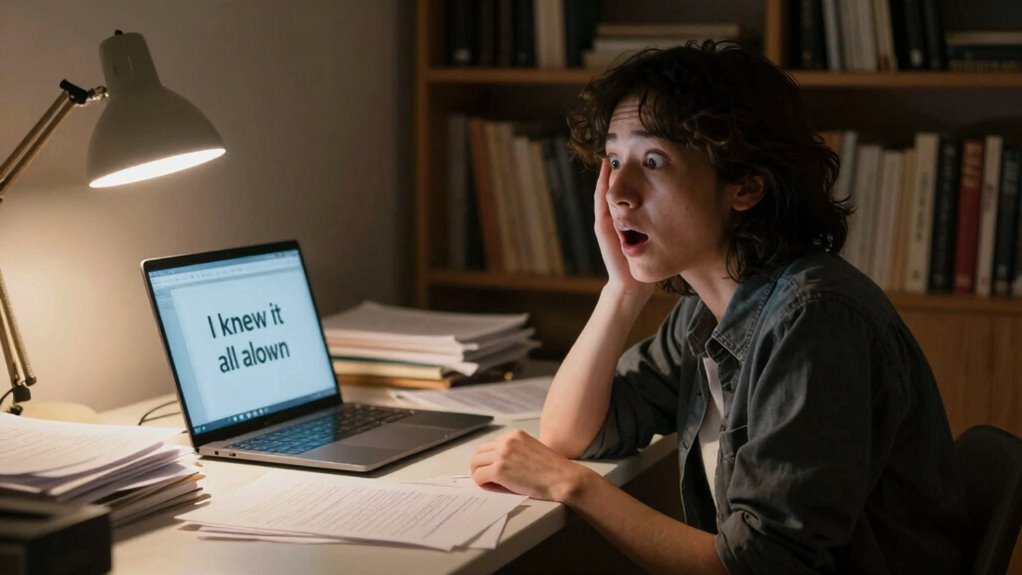

The “I Knew It All Along” bias tricks you into believing you predicted outcomes accurately, but it’s really a mental shortcut that distorts your memory and inflates your confidence. When you look back, your brain reshapes events to seem inevitable, making you think you foresaw everything. This bias boosts overconfidence and hides how uncertain you truly were. Keep exploring, and you’ll discover how recognizing this bias can improve your decision-making and self-awareness.
Key Takeaways
- The bias causes us to believe outcomes were predictable after they happen, skewing our perception of foresight.
- Memory reconstruction inflates certainty, making past predictions seem more accurate than they truly were.
- Awareness of hindsight bias helps prevent overconfidence and false assumptions about decision-making skills.
- Recognizing how past events are reshaped clarifies that certainty often results from memory, not actual knowledge.
- Reflecting on initial uncertainty can reduce the tendency to falsely believe “I knew it all along.”

Have you ever looked back at a situation and thought, “I knew it all along”? That feeling is familiar for many, yet it’s a sneaky bias that distorts your perception of your own judgment. This phenomenon is often called hindsight judgment, and it makes you believe, in retrospect, that the outcome was obvious all along. But the truth is, your memory tends to reshape events to fit a narrative where the outcome seems inevitable. When you fall into this trap, you’re succumbing to prediction bias — the tendency to overestimate how well you predicted an event after it’s already happened. It’s as if your brain rewrites history, convincing you that you had it all figured out, even if at the time, you were uncertain or confused. Recognizing this cognitive distortion can help you develop a more accurate perspective on your decision-making process. Understanding how your memory reconstructs past events can shed light on why you might feel more confident about your predictions than you should be. This memory bias often leads to an inflated sense of your own foresight, which can distort your perception of past events.
This bias is dangerous because it distorts your understanding of your decision-making process. It might seem harmless to think, “I knew that was going to happen,” but it can lead you to overconfidence. When you believe you predicted an outcome perfectly, you might start trusting your intuition too much, ignoring the complex factors that actually influenced the event. It’s a form of mental shortcut that simplifies reality, but it’s also a trap that can prevent you from learning. You might dismiss the unpredictable nature of much of life or overlook the genuine uncertainty you faced at the moment. Recognizing how past predictions are reconstructed, rather than truly predicted, is crucial in understanding this prediction bias. Additionally, understanding the role of hindsight judgment can help you see that this bias isn’t about being especially insightful; it’s about how your mind reconstructs the past to feel more certain than it was. It’s natural to want to feel confident about your decisions, but recognizing these biases makes you better at evaluating your real abilities. When you reflect on past events, try to remember how uncertain you were at the time. Was there really enough information to confidently predict the outcome? Or are you just reconstructing a narrative that makes your decisions seem smarter than they actually were?

The Next Right Thing Guided Journal: A Decision-Making Companion
As an affiliate, we earn on qualifying purchases.
As an affiliate, we earn on qualifying purchases.
Frequently Asked Questions
How Does the Bias Affect Decision-Making in Everyday Life?
This bias influences your decision-making by making you rely on hindsight reflection, which can lead you to believe you predicted outcomes all along. As a result, you might feel decision regret more intensely, thinking you should have known better. It clouds your judgment, making you overconfident in past choices and potentially ignoring new information. Recognizing this bias helps you make more objective decisions instead of being swayed by past outcomes.
Can the Bias Be Reduced Through Specific Strategies?
Yes, you can reduce this bias by being aware of heuristic simplification and emotional reasoning. When making decisions, pause and question whether your intuition is clouded by emotions or oversimplified judgments. Take time to analyze evidence objectively, rather than relying solely on gut feelings. Practicing mindfulness and reflective thinking helps you recognize when these biases influence your choices, leading to more accurate and balanced decisions.
Does This Bias Influence How We Remember Past Events?
Imagine your mind as a foggy mirror, distorting reflections of past events. The “I Knew It All Along” bias influences how you remember, creating a hindsight effect that makes outcomes seem obvious in retrospect. This memory distortion convinces you that you predicted events all along, skewing your perception of past accuracy. As a result, your memories become clearer through this bias, even though they might be less reliable.
Is the Bias More Common in Certain Age Groups?
You’re more likely to notice the “I Knew It All Along” bias in older adults, as age-related perception influences how they interpret past events. Generational differences also play a role, with younger people sometimes less prone to this bias because they may process information differently. Overall, this bias can vary across age groups, but it tends to become more pronounced with age due to changes in memory and perception.
How Does the Bias Impact Learning From Mistakes?
This bias impacts your learning from mistakes by encouraging retrospective thinking that distorts your judgment. When you believe you knew the outcome all along, you may dismiss the lessons learned, thinking the mistake was obvious or inevitable. This judgment distortion prevents genuine reflection, making it harder to recognize what you could do differently next time. As a result, you miss opportunities to grow and improve, reinforcing the bias over time.

Cognitive Bias Awareness: Overcoming Mental Blocks In Decision Making
As an affiliate, we earn on qualifying purchases.
As an affiliate, we earn on qualifying purchases.
Conclusion
So, next time you find yourself thinking, “I knew it all along,” pause. Remember how that feeling often blinds you to surprises, much like expecting a plot twist but missing it entirely. It’s a reminder that certainty can be a barrier to understanding. Embrace the unknown with curiosity, just as you’d savor an unexpected gift. After all, life’s surprises make the story richer—don’t let the bias steal that joy.

The Self-Reflection Workbook: Evidence-Based Approaches for Personal Growth and Development
As an affiliate, we earn on qualifying purchases.
As an affiliate, we earn on qualifying purchases.

Mindfulness & Guided Sleep Meditation
Meditation to improve focus
As an affiliate, we earn on qualifying purchases.
As an affiliate, we earn on qualifying purchases.