
TL;DR

Prime made for students and young adults
- Fast, free delivery for dorm and study essentials
- Prime Video and Amazon Music included
- Member-only deals
Anthropic’s $65 billion Series H at a $965 billion valuation shows the company is investing heavily in compute infrastructure. This shift signals that the real bottleneck for AI growth isn’t just funding but access to massive computing power and memory. The future of AI hinges on who controls the hardware, not just the models.
Forget the headline: the real story isn’t just about Anthropic’s eye-watering $965 billion valuation. It’s about what that number actually signifies. Behind the scenes, this isn’t a typical VC funding round. It’s a colossal push to lock down the compute and infrastructure needed to power the next generation of AI models.
In this post, we’ll break down what makes this funding so different, why it signals a shift from model innovation to hardware dominance, and what it means for the future of AI development. Buckle up — the game is changing faster than you think.
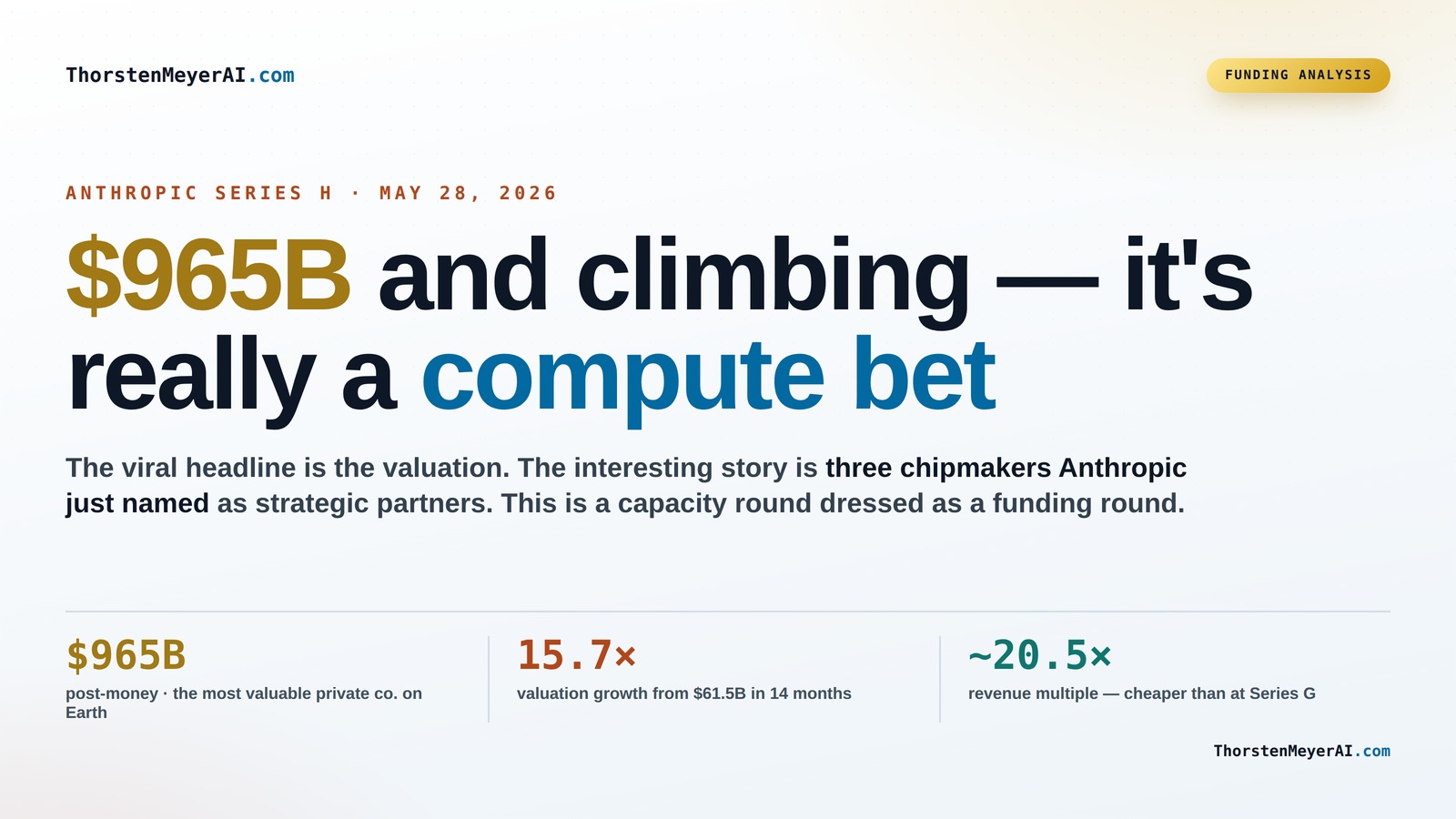
$965B and climbing — it’s really a compute bet
The viral headline is the valuation. The interesting story is in the press release’s middle paragraphs — and in three chipmakers Anthropic just named as strategic partners. This is a capacity round dressed as a funding round.
The numbers nobody can quite parse in sequence
Read together they describe a trajectory with no precedent in enterprise software. Read individually, each looks like a typo.
From $61.5B to $965B in fourteen months
Salesforce took roughly two decades to reach revenue numbers Anthropic just blew past. The sequence below is the part most coverage skips — it’s not the size, it’s the shape.
Anthropic’s valuation ladder · Mar 2025 → May 2026
Five rounds, fourteen months. Bar height is the valuation; the climb itself is the story. Tap any milestone for context.
The multiple actually got cheaper
Bubbles look like multiples expanding while revenue lags. Anthropic’s pattern is the inverse — the valuation tripled, but revenue grew faster, and the multiple compressed.
Revenue-to-valuation multiple · Series G → Series H
Same company, three months apart. The denominator (revenue) is outrunning the numerator (valuation) — exactly the opposite of what a bubble narrative predicts.
10+ gigawatts and three chipmakers
When you name Micron, Samsung & SK hynix alongside your equity backers, you’re saying the binding constraint isn’t demand or model quality — it’s the physical supply of memory chips. The Series H is a capacity round.
Compute commitments backing Anthropic’s capacity bet
$200B+ in announced compute spend across multi-year contracts. The $65B Series H raise has to be read against that bill, not against operating losses.
A genuinely durable bet — or a structural exposure?
Both readings can be true at once. The answer arrives over the next 18–24 months as the gigawatts come online and either fill with paying demand or don’t.
Revenue growth has no precedent in B2B software ($1B → $47B in 17 months). The multiple is compressing, not expanding. Claude is the only frontier model on all 3 major clouds. Enterprise AI spend share went from ~10% to >65% in a year. Compute commitments are tied to specific contracts with capacity dates.
20× revenue is not cheap by any historical software-investing standard. Revenue is reported gross of cloud-reseller pass-throughs, which inflates the top line. Profitability is 2 years out. Amodei’s own warning: a 12-month delay in AI progress “would make him bankrupt” — the compute commitments are a structural exposure to demand persistence.
The valuation race — and the IPO context
Anthropic shipped Opus 4.8 the same morning as Series H — not a coincidence. One week after OpenAI filed confidentially for IPO. The late-2026 frame is set: two frontier AI companies racing to public markets, each pitching durability.
Key Takeaways
- Anthropic’s $965 billion valuation signals a shift from model innovation to infrastructure dominance.
- The $65 billion raise is primarily a capacity round, securing hardware, memory, and data-center investments.
- Rapid revenue growth (over $47 billion run-rate) is fueling a need for massive compute capacity, not just more models.
- Strategic partnerships with hyperscalers and chipmakers are central to controlling AI’s hardware future.
- This move suggests AI’s next bottleneck is access to compute, not just data or algorithms.
AI compute infrastructure hardware
As an affiliate, we earn on qualifying purchases.
As an affiliate, we earn on qualifying purchases.
Why this isn’t just a valuation — it’s a capacity race
Anthropic’s $65 billion raise isn’t about just valuing the company higher. It’s about securing the infrastructure backbone for AI’s explosive growth. Think of it as a giant infrastructure investment, like building a highway network for AI models to travel on.
They named chipmakers Micron, Samsung, and SK hynix as key partners, along with commitments for over 10 gigawatts of compute. That’s enough to run thousands of large models simultaneously — a game changer for deployment and training.
Imagine trying to build a skyscraper without enough steel. That’s what AI companies face without enough compute capacity. This round aims to solve that bottleneck — a clear sign that the future of AI depends on hardware, not just algorithms.
Why does this matter? Because in AI, hardware limitations directly impact speed, scale, and innovation. If you don’t have enough compute, your models can’t be trained or deployed effectively, stalling progress. This shift indicates that the industry is recognizing hardware as the new bottleneck, and control over it could determine who leads in AI innovation.

high performance GPU for AI training
As an affiliate, we earn on qualifying purchases.
As an affiliate, we earn on qualifying purchases.
The size and speed of revenue growth — what it really means
Anthropic’s revenue shot from about $9 billion at the end of 2025 to over $47 billion this month. That’s a 5.4× leap in just four months. To put it simply: demand for AI is exploding, and revenue is racing ahead of infrastructure supply.
This rapid growth isn’t just a sign of market appetite. It’s a signal that the company needs a massive boost in hardware capacity to keep up. Without enough compute, growth stalls — so they’re investing now to avoid that bottleneck later.
For example, a single large AI model training run can consume millions of dollars’ worth of GPU hours. As models grow more complex, the hardware cost skyrockets. This means that the ability to train and deploy models at scale hinges on access to vast, reliable compute resources. The tradeoff is clear: without sufficient infrastructure, the pace of innovation and revenue growth could slow significantly, potentially ceding ground to competitors with better hardware access.

As an affiliate, we earn on qualifying purchases.
How hyperscaler partnerships reshape AI’s future
Anthropic’s strategic partners include Amazon, Microsoft, and Nvidia. These aren’t just customers — they’re co-investors in the hardware future. Amazon’s $5 billion commitment is a clear sign that cloud giants see AI compute as a long-term asset.
Think of these partnerships as a three-way tug-of-war for control over AI infrastructure. Each chipmaker and cloud provider wants a piece of the pie, because whoever controls the hardware controls the AI future.
For instance, Amazon’s investment isn’t just about hosting models; it’s about owning the supply chain for chips and servers. That means more control over costs, performance, and the ability to scale faster than competitors. These partnerships could give these giants a strategic advantage, enabling them to deploy AI services more efficiently and at a larger scale, potentially shaping industry standards and pricing models for years to come.

As an affiliate, we earn on qualifying purchases.
Memory and storage suppliers are just as crucial as GPUs
When you think about AI compute, GPUs often steal the spotlight. But the real bottleneck is memory and storage. Companies like Micron and Samsung are supplying the high-speed RAM and storage that keep these massive models running smoothly.
Imagine a chef trying to cook a gourmet meal with a tiny fridge. No matter how good the recipe, if the ingredients aren’t there, it stalls. That’s what memory and storage do for AI — they’re the ingredients that keep everything flowing.
Anthropic’s focus on memory chip partnerships signals they’re investing in the entire hardware ecosystem, not just GPUs. This holistic approach is what will allow faster, cheaper, and more efficient AI training and inference. The implications are significant: as models grow larger and more complex, the demand for high-capacity, high-speed memory becomes critical. Companies that secure this supply chain will have a competitive edge, enabling them to train bigger models faster and reduce latency during inference, which is vital for real-time applications.

What a nearly $1 trillion valuation really says about AI’s future
A $965 billion valuation might seem like just a number, but it reflects a fundamental shift. Investors now see AI as a hardware-driven industry, where control over compute capacity is the real prize.
Compared to OpenAI’s earlier valuation of around $852 billion, Anthropic’s private valuation is even larger — and it’s growing faster. This signals that the race isn’t just about models or data; it’s about who owns the hardware supply chain, the critical infrastructure that powers all AI advancements.
Think of it as a real estate bubble, but for hardware: the land is the infrastructure, and the players who control it will shape AI’s trajectory for decades. This valuation indicates that future AI breakthroughs will likely depend less on novel algorithms and more on who can supply and optimize the hardware ecosystem at scale, which could lead to a concentration of power among a few dominant players.

The revenue vs. infrastructure spending gap — what’s really happening
Anthropic’s revenue is skyrocketing, but so is their infrastructure spending. The company’s investing billions into chips, data centers, and memory to keep pace with demand.
This creates a paradox: rapid revenue growth and huge capex, which might seem like a drain but is actually a strategic move. It’s about future-proofing their ability to deploy models at scale without bottlenecks.
Think of it as a farmer planting seeds in a field where water and fertilizer are limited. Investing in infrastructure now ensures the crop will grow bigger and faster later. The tradeoff is clear: by front-loading these investments, Anthropic aims to avoid bottlenecks that could slow down growth and innovation, but it also means significant capital is tied up upfront, which could strain short-term financials if not managed carefully. The long-term payoff, however, is a more resilient and scalable AI ecosystem that can support the next wave of breakthroughs.

How this funding approach differs from OpenAI’s strategy
OpenAI raised money primarily to fund model development and commercial deployment. Anthropic’s recent round signals a different approach: raising capital to secure hardware capacity.
While OpenAI focuses on building bigger models, Anthropic is betting on owning the hardware pipeline, including chips and memory. It’s a shift from *what* they build to *how* they build it, emphasizing infrastructure as the foundation for scaling AI capabilities. This strategic pivot could determine industry leadership, as controlling hardware supply chains offers not just cost advantages but also greater resilience against supply chain disruptions and hardware shortages. It also positions Anthropic to potentially dictate hardware standards and prices in the future, shaping the entire AI ecosystem’s evolution.
Frequently Asked Questions
Why is this round described as a compute deal rather than a normal fundraising round?
Because most of the money is earmarked for hardware, chips, and data-center capacity. It’s about building the infrastructure to run larger, faster models — not just funding the company’s growth.How can Anthropic justify a $965B valuation?
The valuation reflects investor confidence in the company’s strategic focus on infrastructure, its explosive revenue growth, and its dominant position in AI hardware deployment, not just current revenue.What does a $47 billion revenue run-rate actually mean?
It indicates the company is generating that amount of revenue annually based on current growth, signaling huge demand for AI services and models that require vast hardware support.How much of the $65 billion is new cash versus committed infrastructure capital?
A significant chunk — about $15 billion — is tied to existing commitments with hyperscalers like Amazon, with the rest allocated to new hardware, chips, and data centers.Why are chipmakers and memory suppliers so central here?
Because AI’s future depends on high-speed, massive memory and processing power. Chipmakers and memory suppliers control the hardware needed to train and run huge models efficiently.Conclusion
This isn’t just another billion-dollar funding round. It’s a clear message: the real race in AI now revolves around hardware, chips, and infrastructure. Control over compute capacity will determine who leads the next wave of breakthroughs.
As Anthropic invests billions into securing this future, the industry’s focus shifts from models to hardware ecosystems. The question isn’t just what AI can do — it’s who can supply the power to do it.

Halloween Picks
halloween
As an affiliate, we earn on qualifying purchases.