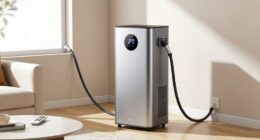

A simple worksheet helps you identify essential appliances, note their wattages, and estimate how long you’ll need backup power. You can then calculate the right generator size to handle your total load, including surge wattages, with some safety margin. Next, determine your solar battery capacity based on your daily energy needs and backup duration. Combining these steps guarantees a tailored, reliable system. Keep exploring for detailed tips on optimizing your backup power setup.
Key Takeaways
- List essential appliances, their wattages, and usage times to assess total power needs.
- Calculate the combined wattage, including surge requirements, for selecting an appropriately sized generator.
- Determine household energy consumption and backup duration to choose suitable solar battery capacity.
- Use a planning worksheet to organize appliance data and prevent over- or under-sizing backup systems.
- Consider the system’s interaction with the grid and other sources using the free floating concept for safety and compatibility.

Planning for home backup power is essential to make certain your household stays functional during outages. When you’re preparing for power disruptions, understanding how to size your system appropriately can save you money and frustration later on. A simple worksheet approach can help you determine the right setup, whether that involves a solar battery, a generator, or a combination of both. First, list out the essential appliances and devices you need to keep running during an outage—refrigerators, lights, medical equipment, and communication devices. Next, note their wattage requirements, which you can usually find on labels or in user manuals. This step is critical because it helps you understand the total power load your backup system must support.
Once you have your essential loads listed, you can begin thinking about generator sizing. Generator sizing involves calculating the total wattage of all appliances you’ll run simultaneously and then adding a buffer for startup surges, especially for devices like refrigerators or HVAC systems. For example, if your refrigerator needs 600 watts to run and has a startup surge of 1,200 watts, you’ll want a generator capable of handling at least 1,200 watts. Similarly, if your total essential load sums up to 3,000 watts, choosing a generator rated for around 3,500 to 4,000 watts provides enough margin for safety and future expansion. This process guarantees you don’t under- or over-allocate capacity, which can lead to system failures or unnecessary expenses.
In parallel, consider the role of a solar battery in your setup. Solar batteries store excess energy generated by solar panels during the day, providing reliable power during outages without relying solely on a generator. To determine the necessary size of your solar battery, estimate your daily energy consumption of essential devices. For instance, if your household consumes 10 kWh daily and you want at least a few hours of backup, select a solar battery with a capacity that exceeds your immediate needs, factoring in efficiency losses. This way, you can maximize the use of renewable energy and reduce fuel costs associated with generators.
Additionally, understanding the free floating concept is vital when designing your backup system, as it influences how your system interacts with the grid and other power sources. Putting these elements into a simple worksheet helps streamline your planning process. By clearly listing your appliances, their wattages, and estimated usage times, you can make informed decisions about the appropriate generator size and solar battery capacity. This approach prevents overbuying, which saves money, and underestimating, which risks leaving you powerless during outages. Combining a well-sized generator with a capable solar battery creates a resilient backup system tailored to your household’s needs. With this straightforward method, you’ll gain clarity and confidence in your home backup power planning, ensuring you stay connected and comfortable no matter what the weather brings.
Frequently Asked Questions
How Often Should I Review My Backup Power Plan?
You should review your backup power plan at least twice a year. Regular maintenance scheduling and system testing help guarantee everything works when needed. During these reviews, check for outdated batteries, test generators, and update any changes in your home’s power needs. Staying proactive prevents surprises during outages, so set reminders to evaluate your plan periodically and keep your backup system reliable and ready to activate smoothly.
What Safety Precautions Are Needed During Installation?
Like a knight donning armor before battle, you need to prioritize generator safety during installation. Always turn off the main power before connecting your generator to avoid backfeeding, which can endanger you and utility workers. Follow electrical precautions carefully—use proper grounding, avoid extension cords, and ensure all connections are secure. Wearing protective gear is essential, and consulting a professional guarantees everything is installed safely and correctly.
Can I Use Renewable Energy Sources for Backup Power?
Yes, you can use renewable energy sources like solar integration and wind power for backup power. These options provide clean, sustainable energy during outages. You’ll need to install solar panels or wind turbines properly, ensuring they’re compatible with your backup system. Consider adding battery storage to hold excess energy. This way, you can enjoy reliable backup power while reducing your carbon footprint and dependence on traditional generators.
How Do I Prioritize Appliances During an Outage?
Ever imagine a power outage disrupting your day? To manage it effectively, prioritize your appliances by importance—think medical devices, refrigeration, and essential lighting first. Use appliance prioritization to keep critical systems running and prevent chaos. During outage management, switch off non-essential devices to conserve power. This way, you guarantee crucial functions stay operational while minimizing strain on your backup power source. Wouldn’t you want peace of mind when the lights go out?
What Is the Average Cost of a Backup Power System?
The average cost of a backup power system ranges from $3,000 to $15,000, depending on size and features. You should consider generator maintenance costs and the battery lifespan of portable units when budgeting. Regular maintenance guarantees your system runs smoothly during outages, and understanding battery lifespan helps you plan for replacements without unexpected expenses. Investing wisely now saves you money and stress during power outages.
Conclusion
By planning your home backup power with this simple worksheet, you gain confidence and control. Instead of reacting blindly during outages, you proactively prepare for unexpected disruptions. It’s easy to overlook the importance of preparation, but with a clear plan, you’re not just surviving power outages—you’re safeguarding your comfort and safety. In the end, it’s not just about the equipment you choose, but the peace of mind you’ll enjoy knowing you’re ready for anything.