
You might prefer RAID enclosures because they let you customize hardware to match your specific performance and capacity needs. They’re usually more flexible, making upgrades and replacements easier, and they take up less space. Plus, with hardware-based RAID, you can set up redundancies for better data protection. If you want more control over your storage setup and long-term flexibility, RAID enclosures could be a better fit — and there’s more to discover below.
Key Takeaways
- RAID enclosures offer greater hardware customization for specific performance and capacity needs.
- They are generally more compact and space-efficient than full NAS systems.
- RAID enclosures provide easier hardware upgrades and replacements, enhancing long-term utility.
- They support hardware-based RAID for simplified setup and improved data redundancy.
- RAID enclosures often have fewer restrictions, allowing tailored configurations for diverse user requirements.
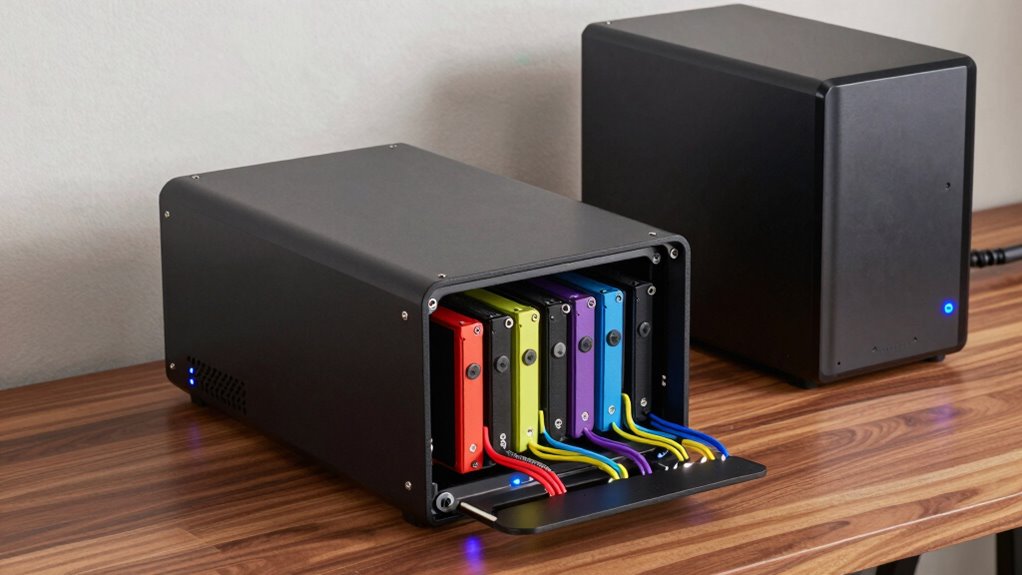
Furthermore, RAID enclosures give you more control over your hardware choices. You can select drives based on capacity, speed, or brand, tailoring your setup exactly to your needs. This flexibility often results in better performance and easier upgrades compared to some NAS systems, which might lock you into specific hardware or software ecosystems. Plus, since RAID enclosures are generally more compact, they are easier to fit into limited spaces and require less maintenance. Additionally, the popularity of hardware-based RAID configurations means that many enclosures are designed with user-friendly features to simplify setup and troubleshooting. For users concerned about data security strategies, RAID enclosures can be configured to optimize redundancy and fault tolerance, giving added protection against data loss. The ability to customize and select specific hardware components also appeals to users who value hardware flexibility for tailored performance. Moreover, understanding storage management can help users maximize the benefits of RAID enclosures in complex data environments. Exploring scalability options can further enhance the long-term utility of these setups as data needs grow.
hardware RAID enclosure
As an affiliate, we earn on qualifying purchases.
As an affiliate, we earn on qualifying purchases.
Frequently Asked Questions
Can RAID Enclosures Be Used Independently Without a Network?
Yes, you can use RAID enclosures independently without a network. They typically connect via USB, making setup simple and direct. As long as your device supports the enclosure’s hardware compatibility, you can manage and access your data locally without needing a network connection. This portability and ease of use make RAID enclosures appealing for users who prioritize quick, straightforward storage solutions without the complexities of full NAS systems.
How Does Data Recovery Differ Between RAID Enclosures and NAS?
Data recovery in RAID enclosures differs from NAS because RAID relies on data redundancy across disks, allowing you to replace a failed drive and rebuild data. Recovery methods often involve hardware swaps or specialized tools, and recovery is usually quicker if a single drive fails. In contrast, NAS systems may use more complex software solutions, and recovery can be slower or more complicated, especially with multiple drive failures or degraded arrays.
Are RAID Enclosures Suitable for Enterprise-Level Storage Needs?
You might say it’s a tall order for RAID enclosures to meet enterprise-level storage needs. While they excel in data redundancy and cost efficiency, they often lack the scalability, advanced management features, and redundancy options of full NAS systems. For critical, large-scale deployments, a dedicated NAS offers a more robust, reliable solution. RAID enclosures work well for smaller setups, but enterprises typically need the all-encompassing features of full NAS systems.
What Are the Power Consumption Differences Between RAID Enclosures and NAS?
RAID enclosures generally consume less power than full NAS systems because they focus on storage and have fewer features, enhancing energy efficiency. With better power management, they reduce energy use during idle times and lower operational costs. If you’re seeking a compact, energy-efficient solution, RAID enclosures are more appealing due to their lower power consumption, making them ideal for setups prioritizing cost-effective and efficient storage.
Do RAID Enclosures Support Remote Access Like NAS Systems?
RAID enclosures typically don’t support remote access like NAS systems do. You can’t usually manage them remotely for cloud backup or remote management purposes, which limits their flexibility. If remote access is essential for your setup, a NAS system offers built-in features that make it easier to access your data from anywhere. RAID enclosures are more suited for direct, local use rather than remote management.
USB RAID enclosure for data storage
As an affiliate, we earn on qualifying purchases.
As an affiliate, we earn on qualifying purchases.
Conclusion
In the end, choosing between a RAID enclosure and a full NAS system depends on what you value most. RAID enclosures offer flexibility and control, while NAS systems provide convenience and built-in features. Remember, “you get what you pay for,” so weigh your needs carefully. If you prefer customization and performance, a RAID enclosure might be your best bet. But if simplicity and ease of use matter more, a NAS could serve you better.
compact RAID enclosure with multiple drives
As an affiliate, we earn on qualifying purchases.
As an affiliate, we earn on qualifying purchases.
customizable RAID enclosure for PC
As an affiliate, we earn on qualifying purchases.
As an affiliate, we earn on qualifying purchases.