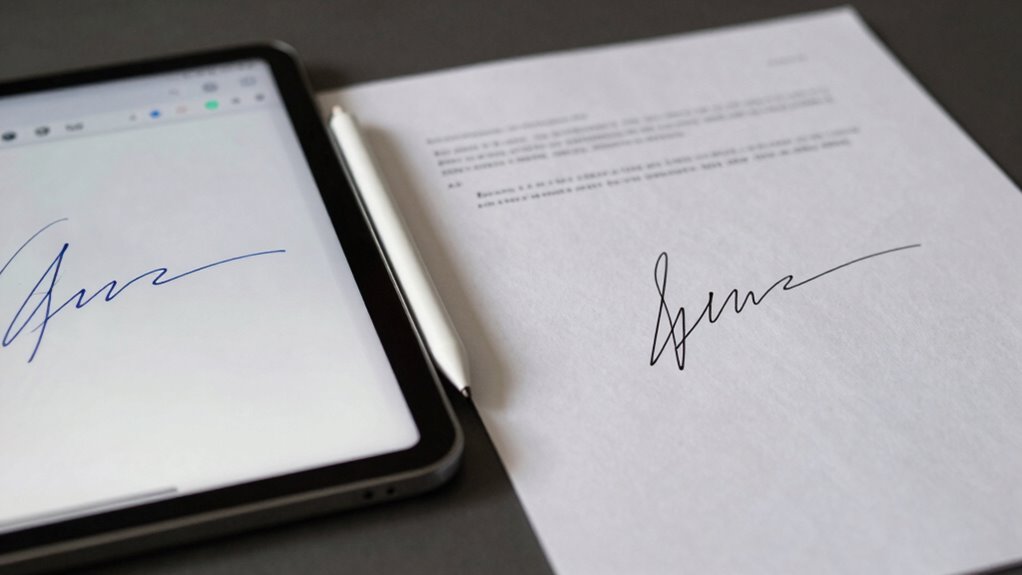

Digital signatures are ideal when you need legally recognized, secure, and tamper-proof verification of a document’s authenticity, linking cryptographically to guarantee trustworthiness. Scanned signatures might suffice for informal or internal use where legal validity isn’t critical, but they lack security and are easy to forge. Choosing between them depends on your need for legality and security—if you want a thorough understanding of scenarios, there’s more to explore.
Key Takeaways
- Digital signatures provide legally binding proof and strong verification of authenticity, unlike scanned signatures which are just images.
- Digital signatures ensure document integrity and security through cryptographic linkage, while scanned images are easy to forge or alter.
- Use digital signatures for official, legally recognized, and secure transactions; scans are suitable for informal or internal purposes.
- Digital signatures enable faster, paperless workflows and remote signing; scanned signatures involve manual signing and scanning steps.
- Evaluate security features when trustworthiness is critical; scanned signatures lack embedded security measures, making them less reliable.

In today’s digital world, choosing between digital signatures and scanned documents can impact the security and efficiency of your workflows. Digital signatures offer a level of legal validity that scanned documents often lack. When you digitally sign a document, it’s not just an image of your signature; it’s cryptographically linked to the document itself, making it extremely difficult for anyone to alter without detection. This means that, in legal terms, digital signatures are generally recognized as equivalent to handwritten signatures in many jurisdictions, providing you with a solid, legally binding proof of your agreement. On the other hand, scanned documents are simply images of handwritten signatures, which can be easily forged or manipulated. If you rely on scans for contracts or official records, you might face challenges proving authenticity in a legal dispute, especially in cases where security concerns are paramount. Additionally, understanding the security features of digital signatures can help you better evaluate their reliability and trustworthiness.
Frequently Asked Questions
How Do Digital Signatures Comply With International Legal Standards?
You can guarantee digital signatures comply with international standards by verifying their Legal Recognition under frameworks like eIDAS in Europe or ESIGN in the US. These standards set criteria for authenticity, integrity, and non-repudiation, making your digital signatures legally valid across borders. When your digital signatures meet these International Standards, they’re recognized globally, providing a secure, efficient way to sign documents while maintaining legal compliance.
Can Scanned Documents Be Legally Binding in All Jurisdictions?
You may find that scanned documents are legally binding in some jurisdictions, but it’s a case of “don’t count your chickens before they hatch.” Legal recognition varies widely, with jurisdictional differences affecting their validity. In certain areas, scanned copies hold up in court, while elsewhere, digital signatures are required for enforceability. Always verify local laws to confirm your scanned document’s legal standing before relying on it.
What Are the Security Risks Associated With Digital Signatures?
You should know that digital signatures face security risks like cryptographic vulnerabilities, which could allow hackers to forge signatures or tamper with data. Additionally, weak user authentication methods can lead to unauthorized access, compromising the signature’s integrity. To minimize these risks, guarantee you use strong encryption algorithms and multi-factor authentication, keeping your digital signatures secure and trustworthy.
How Do Digital Signatures Affect Document Storage and Archiving?
Your digital signatures revolutionize document storage and archiving, guaranteeing unmatched document integrity and effortless signature verification. They transform static files into secure, tamper-proof records, making it easier to verify authenticity long-term. Unlike scans, which can be altered or lost, digital signatures provide a reliable, enduring trail of proof, simplifying compliance and audits. This tech ensures your documents stay trustworthy and accessible for years to come—no more lost or compromised records.
Are There Specific Industries That Prefer Scans Over Digital Signatures?
Certain industries prefer scans over digital signatures due to industry-specific preferences and regional regulations. For example, real estate and healthcare often rely on scanned documents because regulations may limit digital signature use or require physical copies. You should consider regional laws and industry standards before choosing scans, especially if digital signatures aren’t yet widely accepted or legally mandated in your field. This guarantees your documents remain compliant and valid.
Conclusion
So, next time you’re tempted to scan a signature, remember—nothing beats the security of a digital one, right? But hey, if you enjoy the thrill of uncertainty and a dash of ambiguity, a simple scan will do just fine. After all, why bother with complex encryption when a quick snapshot can keep things just as “trustworthy”? Ironically, in the world of signatures, the simplest method often feels the most “secure.”