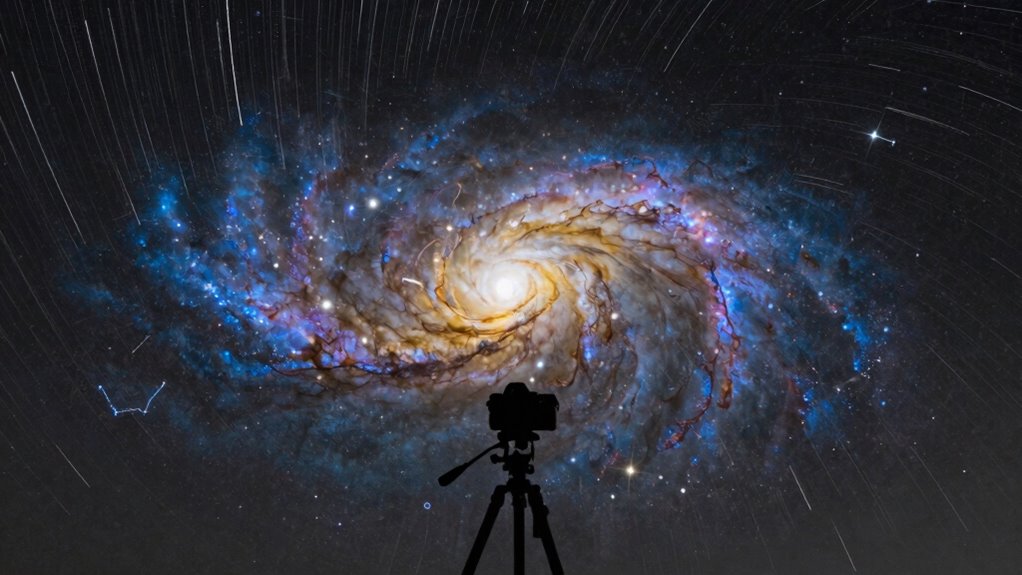

To get started with astrophotography, focus on mastering tracking, stability, and patience. Use a sturdy tripod and stabilize your camera well to prevent vibrations during long exposures. Employ a star tracker or mount to accurately follow the stars’ motion, allowing for longer, clearer shots. Remember, patience is key—experiment with different settings, take multiple shots, and fine-tune your technique. Keep exploring these concepts to improve your night sky images and capture stunning celestial scenes.
Key Takeaways
- Use a sturdy, level tripod to keep your camera stable during long exposures.
- Employ star trackers or equatorial mounts to accurately track celestial movement and prevent star trails.
- Focus manually on a bright star for sharp images, as autofocus is unreliable in dark conditions.
- Keep patience; experiment with settings and conditions to gradually improve your astrophotography results.
- Allow time for practice and adjustments to master tracking, stability, and capturing clear night sky images.
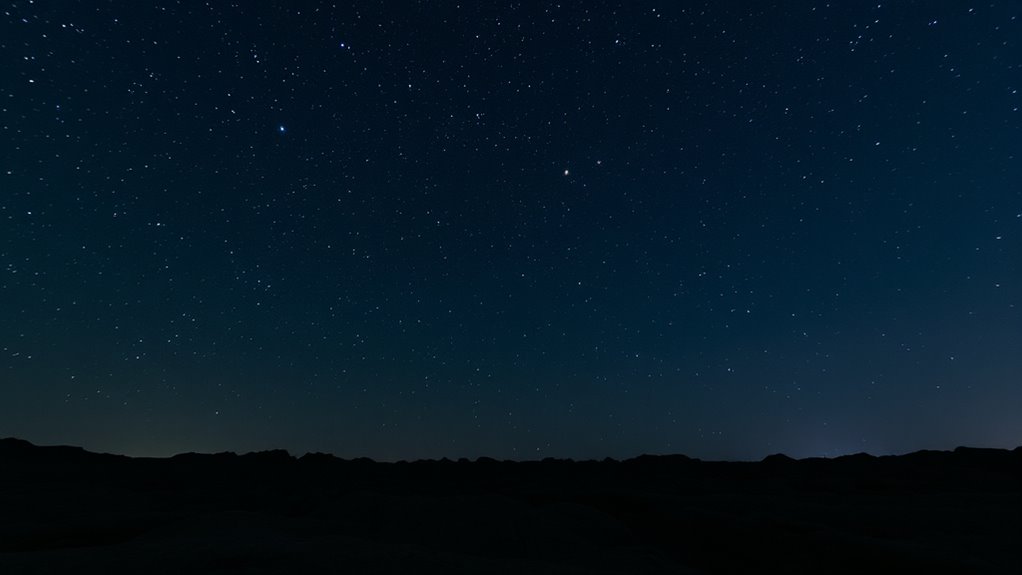
Getting started with astrophotography can seem intimidating, but understanding some basic concepts makes it much more approachable. One of the first steps is selecting the right lens. For deep-sky objects like galaxies and nebulae, you’ll want a lens with a wide aperture and a wide field of view. A fast lens with a large f-number, such as f/2.8 or lower, allows more light to hit your sensor, which is essential in low-light conditions. Prime lenses often outperform zooms in astrophotography because they typically have better optical quality and larger apertures. If you’re capturing the night sky, a wide-angle lens—say 14mm to 24mm—gives you expansive views of the Milky Way or star trails, making your images more dramatic and detailed.
Once you’ve chosen your lens, setting your camera correctly is fundamental. Adjust your camera settings to maximize light gathering while minimizing noise. Start with a low ISO setting—around 800 to 1600—so your images stay clean. Use manual mode to control exposure time; for capturing stars as points, keep your shutter speed within the “500 rule”—divide 500 by your lens’s focal length (for example, 500/24mm ≈ 20 seconds). This prevents star trails caused by Earth’s rotation. Aperture should be fully open, maximizing light intake. Focus is paramount; use live view to manually focus on a bright star or distant light source. Autofocus usually struggles in dark conditions, so manual focus is your best bet for sharp images. Additionally, understanding the importance of tracking is essential. Earth’s rotation causes stars to drift across the sky, so without tracking, your long exposures will result in streaks. Using a star tracker or equatorial mount helps compensate for this movement. With tracking, you can extend exposure times considerably, capturing more detail and reducing noise. Stability is equally important; set up your camera on a sturdy tripod, ensuring it’s level and steady. Any vibrations or movement can ruin a shot, especially during long exposures. Patience plays a huge role in astrophotography. Conditions change, and it might take multiple attempts to get the perfect shot. Don’t rush adjustments or settle for mediocre images. Instead, take your time to refine your focus, experiment with different exposures, and learn from each session. Over time, your skills will improve, and so will the quality of your astrophotos. Remember, astrophotography combines technical knowledge with persistence. With the right lens selection, camera settings, tracking, and patience, you’ll gradually capture stunning images of the night sky that reveal its true beauty.
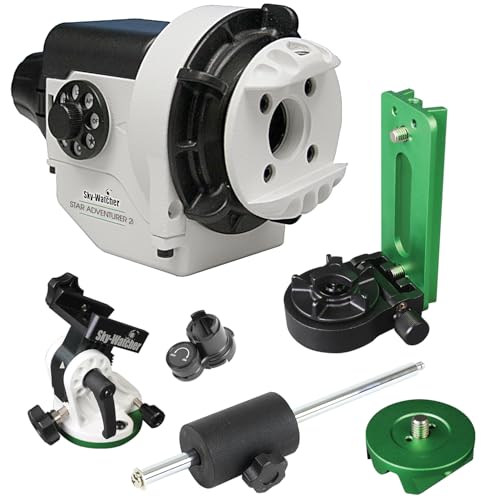
Sky-Watcher Star Adventurer 2i Pro Pack – Motorized DSLR Night Sky Tracker Equatorial Mount for Portable Nightscapes, Time-Lapse and Panoramas – Wi-Fi App Camera Control – Long Exposure (S20512)
Portable nightscape tracking platform: Motorized portable tracking platform perfect for capturing incredible detail of the Milky Way, eclipses…
As an affiliate, we earn on qualifying purchases.
As an affiliate, we earn on qualifying purchases.
Frequently Asked Questions
What Camera Settings Are Best for Astrophotography?
For astrophotography, set your camera to a wide aperture like f/2.8 or lower to capture more light. Use a low ISO around 800 to reduce noise, and keep your shutter speed between 15-30 seconds to prevent star trail distortion. Choose a fast, wide-angle lens for better star trail prevention, and avoid excessive exposure to maintain star sharpness. Manual focus on a bright star guarantees precise clarity.
How Do I Choose the Right Tracking Mount?
Imagine your camera gliding smoothly across the night sky like a gentle stream—this is where choosing the right tracking mount matters. Opt for an equatorial mount that aligns with Earth’s rotation, ensuring sharp images of stars and planets. Consider portability if you plan to shoot on varied terrains; lightweight models make setup easier without sacrificing stability. Balance your needs between precision and ease, and your astrophotography will soar.
What Are Common Astrophotography Post-Processing Techniques?
You should focus on post-processing techniques like image stacking and noise reduction to enhance your astrophotography. Image stacking involves combining multiple exposures to improve detail and reduce noise, making faint objects pop. Noise reduction helps eliminate graininess caused by high ISO settings or long exposures. Use software like DeepSkyStacker or Photoshop to apply these techniques, and you’ll get clearer, more detailed astrophotos that truly stand out.
How Can I Prevent Star Trails in My Images?
To prevent star trails, think of your camera as a steady ship sailing through calm waters. Use proper tracking equipment to follow the stars’ movement, and keep your camera stable on a sturdy tripod. For images that still show trails, try star trail removal techniques in editing software or enhance your shots through image stacking, which combines multiple exposures to create a smooth, trail-free starry sky.
What Are Affordable Options for Beginner Astrophotography Equipment?
You can start with budget alternatives like a basic DSLR or mirrorless camera paired with a sturdy tripod, which offers portable solutions for astrophotography. Consider affordable star trackers or intervalometers to improve tracking without breaking the bank. These options are easy to carry and set up, helping you capture clearer images of the night sky while staying within your budget. As you progress, you can upgrade gradually for better results.

EUCOS Metal 67" iPhone Tripod Stand with Remote & Lightweight Camera Stand, Sturdy Extendable Cell Phone Tripod for iPhone 15 Pro Max 14 13 12/Android
100% LIFETIME PROTECTION: Enjoy reliable performance with lifetime coverage, guaranteeing your tripod is always protected against any defects…
As an affiliate, we earn on qualifying purchases.
As an affiliate, we earn on qualifying purchases.
Conclusion
As you begin your astrophotography journey, remember that patience and practice are your best allies. While the stars may seem distant at first, each shot brings you closer to capturing their magic. Embrace the gentle art of tracking and stability, and don’t rush the process. With time, what once felt elusive will become a stunning reality—your unique celestial story waiting to unfold, just beyond the horizon of your patience.

Acuvar MM 0.43x Professional HD Wide Angle Camera Lens with Macro Portion DSLR Cameras – Wide Angle, Macro, Photo, Video Lens (67MM)
30MM 0.43x Wide Angle Lens for Canon DSLR Cameras — Compatible with Canon EOS 70D, 77D, 80D, 90D,…
As an affiliate, we earn on qualifying purchases.
As an affiliate, we earn on qualifying purchases.

TTArtisan 500mm F/6.3 Telephoto Lens for X-Mount Full Frame Manual Focus Prime Supertelephoto Lens X-A3 X-A5 X-A7 X-H1 X-T100 X-T20 X-T200 X-T3 X-T30 X-T30II X-T4 X-Pro3 X-E3 X-E4 X-S10
Capture Distant Wonders: The TTArtisan 500mm F/6.3 telephoto lens is ideal for photographing distant subjects, from sporting events…
As an affiliate, we earn on qualifying purchases.
As an affiliate, we earn on qualifying purchases.