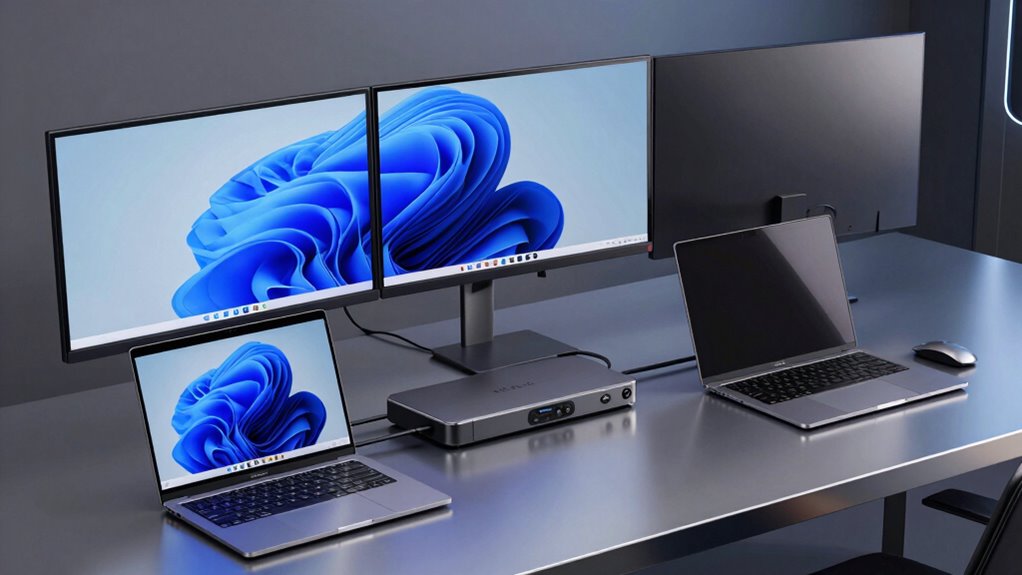

Docking stations vary in their ability to support dual 4K displays because it depends on their wireless, power, and hardware capabilities. If a dock offers high-bandwidth Wi-Fi 6, Bluetooth 5.0, and sufficient power delivery (at least 85W), it can handle multiple high-resolution screens smoothly. Advanced interfaces like Thunderbolt 3/4 or DisplayLink guarantee seamless performance. If you’re curious how these factors work together, exploring further will reveal the key differences.
Key Takeaways
- Support for high-bandwidth interfaces like Thunderbolt 3/4 or DisplayLink is essential for dual 4K monitor support.
- Adequate power delivery (85W+) ensures the dock can power laptops and multiple high-resolution displays simultaneously.
- Wireless standards such as Wi-Fi 6 and Bluetooth 5.0 improve connection stability, impacting the performance of dual 4K setups.
- The hardware quality and internal technology determine a dock’s ability to handle high-resolution data without lag.
- Combining advanced wireless, power, and hardware features is necessary for a reliable dual 4K display experience.

Have you ever wondered how to easily expand your laptop’s connectivity? Docking stations are the answer, providing a simple way to connect multiple devices, external displays, and accessories through a single hub. If you’re aiming for a setup that includes dual 4K monitors, understanding why some docking stations can handle this while others can’t becomes essential. The key factors here are wireless connectivity options and power delivery capabilities, which directly influence performance and compatibility.
Expand your laptop’s connectivity with docking stations that support dual 4K displays, high-speed wireless, and powerful charging.
When selecting a docking station, one of the first things to consider is how it manages wireless connectivity. A good docking station should support fast, reliable connections for your Wi-Fi and Bluetooth devices, ensuring seamless data transfer without lag. This is especially important if you rely on wireless peripherals or need to access online content swiftly. Dual 4K support often requires high-bandwidth connections, so stations that optimize wireless connectivity through advanced standards like Wi-Fi 6 or Bluetooth 5.0 can handle the data demands better, reducing latency and maintaining stable connections during intensive tasks. Additionally, high-bandwidth connections are crucial for supporting multiple high-resolution displays simultaneously.
Power delivery is another essential aspect that distinguishes stations capable of supporting dual 4K displays. Power delivery enables your dock to supply sufficient electricity to your laptop, eliminating the need for separate chargers. High wattage power delivery (typically 85W or more) not only keeps your device charged but also allows for powering multiple peripherals simultaneously. Stations that lack robust power delivery might cause your laptop to run out of juice, especially during prolonged use or when connected to multiple high-powered accessories, including dual 4K monitors. The ability to deliver enough power guarantees your setup remains stable and efficient, preventing disruptions that can occur when devices aren’t properly powered.
Furthermore, the internal hardware and connections within the docking station influence whether it can support dual 4K monitors. Many stations use DisplayLink technology or Thunderbolt 3/4 interfaces, which are designed to handle high-resolution displays with minimal lag. These technologies depend on the bandwidth they can provide, which is directly impacted by the station’s hardware and the connection to your laptop. Stations with Thunderbolt 3 or 4 ports typically offer higher bandwidth, enabling seamless dual 4K display support, whereas lower-spec docks might struggle with the bandwidth requirements, resulting in only one 4K display or reduced resolution.
In essence, the ability of a docking station to run dual 4K displays hinges on its wireless connectivity, power delivery, and internal hardware capabilities. Choosing one that supports high-speed wireless connections and delivers enough power ensures your workspace remains efficient, clutter-free, and capable of handling demanding tasks. Understanding these factors helps you make an informed decision, so you can enjoy a smooth, high-resolution multitasking experience with your laptop.
Frequently Asked Questions
Can a Docking Station Upgrade Existing Monitor Connections?
Yes, a docking station can upgrade your existing monitor connections if it supports higher monitor resolution and cable compatibility. You just need to guarantee the dock has the right ports, like HDMI or DisplayPort, and supports the resolution you want, such as 4K. By upgrading, you can achieve better display quality and connect multiple monitors more efficiently, making your workspace more productive and visually impressive.
Are There Compatibility Issues With Specific Laptop Brands?
Yes, you might face compatibility issues with specific laptop brands. Your brand’s compatibility depends on its support for the docking station’s port standards, like USB-C or Thunderbolt 3. Some brands may have limited support or require specific drivers, so always check if your laptop’s brand compatibility aligns with the docking station’s port standards before purchasing. Ensuring compatibility prevents connection problems and maximizes your docking station’s performance.
How Do Docking Stations Impact Overall System Performance?
Think of a docking station as the engine behind your laptop’s performance. It can boost graphics performance by providing additional video outputs and enhance data transfer speeds, making multitasking smoother. However, if your dock isn’t compatible or is underpowered, it could bottleneck system performance, causing lag or reduced graphics quality. So, choosing the right docking station guarantees your system runs seamlessly, revealing its full potential without compromising speed or visuals.
Is There a Difference Between Powered and Non-Powered Docks?
Yes, there’s a difference between powered and non-powered docks. Powered docks include a dedicated power supply, ensuring your devices get enough power for ideal performance and compatibility. This means you can connect multiple high-power devices without worry. Non-powered docks rely on your computer’s power, which might limit device compatibility and performance, especially for demanding peripherals. So, if you need reliable device support, a powered dock is the better choice.
Can Docking Stations Connect Multiple Devices Simultaneously?
Yes, docking stations can connect multiple devices simultaneously, enabling a seamless multi-device setup. You can plug in your monitor, keyboard, mouse, external drives, and even audio devices at once. This simultaneous connectivity simplifies your workspace, reducing clutter and improving efficiency. Just make certain your dock supports multiple ports and the required power and data transfer standards to handle all connected devices smoothly.
Conclusion
Choosing the right docking station is like selecting the perfect bridge; it connects your devices seamlessly and supports your workflow. If you need dual 4K displays, make sure your station is built to handle the load. Otherwise, it’s like trying to cross a river with a small canoe—you’re bound to hit limitations. So, pick wisely, and you’ll enjoy a smooth, uninterrupted journey across your digital landscape.