
TL;DR

Prime made for students and young adults
- Fast, free delivery for dorm and study essentials
- Prime Video and Amazon Music included
- Member-only deals
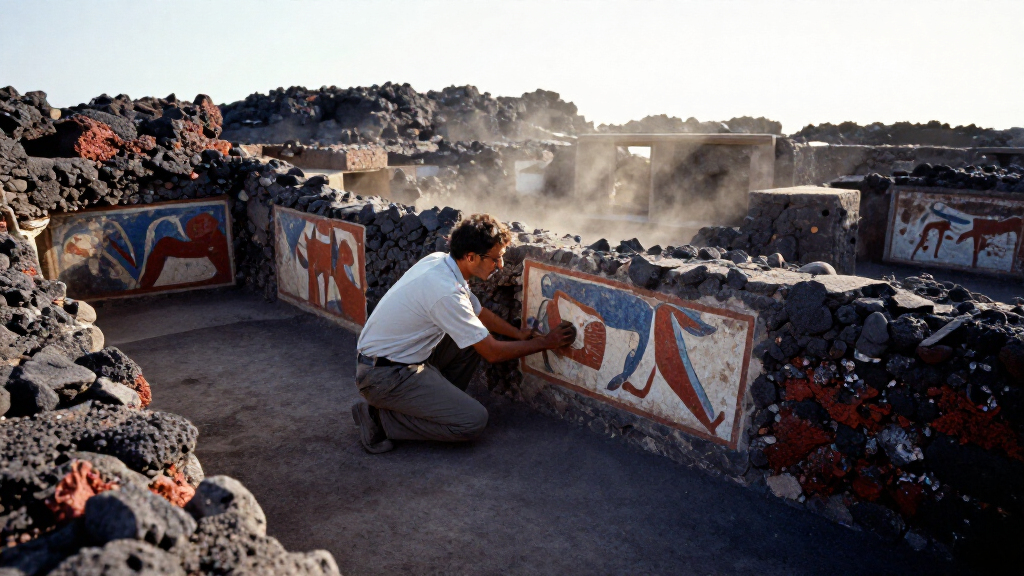
The eruption of Thera, the volcano on modern Santorini, buried the Bronze Age settlement of Akrotiri in ash and pumice. Scholars generally date the disaster to 1620–1530 B.C.E.; its precise timing and the eruption’s role in the wider decline of the Minoan civilization remain disputed.
The eruption of Thera, the volcano on modern Santorini, buried the nearby Bronze Age settlement of Akrotiri beneath ash and pumice, preserving its remains and offering evidence of life in a seafaring Aegean society. A Smithsonian Magazine report published November 3, 2026, says scholars generally place the eruption between 1620 and 1530 B.C.E., although its exact date remains debated.
The disaster followed a period of earthquakes and volcanic activity, according to the Smithsonian account. Residents appear to have left the settlement before the main eruption: the report describes belongings and valuables being stored, followed by an initial evacuation, a return to begin repairs, and a later departure as conditions worsened. These details point to a community responding to escalating danger, though the account does not establish every step as a complete record of events.
The eruption covered Akrotiri in volcanic material and reshaped the island. The report estimates that ash and pumice reached depths of about 200 feet in parts of the affected area. A portion of the volcanic caldera later collapsed into the sea, while layers of sand and pebbles found among archaeological deposits suggest that tsunamis also contributed to the destruction. Volcanic ash spread far beyond Santorini, with deposits reported as far away as modern Egypt and Israel.
Akrotiri is often compared with Pompeii because volcanic material preserved the settlement. The analogy describes how the remains were buried; it does not mean the two disasters happened in the same period or under identical circumstances. The site offers a rare archaeological record of a Middle Bronze Age Cycladic community, whose wider culture flourished across the Aegean islands between about 3000 and 1000 B.C.E.
What Akrotiri Preserves
The burial of Akrotiri left archaeologists with a settlement preserved beneath volcanic deposits, providing evidence about a society that would otherwise be much harder to reconstruct. Its buildings and archaeological layers can help researchers study how people lived, built, and responded to a natural disaster in the Bronze Age. The site is therefore significant not simply as a record of destruction, but as a surviving record of daily life.
The eruption also matters to the history of the wider Aegean. It transformed Santorini’s landscape and may have affected nearby communities through ashfall and tsunamis. However, the scale of the eruption does not by itself prove that it caused the decline of the Minoan civilization on Crete. Treating the disaster as a single explanation for that decline would go beyond what the evidence supports.
Popular right now

Dreame D30 Ultra CE Robot Vacuum and Mop

KitchenAid Artisan Series 5-Quart Tilt-Head Stand Mixer with Pouring Shield, Cherry Tomato

TCL 75-Inch QM6K QLED Mini LED 4K HDR Smart Google TV, 144Hz
As an affiliate, we earn on qualifying purchases.
From Excavation to Interpretation
The remains were first noticed in the 19th century, when miners on Therasia, west of Santorini, encountered a prehistoric building while quarrying pumice. A small excavation followed in 1870, but sustained work at Akrotiri began in 1967, led by archaeologist Spyridon Marinatos. Excavating a site preserved under ash presents a challenge: uncovering evidence also exposes it to damage and decay.
Marinatos linked the Thera eruption to the decline of the Minoans, whose major center included Knossos on Crete. He proposed that earthquakes and tsunamis disrupted buildings and coastal trade. The Smithsonian report says this single-cause theory is no longer widely accepted. Many historians instead point to a combination of environmental changes, weaker trade, political instability, and conflict with the rising Mycenaean civilization.
The eruption’s scale is another reason for continued interest. The report describes it as one of the largest volcanic eruptions in recorded history and estimates that it released about four times as much volcanic material as Krakatau’s 1883 eruption. That comparison is an estimate of material released, not a measure of equivalent human impact: the source gives no matching death toll for Thera.
““Everything was absolutely annihilated and completely encapsulated on the island.””
— Lefteris Zorzos, archaeologist, as quoted by Smithsonian Magazine
Dating and Minoan Effects
The eruption’s exact date has not been settled. The report gives a broad range of 1620–1530 B.C.E., reflecting continuing debate among scholars. It also does not establish precisely how long each stage of the volcanic activity lasted or how the evacuation unfolded; the sequence described in the article should not be mistaken for a fully documented eyewitness account.
The extent of the eruption’s effects on Crete and the Minoans remains contested. Marinatos argued that earthquakes and tsunamis damaged settlements and disrupted trade, but the report says historians generally consider several possible causes of Minoan decline. The available account does not quantify the eruption’s direct effects on the population or establish a single causal chain from Thera to the civilization’s later political changes.
Akrotiri is sometimes identified with Atlantis, but the report says most modern scholars view Plato’s story as an allegory, not a historical identification of the settlement. Similarities between a buried island and Plato’s account do not establish that Akrotiri was the lost city described in the dialogue.
Further Archaeological Work
The source report does not announce a new excavation, a revised date, or a forthcoming research milestone. The immediate next step for readers is to follow future archaeological studies that may refine the eruption’s chronology and clarify how its ash and tsunamis affected different parts of the Aegean.
At Akrotiri, the central task remains studying and preserving evidence as it is exposed. Further findings could add detail to the settlement’s layout and its inhabitants’ lives, while comparisons with evidence from Crete and other islands may help researchers test claims about regional damage. Until those questions are resolved, the strongest conclusion is that Thera’s eruption buried Akrotiri and left an unusually valuable Bronze Age archaeological record.
Key Questions
Where was Akrotiri?
Akrotiri was a Bronze Age settlement on the island of Thera, now known as Santorini, in Greece.
When did the Thera eruption happen?
Scholars generally date it to between 1620 and 1530 B.C.E. The precise date remains debated.
Why is Akrotiri compared with Pompeii?
Both settlements were buried by volcanic material, which preserved archaeological remains. The comparison concerns their preservation, not their dates: Akrotiri is a Bronze Age site, while Pompeii was destroyed in 79 C.E.
Did the eruption cause the fall of the Minoan civilization?
That has not been established. The report says the single-cause theory is no longer widely accepted; historians point to multiple possible factors, including environmental change, trade decline, political instability, and conflict.
Was Akrotiri the lost city of Atlantis?
There is no accepted evidence that it was. The report says most modern scholars regard Plato’s Atlantis as an allegory, rather than a direct account of Akrotiri.
Source: smithsonianmag.com