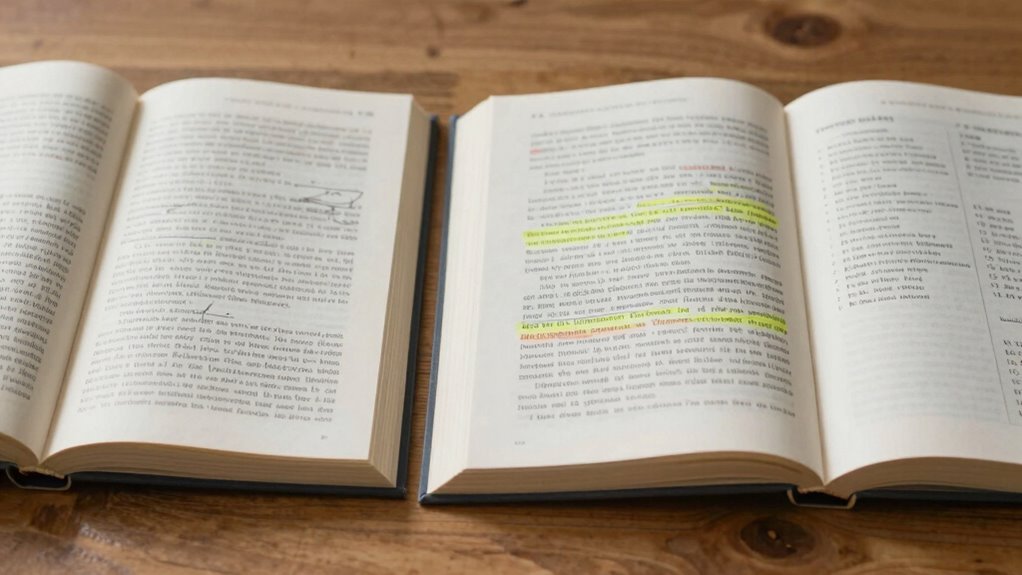

When you read for exposure, you’re just skimming words without really understanding or engaging with the material, like background noise. In contrast, reading for retention involves actively focusing, summarizing, and reflecting on what you learn. You challenge yourself with questions, create mental images, and connect new ideas to what you already know. By actively participating, you turn information into lasting knowledge. Keep exploring to discover effective strategies that boost your understanding even more.

Prime made for students and young adults
- Fast, free delivery for dorm and study essentials
- Prime Video and Amazon Music included
- Member-only deals
Key Takeaways
- Reading for exposure involves passive skimming without deep processing, while reading for retention requires active engagement and comprehension.
- Exposure reading offers brief familiarity but often lacks lasting understanding; retention-focused reading promotes long-term memory.
- Active strategies like summarizing, questioning, and reflection enhance retention beyond mere exposure.
- Retention-oriented reading emphasizes conscious mental effort to encode information into long-term memory.
- Passive exposure is akin to background viewing, whereas retention requires deliberate focus and cognitive strategies.

When you pick up a book or scan through articles, you might wonder whether you’re simply exposing yourself to information or actually understanding and remembering it. The difference hinges on your level of mental engagement and the cognitive strategies you employ. Reading for exposure often involves passively skimming words without truly processing their meaning. It’s like watching a movie from the background—you see the visuals, but your mind isn’t fully involved. In contrast, reading for retention requires active engagement. You intentionally focus on the material, asking questions and making connections, which helps encode the information into your memory.
Passive reading skims without understanding; active engagement transforms information into lasting knowledge.
To deepen your understanding, you need to activate cognitive strategies that promote mental engagement. Instead of just reading passively, try summarizing what you’ve read in your own words or teaching the concept to someone else. These strategies force your brain to organize and process information more thoroughly. Highlighting key points can be helpful, but only if you pause afterward to reflect on why those points matter. This reflection is a crucial part of cognitive engagement because it moves the information from short-term to long-term memory. Incorporating active learning techniques can further enhance your retention and comprehension.
Another effective approach is to pause periodically to test your understanding. Ask yourself questions about the material, such as “What’s the main idea here?” or “How does this connect to what I already know?” This active recall reinforces your memory and uncovers gaps in your understanding. Additionally, creating mental images or analogies related to the content can make abstract ideas more concrete, further boosting retention. These mental strategies involve more than just reading—they require deliberate effort to process and internalize information. Engaging with cognitive strategies can help transform passive exposure into meaningful learning experiences, especially when combined with other learning techniques. Incorporating metacognitive awareness into your reading habits can also help you identify which strategies are most effective for your learning style. Recognizing your own learning preferences can help tailor your approach to maximize retention.
Ultimately, reading for retention isn’t about rushing through pages, but about intentionally engaging your mind with the material. It’s a conscious effort to stay mentally present and utilize cognitive strategies that enhance comprehension and memory. When you approach reading with this mindset, you’re not just exposing yourself to words; you’re actively building knowledge. This kind of engagement makes it more likely that what you’ve read will stick with you long after you’ve finished the book or article. So next time you read, consider how you can turn passive exposure into active mental engagement—your brain will thank you with better understanding and stronger memory.
active reading comprehension tools
As an affiliate, we earn on qualifying purchases.
As an affiliate, we earn on qualifying purchases.
Frequently Asked Questions
How Can I Tell if I’M Reading for Exposure or Retention?
You can tell if you’re reading for exposure or retention by observing your approach. If you’re using skimming techniques in a relaxed reading environment, you’re probably reading for exposure—just getting a general sense. But if you actively take notes, review details, and focus deeply, you’re reading for retention. Paying attention to your intent and methods helps you identify your purpose, guiding your focus accordingly.
What Techniques Improve Long-Term Retention of Information?
To improve long-term retention, you should use memory techniques like spaced repetition and active recall. Incorporate cognitive strategies such as summarizing information in your own words and teaching others. These methods reinforce your understanding and help embed knowledge into your memory. Consistently reviewing material over time and testing yourself can also boost retention, making it easier to recall information when you need it most.
Does Reading for Exposure Boost Overall Reading Speed?
Ironically, reading for exposure might seem like it’d slow down your reading speed, but it actually can boost your overall reading comprehension. When you’re just scanning or casually engaging with texts, you become more comfortable with different styles and vocabularies. This cognitive engagement helps your brain process information faster over time, subtly increasing your reading speed without sacrificing understanding. So, yes, exposure can make you a quicker, more adaptable reader.
Are There Specific Genres Better Suited for Retention-Focused Reading?
Certain genres, like dense nonfiction, academic texts, or complex literary works, are better suited for retention-focused reading because they require careful analysis and deep understanding. If you want to improve your reading habits for retention, explore genres that challenge your comprehension skills and encourage critical thinking. Engaging with these genres helps you retain information longer, making your reading more effective. So, tailor your genre exploration to boost your retention efforts.
How Do I Balance Reading for Exposure and Retention Effectively?
To balance reading for exposure and retention, you should alternate between skimming strategies for quick familiarity and detailed reading for retention. Use annotation techniques to highlight key points and jot down notes, which reinforce understanding. Schedule dedicated sessions for deep reading to retain information, while also setting aside time for lighter skimming to stay engaged with new content. This combined approach helps you maximize both exposure and retention effectively.
note-taking and highlighting tools
As an affiliate, we earn on qualifying purchases.
As an affiliate, we earn on qualifying purchases.
Conclusion
Understanding the difference between reading for exposure and reading for retention helps you optimize your learning. Did you know that you’re more likely to remember only 10% of what you read for exposure, but up to 65% when you actively work to retain it? By choosing to focus on retention techniques, you markedly boost your ability to recall information. So, next time you read, decide whether you’re just browsing or truly engaging—your brain will thank you.
As an affiliate, we earn on qualifying purchases.
As an affiliate, we earn on qualifying purchases.
Halloween Picks
halloween
As an affiliate, we earn on qualifying purchases.