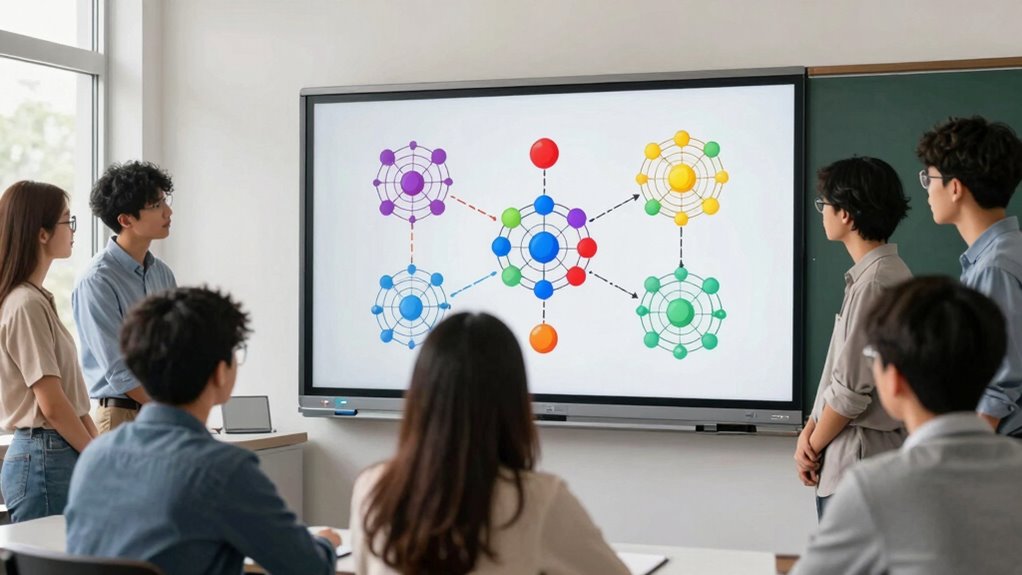

Transfer learning helps you teach models to understand underlying concepts rather than just memorize facts. By using pre-trained models, you enable them to recognize shared features like patterns, edges, or textures, which speeds up learning and improves accuracy. Instead of starting from scratch, you fine-tune existing knowledge for related tasks, saving time and resources. Keep exploring to discover how this approach can make your models smarter and more adaptable across different domains.
Key Takeaways
- Transfer learning enables models to adapt knowledge from related tasks, focusing on understanding concepts rather than memorizing facts.
- By fine-tuning pre-trained models, systems learn underlying patterns, promoting conceptual understanding instead of surface-level data.
- Leveraging shared features across tasks helps models grasp broader ideas, moving beyond mere fact recall.
- Transfer learning reduces the need for extensive data, encouraging models to learn core concepts efficiently.
- It enhances generalization, allowing models to apply learned principles to new problems rather than just specific facts.

Have you ever wondered how machines can learn new tasks quickly by building on previous knowledge? That’s where transfer learning shines. It allows models to adapt from one problem to another, saving you time and effort. Instead of training a model from scratch every time, transfer learning leverages what’s already learned, making the process more efficient and effective. At its core, transfer learning involves taking a pre-trained model—one that has already learned to recognize patterns or features from a large dataset—and tweaking it to suit a new but related task. This approach hinges on the idea that many tasks share underlying features, which means you can reuse these features rather than starting from zero each time.
Model adaptation plays an indispensable role here. When you adapt a pre-trained model, you’re essentially fine-tuning it to recognize the nuances of the new task. This process often involves adjusting the model’s weights or retraining certain layers, allowing it to specialize in the new context while retaining the core knowledge it previously acquired. The adaptation is typically faster and requires less data compared to training a new model from scratch because you’re building on established feature representations. This is where feature reuse becomes invaluable. The features learned by the original model—such as edges, textures, or shapes in image recognition—are often universal. Reusing these features in the new task means you can transfer relevant features rather than learn them anew, which accelerates learning and improves performance, especially when data for the new task is limited.
By reusing features, you’re effectively transferring the model’s understanding of fundamental patterns to a new domain. For example, a model trained to identify animals can be adapted to recognize specific breeds by reusing its learned features. Instead of retraining everything, you only need to fine-tune a few layers, saving time and computational resources. This process not only boosts efficiency but also enhances accuracy, as the model benefits from the broad knowledge it already possesses. Transfer learning demonstrates the power of learning concepts rather than just facts—by understanding the underlying features, models can generalize better across tasks.
Top picks for "learn transfer concept"
Open Amazon search results for this keyword.
As an affiliate, we earn on qualifying purchases.
Frequently Asked Questions
How Does Transfer Learning Differ From Traditional Machine Learning?
You notice transfer learning differs from traditional machine learning because it adapts features from a pre-trained model to new tasks, helping you handle domain shift effectively. Unlike traditional methods that require training from scratch, transfer learning leverages existing knowledge, saving time and resources. This approach allows you to transfer learned features and improve performance even when data in the new domain is limited.
What Are the Best Applications for Transfer Learning?
Ever wondered where transfer learning shines? You’ll find it excels in applications like image recognition, natural language processing, and speech recognition. By leveraging model fine-tuning and feature extraction, you can adapt pre-trained models to specific tasks efficiently. This approach saves time and resources, making it ideal for scenarios with limited data. So, if precision and speed matter, transfer learning is your best choice for customizing solutions across various domains.
Can Transfer Learning Be Used With Small Datasets?
Yes, transfer learning works well with small datasets because it addresses data scarcity by leveraging pre-trained models. You can fine-tune these models on your limited data, which requires less training time and resources. This approach allows you to achieve high accuracy without needing large datasets, making it ideal for situations where collecting data is challenging. So, if you’re working with limited data, transfer learning is a smart choice.
What Are Common Challenges When Implementing Transfer Learning?
Challenges crop up when you’re implementing transfer learning, especially with model adaptation and data compatibility. You might struggle to fine-tune models without overfitting, or find that your data doesn’t match the original training data, causing poor performance. Balancing these hurdles requires careful calibration, constant correction, and creative customization, ensuring your transfer learning effort smoothly shifts from one domain to another. Stay vigilant to navigate these common stumbling blocks successfully.
How Do I Choose the Right Pre-Trained Model for My Task?
You should focus on model selection by identifying a pre-trained architecture that closely aligns with your task’s requirements. Consider the complexity, size, and domain of your data to guarantee compatibility. Evaluate popular models like ResNet or BERT, based on their performance benchmarks and transferability. By choosing a pre-trained model suited to your specific needs, you’ll enhance efficiency and improve your chances of success in fine-tuning and achieving accurate results.
Conclusion
By embracing transfer learning, you realize that mastering concepts opens doors beyond memorized facts. Instead of merely recalling isolated information, you connect ideas across domains, gaining true understanding. It’s like building a bridge from what you already know to new horizons—faster, stronger, smarter. So, don’t just learn facts; learn how to transfer knowledge. In doing so, you unleash endless possibilities, turning simple facts into powerful tools for innovation and growth.