
TL;DR

Get school and study supplies delivered free — and shop member deals
- Fast, free delivery on millions of items
- Access to Prime Big Deal Days deals on October 6–7
- Prime Video, Amazon Music and more included
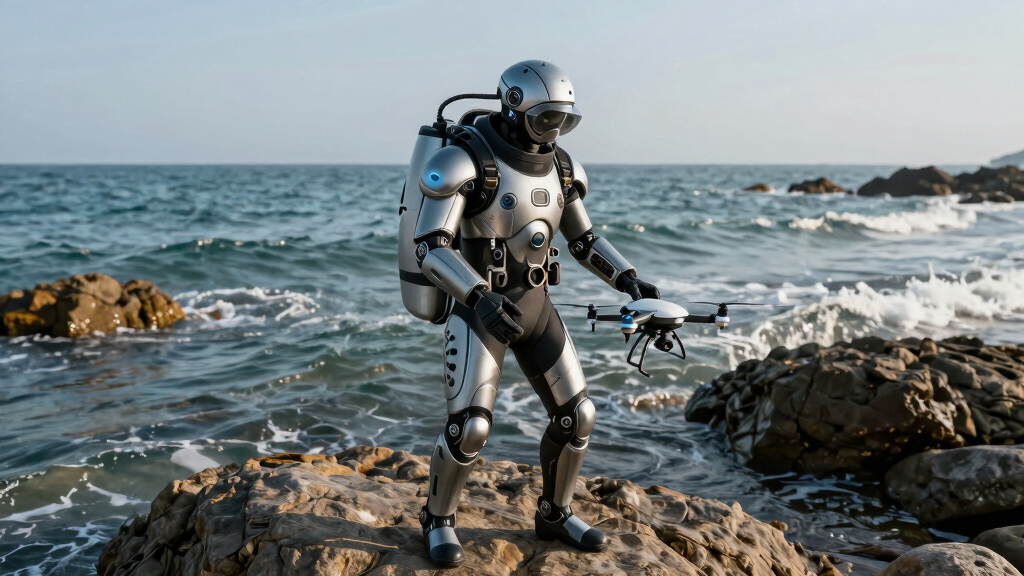
Scientists have created a cyborg insect fitted with an underwater suit, allowing it to dive and move between land and water. This innovation advances bio-robotics and environmental monitoring capabilities.
Researchers have unveiled an underwater suit-wearing cyborg insect capable of diving and moving across land and aquatic environments. This development represents a breakthrough in bio-robotic technology, with potential applications in environmental monitoring, search and rescue, and ecological research.
The project, led by a team of engineers and biologists, involves a robotic insect integrated with a lightweight, waterproof exoskeleton that allows it to submerge and navigate underwater. The insect is equipped with sensors and actuators that enable it to control movement both on land and beneath water surfaces. According to the research team, the prototype can perform controlled dives and surface transitions, demonstrating a new level of environmental adaptability for robotic insects. The device is still in experimental stages, with ongoing tests to refine its mobility and autonomy in complex terrains.Initial tests involved the insect navigating shallow waters and terrestrial terrains, with plans to extend capabilities to deeper dives and longer durations. The team emphasizes that the insect’s design mimics natural insect movement patterns, enhancing its ability to maneuver in diverse environments. The project aims to develop autonomous operation, with future versions potentially equipped with cameras and environmental sensors for data collection.While the technology is promising, it remains in early development, and scalability or commercial deployment is not yet confirmed.Implications for Environmental and Search Missions
This innovation could transform environmental monitoring, ecological research, and search-and-rescue operations. The ability for a robotic insect to traverse land and water surfaces allows access to previously difficult terrains, such as flooded areas or submerged habitats. It offers a minimally invasive method to collect data in sensitive ecosystems and could assist in locating missing persons or assessing disaster zones with high precision. Experts suggest that such bio-inspired robots may reduce risks to human responders and expand the scope of remote environmental assessments.
As an affiliate, we earn on qualifying purchases.
Advances in Bio-Robotics and Underwater Mobility
Recent years have seen significant progress in bio-inspired robotics, with insects and small animals serving as models for mobility in complex terrains. Previous efforts focused mainly on terrestrial or aquatic robots separately. The development of a hybrid insect capable of both land and underwater movement marks a notable step forward. The concept draws on natural insect behaviors, such as burrowing and swimming, integrating these into robotic systems. The project builds on prior research into waterproof exoskeletons and autonomous navigation but is among the first to demonstrate a functional, multi-environment robotic insect prototype.
“This insect prototype demonstrates a new frontier in bio-robotics, combining natural movement with advanced underwater capabilities. It opens possibilities for exploration in environments previously inaccessible to robots.”
— Dr. Emily Chen, lead engineer
As an affiliate, we earn on qualifying purchases.
Technical Limitations and Future Development Challenges
It is still unclear how long the insect can operate underwater, its autonomy levels, and how well it can handle complex underwater environments at greater depths. The scalability of the technology for mass deployment or commercial use remains unconfirmed. Researchers are also assessing durability, energy efficiency, and control systems for real-world applications.
As an affiliate, we earn on qualifying purchases.
Upcoming Tests and Potential Applications
The research team plans to conduct extended field tests, including deeper water dives and longer operation periods. They aim to improve autonomy, integrate environmental sensors, and explore applications in ecological monitoring, disaster response, and military reconnaissance. Further development could lead to commercial prototypes within the next few years, pending successful testing.
underwater environmental monitoring robot
As an affiliate, we earn on qualifying purchases.
As an affiliate, we earn on qualifying purchases.
Key Questions
How does the cyborg insect move underwater?
The insect uses waterproof actuators and sensors that mimic natural insect movement, allowing it to swim and surface smoothly while maintaining control and stability.
What are the potential uses of this technology?
Potential applications include environmental data collection, ecological research, search and rescue missions, and surveillance in both terrestrial and aquatic environments.
Is this technology ready for commercial deployment?
No, the project remains in early testing stages. Further development and validation are needed before commercial or widespread use can be considered.
What challenges remain for this robotic insect?
Major challenges include improving underwater endurance, autonomy, durability in harsh environments, and scalability for mass production.
Source: hn
Halloween Picks
halloween
As an affiliate, we earn on qualifying purchases.