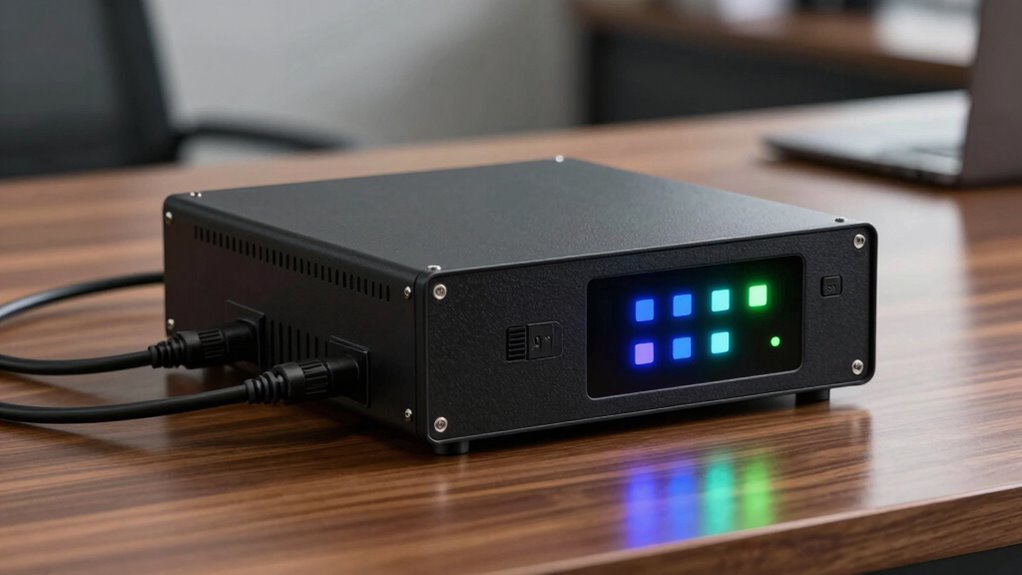

When comparing UPS ratings, VA measures apparent power, while watts show the real power your devices consume. Your equipment often lists power in watts, so understanding that VA is about capacity and watts reflect actual work helps you choose the right system. Properly matching these ratings guarantees your devices run smoothly without overloads. Want to know how these differences impact your setup? Keep exploring to get a clear picture of how VA and watts work together.
Key Takeaways
- VA indicates the apparent power capacity, while watts measure the actual power delivered to devices.
- To avoid confusion, match device wattage requirements with the UPS’s watt rating, not just VA.
- A UPS’s VA rating shows total capacity, but real power depends on its watt rating.
- Power factor (usually between 0.6 and 1) converts VA to watts; multiply VA by power factor for real wattage.
- Understanding both VA and watts ensures you select a UPS that safely supports your equipment without overload.

Have you ever wondered what those UPS ratings really mean? When you’re shopping for an uninterruptible power supply, terms like VA and watts can seem confusing, but understanding them is essential to choosing the right model for your needs. The ratings tell you about the UPS’s capacity to handle your devices during power outages, and they are closely tied to the unit’s battery capacity and surge power capabilities. The VA rating, or volt-ampere rating, indicates the apparent power the UPS can supply, which is based on the combined voltage and current it can handle. Meanwhile, the watt rating shows the real power it can deliver to your equipment, reflecting the actual work done by the UPS. Knowing the difference is vital because many devices specify their power requirements in watts, so matching your equipment’s needs to the UPS’s watt capacity guarantees reliable backup without overloading the system.
The battery capacity of a UPS is a major factor in its overall performance. It determines how long your devices can stay powered during an outage, but it also influences surge power capacity. Surge power is the UPS’s ability to handle brief spikes in power demand, like when a device with a motor or compressor starts up. A UPS with higher surge power can better protect sensitive electronics from damaging sudden voltage spikes and ensure smooth operation during these moments. When you pick a UPS, you want one with sufficient surge power to handle the startup current of all connected devices, especially if you’re powering multiple electronics or equipment with high inrush currents. The battery capacity directly impacts how long your devices stay operational once the power goes out, but a high surge power rating guarantees your equipment is protected from damaging surges that could occur when devices turn on or during temporary voltage fluctuations. Additionally, understanding the free floating concept helps clarify how some UPS systems manage their battery charge and readiness for backup situations.
Frequently Asked Questions
How Do I Convert VA to Watts for Specific Devices?
To convert VA to watts for your devices, you need to consider the power factor, which indicates device efficiency. Multiply the VA rating by the power factor (usually between 0.8 and 1.0). This calculation helps ensure device compatibility with your UPS, preventing overloads. Always check your device’s specifications for the exact power factor to get an accurate wattage. This way, you can select the right UPS capacity for your needs.
What Is the Impact of Power Factor on UPS Ratings?
The power factor affects UPS ratings by indicating how efficiently your device uses energy. A higher power factor means your device draws power more effectively, resulting in better energy efficiency and potentially smaller UPS needs. Low power factor devices may require a UPS with a higher VA rating to handle the same load, which can lead to increased costs and less efficient power use. Always check your device’s power factor for ideal UPS selection.
Can I Use VA Ratings to Compare Different UPS Models?
You shouldn’t rely solely on VA ratings to compare UPS models because they don’t account for power factor, which affects real power usage. Look at efficiency ratings and the UPS’s power factor to get a clearer picture of performance. A higher power factor means the UPS uses power more effectively, so consider these factors alongside VA ratings to choose the best model for your needs.
How Does Load Efficiency Affect UPS Performance?
Ironically, load efficiency is what really shows how your UPS performs under pressure. When your load is efficient, it conserves battery capacity and delivers power smoothly, ensuring surge protection works when you need it most. A poorly performing load drags down the system, wasting energy and risking battery drain. So, keeping your load efficient isn’t just smart; it’s essential for reliable backup power and ideal surge protection.
Are There Industry Standards for UPS VA and Watt Ratings?
Yes, industry standards exist for UPS VA and watt ratings to guarantee safety and reliability. When you experience a power surge or need to protect equipment, these standards help you compare UPS units effectively. A higher VA and watt rating indicates better battery capacity and power handling, giving you confidence that your system can handle load fluctuations. Always check these ratings to match your needs and secure peak performance during outages.
Conclusion
Understanding UPS ratings like VA and watts might seem tricky at first, but remember: they’re the compass guiding your power needs. Think of VA as the size of the boat and watts as how much cargo it can carry; both matter, but they serve different purposes. Don’t let confusion sink you—clarify these figures, and you’ll navigate your backup power with confidence. After all, isn’t knowledge the true power in any storm?