

Many believe that increasing resolution to 4K or boosting bitrate automatically improves video quality, but that’s a myth. The real key is proper lighting, which ensures your footage captures accurate colors, detail, and depth. Without good lighting, higher resolution or bitrate won’t make your video clearer or more appealing. To truly enhance your videos, you need to comprehend how lighting, color grading, and technical settings work together—keep exploring to learn the full picture.
Key Takeaways
- Higher resolution like 4K doesn’t guarantee better quality without proper lighting and color grading.
- Increasing bitrate improves detail only if the footage is well-lit; poor lighting can’t be fixed by bitrate alone.
- Good lighting is more critical than resolution or bitrate for capturing accurate colors and reducing noise.
- Resolution and bitrate are important, but they won’t compensate for underexposed or poorly lit scenes.
- Proper infrastructure and camera settings combined with lighting enhance overall video quality more effectively than focusing solely on resolution or bitrate.
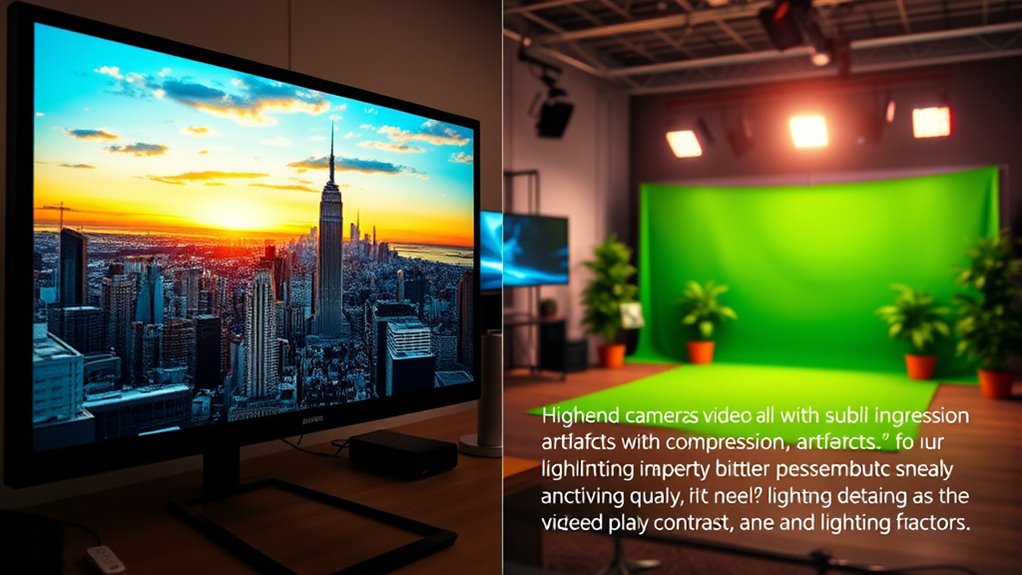
Many people believe that higher resolution automatically means better video quality, but that’s a common myth. While camera resolution is certainly a factor, it doesn’t tell the whole story. A higher resolution, such as 4K, provides more detail, but if your camera resolution isn’t paired with proper lighting, good color grading, and correct settings, the footage can still look dull or noisy. Resolution alone doesn’t guarantee clarity or visual appeal; instead, it’s just one piece of the puzzle. You should focus on how well your camera captures colors and tones, which is where color grading comes into play. Color grading enhances the mood, corrects exposure issues, and makes footage visually engaging. Without skilled color grading, even high-resolution footage can appear flat or washed out. Additionally, European cloud innovation plays a role in providing reliable infrastructure that supports high-quality video production and distribution. Many beginners assume that increasing bitrate automatically improves video quality. Bitrate determines how much data is processed per second, and a higher bitrate can support more complex details and smoother motion. However, if you’re shooting in poor lighting, no amount of bitrate will compensate for the lack of light. Conversely, if your lighting is excellent but your bitrate is too low, your footage might appear compressed, with pixelation and artifacts that ruin clarity. It’s essential to balance bitrate with your resolution, lighting conditions, and the type of content you’re producing. An optimized bitrate ensures your footage maintains detail without unnecessary file size bloat. Lighting plays a critical role, often more so than resolution or bitrate. Even the most advanced camera can’t produce great footage in poor lighting conditions. When you light your scene well, you give your camera the best chance to capture accurate colors and fine details. Proper lighting reduces noise and helps your camera’s sensor perform at its best. This is especially true when you’re doing color grading afterward; good lighting provides a solid foundation, so adjustments look natural and polished. In poorly lit environments, no amount of resolution or bitrate can fully salvage the footage. You need to invest in proper lighting setups to truly elevate your videos.

NEEWER 2 Pack Bi Color 660 LED Video Light and Stand Kit: (2) 3200-5600K CRI 96+ Dimmable Light with U Bracket and Barndoor, (2) 75 inches Light Stand for Studio Photography, Video Recording (Black)
【Bi Color Dimmable LED Studio Light】 With 330 warm white and 330 cool white LEDs, this 660 40W…
As an affiliate, we earn on qualifying purchases.
As an affiliate, we earn on qualifying purchases.
Frequently Asked Questions
How Do You Measure Perceived Video Quality Accurately?
You measure perceived video quality by observing factors like video noise and color fidelity, which directly affect your viewing experience. Pay attention to how smooth the image appears, the absence of distracting noise, and whether colors look natural and vibrant. Using calibrated displays and subjective testing, you can accurately assess how well a video maintains quality, ensuring it meets your expectations for clarity, detail, and overall visual appeal.
Can High Bitrate Compensate for Poor Lighting Conditions?
High bitrate can’t fully compensate for poor lighting conditions because lighting challenges heavily impact image clarity and detail. While increasing bitrate improves overall video quality, it has limitations due to bitrate restrictions and compression artifacts. Poor lighting causes noise and loss of detail that even high bitrate can’t fix. To achieve the best quality, you need proper lighting, and use a suitable bitrate within your limits to balance quality and file size.
Does Higher Resolution Always Mean Better Video Quality?
Higher resolution doesn’t always mean better video quality because resolution trade-offs depend on your viewing environment. If you’re watching on a small screen or in a poorly lit room, the extra pixels won’t improve clarity or detail. Instead, consider the balance between resolution, bitrate, and lighting. You need to optimize all three to get the best viewing experience, rather than assuming that higher resolution alone guarantees superior quality.
What Role Does Compression Play in Video Quality?
Compression plays a vital role in video quality by balancing file size and clarity. When you compress videos, you risk creating compression artifacts—blocky or blurry spots—that degrade the image. Efficient encoding improves quality by maximizing encoding efficiency, which means you get better image preservation at lower bitrates. Ultimately, good compression preserves detail and minimizes artifacts, ensuring your videos look sharp without unnecessary file size increases.
Are There Optimal Settings for Different Viewing Devices?
You should adjust your video settings based on your device’s display calibration and compatibility. When choosing ideal settings, consider the resolution, bitrate, and lighting to match the device’s capabilities. Coincidentally, a well-calibrated display reveals hidden details, emphasizing the importance of tailoring your video quality. By refining these settings, you ensure the best viewing experience, whether on a smartphone, tablet, or 4K TV, making every pixel count.

Galyimage 4K Webcam with Ring Light Web Cam 4K Autofocus with TOF Computer Camera 1080P 60FPS Web Camera Built-in Privacy Cover and Microphone Streaming Webcams for Zoom/Skype/Google Meet
【4K UHD Webcam】This webcam for pc supports resolutions from 4K@30FPS to 1080P@60FPS, with frame rates that capture every…
As an affiliate, we earn on qualifying purchases.
As an affiliate, we earn on qualifying purchases.
Conclusion
Don’t let the myths cloud your vision; remember, video quality is a mosaic of factors, not just a single piece. Think of 4K, bitrate, and lighting as the instruments of a symphony — when played together, they create a masterpiece. So, instead of chasing illusions, trust your eyes and experiment. With a little knowledge, you’ll turn your footage into a vibrant canvas, where every pixel tells a story worth watching.

Color Grading 101: Getting Started Color Grading for Editors, Cinematographers, Directors, and Aspiring Colorists
As an affiliate, we earn on qualifying purchases.
As an affiliate, we earn on qualifying purchases.

2-Pack LED Video Light Kit, NiceVeedi Studio Light, 2800-6500K Dimmable Photography Lighting Kit with Tripod Stand&Phone Holder, 73" Stream Light for Video Recording, Game Streaming, YouTube
【MULTIPLE COLOR TEMPERATURE & ADJUSTABLE BRIGHTNESS】There are 3 Color temperatures (2800K, 4800K & 6500K) which offer different lighting…
As an affiliate, we earn on qualifying purchases.
As an affiliate, we earn on qualifying purchases.