
For students who need a hands-on way to study anatomy, I’d start with the EVOTECH SCIENTIFIC 15-Piece Human Torso Model as the best overall pick: its removable organs make core body structures easier to review. The EVOTECH 17-Inch Torso offers more room to inspect parts, while the Kaplan Anatomy Coloring Book suits learners who retain information through drawing and quizzes. The main tradeoff is between focused detail, portability, and the breadth of a kit: a compact torso is easier to store, while a full-size skeleton or multi-model set covers more ground. Some options are aimed at younger learners rather than advanced coursework, so match complexity to the student’s level. Read on for the full breakdown and guidance on choosing the right model for the way you study.

Get school and study supplies delivered free — and shop member deals
- Fast, free delivery on millions of items
- Access to Prime Big Deal Days deals on October 6–7
- Prime Video, Amazon Music and more included
Key Takeaways
- The 11-inch EVOTECH 15-piece torso is the clearest all-around study choice in this lineup, pairing removable anatomy with a size that is easier to store than full-size displays.
- The 17-inch EVOTECH torso and the 17-inch musculature model focus on different lessons: one emphasizes internal organs, while the other centers on muscle anatomy.
- The Breesky life-size skeleton with nervous system and rolling stand is the most display-oriented option; its scale and stand suit shared spaces better than a small personal desk.
- Several compact skeletons and kid-focused interactive kits prioritize approachable handling over the breadth and detail needed for advanced coursework.
- The EVOTECH multi-model set and the Human Anatomy Study Cube broaden study formats, but buyers should choose a bundle only if its mix of models and activities matches the student’s actual syllabus.
| EVOTECH SCIENTIFIC 15-Piece Human Torso Anatomy Model, 11 Inch |  | Best Compact Torso for Hands-On Study | Brand: EVOTECH SCIENTIFIC | Model: Human Body Model | Height: 11 inches | VIEW LATEST PRICE | See Our Full Breakdown |
| 15-Piece Detachable Human Body Anatomy Model (11 Inches) |  | Best for Guided Introductory Study | Dimensions: 11 inches | Piece count: 15 | Material: Plastic (implied by model type) | VIEW LATEST PRICE | See Our Full Breakdown |
| Breesky Life-Size Human Skeleton Model with Nervous System and Rolling Stand |  | Best for Full-Scale Skeleton Study | Brand: Breesky | Height: 70.8 inches | Weight: 22 pounds | VIEW LATEST PRICE | See Our Full Breakdown |
| EVOTECH SCIENTIFIC 17-Inch Human Torso Anatomy Model, 16 Removable Parts |  | Best Torso for Broader Anatomy Coverage | Manufacturer: EVOTECH SCIENTIFIC | Height: 17 inches | Removable parts: 16 | VIEW LATEST PRICE | See Our Full Breakdown |
| Kaplan Anatomy Coloring Book with 450+ Realistic Medical Illustrations and Quizzes |  | Best Supplement for Visual Review | ASIN: 1506295266 | Publisher: Kaplan Test Prep | Format: Coloring book | VIEW LATEST PRICE | See Our Full Breakdown |
| Human Anatomy Study Cube |  | Best Compact Study Aid | Brand: Kits of Medicine | Material: Plastic | Dimensions: 2.76 x 2.76 x 2.76 inches (7 x 7 x 7 cm) | VIEW LATEST PRICE | See Our Full Breakdown |
| NLShan 17″ Human Skeleton Anatomy Model with Movable Arms, Legs & Display Stand | 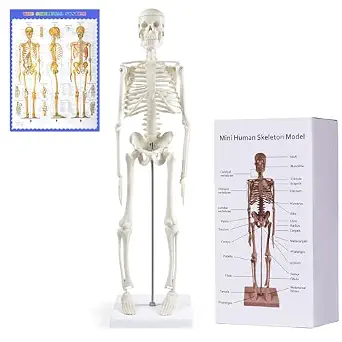 | Best Mini Skeleton for Demonstrations | Height: 17.7 inches | Base size: 4.75 x 4.75 inches | Weight: 1.08 pounds | VIEW LATEST PRICE | See Our Full Breakdown |
| Science Can Interactive Human Body Anatomy Model for Kids |  | Best for Young Beginners | Brand: Science Can | Age range: 6–12 years | Model number: 160022 | VIEW LATEST PRICE | See Our Full Breakdown |
| Human Skeleton Model for Anatomy: 17.7-inch with Movable Arms and Legs |  | Best Budget-Style Skeleton for Basic Study | Height: 17.7 inches | Base dimensions: 4.75 x 4.75 inches | Weight: 1.1 pounds | VIEW LATEST PRICE | See Our Full Breakdown |
| EVOTECH SCIENTIFIC Disarticulated Human Skeleton Model, 67 Inch Full Size |  | Best for Advanced Bone Study | Brand: EVOTECH SCIENTIFIC | Scale: 1:1 full size | Height: 67 inches | VIEW LATEST PRICE | See Our Full Breakdown |
| EVOTECH SCIENTIFIC Human Anatomy Model Set: Body, Skeleton, Heart, and Half-Size Skull with Brain |  | Best Multi-System Set | Included models: Human body, skeleton, heart, and half-size skull with brain | Skeleton height: About 17.7 inches | Torso height: About 11 inches | VIEW LATEST PRICE | See Our Full Breakdown |
| Human Anatomical Body Skeleton Heart Skull with Brain Models and Cubes Set |  | Best for Tactile Anatomy Practice | Included models: Skeleton, torso, heart, skull with brain, and anatomical cubes | Skeleton height: 17.7 inches | Torso height: 11 inches | VIEW LATEST PRICE | See Our Full Breakdown |
| Be Amazing! Toys Interactive Human Body Anatomy Figure, 60 Pieces, Ages 8+ |  | Best for Younger Beginners | Height: 14 inches | Number of pieces: 60 | Recommended age: 8 years and up | VIEW LATEST PRICE | See Our Full Breakdown |
| Human Body Deluxe Musculature Model, 17 Inch Torso with 16 Removable Parts |  | Best for Advanced Torso Study | Model type: Human torso musculature model | Dimensions: 18.1 × 8.3 inches | Removable parts: 16 | VIEW LATEST PRICE | See Our Full Breakdown |
| Learning Resources Anatomy Models Bundle Set |  | Best Four-Model Starter Set | Included models: Heart, brain, body, and skeleton | Set size: 4 models | Material: Plastic | VIEW LATEST PRICE | See Our Full Breakdown |
| anatomy models for student | Material |
|---|---|
| EVOTECH SCIENTIFIC 15-Piece Hu | Non-toxic PVC |
| 15-Piece Detachable Human Body | Plastic (implied by model type) |
| Breesky Life-Size Human Skelet | Polyvinyl chloride (PVC) |
| EVOTECH SCIENTIFIC 17-Inch Hum | Non-toxic PVC |
| Kaplan Anatomy Coloring Book w | — |
| Human Anatomy Study Cube | Plastic |
| NLShan 17" Human Skeleton Anat | Non-toxic PVC |
| Science Can Interactive Human | — |
| Human Skeleton Model for Anato | Plastic (implied) |
| EVOTECH SCIENTIFIC Disarticula | PVC plastic |
| EVOTECH SCIENTIFIC Human Anato | Plastic |
| Human Anatomical Body Skeleton | — |
| Be Amazing! Toys Interactive H | Hard plastic |
| Human Body Deluxe Musculature | Non-toxic PVC |
| Learning Resources Anatomy Mod | Plastic |
More Details on Our Top Picks
EVOTECH SCIENTIFIC 15-Piece Human Torso Anatomy Model, 11 Inch
For students who want a small, physical model to pair with textbook work, this 11-inch torso offers a useful balance of portability and removable anatomy. Its 15 pieces let learners take out and replace organs, turning basic identification into a hands-on exercise. Compared with the 17-inch EVOTECH torso, it takes up less desk and storage space, but the larger model is easier to see during a group demonstration and includes male and female anatomy. The wooden base supports display between study sessions, while the brochure adds a simple reference point. The tradeoff is scale: small structures may be harder to inspect closely, and individual pieces need careful handling. Since the parts can pose a choking risk, this is better suited to teens and older students than households with young children.
Pros:- Fifteen removable pieces support hands-on organ identification.
- Compact 11-inch format is easier to store and carry than the 17-inch EVOTECH torso.
- Wooden base and included brochure support display and basic reference.
Cons:- Small scale limits visibility for group demonstrations.
- Small removable parts need careful storage and are unsuitable around young children.
- Some components may require assembly.
Best for: High-school and introductory college students who want a portable torso model for individual desk study and basic organ identification.
Not ideal for: Teachers presenting to a large class, or households with young children who could access the small removable parts.
- Brand:EVOTECH SCIENTIFIC
- Model:Human Body Model
- Height:11 inches
- Material:Non-toxic PVC
- Removable pieces:15
- Base:Oak wooden base
- Included components:Trunk, brain, heart, esophagus and aorta, lungs, skull cap, stomach, diaphragm, liver, pancreas and spleen, intestines, educational brochure
- Recommended age:14 years and up
- Power:No power source required
Our verdict“Choose this compact torso for teen or adult students who want removable organs without giving up much desk space.”
15-Piece Detachable Human Body Anatomy Model (11 Inches)
This model suits students who benefit from a manual alongside a 15-piece detachable torso. Its 11-inch size makes it a desk-friendly alternative to the EVOTECH SCIENTIFIC 17-inch torso, while the included colorful manual and stable base give beginners support for identifying parts and keeping the model upright. The listed components include a two-part brain and four-part lungs, providing some breakdown of structures beyond a single removable organ. That makes it a practical option for home study or a small lab, though its compact scale is less effective when several students need to see the details at once. The product data describes the material only as plastic, so students who prioritize specified material details may prefer the EVOTECH model’s non-toxic PVC listing. Its smaller format also favors introductory review over close examination of fine anatomical features.
Pros:- Detachable design includes a two-part brain and four-part lungs for component-level study.
- Colorful manual supports part identification for beginners.
- Compact dimensions and stable base suit desk use and small study spaces.
Cons:- At 11 inches, details may be difficult to see in group demonstrations.
- Plastic construction is less specifically documented than the non-toxic PVC listed for the EVOTECH torso.
- Compact scale limits close study of smaller anatomical features.
Best for: Beginning anatomy students studying at home or in a small lab who want a compact model paired with an identification manual.
Not ideal for: Instructors needing a model visible across a large classroom, or buyers seeking clearly specified material construction.
- Dimensions:11 inches
- Piece count:15
- Material:Plastic (implied by model type)
- Included components:Torso, two-part brain, heart, esophagus, aorta, four-part lungs, skull, manual, base
- Manual:Colorful educational manual
- Base:Stable display base
Our verdict“Pick this model for guided, introductory desk study when a manual matters more than classroom visibility or detailed material specifications.”
Breesky Life-Size Human Skeleton Model with Nervous System and Rolling Stand
Students focused on bones and joint relationships need a different kind of teaching aid from a removable-organ torso: this 70.8-inch articulated skeleton presents anatomy at full scale, with 206 movable bones for examining structure and movement. The five-wheel stand makes it easier to reposition than a fixed display, and the three posters provide supplementary reference material. Compared with the EVOTECH 17-inch torso, this is far more suitable for whole-body skeletal study and demonstrations, but it takes up much more room and is less convenient to store. The 22-pound weight also means moving it between rooms may take effort, even with the rolling stand. PVC is described as easy to clean, though students seeking a more lifelike material feel may find it less authentic than resin or other rigid finishes.
Pros:- Full-size presentation makes body proportions and bone placement easier to relate to human anatomy.
- 206 articulated bones and movable joints support structural and movement study.
- Five-wheel rolling stand allows repositioning around a study or teaching space.
- Three included posters add reference material beyond the model.
Cons:- At 70.8 inches and 22 pounds, it needs substantial room and can be awkward to lift.
- A skeleton model does not provide the organ-focused study offered by either EVOTECH torso.
- PVC may feel less authentic than resin or other rigid model materials.
Best for: Anatomy students, tutors, and small teaching spaces that need a full-size model for studying bones, joints, and body proportions.
Not ideal for: Students with limited storage, frequent transport needs, or a primary focus on internal organs rather than the skeleton.
- Brand:Breesky
- Height:70.8 inches
- Weight:22 pounds
- Bone count:206 articulated bones
- Material:Polyvinyl chloride (PVC)
- Stand:Five-wheel rolling stand
- Included components:Skeleton model, rolling stand, three posters
- Color:Bone white and grey
Our verdict“Choose this full-size skeleton if bone and joint study is your priority and you have room for a tall, mobile display.”
EVOTECH SCIENTIFIC 17-Inch Human Torso Anatomy Model, 16 Removable Parts
Among the torso options here, this 17-inch model gives students more room to inspect removable structures than either 11-inch torso. Its 16 parts include male and female anatomy, adding a dimension that the smaller EVOTECH model does not list. Hand-painted details, an oak-wood base, and a brochure make it suitable for both study and display. Compared with the life-size Breesky skeleton, it is much easier to fit on a desk and focuses on internal anatomy rather than bones, but it cannot match the skeleton’s scale for whole-body demonstrations. The 5.02-pound weight and half-size format still make it a substantial tabletop model, not a pocket-sized study aid. Small detachable pieces also call for supervised storage around young children.
Pros:- Sixteen removable parts offer hands-on study of multiple internal structures.
- Includes male and female anatomy, unlike the listed 11-inch EVOTECH torso.
- Larger 17-inch size can make components easier to inspect at a desk.
- Oak-wood base, hand-painted details, and brochure support display and study.
Cons:- Half-size construction is less suitable than the Breesky skeleton for full-body demonstrations.
- At 5.02 pounds, it is less convenient to carry than either 11-inch torso.
- Small detachable pieces pose a choking risk to young children.
Best for: High-school, pre-med, and nursing students who want a tabletop torso with removable organs and male and female anatomy.
Not ideal for: Students who need a lightweight travel model, a full-size classroom display, or a model safe to leave within reach of young children.
- Manufacturer:EVOTECH SCIENTIFIC
- Height:17 inches
- Removable parts:16
- Material:Non-toxic PVC
- Item weight:5.02 pounds
- Base:Oak wood
- Included:Educational brochure
- Package dimensions:18.11 x 8.66 x 5.94 inches
Our verdict“Choose this larger torso for broader organ study and male and female anatomy when a tabletop model fits your space.”
Kaplan Anatomy Coloring Book with 450+ Realistic Medical Illustrations and Quizzes
This book takes a different approach from the physical models in this roundup: it gives students 450+ medical illustrations to color, with quizzes tied to the illustrations for active recall. That makes it a useful companion for labeling and reviewing anatomy away from a desk model. Unlike the EVOTECH 17-inch torso, it can cover anatomy through a large collection of images rather than removable three-dimensional organs; unlike the Breesky skeleton, it offers no articulated structure to inspect. The quiz element gives each coloring task a learning prompt, but working through detailed illustrations takes time and the book is not presented as a replacement for a full textbook. It makes the most sense as a study supplement for medical, nursing, and pre-med students, not as a standalone model or complete course resource.
Pros:- More than 450 realistic medical illustrations provide extensive visual practice.
- Quizzes paired with illustrations encourage recall rather than coloring alone.
- Book format offers a portable alternative to carrying a torso or skeleton model.
Cons:- Detailed coloring activities can take substantial study time.
- Two-dimensional illustrations cannot provide hands-on spatial learning like the EVOTECH torso models.
- Not intended to replace a full anatomy textbook.
Best for: Medical, nursing, and pre-med students who want illustration-based practice and quizzes to supplement textbook and model study.
Not ideal for: Students seeking a three-dimensional anatomy model, rapid reference, or a standalone textbook covering anatomy in full depth.
- ASIN:1506295266
- Publisher:Kaplan Test Prep
- Format:Coloring book
- Illustrations:More than 450 realistic medical illustrations
- Study features:Quizzes for each illustration
Our verdict“Choose this book as a visual-review supplement if you want quiz-backed illustration practice rather than a physical model.”
Human Anatomy Study Cube
The Human Anatomy Study Cube is a portable review aid, not a substitute for a three-dimensional model. Its folding panels cover nine body areas and systems, giving students a quick prompt for recall during commutes or short study breaks. Compared with the Science Can Interactive Human Body Anatomy Model, it takes up far less space, but it lacks removable organs, audio instruction, and quiz modes. The cube’s tactile folding action can make brief review more engaging than reading a list, while its small format limits how much detail it can display at once. Small text may be hard to read, and its plastic construction may not suit heavy, long-term handling. I’d choose it as a supplemental memory tool, rather than as a student’s main anatomy teaching model.
Pros:- Folding format is compact and easy to carry for short study sessions.
- Covers nine body areas and systems, including the brain, heart, and digestive system.
- Interactive panels offer a tactile alternative to passive reading.
Cons:- Small text can be difficult to read.
- Plastic construction may feel less durable with frequent handling.
- Does not provide three-dimensional body structures or removable parts.
Best for: Medical students and anatomy enthusiasts who want a pocketable way to revisit major body systems between classes.
Not ideal for: Students seeking life-size structure, removable parts, or large, clearly displayed labels for detailed study.
- Brand:Kits of Medicine
- Material:Plastic
- Dimensions:2.76 x 2.76 x 2.76 inches (7 x 7 x 7 cm)
- Weight:100 g
- Age range:Adult
- Body areas covered:Eye, ear, heart, lungs, brain, skin, digestive system, muscles and bones, circulatory system
Our verdict“Choose this cube for portable recall practice, but pick the Science Can model or a skeleton model for hands-on anatomical exploration.”
NLShan 17″ Human Skeleton Anatomy Model with Movable Arms, Legs & Display Stand
The NLShan 17-inch skeleton is a small, poseable display model for students who want to demonstrate basic skeletal movement without dedicating much desk space. Its joints move from shoulders to ankles, while the removable skull and spring-loaded jaw add a simple way to discuss the head. A metal support bar and base keep it upright, and the included poster offers a reference beyond the model itself. Compared with the similarly sized Human Skeleton Model for Anatomy: 17.7-inch, this version lists a poster, hand-painted finish, and a more specific joint range; neither miniature provides the scale or detail of the EVOTECH SCIENTIFIC Disarticulated Human Skeleton. Its main tradeoff is size: it works for overview and display, not close examination of fine bone features.
Pros:- Movable joints from shoulders to ankles support basic pose and movement demonstrations.
- Removable skull and spring-loaded jaw provide an entry point for discussing head anatomy.
- Metal support bar and base help keep the model upright.
- Includes a study poster and hand-painted finish.
Cons:- Miniature scale limits detail for advanced study.
- Small size may be less visible during group instruction.
- PVC construction offers less anatomical realism than a full-size skeleton.
Best for: Students who need a poseable, compact skeleton for introductory demonstrations or a small study desk.
Not ideal for: Advanced anatomy students who need full-size bone detail or a model for close examination of skeletal structures.
- Height:17.7 inches
- Base size:4.75 x 4.75 inches
- Weight:1.08 pounds
- Material:Non-toxic PVC
- Articulation:Flexible joints from shoulders to ankles
- Skull:Removable skull with spring-loaded jaw
- Included accessory:Study poster
- Model number:X-4
Our verdict“Pick the NLShan for compact, poseable demonstrations; choose the EVOTECH full-size model when scale and bone detail matter more.”
Science Can Interactive Human Body Anatomy Model for Kids
For younger learners, the Science Can Interactive Human Body Anatomy Model turns body-system basics into a hands-on activity: children can remove more than 15 parts, hear explanations, and answer quiz prompts. The included illustrated book and knowledge cards add learning material that the NLShan skeleton and Human Anatomy Study Cube do not offer as a comparable child-focused kit. Its torso-and-organ approach also covers a different need from those skeleton models, which focus on bones and movement. The tradeoff is a younger audience: at 11 inches, it is a toy-scale teaching aid rather than a detailed model for older students’ anatomy coursework. It needs three AA batteries, which are not included, and the removable pieces call for supervision around children who may put small objects in their mouths.
Pros:- Explanation and Quiz modes support guided learning and recall practice.
- More than 15 removable organs, muscles, and bones give children hands-on exploration.
- Includes a 26-page illustrated book and double-sided knowledge cards.
- Combines torso anatomy with interactive activities in one kit.
Cons:- Requires three AA batteries, which are not included.
- Small removable pieces require care around younger children.
- Toy-scale construction and age focus limit its usefulness for advanced study.
Best for: Children aged 6–12 who learn best through guided audio, quizzes, and handling removable body parts.
Not ideal for: High school, college, or medical students who need detailed anatomical scale and terminology for advanced coursework.
- Brand:Science Can
- Age range:6–12 years
- Model number:160022
- Model dimensions:11 inches
- Removable parts:More than 15 organs, muscles, and bones
- Power:3 AA batteries (not included)
- Included components:Torso model, base, 26-page illustrated book, 4 double-sided knowledge cards
Our verdict“Choose this kit for interactive elementary-level learning, but older students should look to a larger, more detailed anatomy model.”
Human Skeleton Model for Anatomy: 17.7-inch with Movable Arms and Legs
This 17.7-inch skeleton model covers the fundamentals for students who want a movable figure to assemble, pose, and keep on a desk. Its removable skull cap and moving arms and legs provide more physical reference than the flat, pocketable Human Anatomy Study Cube, but less guided material than the NLShan 17-inch skeleton, which specifically includes a study poster and describes flexible joints through the ankles. The model’s compact footprint suits introductory demonstrations, though its basic anatomical detail limits its value for learning fine bone landmarks. The description also notes jaw movement, but a removable skull cap can make handling less stable. I’d treat it as a starter visual aid, not the main resource for advanced anatomy study.
Pros:- Movable arms and legs make basic positioning and movement easier to demonstrate.
- Removable skull cap gives access to the interior of the skull.
- Compact size is practical for desks and portable educational settings.
- Designed for straightforward assembly and display.
Cons:- Basic anatomical detail limits use for advanced coursework.
- Miniature size is poorly suited to group demonstrations or close study of fine structures.
- Removable skull cap may affect stability during handling.
Best for: Students or educators seeking a small, movable skeleton for basic bone identification and simple classroom demonstrations.
Not ideal for: Learners who need advanced bone detail, a study poster, or a full-size model visible from across a classroom.
- Height:17.7 inches
- Base dimensions:4.75 x 4.75 inches
- Weight:1.1 pounds
- Material:Plastic (implied)
- Movable parts:Arms and legs
- Skull:Removable skull cap; jaw movement described
- Format:Miniature skeleton for study and display
Our verdict“This is a straightforward starter skeleton for compact study, while the NLShan is the stronger choice for a more articulated model with a poster.”
EVOTECH SCIENTIFIC Disarticulated Human Skeleton Model, 67 Inch Full Size
Students who need to examine bone structures at human scale will get more from the EVOTECH SCIENTIFIC 67-inch disarticulated skeleton than from either 17.7-inch model in this group. Its full-size format and components such as the spine with cartilage, pelvis, and articulated hands and feet give learners a closer reference for identification and art study. A laminated poster adds a labeling aid, while the disarticulated design lets students inspect separate structures rather than relying on a fixed pose. That same design is its biggest drawback: it cannot be fully assembled to show joint movement, and ribs and thoracic cartilage require specific tools for assembly. Beginners may also find the separate parts difficult to organize without guidance. I’d choose this for detailed bone study, not as an easy first introduction to the skeleton.
Pros:- Full-size 1:1 scale supports closer study than the miniature skeletons in this roundup.
- Includes a spine with cartilage, skull, pelvis, and articulated hand and foot components.
- Molded from real male skeletons to represent bone texture and structure.
- Laminated identification poster supports bone labeling.
Cons:- Disarticulated parts do not create a fully assembled model for joint-movement demonstrations.
- Ribs and thoracic cartilage require specific tools for assembly.
- Separate components can be confusing for beginners without guidance.
Best for: Advanced anatomy students, instructors, and art students who need full-size bone references for close inspection.
Not ideal for: Beginners seeking a ready-to-use articulated skeleton or students without room to store a full-size model and its separate parts.
- Brand:EVOTECH SCIENTIFIC
- Scale:1:1 full size
- Height:67 inches
- Weight:8.07 kg
- Material:PVC plastic
- Included components:Skull, spine, pelvis, articulated hand and foot
- Included accessory:Laminated identification poster
- Color:White
Our verdict“Choose this model when full-size bone detail is the priority, but select an articulated miniature for simpler demonstrations of skeletal movement.”
EVOTECH SCIENTIFIC Human Anatomy Model Set: Body, Skeleton, Heart, and Half-Size Skull with Brain
I’d choose this set when a student needs to compare several body systems without relying on a single torso model. Its four separate models cover the body, skeleton, heart, and skull with brain, while the included guides and chart give learners material to consult alongside the pieces. Compared with the Learning Resources Anatomy Models Bundle Set, this set is aimed at older students and includes a carrying case and printed reference materials; the Learning Resources set is designed for ages 8 and up and highlights movable joints and hinged heart sections. The tradeoff is scale: the 3.5-inch skull and 8-inch heart are less suited to close inspection than a larger, dedicated torso. I’d favor it for organized, portable study, not detailed lab demonstration.
Pros:- Four models introduce several anatomical structures and systems
- Includes a carrying case, chart, brochure, and model guides
- Separate models allow focused study beyond a single torso
- Compact sizes make the set easier to store and carry
Cons:- The 3.5-inch skull and other smaller pieces limit close inspection
- Recommended age of 14 and up excludes younger learners
- Multiple small models may be less useful than a larger torso for studying organ placement in the body
Best for: Students aged 14 and up who want a portable collection spanning skeletal, cardiac, and whole-body anatomy, with guides for independent study.
Not ideal for: Younger children or students who need large, close-up models for detailed classroom demonstrations.
- Included models:Human body, skeleton, heart, and half-size skull with brain
- Skeleton height:About 17.7 inches
- Torso height:About 11 inches
- Heart height:About 8 inches, including base
- Skull size:About 3.5 inches
- Material:Plastic
- Recommended age:14 years and up
- Included accessories:Carrying case, anatomy brochure, skeleton chart, heart manual, and skull manual
Our verdict“Choose this portable set if an older student wants guided study across several anatomy topics and can work with compact models.”
Human Anatomical Body Skeleton Heart Skull with Brain Models and Cubes Set
The extra anatomical cubes give this set a different study angle from the EVOTECH SCIENTIFIC Human Anatomy Model Set: both include a skeleton, heart, and skull with brain at similar compact sizes, but this set adds cube-shaped pieces for hands-on exploration. Manuals, illustrations, and a carrying case make it a plausible choice for students who want a portable set with several forms to handle. Its 17.7-inch skeleton and 11-inch torso also keep the main models at a manageable desk scale. I’d rank it below a dedicated torso for organ-by-organ study: the skull is just 3.5 inches, and the product information warns that detailed craftsmanship may make pieces fragile. The listed bases and finish sound decorative as well as educational, which may not suit rough everyday handling.
Pros:- Combines skeleton, torso, heart, skull with brain, and anatomical cubes
- Includes manuals and illustrations to support independent learning
- Carrying case supports storage and transport
- Compact dimensions suit desk-based study
Cons:- The 3.5-inch skull and other small components restrict fine-detail study
- Detailed craftsmanship may make models more vulnerable to damage
- Several separate pieces may be less direct for learning how organs fit within a torso
Best for: Students who want a portable, hands-on assortment of body models and cubes for supplementary anatomy practice at a desk.
Not ideal for: Learners who need large anatomical parts, robust pieces for frequent handling, or a single detailed torso for focused organ study.
- Included models:Skeleton, torso, heart, skull with brain, and anatomical cubes
- Skeleton height:17.7 inches
- Torso height:11 inches
- Heart height:8 inches
- Skull with brain size:3.5 inches
- Anatomical cube size:2.76 inches
- Materials:Hand-painted craftsmanship; crystal, oak, and plastic bases
- Included accessories:Carrying case, manuals, and detailed illustrations
Our verdict“Pick this set for varied, portable handling activities, but choose a dedicated torso if close study of internal anatomy is the priority.”
Be Amazing! Toys Interactive Human Body Anatomy Figure, 60 Pieces, Ages 8+
For a younger student, the appeal here is active assembly rather than display: this 14-inch articulated figure has 60 removable pieces representing bones, muscles, and organs. The poseable form and adjustable stand let learners handle parts and see how they relate to a body-shaped model, while illustrated instruction cards offer a starting point for guided exploration. Compared with the Human Body Deluxe Musculature Model, which is aimed at adults and medical students and has 16 removable parts, this figure is more approachable for children but offers less of a large, stable study surface. Its hard-plastic construction and many separate components call for careful organization; the provided information doesn’t specify storage or the level of detail in the instructions. I’d choose it for introductory, hands-on learning, not advanced anatomical reference.
Pros:- 60 removable pieces encourage hands-on exploration
- Includes bones, muscles, and organs in one body-shaped figure
- Articulated design can be posed on an adjustable stand
- Illustrated instruction cards support beginner study
Cons:- At 14 inches, the model may be small for group demonstrations
- Many separate parts can be misplaced and require careful handling
- The beginner-oriented format may not provide enough detail for advanced study
Best for: Children aged 8 and up who learn by assembling and posing a model, especially in a homeschool or introductory science setting.
Not ideal for: Older students seeking a durable, detailed reference for advanced anatomy or a large torso for classroom demonstrations.
- Height:14 inches
- Number of pieces:60
- Recommended age:8 years and up
- Model design:Articulated and poseable
- Removable parts:Bones, muscles, and organs
- Material:Hard plastic
- Included accessories:Adjustable stand and illustrated instruction cards
Our verdict“Choose this figure for a child who will learn more from assembling and handling anatomy than from a static display model.”
Human Body Deluxe Musculature Model, 17 Inch Torso with 16 Removable Parts
This is the most focused choice here for students who need to study a torso in greater depth. Its 16 removable parts include the heart, head, skull, and brain, and the hand-painted PVC model sits on an oak-wooden base for stable indoor display. Compared with the Be Amazing! Toys Interactive Human Body Anatomy Figure, which has 60 pieces and targets ages 8 and up, this model is aimed at adults and medical students, with a more substantial torso format rather than a child-oriented assembly activity. That focus comes with tradeoffs: it weighs 2.38 kg, making it less convenient to move, and the primarily red color palette may be less helpful for learners who prefer strong color coding. I’d choose it for a stationary study space, not a portable student kit.
Pros:- Sixteen removable parts support focused torso study
- Includes heart, head, skull, and brain components
- Oak-wooden base provides a stable display platform
- Non-toxic PVC is described as durable and easy to clean
Cons:- At 2.38 kg, it is less convenient to transport between classrooms
- Primarily red coloring may make structures harder to distinguish for some learners
- A single torso offers less breadth than multi-model sets such as the EVOTECH SCIENTIFIC Human Anatomy Model Set
Best for: Adult learners and medical students who want a stable, torso-centered model with removable structures for individual or small-group study.
Not ideal for: Younger students, learners who need a portable model, or buyers seeking multiple separate models covering different body systems.
- Model type:Human torso musculature model
- Dimensions:18.1 × 8.3 inches
- Removable parts:16
- Material:Non-toxic PVC
- Base material:Oak-wooden
- Weight:2.38 kg
- Usage:Indoor
- Target audience:Adults and medical students
Our verdict“Choose this model for stable, detailed torso study when portability and a multi-system collection matter less.”
Learning Resources Anatomy Models Bundle Set
I’d put this bundle on a younger student’s shortlist because its four models combine hands-on features with a recommended age of 8 and up. The movable skeleton joints and hinged heart sections give learners something to manipulate, while the body and brain extend the set beyond a single anatomy topic. Compared with the EVOTECH SCIENTIFIC Human Anatomy Model Set, this one is explicitly pitched to younger learners and calls out interactive parts, while EVOTECH includes a carrying case and several printed guides and is recommended for ages 14 and up. The tradeoff is that the available product details don’t give dimensions or piece counts, making it harder to judge scale and complexity before choosing. I’d favor it for introductory classroom or homeschool activities rather than older students seeking detailed reference material.
Pros:- Four models cover the heart, brain, body, and skeleton
- Movable skeleton joints encourage exploration of articulation
- Hinged heart sections provide a hands-on way to study the heart
- Designed for classroom, homeschool, and individual use
Cons:- Product details do not specify model dimensions or piece counts
- Recommended age of 8 and up may not suit younger children
- The beginner-focused set may be less useful for advanced anatomy study
Best for: Families and teachers introducing anatomy to learners aged 8 and up who benefit from handling and assembling models.
Not ideal for: Older students who need detailed, large-scale models or buyers who want published dimensions and a clearly specified number of parts.
- Included models:Heart, brain, body, and skeleton
- Set size:4 models
- Material:Plastic
- Recommended age:8 years and up
- Skeleton feature:Movable joints
- Heart feature:Hinged sections
- Display:Display stands included
Our verdict“Choose this bundle for an age-appropriate, interactive introduction to several anatomy topics, especially in a home or classroom setting.”

How We Picked
I compared the 15 options by how well they support active study, not by how many parts or accessories they list. The main criteria were anatomical coverage, visibility of structures, whether parts can be removed or moved for hands-on review, scale and storage needs, and how readily the format fits a student’s study level. I also separated physical models from learning tools such as the coloring book and study cube, since those support different kinds of practice.
The ranking favors useful, focused learning tools that can fit into regular study routines. Compact torso models rank highly for their balance of manipulable anatomy and manageable size; larger skeletons rank higher for whole-body structure or classroom display, but lower for portability. Bundles can offer broader coverage, yet they rank behind a strong single-purpose model when the extra pieces may not match a student’s course. Kid-oriented products can be a good entry point, but they are not interchangeable with models intended for deeper study.
Factors to Consider When Choosing Anatomy Models For Students
Before choosing, match the model to the learning task rather than buying the largest set. A student reviewing organ placement needs a different tool from someone learning bone landmarks, muscle groups, or terminology. The points below help narrow the choice before you compare individual models.
Match the model to the course
Start with the topics the student will need to identify, explain, or label. A torso helps with organ location and relationships, while a skeleton is better for bone structure and joint movement; a musculature model supports a different unit again. A general body kit may touch on several systems without giving any one of them enough depth for a demanding course. Check the class syllabus or study objectives before selecting a broad set. A common mistake is buying a visually impressive model that does not represent the structures the student is expected to learn.
Choose detail that suits the learner
More removable pieces can support close inspection, but they also add parts to handle, sort, and keep track of. Younger learners may benefit from larger, simpler components and an interactive format, while older students may need more anatomical specificity and terminology. Ask whether the learner will use the model independently or with a teacher who can explain unfamiliar structures. Avoid assuming that a higher part count means better instruction; the pieces need to serve a clear learning goal. A model that is easy to revisit can be more useful than one that is detailed but rarely taken out.
Plan for available space and handling
Scale affects more than appearance: it changes what can be seen, where the model can be stored, and whether it can be used at a desk. Small torsos and skeletons are easier to put away, but tiny structures may be harder to inspect closely. Life-size models can support group teaching, yet they need floor space and a stable place to stand. Think about who will move the model and how often, especially if it has loose or articulated parts. Measure the intended study or display area before choosing a full-size option.
Treat bundles as a curriculum choice
A multi-model set can reduce the need to buy separate tools, but only if its components cover the student’s actual subjects. A torso, skeleton, heart, skull, and brain set offers a wider range of physical references than a single model, while a cube or book provides a different kind of study activity. Compare the bundle contents with the required course topics instead of focusing on the number of items. Duplicate or lightly used pieces can take up space without improving learning. For a student focused on one unit, a well-matched individual model may be the more practical choice.
Balance hands-on models with active recall
A model helps students see spatial relationships, but recognition alone does not prove they can name or explain a structure. Pair physical study with labeling from memory, drawing, quizzes, or short verbal explanations. A coloring book can support visual recall, while movable parts help students test where structures fit. Choose a model that leaves room for active practice rather than treating it as a display object. If the student already has strong visual resources, a more interactive model may add more than another static reference.
Check maintenance and part management
Removable and movable pieces make a model more interactive, but they also create a storage and care routine. Consider whether the student has a safe place to keep small parts and whether the model will be shared by several people. A simple labeled container or dedicated shelf can prevent pieces from getting separated from the model. For classroom use, durability and ease of reassembly may matter more than the finest detail. Avoid choosing a complex set unless someone can keep its components organized between study sessions.
Frequently Asked Questions
Is a torso model or a skeleton model a better first purchase for a student?
Choose a torso if the student’s immediate work centers on internal organs and their positions within the body. Choose a skeleton if bone names, structure, or movement are the main learning goals. Neither one replaces the other, so course content should decide which comes first. If the student is exploring anatomy before choosing a specialty, a manageable torso can offer a broad introduction, while a skeleton makes more sense for lessons focused on bones. A combined set is useful only when the student will work with both systems.
Will a kids’ anatomy kit work for a high school or college student?
It depends on the depth of the course and the purpose of the kit. Interactive products designed for children can make basic body concepts approachable, but they may not provide the detail or terminology expected in advanced classes. For high school or college study, check whether the model supports the structures and level of identification required by the syllabus. A simpler kit can still work as a supplement or for explaining fundamentals to younger learners. It should not be the only study reference when coursework demands more precise anatomy.
Should I choose a larger model if it has more visible detail?
A larger scale can make parts easier to see, especially during demonstrations or group study, but it also takes more room to set up and store. Consider where the student will use it most often: a desk, a shared classroom, or a dedicated study area. A model that is too large to keep accessible may get less use than a compact option. Also check whether the extra scale improves visibility of the specific structures the student needs to learn. Size should solve a practical study problem, not serve as the only measure of usefulness.
Are anatomy coloring books and study cubes useful alongside physical models?
Yes, because they support different kinds of practice. A physical model helps with three-dimensional relationships and the placement of structures, while coloring, labeling, and quiz activities can strengthen recall. These tools work best when the student uses them to identify structures without relying on a diagram or model every time. They are less useful as substitutes for a physical reference when the course requires spatial understanding. If choosing between formats, base the decision on whether the student needs hands-on exploration or more structured review.
What should I check before buying a model with removable parts?
Check whether the pieces are clearly distinguished, whether the model is intended to be disassembled regularly, and how the parts can be stored between sessions. Think about the student’s age, dexterity, and likelihood of using the model in a shared setting. A removable-part design supports hands-on identification, but loose pieces can be misplaced or reassembled incorrectly. If the model will be used for class demonstrations, a simple routine for packing and checking components can help. Choose added complexity only when it supports the student’s actual study tasks.
Conclusion
For most students seeking one physical reference for regular study, I’d choose the EVOTECH SCIENTIFIC 15-Piece 11-Inch Torso as the best overall balance of manipulable anatomy and manageable size. The 15-Piece Detachable Human Body Model is a value-minded alternative for learners who want a similar compact torso format, while the EVOTECH 17-Inch Torso is a stronger fit for students who prefer a larger view of removable parts. For a premium, room-based teaching setup, the Breesky Life-Size Skeleton with Nervous System and Rolling Stand stands apart; beginners and younger learners may prefer the approachable Science Can Interactive Human Body Model or the Be Amazing! Toys Interactive Figure. For focused needs, choose the musculature model for muscle study, the Kaplan book for drawing and quizzes, or a multi-model set when the student will use its range of references. The best choice is the one that matches the course, learner, and available study space—not simply the one with the most pieces.
Halloween Picks
halloween
As an affiliate, we earn on qualifying purchases.