
TL;DR

Prime made for students and young adults
- Fast, free delivery for dorm and study essentials
- Prime Video and Amazon Music included
- Member-only deals
IdeaClyst is a local-first, AI-powered platform that acts as a war room for your ideas. It helps founders validate, critique, and organize their best concepts while keeping everything private and ownership intact. It’s a game-changer for making smarter, faster decisions.
Imagine having a dedicated war room for your ideas—an environment where your smartest concepts are challenged, refined, and prepared for action. Not a physical space, but a digital hub that funnels your creativity through a rigorous, collaborative process. That’s what IdeaClyst offers—a private, local-first platform that turns your brainstorms into actionable plans.
In a world where startups fail mostly because they build for markets that don’t exist, having a clear, validated path from idea to execution is gold. This tool isn’t just about capturing ideas; it’s about turning them into strategic decisions grounded in real research and honest critique. Ready to see how it works? Let’s step inside the digital war room that might just change how you innovate.
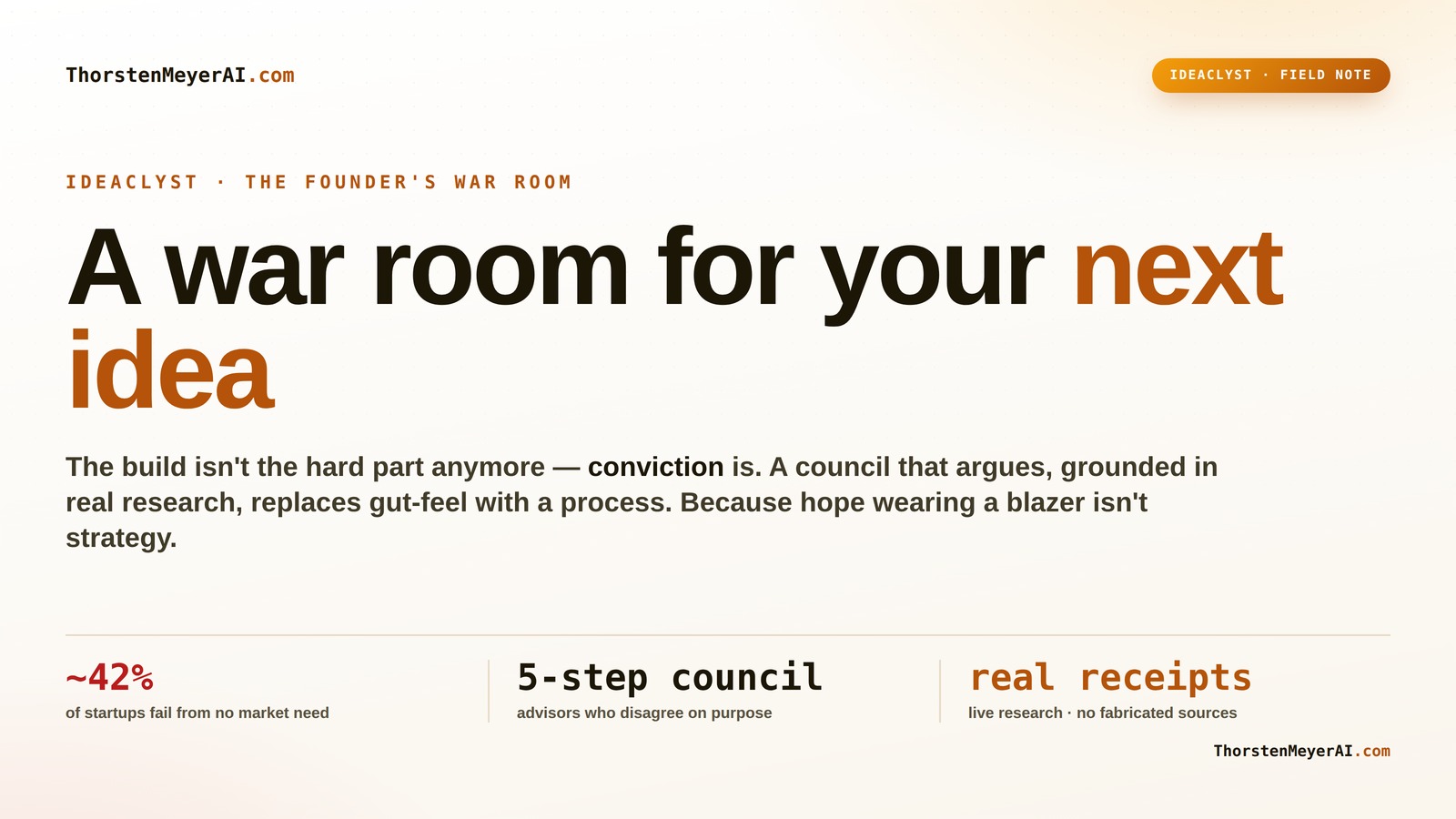
A war room for your next idea
The build isn’t the hard part anymore — conviction is. Knowing which idea deserves the next six months, and being able to defend it. Most founders answer with gut feel and optimistic math. That’s hope wearing a blazer. IdeaClyst replaces it with a process.
The most expensive decision is what to build
The single most valuable thing a tool can do is talk you out of the wrong six months. The numbers make the case better than any pitch.
Three tools in one — on your own machine
Strip away the framing and IdeaClyst is three things at once, all running locally with nothing leaving your laptop.
An AI council
Pressure-tests an idea you bring it — advisors who argue on purpose.
A discovery engine
Finds ideas you didn’t know to look for by hunting real demand signals.
A founder’s workspace
Carries winners from “interesting” all the way to “ready to build.”
Advisors who disagree on purpose
Not one confident, agreeable answer — a structured five-step deliberation where models play different roles and turn on their own work. The disagreement is the feature.
The five-step deliberation
A council that leads with the bad news surfaces the objections you’d otherwise find the expensive way, on month five.
Product strategy
Who’s it for, what’s the wedge, why now, what’s the business model.
Technical architecture
What would it actually take to build — and where’s the risk.
Critique pass
The council turns on its own work. Where’s the hand-waving? What kills this?
Second, independent critique
A different voice, a different angle — so blind spots don’t survive.
Final synthesis
Everything into one coherent founder packet: strategy, architecture, validation, plan.
When IdeaClyst cites a source, it actually fetched it
The hard departure from “ask an AI what it thinks of my startup.” It runs in a strict, real-data-only mode — if it can’t gather genuine evidence, it says so plainly rather than inventing a plausible paragraph.
Confidence with receipts
No fabricated statistics, no imaginary competitors, no made-up citations. The packet survives a skeptical co-founder or a sharp investor because the reasoning has receipts.
Market research first
Scouts the landscape before the council reasons about anything.
Competitor read
Real positioning, pricing signals, feature claims — differentiation vs. reality.
Validation with links
Not “talk to customers” — concrete signals & sources you can click.
From the blank page to build-ready
Evaluation is half the problem; the blank page is the other half. And a plan is worthless if it dies in a tab you never reopen.
Bring a space, not an idea
“AI for accountants,” “tools for indie game studios” — plus your goal and real capacity. It hunts demand signals across HN, Reddit, Product Hunt, GitHub, pricing pages.
- An honest market read — leads with the bad news when a space is hard
- An opportunity map — high pain, thin competition
- Ranked candidates — wedge, who pays, effort, risk, confidence
- each with KILL CRITERIA — when to walk away
A home and a forward path
Every promising idea gets carried forward, with every artifact in plain files on your disk.
- Validation tooling — sprint board, interview list, evidence browser
- Founder profile — a personal-fit lens; same discovery, different advice
- Build workspaces — funnel, personas, landing draft, version history
- “Build this idea” → a PRD + task queue, ready for a coding agent
Key Takeaways
- IdeaClyst acts as a private, local-first digital war room for testing and refining ideas with a structured AI council.
- Its five-step workflow—idea input, debate, critique, synthesis, and storage—accelerates decision-making and reduces risky investments.
- Grounded in real research, not model vibes, it ensures validation is based on evidence, not just confidence.
- The platform is flexible for physical, digital, or hybrid setups, making it adaptable for remote teams.
- Using IdeaClyst can cut validation time from months to days, saving thousands of dollars and preventing costly missteps.
private digital brainstorming platform
As an affiliate, we earn on qualifying purchases.
As an affiliate, we earn on qualifying purchases.
What is IdeaClyst? Your Personal Digital War Room for Ideas
IdeaClyst is a local-first platform designed for founders and teams hungry to turn raw ideas into validated plans. Think of it as your personal war room—where ideas are debated, critiqued, and refined by a structured AI council. Unlike typical brainstorming tools, it pushes ideas through multiple lenses: strategy, tech risk, market critique, and more.
For example, a founder considering a new SaaS product can bring their initial concept—”a platform that automates onboarding for remote teams.” IdeaClyst’s council then tests this idea from different angles: who’s the customer? What’s the technical challenge? What could kill it? And it writes a clear report, all stored securely on your own machine.
collaborative idea validation software
As an affiliate, we earn on qualifying purchases.
As an affiliate, we earn on qualifying purchases.
How Does IdeaClyst Turn Ideas Into Action? The Workflow Breakdown
At its core, IdeaClyst guides you through five clear steps:
- Input your idea: Write a sentence or paragraph describing your concept.
- Council deliberation: Five AI agents debate your idea, each taking a different role—strategy, tech risk, market critique, etc.
- Critique and refine: The council finds holes, assumptions, or risks, pushing you to think deeper.
- Final synthesis: The AI consolidates feedback into a comprehensive founder report, with clear next steps.
- Store and version: All reports are saved locally as Markdown files, so you own every piece of your decision.
This process helps you avoid the common trap—thinking an idea is good just because it sounds promising. Instead, you get concrete, actionable insights, fast.
As an affiliate, we earn on qualifying purchases.
Why Founders Love IdeaClyst: Real Examples of Impact
Take Sarah, a SaaS founder, who used IdeaClyst to validate her idea for an AI-driven customer success platform. Instead of spending three months and $30,000 on surveys and consulting, she brought her concept into the war room. The council flagged a key assumption about customer willingness to pay—saving her months of potential dead-end development.
Or consider Mike, developing a new e-commerce feature, who used the platform to explore technical risks. The detailed critique led him to tweak his architecture plan, avoiding costly rework after launch. These founders gained clarity, saved money, and accelerated their path to market.
As an affiliate, we earn on qualifying purchases.
Setup Options: Physical, Digital, or Hybrid—What Works Best?
While traditional war rooms are physical spaces, IdeaClyst offers a flexible digital alternative. It’s a portable, private workspace that lives entirely on your laptop. You can set it up as a dedicated project folder, customize your reports, and access it offline anytime. For teams working remotely, this means a shared digital war room accessible from anywhere.
Some teams even combine physical whiteboards with IdeaClyst’s reports, printing key outputs or hanging printed reports in their physical space. The result? A hybrid approach that keeps everyone aligned, whether remote or in-office.
The Real Benefits of Using a War Room Like IdeaClyst
Speed tops the list. Instead of waiting weeks for market research, you get instant feedback from the AI council—making your decision cycle faster. For example, a startup that typically spends 3-6 months validating ideas can cut that down to just days.
Next is alignment. Everyone on your team sees the same structured critique, reducing miscommunication. Accountability improves because every idea has a documented critique and plan, visible and versioned.
And there’s a boost in creativity. The structured debate pushes you to think beyond your initial assumptions, opening doors to opportunities you might overlook. It’s like having a panel of expert advisors on call, always ready to challenge your thinking.
Common Pitfalls When Setting Up a Digital War Room (And How to Avoid Them)
Many founders make the mistake of overcomplicating their setup or neglecting upkeep. A cluttered war room becomes overwhelming—like a messy desk. Keep your idea files organized and update critiques regularly.
Another mistake: relying solely on AI without human input. Remember, IdeaClyst enhances your judgment, not replaces it. Use it as a sparring partner, not the oracle.
Lastly, avoid the trap of overconfidence. A strong critique doesn’t mean your idea is ready; it’s a tool to refine your thinking before committing resources. The goal is continuous, honest debate—like a good coach pushing you to do better.
Your Next Step: Building a Smarter Idea Process Today
Start by setting up your own IdeaClyst workspace—download it, install it, and create your first idea report. Use the structured council to critique it from multiple angles. Document every step as Markdown files on your computer.
Then, integrate this process into your regular planning cycle—weekly idea reviews, monthly strategy sessions. The goal: make your decision-making faster, more honest, and less risky.
In a landscape where building the wrong thing can cost over $150,000 and months of effort, having a robust war room system isn’t just smart—it’s essential.
Frequently Asked Questions
Is IdeaClyst a physical space or a software tool?
IdeaClyst is a software platform that runs entirely on your local machine. It’s a digital war room where you can organize, critique, and refine ideas privately—no physical space required.How does IdeaClyst help validate ideas faster?
By providing a structured AI council that critiques your idea from multiple perspectives, it accelerates the validation process from months to days—saving time and money while improving decision quality.Can remote teams use IdeaClyst effectively?
Yes, since it’s a portable, offline tool stored on your own machine, remote teams can collaborate seamlessly. They can share files, critique ideas, and keep everyone aligned without relying on cloud platforms.What makes IdeaClyst different from other idea management tools?
Its structured AI council that stages disagreement and critique, grounded in real research, and local-first ownership make it unique. It’s designed for founders who want honest feedback, not just agreement.What are common mistakes to avoid when using a digital war room?
Avoid clutter and overcomplication, don’t rely solely on AI without human judgment, and keep critiques honest and ongoing. Regular upkeep ensures your war room remains a powerful decision-making hub.Conclusion
Think of IdeaClyst as a digital battleground where your best ideas face honest, structured scrutiny. It’s a private, flexible war room that keeps your thinking sharp and your plans solid. If you’re serious about building for the right market, this tool might be your secret weapon.
Every great leader needs a war room. For your next big idea, make it digital. Make it yours. And never build blindly again.
Halloween Picks
halloween
As an affiliate, we earn on qualifying purchases.