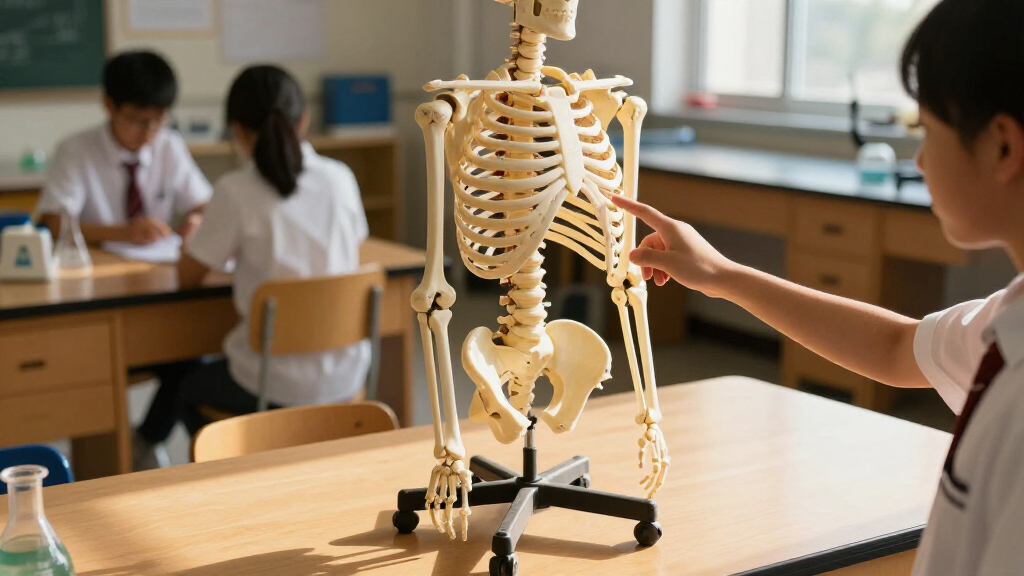
Human skeleton models for students range from small desktop aids to full-size teaching figures, and the right choice depends on study space, detail, and how often the model needs to move. My best overall pick is the Axis Scientific Life Size Skeleton Model for Anatomy Study for students who want a full-scale study model without making charts or extra systems the main attraction. The 70.8-inch model with muscles, ligaments, and nervous system adds broader anatomical context, while the Axis Scientific Mini suits a crowded desk or a portable study setup. The main tradeoff is between life-size visibility and compact convenience, with added features sometimes bringing more complexity than a beginner needs. Read on for the full comparison, selection criteria, and advice by student type.

Prime made for students and young adults
- Fast, free delivery for dorm and study essentials
- Prime Video and Amazon Music included
- Member-only deals
Key Takeaways
- Full-size models make anatomical relationships easier to read at a glance: the 70.8-inch options offer a different learning experience from the 17.7- to 33.5-inch desktop models, but need dedicated floor space.
- Extra anatomy can help students connect systems: models showing muscles, ligaments, or the nervous system provide more context than a basic skeleton, though they may be more than a first-time learner needs.
- Compact models are practical for personal study: the Axis Scientific Mini and other desktop choices fit tighter spaces, but smaller bones and joints can be harder to inspect closely.
- Stand design affects day-to-day use: rolling stands suit classrooms where the model moves between lessons; desktop stands and fixed displays make more sense for a stable home study spot.
- Special-purpose kits are not interchangeable with anatomy models: the glow-in-the-dark GobiDex kit is oriented toward an engaging science activity, while the disarticulated full-size model supports hands-on bone arrangement.




| human skeleton models for student | Material | Weight | Height |
|---|---|---|---|
| GobiDex Human Body Skeleton Mo | Plastic | — | — |
| 70.8-inch Human Anatomy Skelet | PVC | 20 pounds | 70.8 inches |
| Breesky Scientific Human Skele | Metal (listed); description also notes plastic parts | — | 33.4 inches |
| 70.8" Life-Size Human Skeleton | PVC | 23.3 pounds | 70.8 inches |
| Axis Scientific Mini Human Ske | Metal | 5 pounds | 31 inches |
| NLShan Life-Size Human Skeleto | Cast from a real human specimen | 21.6 pounds | 70.8 inches |
| Axis Scientific Life Size Skel | Medical-grade PVC | 24.6 pounds | Approximately 5 feet 6 inches |
| Human Skeleton Model Mini 33.5 | PVC, ABS, and SST | 2.2 pounds | — |
| Human Skeleton Model for Anato | PVC | 22.4 pounds | 70.8 inches |
| NLShan Human Skeleton Model fo | Non-toxic PVC | 1.08 pounds | — |
| Disarticulated Human Skeleton | PVC | 8.07 kg | 67 inches |
| Breesky Human Skeleton Model f | Plastic (implied) | 1.1 pounds | 17.7 inches |
| 17.72 Inch Mini Skeleton Anato | Hard PVC | 1.08 pounds | — |
| Human Body | Plastic | — | — |
| Breesky Life-Size Human Skelet | Polyvinyl chloride (PVC) | 22 pounds | 70.8 inches |
More Details on Our Top Picks
GobiDex Human Body Skeleton Model Kit, Glow in The Dark Science Kit for Kids
For students just starting to learn anatomy, I’d choose the GobiDex kit over a display model because children assemble the 40 pieces themselves, then can take them apart and repeat the process. Its 12.6-inch size is manageable for a desk or home study area, and glow-in-the-dark bones add a playful visual cue that can help keep younger learners engaged. The included colorful manual extends the activity beyond bone names to muscles and organs. Compared with the Axis Scientific Mini Human Skeleton, GobiDex is more clearly aimed at children and hands-on introductory learning, while Axis is a larger study display with a landmark manual. The tradeoff is depth: this kit covers basic anatomy, not the detail a student needs for advanced coursework, and small parts call for adult oversight with younger children.
Pros:- 40-piece kit encourages hands-on assembly and repeat practice
- Glow-in-the-dark bones add a memorable visual feature
- Colorful manual introduces anatomy, muscles, and organs
- Compact size suits a child’s desk or home study space
Cons:- Basic anatomical detail is limited for advanced study
- Small components require supervision for younger children
- At 12.6 inches, it is less useful for demonstrating anatomy to a group
Best for: Children ages 8–16 who are beginning anatomy or STEM activities and want an assembly-based learning project.
Not ideal for: Secondary or college students who need a detailed reference model, or classrooms seeking a full-size skeleton for group demonstrations.
- Size:12.6 x 5.71 x 3.15 inches
- Material:Plastic
- Number of pieces:40
- Age range:8–16 years
- Theme:Model kit, STEM, science kit
- Bone feature:Glow-in-the-dark
- Included learning material:Colorful manual covering anatomy, muscles, and organs
Our verdict“Choose GobiDex for an engaging first anatomy project for children, not as a detailed classroom reference.”
70.8-inch Human Anatomy Skeleton Model with Muscles, Ligaments, and Nervous System
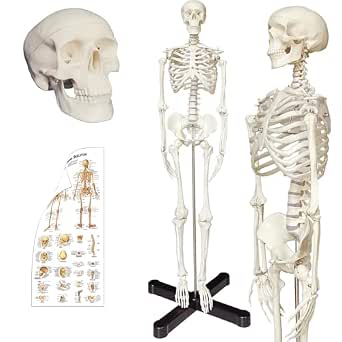
Among these options, I’d place this model first for students who need a broad, life-size teaching aid rather than a compact desk reference. Its 70.8-inch frame gives a class a more natural sense of scale, while the added muscles, ligaments, and nervous system connect the skeleton to surrounding structures. A removable skull cap, detachable teeth, movable jaw, and hinged limbs support demonstrations that the smaller Breesky 33.4-inch model cannot match as easily from across a room. The rolling metal stand helps with repositioning, though its 20-pound weight still makes frequent transport less convenient than a tabletop model. Removable parts also add useful teaching flexibility but call for careful handling and storage. I’d pick it for a dedicated classroom or lab, not for a student needing a low-footprint personal study model.
Pros:- Life-size height supports full-class demonstrations
- Muscles, ligaments, and nervous system broaden study beyond bones
- Removable skull cap, teeth, and movable jaw aid focused instruction
- Rolling stand and educational illustrations support classroom use
Cons:- 20-pound weight makes frequent moving cumbersome
- Large footprint is poorly suited to small study spaces
- Removable components need careful handling during use and storage
Best for: Anatomy instructors and advanced students who need a life-size model with several body systems for classroom demonstrations.
Not ideal for: Students with limited floor space or those who need to carry a model regularly between classes.
- Height:70.8 inches
- Material:PVC
- Weight:20 pounds
- Stand:Metal stand with wheels
- Skull:Removable skull cap and movable jaw
- Teeth:Detachable
- Additional features:Muscles, ligaments, nervous system, hinged limbs, and dust-proof cover
- Learning materials:Educational charts and illustrations
Our verdict“Choose this model for a dedicated teaching space where life-size scale and multiple anatomical systems matter more than portability.”
Breesky Scientific Human Skeleton Model for Anatomy, 33.4” Skeleton with Metal Stand, Removable Arms & Legs, Educational and Halloween Decor
The Breesky’s main advantage is its 33.4-inch scale: it is easier to place and handle than the full-size rolling models, yet more visible than the 12.6-inch GobiDex kit. The listing describes it as cast from a real specimen and gives it full articulation with removable arms and legs, making it a useful middle ground for students who want to pose and examine the body without dedicating a large area to a life-size figure. It is also described as easy to assemble, which suits a display that may be set up for lessons and packed away afterward. Compared with the Axis Scientific Mini Human Skeleton, the Breesky is slightly taller, while Axis specifies a removable skull cap and includes a study manual. Breesky’s adult-use designation and limited detail make it a weaker fit for younger learners or advanced anatomy study.
Pros:- Mid-size format balances visibility with easier placement than life-size models
- Articulated body and removable arms and legs support posing and study
- Designed for assembly and disassembly
- Description identifies it as cast from a real specimen
Cons:- Adult-use designation makes it a poor choice for children
- Smaller than life-size models for whole-class demonstrations
- Plastic parts may be less durable over time
Best for: Adult students or educators seeking an articulated, mid-size skeleton for tabletop demonstrations and display.
Not ideal for: Children, students who need a full-size classroom reference, or learners seeking a detailed manual and advanced anatomical labeling.
- Height:33.4 inches
- Material:Metal (listed); description also notes plastic parts
- Age range:Adult
- Number of items:1
- Articulation:Fully articulated
- Removable parts:Arms and legs
- Model number:85cm-3
- UPC:795274310022
Our verdict“Choose Breesky if you want a poseable mid-size model for adult study or display without a life-size footprint.”
70.8″ Life-Size Human Skeleton Model with Nervous System & Charts
This life-size model is the stronger pick when lessons focus on how the skeleton relates to the nervous system and carotid arteries. Its 70.8-inch height matches the classroom scale of the other full-size model in this lineup, but the listed emphasis on these structures and the included color charts and poster gives students extra visual support for identification. A rolling stand and dust-proof cover also make it more practical as a shared teaching resource than a stationary display. Compared with the 70.8-inch model with muscles and ligaments, this one is specified at 23.3 pounds and foregrounds nervous-system detail rather than those added structures. That makes the intended lesson focus clearer, but the weight and large package make setup and storage demanding. I’d reserve it for a classroom with room to keep it assembled, rather than a student’s small study area.
Pros:- Life-size form supports realistic classroom demonstrations
- Nervous-system and carotid artery details extend study beyond the skeleton
- Rolling stand and dust-proof cover suit shared classroom storage
- Color illustrations, assembly instructions, and poster support lessons
Cons:- 23.3-pound weight can make setup and moving difficult
- Large package and full-size frame need substantial storage space
- Its added detail may be more than an introductory student needs
Best for: Anatomy teachers and students studying skeletal structures alongside the nervous system and carotid arteries.
Not ideal for: Learners with little floor or storage space, or anyone who needs to move a model often without help.
- Height:70.8 inches
- Material:PVC
- Weight:23.3 pounds
- Package dimensions:35.2 x 15.25 x 9.7 inches
- Structures:Nervous system and carotid arteries
- Features:Movable joints, removable skull cap, and detachable teeth
- Stand and cover:Rolling stand and dust-proof cover
- Included learning materials:Color illustrations, assembly instructions, and color poster
Our verdict“Choose this model when nervous-system study and included visual aids justify the space and handling demands of a life-size display.”
Axis Scientific Mini Human Skeleton Model with Metal Stand
For a student who wants a model close at hand, I’d favor the Axis Scientific over either 70.8-inch option: at 31 inches and 5 pounds, it is far easier to place on a desk or move between study areas. Its fully articulated joints, removable limbs, and removable skull cap let learners inspect and reposition parts, while the included full-color manual identifies anatomical landmarks. Compared with the similarly mid-size Breesky 33.4-inch model, Axis is a little shorter but specifies the skull cap and study manual, which makes its study purpose more explicit. The compromise is scale: it cannot give a class the same life-size perspective, and the manual may not go far enough for advanced coursework. I’d choose it for individual study and small-group demonstrations, not as the sole model for a large anatomy classroom.
Pros:- 31-inch size and 5-pound weight are easier to handle than life-size models
- Fully articulated joints allow students to explore movement
- Removable limbs and skull cap support closer inspection
- Full-color manual highlights anatomical landmarks
Cons:- Compact scale is less effective for whole-class demonstrations
- Study manual may be insufficient for advanced anatomy
- Does not provide the life-size perspective of the two 70.8-inch models
Best for: Students who need a portable, articulated model with labeled landmarks for regular desk-side anatomy study.
Not ideal for: Teachers needing a life-size demonstration model or advanced learners who require extensive written reference material.
- Height:31 inches
- Weight:5 pounds
- Material:Metal
- Articulation:Fully articulated joints
- Removable parts:Limbs and skull cap
- Stand:Metal stand included
- Included learning material:Full-color study manual highlighting anatomical landmarks
- Warranty:3 years
Our verdict“Choose Axis Scientific for portable individual study with articulated parts and landmark guidance, rather than life-size teaching.”
NLShan Life-Size Human Skeleton Model with Nervous System and Rolling Stand
For students who need to study bone relationships at human scale, this NLShan model pairs 206 articulated bones with a 70.8-inch frame and a detachable skull cap. Its specimen-based casting is the key distinction: it is aimed at learners who value realistic bone detail, rather than a smaller model that is easier to store. Compared with the Axis Scientific Life Size Skeleton Model, this option emphasizes full-scale study and mobility, while Axis supplies labeling stickers and three study guides that give students more built-in practice material. The five-wheel stand helps move the model around a classroom, but its 21.6-pound weight still makes setup and lifting less convenient. Choose it for a permanent or shared study space; skip it if frequent carrying or structured labeling exercises matter most.
Pros:- Life-size form supports realistic comparison of bone position and proportions
- 206 articulated bones allow hands-on study of movement and relationships
- Detachable skull cap supports closer examination of the skull
- Five-wheel rolling stand makes room-to-room repositioning easier
Cons:- At 21.6 pounds, it is cumbersome to lift and may need help during assembly
- Three posters provide less interactive labeling practice than the Axis Scientific model’s stickers and guides
Best for: Anatomy students and instructors who want a realistic, full-scale model for a classroom or dedicated study area.
Not ideal for: Students who need a lightweight model to carry between classes or want included labeling exercises and study guides.
- Height:70.8 inches
- Bone count:206 articulated bones
- Material:Cast from a real human specimen
- Weight:21.6 pounds
- Stand:Five-wheel rolling stand
- Included references:Three colorful posters
- Package dimensions:33.25 x 15.25 x 10 inches
- Manufacturer:NLShan
Our verdict“Choose this NLShan model for specimen-based detail and full-scale study, but pick Axis Scientific if built-in labeling exercises matter more.”
Axis Scientific Life Size Skeleton Model for Anatomy Study
Axis Scientific is the strongest fit here for students who want a full-size skeleton plus materials that actively support review. Its three study guides and numbered labeling stickers give learners a way to quiz themselves, a practical advantage over the NLShan 70.8-inch model, which offers posters but not the same labeling setup. At 5 feet 6 inches, it is slightly shorter than that NLShan option, while its 206 articulated bones and pelvic-mounted rolling stand still suit demonstrations and hands-on lessons. The tradeoff is weight: at 24.6 pounds, it is the heaviest of these five picks, so the stand helps with rolling but not with stairs or frequent lifting. I would choose it for a classroom or study room where it can stay assembled, not for students who need a portable model.
Pros:- Three study guides and numbered stickers support active recall and self-testing
- Life-size proportions make it useful for classroom demonstrations
- Articulated joints allow hands-on exploration of movement
- Pelvic-mounted rolling stand and dust cover suit a dedicated teaching space
Cons:- At 24.6 pounds, lifting and frequent relocation are difficult
- Its classroom-focused accessories and full-size build are less suited to compact home study
- The supplied details do not specify a detachable skull or poster set
Best for: Students, tutors, and instructors who want a full-size skeleton with guides and labeling activities for structured anatomy review.
Not ideal for: Students who need to carry a model between locations or prefer a compact home-study option like the 33.5-inch desktop skeleton.
- Height:Approximately 5 feet 6 inches
- Number of bones:206
- Material:Medical-grade PVC
- Weight:24.6 pounds
- Stand:Pelvic-mounted rolling stand
- Study materials:Three study guides with labeled structures and stickers
- Additional accessory:Dust cover
Our verdict“Pick Axis Scientific if guided labeling practice matters more than lighter weight or a smaller footprint.”
Human Skeleton Model Mini 33.5″ Compact Desktop Size Anatomical Chart for Student Home Study
This 33.5-inch model offers a useful middle ground for students who want more visible detail than a hand-sized skeleton without dedicating floor space to a full-size stand. At 2.2 pounds, it is far easier to place on a desk or move between study areas than the 70.8-inch NLShan model, although it cannot show human-scale proportions as clearly. Its PVC, ABS, and stainless-steel components are presented as a durable construction, and the model is described as anatomically accurate; the supplied information, however, does not give a bone count or name specific movable joints. Compared with the 17.7-inch NLShan mini, this one is nearly twice as tall, which should make general demonstrations easier, but it also needs more shelf space. The lack of detailed instructions may slow assembly and first-time study.
Pros:- 33.5-inch height gives a more visible study aid than the 17.7-inch NLShan model
- Light 2.2-pound build is easy to move and store
- PVC, ABS, and stainless-steel components are specified
- Parts can be assembled and detached for handling
Cons:- Desktop scale cannot reproduce life-size proportions
- Small components may be fragile during repeated handling
- No detailed instructions are included, and the supplied data does not specify bone count or joint range
Best for: Students studying at home who want a desk-scale skeleton that is larger than a small display model but easier to store than a life-size one.
Not ideal for: Learners who need full-scale proportions, detailed articulation information, or clear assembly and study instructions.
- Dimensions:8 x 7 x 33.5 inches
- Material:PVC, ABS, and SST
- Weight:2.2 pounds
- Model number:TakeTex-5
- Assembly:Parts assemble and detach
- Intended use:Educational and medical study
Our verdict“Choose this model for portable, desk-based anatomy review, but move up to a full-size skeleton for demonstrations focused on human-scale relationships.”
Human Skeleton Model for Anatomy – Life Size Medical Human Skeleton with Nervous System, 70.8 inches, with Rolling Stand and 3 Posters
This model suits learners who want a life-size skeleton with quick visual references ready for a lesson. The three educational posters add context beyond the movable 206-bone model, and the rolling stand makes it easier to reposition than a fixed display. Against the Axis Scientific life-size option, this pick prioritizes posters and a 70.8-inch height; Axis instead includes study guides and numbered stickers for more direct self-testing. The stated PVC construction keeps the description clear, but it does not carry the specimen-cast detail claimed for the other NLShan life-size model. At 22.4 pounds, it remains a large, heavy classroom piece despite its wheels. It makes sense for group instruction and visual reference, not for students seeking a lightweight study aid or a model for surgical-practice simulation.
Pros:- 70.8-inch height supports full-scale demonstrations
- 206 articulated bones and detachable parts allow hands-on examination
- Three posters provide visual reference alongside the model
- Rolling stand assists with repositioning
Cons:- At 22.4 pounds, it is awkward to carry and may be cumbersome to move often
- PVC construction may not offer the specimen-like detail described for the other NLShan life-size model
- Not intended for surgical-practice use
Best for: Teachers and anatomy students who want a full-size demonstration skeleton paired with posters for classroom reference.
Not ideal for: Students who need a portable personal model, specimen-cast detail, or a tool for surgical-practice simulation.
- Height:70.8 inches
- Number of bones:206
- Material:PVC
- Weight:22.4 pounds
- Stand:Rolling stand included
- Included references:Three educational posters
- Parts:Detachable parts and movable joints
Our verdict“Choose this model for life-size teaching supported by posters, while Axis Scientific is a better match for guided labeling and self-quizzing.”
NLShan Human Skeleton Model for Anatomy: 17.7-inch Scientific Model with Movable Arms, Legs & Display Stand
For a student with limited desk or shelf space, this 17.7-inch NLShan is the most compact articulated option in this group. Its movable arms, legs, and several named joints make it more useful for basic movement demonstrations than a static chart, while the removable skull adds a simple way to inspect the head. Compared with the 33.5-inch desktop skeleton, it takes up less room and weighs only 1.08 pounds, but the smaller scale makes individual anatomical details harder to study. The stand keeps it upright for review, though its 4.75-inch base still needs a stable surface. The included study guide is helpful for introductory learning, but this model is not a substitute for a life-size skeleton like either 70.8-inch option when lessons depend on full-scale bone relationships.
Pros:- Compact 17.7-inch height fits limited study spaces
- Movable arms, legs, and multiple joints support basic movement demonstrations
- Removable skull and included study guide add learning uses
- Light 1.08-pound weight makes it easy to reposition
Cons:- Small scale limits examination of fine anatomical details
- Basic model features may not meet advanced study needs
- The 4.75-inch base requires a stable display surface
Best for: Beginning anatomy students who need a lightweight, articulated model for a small desk, dorm room, or introductory joint demonstrations.
Not ideal for: Advanced learners and instructors who need full-scale proportions or enough size to examine fine anatomical detail during group lessons.
- Model size:17.7 inches
- Material:Non-toxic PVC
- Base size:4.75 x 4.75 inches
- Weight:1.08 pounds
- Removable parts:Skull and limbs
- Articulation:Movable arms, legs, shoulders, elbows, wrists, knees, and ankles
- Included accessory:Display stand
- Included reference:Study guide
Our verdict“Choose this NLShan mini for introductory joint study in a small space, but select a larger model for detailed or group instruction.”
Disarticulated Human Skeleton Model for Anatomy 67 inch High, Full Size
For students who need to examine individual bones rather than just demonstrate a standing skeleton, this 67-inch model with articulated and disarticulated bones offers a different kind of learning aid from the Breesky life-size model with a rolling stand. Its full-size scale supports classroom discussion and drawing reference, while the laminated bone-identification poster gives learners a guide to the structures in front of them. PVC construction is easy to clean, but the size and 8.07 kg weight make it a stationary study choice, not a portable desk model. Assembly also asks more of the buyer: the ribs and thoracic cartilage require specific tools, and it cannot be assembled to demonstrate joint movement. I would choose it for bone identification practice, not for movement lessons.
Pros:- Full-size scale makes skeletal structures easier to inspect and reference.
- Articulated and disarticulated bones support both whole-skeleton viewing and bone identification.
- Laminated poster helps students match bones to their names.
- PVC construction is easy to clean.
Cons:- Ribs and thoracic cartilage require specific tools for assembly.
- Cannot be assembled to demonstrate joint movement.
- Its full-size form and 8.07 kg weight take up substantial study and storage space.
Best for: Anatomy students and art students with room for a full-size model who want to identify and study individual bones.
Not ideal for: Students who need a portable model, a simple setup, or a skeleton that demonstrates joint movement.
- Height:67 inches
- Material:PVC
- Weight:8.07 kg
- Listed item dimensions:67 x 67 inches
- Bone configuration:Articulated and disarticulated bones
- Included learning aid:Laminated bone-identification poster
- Age range:Adult
Our verdict“Choose this full-size model for bone-by-bone study and reference, but pick a movable-joint model for demonstrations of motion.”
Breesky Human Skeleton Model for Anatomy: 17.7-inch with Movable Arms and Legs
This 17.7-inch skeleton suits students who need a basic visual aid that fits on a desk or can be put away between lessons. Its movable arms and legs make it more useful for simple pose demonstrations than the disarticulated 67-inch model, which is focused on bone identification rather than joint movement. A removable skull cap adds a small hands-on element, though the skull jaw movement is limited and the overall anatomical detail is basic. At 1.1 pounds with a 4.75-inch-square base, it is easier to handle than the larger models in this roundup, but that compact scale also makes fine structures harder to study. I see it as a starter aid for introductory learning, not a substitute for a full-size classroom model.
Pros:- Compact size fits desks and small study areas.
- Movable arms and legs support basic pose demonstrations.
- Removable skull cap offers a simple hands-on feature.
- Easy to assemble and disassemble.
Cons:- Basic anatomical detail limits its usefulness for advanced study.
- Miniature scale makes small structures harder to inspect.
- Skull jaw movement is limited.
Best for: Beginning anatomy students or home learners who want a small, movable skeleton for basic demonstrations.
Not ideal for: Advanced students who need fine anatomical detail, full-size reference, or a skull with extensive movement.
- Height:17.7 inches
- Base dimensions:4.75 x 4.75 inches
- Weight:1.1 pounds
- Movable parts:Arms and legs
- Skull feature:Removable skull cap
- Material:Plastic (implied)
Our verdict“Choose this as a manageable first skeleton for basic study, not as a detailed anatomy reference.”
17.72 Inch Mini Skeleton Anatomy Model with Movable Arms and Legs
At nearly the same height as the Breesky 17.7-inch model, this 17.72-inch PVC skeleton serves students who want a compact model for basic demonstrations and display. Movable arms and legs give it more teaching flexibility than a static ornament, and its hard PVC construction is described as durable and easy to assemble or disassemble. The difference from the Breesky is not a major jump in study capability: both remain miniature models with limited detail, and this one has no listed removable skull cap. Its 4.72-inch-square footprint is convenient for a desk, but the small scale restricts close inspection of anatomy. I would pick it when portability and a display-friendly build matter more than a specific skull feature or advanced medical study.
Pros:- Small footprint suits desk use and compact storage.
- Movable arms and legs allow basic pose demonstrations.
- Hard PVC is described as durable.
- Designed for easy assembly and disassembly.
Cons:- Miniature scale limits detailed anatomical study.
- No internal organs are included.
- Basic features do not meet medical-training needs.
Best for: Students or teachers seeking a small, easy-to-store skeleton for introductory demonstrations and classroom display.
Not ideal for: Learners who need detailed anatomical structures, internal organs, or a model for medical training.
- Dimensions:4.72 x 4.72 x 17.72 inches
- Weight:1.08 pounds
- Material:Hard PVC
- Movable parts:Arms and legs
- Age range:Suitable for all ages
- Assembly:Designed for assembly and disassembly
Our verdict“Choose this compact model for introductory demonstrations and display, while advanced learners should opt for a larger, more detailed skeleton.”
Human Body, Skeleton, Heart, Half Size Skull with Brain Models
Students studying more than bones may get more from this four-piece anatomy set than from either 17-inch standalone skeleton. Alongside a 17.7-inch skeleton, it includes a human body model, heart, and half-size skull with brain, giving teachers several structures to connect during a lesson. Manuals and illustrations add learning support that the compact Breesky skeleton does not list. The tradeoff is that this is a collection of smaller models, not a full-size skeletal reference like the Breesky 70.8-inch rolling-stand model. Its hand-painted detail may suit supervised classroom use, but the listed fragility and adult age range make it less suited to rough handling or younger learners. I would choose it for cross-topic lessons, not for joint mechanics or medical training.
Pros:- Four models support lessons across several anatomy topics.
- Manuals and illustrations provide added learning guidance.
- Hand-painted details make the models useful for visual study.
- Set includes a carrying case for portability.
Cons:- Detailed models may be fragile with frequent handling.
- The skeleton is only 17.7 inches tall, limiting full-size reference.
- Designed for education rather than medical training and listed for ages 14 and up.
Best for: Teachers and students aged 14 and up who want to compare skeletal, heart, brain, and body structures in one educational set.
Not ideal for: Younger students, buyers seeking a full-size skeleton, or learners who need a durable model for hands-on medical training.
- Set contents:Human body, skeleton, heart, and half-size skull with brain
- Skeleton height:17.7 inches
- Torso height:11 inches
- Heart size:8 inches
- Skull with brain size:3.5 inches
- Material:Plastic
- Age range:14 years and up
- Included learning materials:Manuals and illustrations
Our verdict“Choose this set for lessons that connect bones with other body systems, not when a full-size or rugged skeleton is the main need.”
Breesky Life-Size Human Skeleton Anatomy Model with Nervous System, Rolling Stand, and 3 Posters
For a student group that needs a life-size skeleton visible from across a room, this 70.8-inch model with 206 articulated bones is a stronger teaching fit than the compact Breesky 17.7-inch skeleton. Its movable joints and detachable head give instructors more options for demonstrations, while the five-wheel stand makes it easier to reposition than the 67-inch disarticulated model. Three posters add reference material without requiring students to rely on the model alone. The tradeoff is footprint: at 22 pounds and full height, it needs dedicated storage and some assembly. The description names a nervous system, but the included-components list specifies the skeleton and three posters, so buyers should verify the nervous-system details before relying on that feature. This is a classroom-scale choice, not a small-space study aid.
Pros:- Life-size height and 206 articulated bones support large-group study.
- Movable joints and detachable head aid demonstrations.
- Five-wheel rolling stand makes repositioning easier.
- Includes three posters for supplementary reference.
Cons:- Full-size form and 22-pound weight require substantial storage space.
- Some assembly is required.
- Nervous-system details are unclear in the included-components information.
Best for: Anatomy teachers and student groups who need a movable, life-size skeleton that can be rolled between teaching areas.
Not ideal for: Students with limited storage space or anyone seeking a lightweight desktop model.
- Height:70.8 inches
- Bones:206 articulated bones
- Material:Polyvinyl chloride (PVC)
- Weight:22 pounds
- Stand:Five-wheel rolling stand
- Included components:Skeleton model and 3 posters
- Age range:Adult
Our verdict“Choose this rolling model for classroom demonstrations and shared study, but confirm the nervous-system components and plan for storage.”
How We Picked
I compared these 15 options around the needs that shape a student’s everyday study: anatomical visibility, scale, articulation, display stability, portability, and the amount of extra material included. I gave greater weight to whether a model can support repeated study of bones and joints than to decorative extras. Full-size models generally rank higher for clear classroom viewing, while compact models earn their place for students who need a desk-friendly option. Models with nervous-system details, posters, or other anatomy can be useful when they add context rather than distract from the skeleton.
The order reflects distinct use cases, not a claim that one size suits every learner. I placed versatile study models ahead of options aimed mainly at novelty or display, then separated classroom-scale picks from compact and specialty choices. Build and stand details matter because a model that is awkward to position or store can be less useful over a school term. Product names and listed features guide this comparison; buyers should check current listings for included components and assembly details.
Factors to Consider When Choosing Human Skeleton Models For Students
Before choosing a model, match it to the way the student will use it: close inspection at a desk, demonstration for a group, or hands-on practice arranging bones. The factors below help avoid common mismatches that product feature lists alone may not make obvious.
Choose a scale that matches the learning setting
Life-size models are easier to point to during a group lesson and make the relative size of bones more intuitive. Their footprint can be a poor fit for a bedroom desk, shared workspace, or small classroom, so measure both the display area and storage path before buying. A mini model saves space but may make small structures harder to distinguish during close study. Students who mainly revise from a seated position may benefit more from a stable desktop model than a full-height figure they rarely move. For shared teaching, scale often matters more than portability; for solo revision, a model that stays within reach may see more regular use.
Decide whether extra systems support the course
A plain skeleton keeps attention on bone names, joints, and overall structure, which can suit an introductory unit. Added nervous-system, muscle, or ligament details can help connect skeletal anatomy to other topics, particularly in advanced classes. More components also mean more visual information to interpret and potentially more parts to handle or keep aligned. Check the syllabus or study goals before paying for features the student may not use. A focused model is not a lesser choice when the learning task is specifically skeletal anatomy.
Check articulation and what can be removed
Movable arms and legs can help demonstrate range of motion, while removable limbs make transport or focused examination easier. These features are useful only when joints remain practical to position and the parts can be stored without getting lost. A fixed display may be the better choice for a student who needs a stable visual reference and does not plan to manipulate the model. For disarticulated study, check whether the student has enough space and a clear way to sort components after use. Buyers often focus on the number of movable parts but overlook the time needed to reset them between study sessions.
Treat the stand as part of the study setup
A rolling stand can make a tall model easier to share across a classroom, but it also needs clear floor space and a place to park. A metal display stand or desktop base is more suited to a fixed home study station, where moving the model is less important. Consider whether the model will sit on carpet, a hard floor, or a crowded work surface, since the environment affects how convenient the stand feels. Check the listed assembly requirements and whether the stand is included rather than assuming every full-size option is ready to display. The best stand is the one that fits the student’s routine, not simply the one with the most mobility.
Plan for storage, handling, and classroom sharing
Students who carry a model between home and class should prioritize manageable dimensions and parts that can be secured during transport. A large model may be easier to teach from but harder to store safely in a shared room. If several students will handle it, look for a design whose joints and removable pieces suit frequent repositioning. For a personal desk model, the main storage question is whether it can stay assembled without crowding books or a laptop. A small storage plan can prevent a useful teaching aid from becoming a fragile display that students avoid touching.
Match the model to the student’s stage and purpose
Beginners often benefit from a clear, uncluttered skeleton and a size that makes basic landmarks easy to identify. Students studying multiple body systems may gain more from a model that adds nervous-system or muscle detail. A science activity kit can spark interest but may not provide the structure or scale expected for sustained anatomy revision. Specialty options, such as a disarticulated model or a set with heart and brain models, make sense when those elements match a specific assignment. Choose for the next course or learning task, rather than assuming the most elaborate model will serve every student best.
Frequently Asked Questions
Is a life-size skeleton model worth choosing over a mini model for home study?
Choose life-size when the student has room to display it and benefits from seeing bone proportions clearly without leaning close. A mini model is easier to keep on a desk, move between rooms, and store alongside study materials. The smaller format can make fine details less visible, while the full-size option can dominate a small workspace. For an occasional reference aid, compact may be the more practical choice; for regular demonstrations or close study of body structure, full-size can justify its footprint. Measure the intended space before deciding.
Should a student choose a model with a nervous system or muscles?
Extra systems are most useful when the student is learning how anatomy connects across topics, not just memorizing bones. A nervous-system or muscle layer can add context to a lesson, but it can also make the model visually busier. For an introductory skeletal unit, a simpler model may keep attention on the required material. Students in broader anatomy courses may prefer the added references, especially if the model will serve across more than one class. Use the course outline to decide whether the extra detail will be used often enough to earn its place.
Is a rolling stand necessary for a full-size student skeleton?
A rolling stand helps when the model needs to move between teaching areas or be positioned for a group. It is less valuable if the skeleton will stay in one study space, where a stable fixed stand may be enough. Rolling models also need room to move and a suitable place to park when not in use. Check the listed stand type and the intended floor surface before choosing, since the word “rolling” alone does not tell you how well it fits a particular room. For home study, convenience often comes down to storage rather than mobility.
What should I choose for a beginner who mainly needs to learn bone names?
A beginner will usually get more from a clear, uncluttered skeleton than from a model packed with extra systems. Pick a size that makes the bones easy to view in the student’s actual study space, then check whether the limbs can be positioned if movement demonstrations matter. A desktop model can lower the barrier to frequent revision, while a full-size option supports group instruction and larger visual comparisons. The glow-in-the-dark GobiDex kit is more activity-oriented than a conventional anatomy reference. Match the model to the course task rather than choosing by novelty alone.
When does a disarticulated skeleton make sense for a student?
A disarticulated model is a strong fit when the assignment involves identifying individual bones, arranging them, or examining skeletal components separately. It is less convenient as a ready-to-use display because the student must manage loose pieces and allow space for sorting. For general classroom demonstration, an assembled life-size model is quicker to reference and easier to present. Before choosing a disarticulated option, consider where the parts will be stored and whether the student has time for setup after each session. It works best as a deliberate study tool, not as a substitute for every kind of skeleton model.
Conclusion
For most students who have room for a full-size display, I recommend the Axis Scientific Life Size Skeleton Model for Anatomy Study as the best overall choice in this lineup. The Axis Scientific Mini is my best value-style pick for a compact personal study station, while the 70.8-inch model with muscles, ligaments, and nervous system is the best premium-style option for students who need broader anatomical context. Beginners should start with a straightforward model at a manageable scale rather than paying for systems they are not studying yet. For classroom mobility, choose a life-size model with a rolling stand; for hands-on bone arrangement, the disarticulated model fits that specific need. The best pick is the one that matches the student’s course, available space, and plan for using it regularly.
Halloween Picks
halloween
As an affiliate, we earn on qualifying purchases.