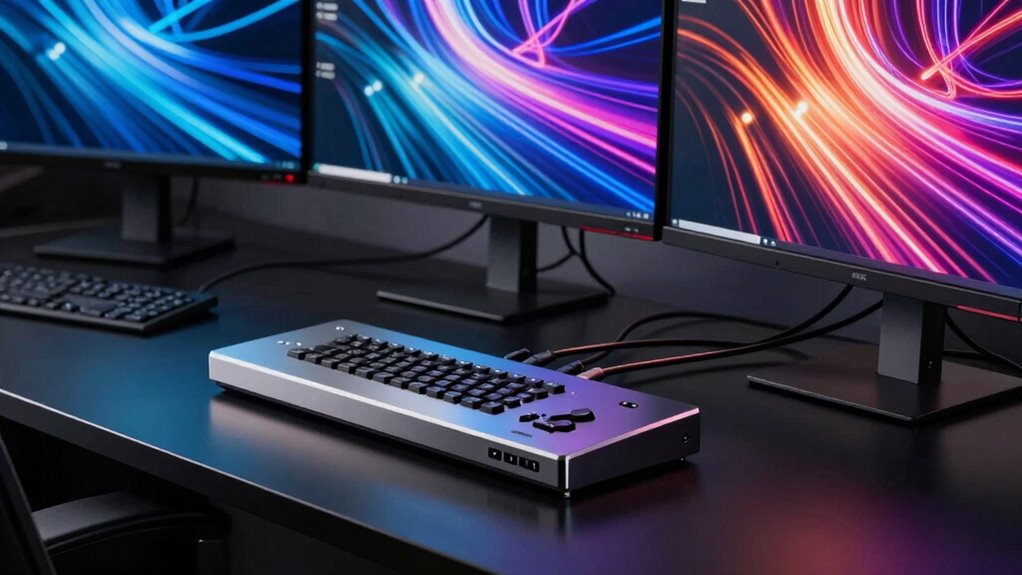

To support 4K resolution and high refresh rates, your KVM switch must explicitly handle at least 3840×2160 pixels and match your monitor’s refresh rate, such as 120Hz or higher. It should also have the bandwidth and compatibility standards like HDMI 2.0 or DisplayHDR to prevent image degradation or lag during changes. Ensuring these specs are met guarantees smooth, ultra-clear visuals and effortless device switching—if you look further, you’ll discover the exact technical details to rely on.
Key Takeaways
- Ensure the KVM supports a minimum of 3840×2160 pixels resolution for crisp 4K visuals.
- Confirm compatibility with high refresh rates like 120Hz or 144Hz for smooth motion.
- Verify the KVM explicitly supports your desired resolution and refresh rate to prevent scaling issues.
- Check for future-proof features like 8K support and higher refresh rates to maintain long-term usability.
- Consider additional standards like European cloud security to align with advanced, secure workflows.
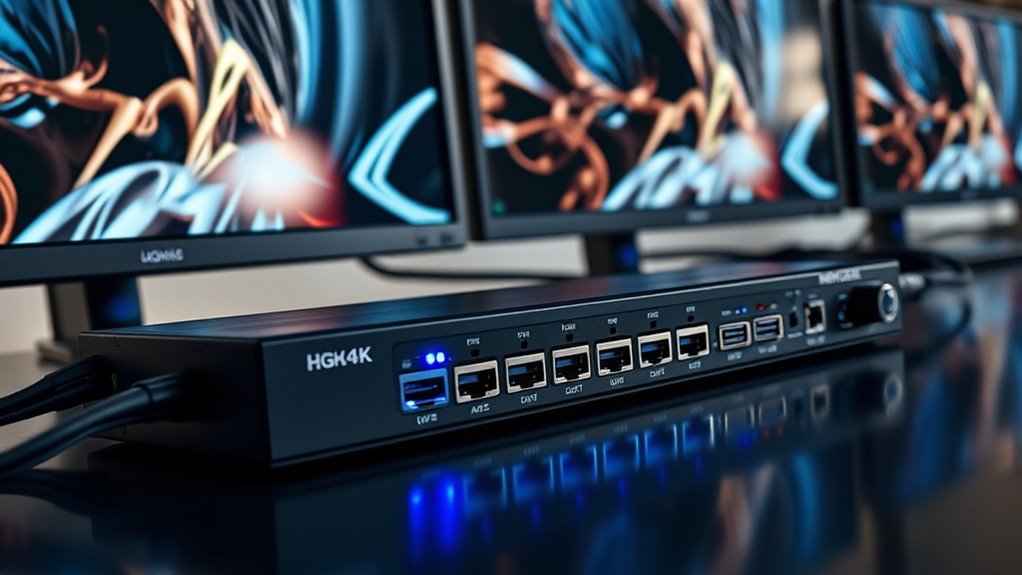
As 4K displays and high-refresh-rate monitors become increasingly common, traditional KVM switches often struggle to keep up with the demands of smooth, lag-free switching. If you’re aiming for seamless control over multiple high-resolution screens, you need a KVM switch that matches the display resolution and refresh rate capabilities of your setup. The display resolution determines how sharp and detailed your visuals appear, especially at 4K. A KVM switch with limited resolution support can cause image degradation or prevent you from fully utilizing your monitor’s capabilities. As a result, it’s essential to choose a switch that explicitly supports 3840×2160 pixels or higher, ensuring crisp images without artifacts or scaling issues.
Refresh rate compatibility is equally critical. High-refresh-rate monitors, such as those running at 120Hz or 144Hz, deliver smoother motion, which is especially important for gaming, video editing, or any fast-paced visual tasks. Traditional KVM switches often default to standard refresh rates like 60Hz, which can introduce lag or choppiness when switching between devices or during real-time use. To avoid these problems, you need a KVM switch designed with high-refresh-rate support in mind. It should handle the maximum refresh rate your monitor can display, maintaining fluid motion without dropping frames or introducing latency.
Matching these specs isn’t just about visual clarity; it also impacts your workflow and gaming experience. If your KVM switch can’t support your monitor’s resolution or refresh rate, you risk degraded image quality, increased latency, or even connection drops. These issues can be frustrating during critical tasks, whether you’re editing high-resolution videos or competing in fast-paced eSports. That’s why verifying the switch’s specifications before purchase is essential. Look for one that explicitly states support for 4K resolution at the desired refresh rate, such as 120Hz or higher, and check for compatibility notes regarding your particular setup.
In addition, consider future-proofing your setup. As display technology advances, 8K and higher refresh rates are emerging. A KVM switch with robust resolution and refresh rate support ensures you’re not constantly upgrading your hardware to keep pace with your monitor’s capabilities. By matching the display resolution and refresh rate, your KVM switch becomes a reliable hub that preserves image quality and responsiveness, making switching between devices smooth and hassle-free. This alignment guarantees that your high-end monitor’s capabilities are fully utilized, providing a seamless experience whether you’re working, gaming, or streaming.
Ensuring your KVM switch supports the latest European cloud innovation standards can also help optimize your setup for enhanced security and sustainability, aligning with the broader trends in cloud technology development.

4K@120Hz Kvm Switch 2 Monitors 2 Computers 8K@60Hz HDMI Displayport Dual Monitor KVM Switches 2 Ports for 2 PC Share Mouse Keyboard and 2 Screens with USB 3.0 Cables and Extended Controller
Dual Monitor KVM Switch: KVM switch 2 ports allows two computers or laptops to share two HD monitors…
As an affiliate, we earn on qualifying purchases.
As an affiliate, we earn on qualifying purchases.
Frequently Asked Questions
Can a KVM Switch Support 8K Displays?
Yes, a KVM switch can support 8K displays, but only if it meets the necessary resolution limits and uses high-quality cables. You’ll need a switch designed for 8K, which guarantees it handles the bandwidth requirements. Keep in mind, cable quality greatly impacts signal integrity at such high resolutions. So, invest in premium cables and verify the switch’s specs to ensure smooth 8K performance.
What Is the Latency Impact of High-Refresh KVM Switches?
High-refresh KVM switches can cause noticeable latency, making your gaming or editing feel like a slow-motion nightmare. You might experience signal degradation and a switching delay that disrupts your workflow or gameplay. While modern switches minimize this impact, expect a small but significant increase in latency, especially with demanding 4K and high-refresh setups. For seamless performance, choose switches specifically designed to reduce these delays.
Are There Compatibility Issues With Specific Graphics Cards?
You might encounter graphics card compatibility issues with certain KVM switches, especially if they don’t support your card’s output or resolution. Make sure your graphics card’s drivers are up-to-date, as outdated drivers can cause compatibility problems or glitches. Always check the switch’s specifications to verify it supports your graphics card’s outputs and features. This helps prevent driver issues and ensures seamless performance across your high-refresh-rate setup.
How Do KVM Switches Handle Audio and USB Peripherals?
You’ll find that KVM switches handle audio management and USB sharing seamlessly. They allow you to switch audio output and input along with your video, so your sound stays synchronized. USB sharing lets you control multiple peripherals like keyboards, mice, and drives from a single set of devices, simplifying your setup. Confirm your KVM supports these features for smooth operation, especially when managing high-resolution 4K and high-refresh displays.
What Is the Maximum Cable Length for 4K High-Refresh Signals?
You can typically use 4K high-refresh signals up to 15-25 feet, but cable quality is essential. High-quality, well-shielded cables help prevent signal degradation, which becomes more likely over longer distances. For lengths beyond this, consider active extenders or fiber optic cables to maintain signal integrity. Remember, lower-quality cables can cause flickering, lag, or image loss, so invest in premium options for the best performance.

UGREEN 8K@60Hz HDMI Displayport KVM Switch 3 Monitors 2 Computers, Aluminum 4K@240Hz with 4 USB 3.0 Ports for 2 Computers Share Triple Monitors with 4 DP+2 HDMI+2 USB Cables/Power Adapter/Controller
KVM Switch 3 Monitors 2 Computers: This 2*Displayport + 1*HDMI KVM Switches allows you to switch effortlessly between…
As an affiliate, we earn on qualifying purchases.
As an affiliate, we earn on qualifying purchases.
Conclusion
To truly enjoy seamless 4K and high refresh experiences, you’ll want to pay close attention to the specs that matter most. Think of it as fine-tuning a musical instrument—you don’t need every string to be perfect, just the right ones. When your KVM matches the necessary requirements, you’ll find your setup sings smoothly, making every click and scroll a delightful note in your digital symphony. Embrace the details, and your workspace will thank you.
UGREEN 8K@60Hz HDMI Displayport KVM Switch 3 Monitors 2 Computers, Aluminum 4K@240Hz with 4 USB 3.0 Ports for 2 Computers Share Triple Monitors with 4 DP+2 HDMI+2 USB Cables/Power Adapter/Controller
KVM Switch 3 Monitors 2 Computers: This 2*Displayport + 1*HDMI KVM Switches allows you to switch effortlessly between…
As an affiliate, we earn on qualifying purchases.
As an affiliate, we earn on qualifying purchases.
UGREEN 8K@60Hz HDMI Displayport KVM Switch 3 Monitors 2 Computers, Aluminum 4K@240Hz with 4 USB 3.0 Ports for 2 Computers Share Triple Monitors with 4 DP+2 HDMI+2 USB Cables/Power Adapter/Controller
KVM Switch 3 Monitors 2 Computers: This 2*Displayport + 1*HDMI KVM Switches allows you to switch effortlessly between…
As an affiliate, we earn on qualifying purchases.
As an affiliate, we earn on qualifying purchases.