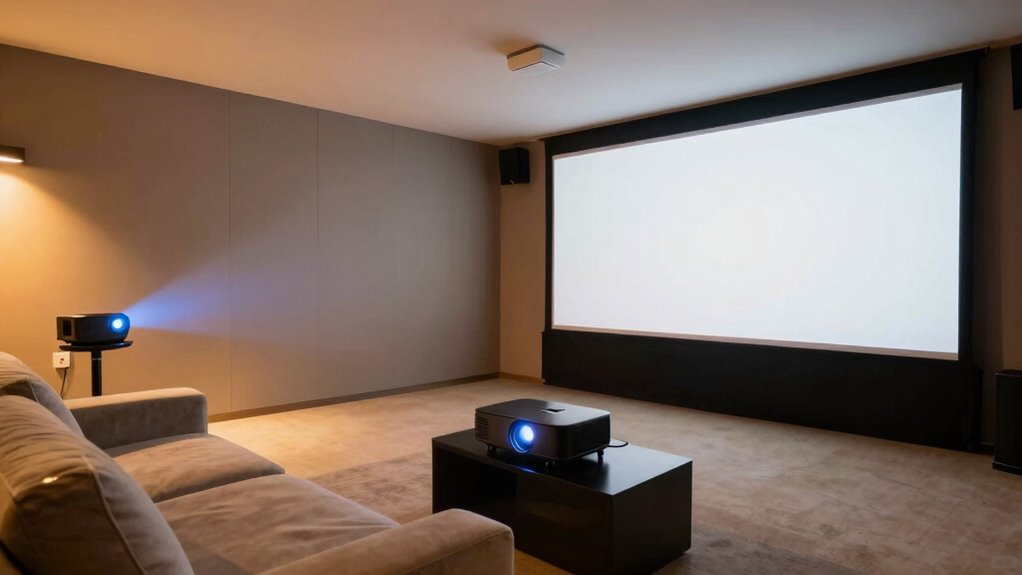
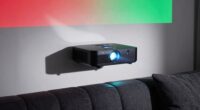
If you’re choosing between short throw and long throw projectors, consider your space and needs. Short throw projectors are great for tight areas or cluttered rooms since they can display large images from close distances, minimizing shadows and cable clutter. Long throw projectors work well in spacious environments like auditoriums or large classrooms. Your setup will depend on available room size and how you plan to use the projector—keep these factors in mind as you explore which setup makes sense for you.
Listen free for 30 days with Audible
Thousands of audiobooks and originals — cancel anytime.
As an affiliate, we earn on qualifying purchases.
Key Takeaways
- Use short throw projectors in small spaces to minimize shadows and clutter; long throw is better for large rooms with ample space.
- Short throw projectors are ideal for environments with limited room behind the screen, reducing installation complexity.
- Long throw projectors suit large venues like auditoriums where projecting from a distance is feasible.
- Choose short throw when shadow reduction and close placement are priorities; opt for long throw when space allows for distant projection.
- Installation ease and space constraints should guide whether a short or long throw setup is appropriate.
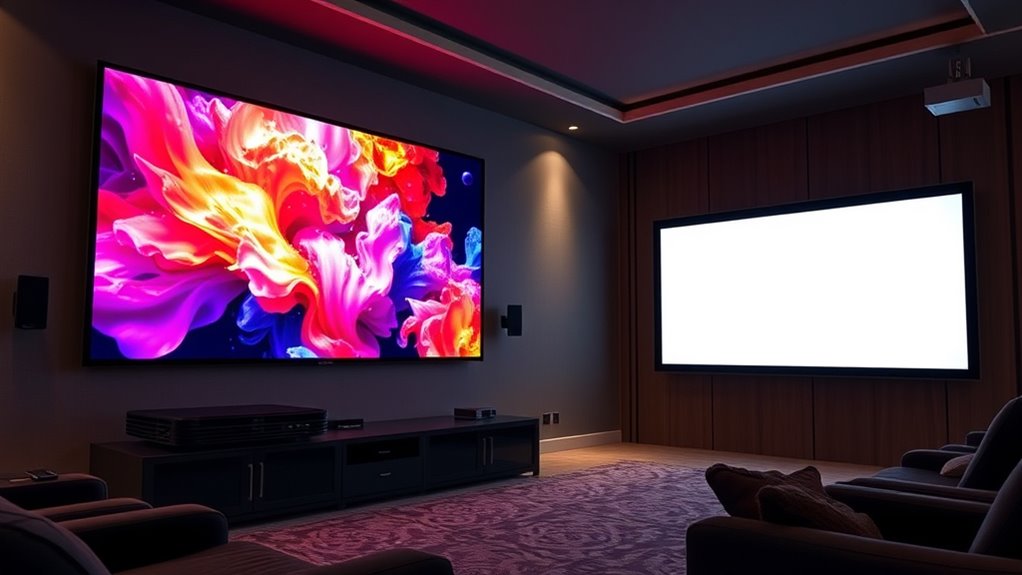
Are you trying to decide between a short throw and a long throw projector? It’s a common dilemma, and the right choice depends on your space, needs, and how you plan to set things up. Understanding the differences in projection technology and installation considerations can help you make an informed decision that fits your environment perfectly.
Short throw projectors use specialized projection technology that allows them to display large images from a very close distance—often just a few feet from the screen or wall. This setup is ideal if you have limited space because it minimizes the throw distance, reducing the risk of shadows or obstructions caused by people walking in front of the projector. When installing a short throw projector, you’ll need to think about wall or ceiling mounting options, ensuring the projector is aligned correctly to project a clear, undistorted image. Its compact size and proximity to the screen also make it easier to hide cables and reduce clutter. However, because short throw projectors often require specific mounting brackets or positioning, you should consider whether your space allows for precise placement, especially if you’re mounting it on a ceiling or near a wall.
On the other hand, long throw projectors generally rely on different projection technology that allows them to project images from a much greater distance—sometimes 10 feet or more. These are suitable for larger spaces like auditoriums, conference rooms, or classrooms, where you have enough room to set up the projector at the back of the room. When installing a long throw projector, you need to think about the available space behind the screen and ensure the projector is placed at the correct distance to achieve the desired image size. This often means a more straightforward installation process, especially if the room already has a dedicated projection wall or screen. However, long throw projectors require more space and may need additional planning to manage cables and ensure the projector isn’t in the way or creating shadows.
Additionally, advancements in AI technology are beginning to influence projection systems, offering smarter calibration and enhanced image quality to improve your viewing experience. In essence, your choice should align with your space constraints and how much flexibility you need in placement. Short throw projectors excel in tight spaces and environments where minimizing shadows and clutter matters most. Long throw projectors are better suited for larger rooms where distance isn’t an issue, and a more straightforward installation process is possible. Ultimately, by contemplating the projection technology and installation considerations, you can select the setup that best fits your needs and creates an optimal viewing experience.

Encyclopedia of Science
- Condition: Used Book in Good Condition
As an affiliate, we earn on qualifying purchases.
Frequently Asked Questions
Can a Projector Switch Between Short Throw and Long Throw Functions?
Most projectors can’t switch between short throw and long throw functions directly because they’re designed for specific setups, limiting versatility. However, some advanced models offer adjustable lens options or multiple throw ratio capabilities, giving you greater setup flexibility. When choosing a projector, consider whether you need this versatility. If you want seamless switching, look for models with zoom or lens shift features that enhance your setup options without the need for different projectors.
Do Short Throw Projectors Require Special Screens?
Think of a short throw projector as a whisper, needing a special kind of canvas—the projection screen—that’s designed to capture its delicate light. Yes, short throw projectors often require specific projection screens that enhance image quality, especially when wall mounting. These screens reduce glare and improve clarity, making your viewing experience seamless. Without the right screen, your projector’s message might get lost in the shadows of a generic wall.
How Does Room Lighting Affect Short Throw Vs Long Throw Projectors?
Room lighting greatly influences both short throw and long throw projectors. Ambient lighting can wash out images, so you need to guarantee your projector has sufficient brightness—measured in lumens—to counteract this. Short throw projectors often excel in brighter rooms because they can be placed close to the screen, reducing glare. For ideal image quality, choose a projector with high projection brightness and control ambient lighting as much as possible.
Are Long Throw Projectors More Durable Than Short Throw Models?
Think of long throw projectors as the marathon runners of the tech world—they typically have a greater durability comparison and longer lifespan differences. You’ll often find they’re built with more robust components, making them more resistant to wear and tear. While short throw models excel in tight spaces, long throw projectors tend to last longer, giving you more value over time. So, yes, long throw projectors are generally more durable than short throw models.
What Are the Maintenance Differences Between Short and Long Throw Projectors?
You’ll find that maintenance requirements differ between short and long throw projectors mainly in bulb replacement frequency. Short throw models often need more frequent bulb replacements due to their brighter images and higher lamp usage. Long throw projectors tend to have less frequent bulb replacements, but you should still monitor lamp lifespan and clean filters regularly. Overall, both types require routine maintenance, but short throw projectors might demand more attention.

Science Book, The: Everything You Need to Know About the World and How It Works
As an affiliate, we earn on qualifying purchases.
Conclusion
Choosing between short throw and long throw setups is like picking the right tool for a job—you’ll be most effective when your choice fits your space and needs. I once watched a friend carefully select a short throw projector for his cozy living room, only to realize he needed the long throw for his spacious basement. Just as a craftsman knows the right tool makes all the difference, understanding when each setup makes sense guarantees your presentation or movie night always hits the mark.
The Way Things Work: Newly Revised Edition: The Ultimate Guide to How Things Work
As an affiliate, we earn on qualifying purchases.

A Dictionary of Science (Oxford Quick Reference)
As an affiliate, we earn on qualifying purchases.
Back to school Picks
back to school
As an affiliate, we earn on qualifying purchases.