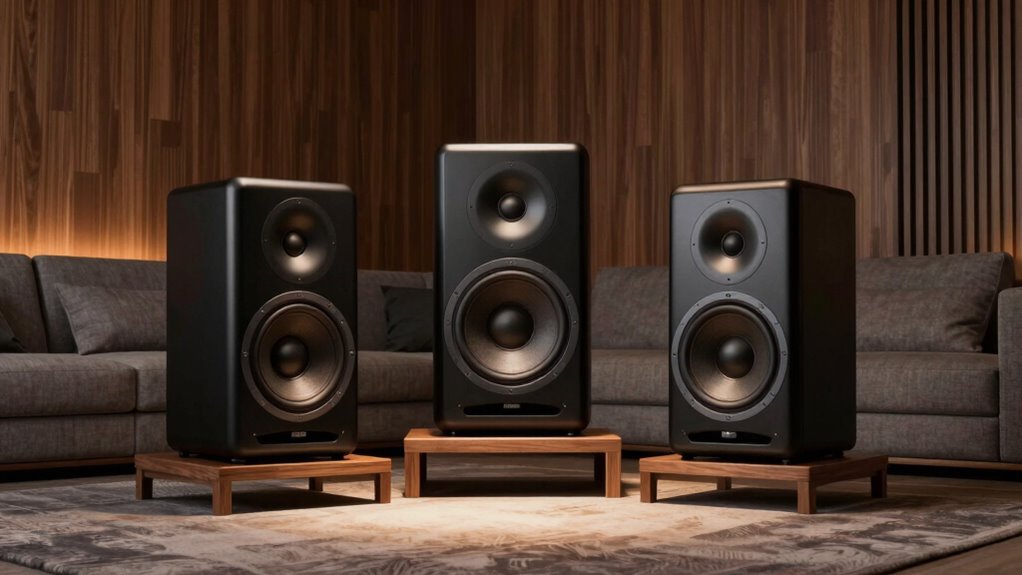

To get the best sound, position your speakers so they form an equilateral triangle with your listening spot, known as the triangle rule. This setup guarantees sound waves reach your ears simultaneously, creating clear stereo imaging and balanced audio. Keep the tweeters at ear level and angle the speakers towards you. Proper placement can dramatically improve clarity and soundstage. Keep exploring to discover more tips on optimizing your listening environment and achieving perfect sound quality.

Prime made for students and young adults
- Fast, free delivery for dorm and study essentials
- Prime Video and Amazon Music included
- Member-only deals
Key Takeaways
- Position speakers to form an equilateral triangle with the listening spot for optimal stereo imaging.
- Ensure tweeters are at ear level and aimed directly at the listening position.
- Maintain equal distance between speakers and the listener to achieve balanced sound.
- Use acoustic treatment to minimize reflections and sound distortions in the room.
- Proper placement combined with room treatment enhances clarity, soundstage, and overall audio quality.
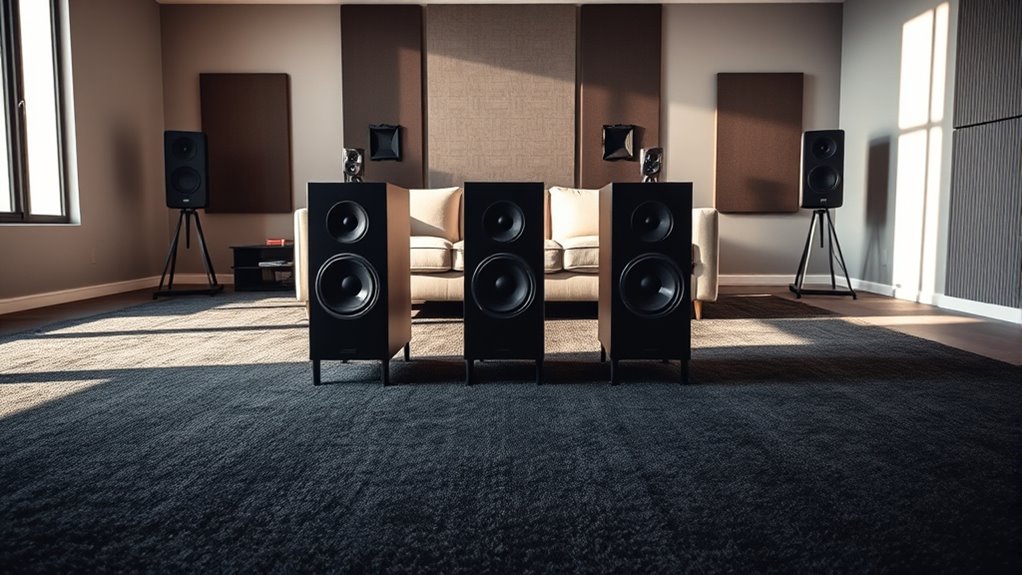
Have you ever wondered why your sound system doesn’t deliver the clarity and balance you expect? The culprit often lies in speaker placement, a vital factor that many overlook. To truly optimize your setup, you need to understand the importance of the triangle rule, which ensures your speakers are positioned for ideal sound staging and imaging. Proper placement isn’t just about aesthetics; it’s about creating an environment where sound can flow freely without interference. This is where soundproofing techniques and acoustic treatment come into play. By controlling the acoustics of your space, you minimize unwanted reflections and reverberations that can muddy your audio. Soundproofing ensures external noise doesn’t interfere, while acoustic treatment manages the internal sound reflections, helping you achieve a cleaner, more precise sound.
The key is to position your speakers so that they form an equilateral triangle with your listening position. Imagine a triangle where each side is equal, and your ears sit at one corner, with each speaker at the other two. This setup guarantees that sound waves reach your ears simultaneously, creating a cohesive stereo image. When your speakers are too far apart or too close together, or if they’re misaligned, you risk skewed soundstage and diminished clarity. You might notice that certain frequencies are overly prominent or that the sound feels disjointed. Achieving the perfect triangle isn’t just about distance; it’s also about angle. Most speakers perform best when their tweeters are at ear level, pointing directly at your listening position. This small adjustment can make a big difference in sound clarity and imaging.
Beyond positioning, the room’s acoustics play an essential role. Using acoustic treatment like bass traps, diffusers, and absorptive panels can greatly improve sound quality. These elements help control reflections that bounce off walls, ceilings, and floors, which can cause phase issues and muddiness. Proper soundproofing techniques also prevent external noise from disrupting your listening experience, allowing you to focus solely on your music or movies. When you combine the triangle rule with strategic acoustic treatment, you create an environment where your sound system can truly shine. The result is a balanced, immersive experience that feels natural and precise. Remember, the best sound isn’t just about quality equipment; it’s about how you position and treat your space to make the most of what you have.
bookshelf speakers for optimal placement
As an affiliate, we earn on qualifying purchases.
As an affiliate, we earn on qualifying purchases.
Frequently Asked Questions
Can the Triangle Rule Be Adjusted for Irregular Room Shapes?
Yes, you can adjust the triangle rule for irregular room shapes. Instead of strict angles, create an adjustable triangle by positioning your speakers to form a flexible, balanced layout that suits your space. Focus on maintaining even sound distribution, avoiding corners and obstructions. Use speaker stands or mounts to fine-tune angles, ensuring superior sound quality. This adaptive approach helps you get the best audio experience, even in irregularly shaped rooms.
How Does Furniture Placement Affect Speaker Positioning?
Imagine your room as a stage where furniture interference shapes your sound experience. You should position speakers to avoid clutter and bulky pieces that block or echo sound waves, creating a clear audio path. A well-thought-out room layout guarantees your speakers breathe freely, delivering balanced sound. Keep furniture away from direct speaker paths, and consider how each piece influences acoustics, so you fill your space with crisp, immersive audio.
Is There a Difference Between Stereo and Surround Sound Speaker Setup?
Yes, there’s a difference between stereo and surround sound setups. Stereo focuses on two speakers to create stereo imaging, giving you a sense of space and direction. Surround sound uses multiple speakers around you, enhancing immersion and providing a more realistic experience. Your placement impacts both, but surround sound demands careful positioning to maximize the immersive effect, while stereo emphasizes balanced placement for clear stereo imaging.
What Are Common Mistakes to Avoid When Applying the Triangle Rule?
You might overlook that uneven speaker symmetry or misaligned listening position can ruin your sound experience. When applying the triangle rule, avoid placing speakers too close or far apart, which distorts stereo imaging. Make sure your speakers form an equilateral triangle with your listening spot, and keep them at ear level. Neglecting these details can lead to imbalanced sound, so double-check your setup for perfect symmetry and ideal listening position.
How Do Room Acoustics Influence Optimal Speaker Placement?
Room acoustics considerably influence your speaker placement. High room reverberation can cause sound muddiness, so you should position speakers to minimize reflections, often by angling them or adding diffusers. Also, set your speaker height so that the tweeters are at ear level when seated, ensuring clear sound. Adjusting placement based on these factors helps you achieve better clarity and a more accurate listening experience.
acoustic treatment panels for soundproofing
As an affiliate, we earn on qualifying purchases.
As an affiliate, we earn on qualifying purchases.
Conclusion
Now that you know the triangle rule, your setup will transform your listening experience. Imagine hearing every detail clearly, like being front row at a concert—yet without the crowds or noise. It’s a simple shift, but it makes all the difference. Just like a well-placed speaker creates perfect harmony, your space becomes a sanctuary of sound. So, embrace the rule, and turn your room into the ultimate audio haven—your favorite music, clearer than ever.
speaker stands for ear level positioning
As an affiliate, we earn on qualifying purchases.
As an affiliate, we earn on qualifying purchases.
As an affiliate, we earn on qualifying purchases.
Halloween Picks
halloween
As an affiliate, we earn on qualifying purchases.






![Terence Tao: Math 2.0 [Pdf]](https://haltmal.com/wp-content/uploads/2026/10/terence-tao-math-2-0-pdf-featured-260x140.jpg)