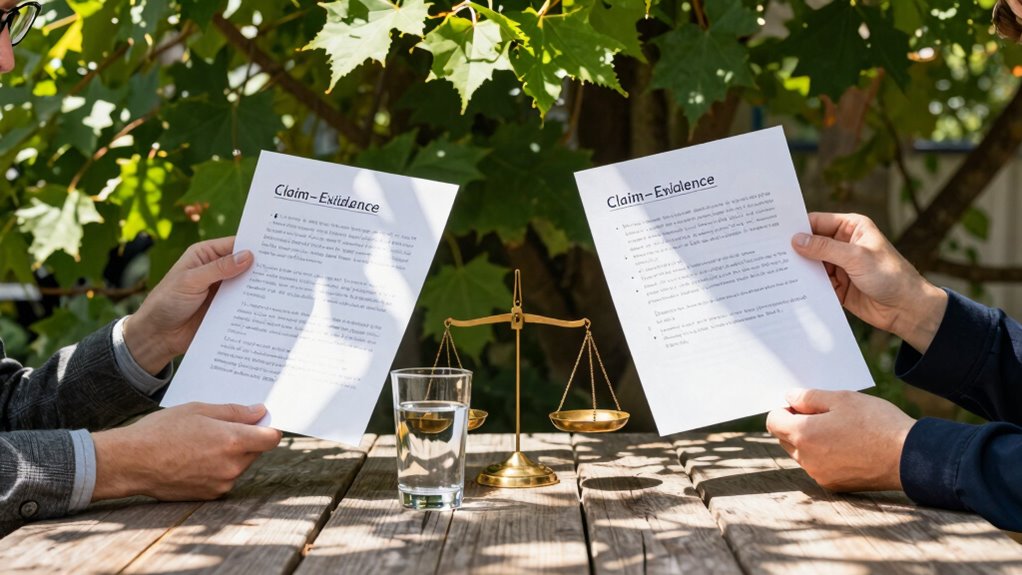

Using the claim–evidence–reasoning framework is the clearest way to evaluate arguments because it helps examine whether claims are well-supported and logically connected. You can identify if evidence is relevant, credible, and effective in backing up the claim. This method also reveals any fallacies or emotional appeals that might weaken the argument. If you keep exploring, you’ll discover how to apply this framework to improve your critical thinking and build stronger arguments.
Key Takeaways
- The Claim–Evidence–Reasoning framework provides a clear structure for evaluating argument strength and validity.
- Effective evaluation involves checking if the evidence directly supports the claim with logical reasoning.
- Identifying logical fallacies and rhetorical tactics helps ensure arguments are based on sound logic.
- Relevance, credibility, and sufficiency of evidence are critical in assessing argument quality.
- Clear and logical connections between claim, evidence, and reasoning lead to more persuasive and fair evaluations.

Understanding how to construct a strong claim, support it with solid evidence, and explain your reasoning is vital for effective argumentation. When you evaluate arguments, it’s important to recognize logical fallacies—errors in reasoning that can undermine your position or your opponent’s. Knowing common logical fallacies helps you spot weaknesses in arguments and avoid falling into their traps yourself. For example, someone might use a straw man fallacy by misrepresenting your point to make it easier to attack. Recognizing this allows you to clarify your position and stay focused on the real issue. Similarly, appeal to authority or false dilemmas can cloud the reasoning process, leading you to accept flawed conclusions. Rhetorical strategies are also at play in many arguments, where emotional appeals or persuasive language are used to sway opinions rather than relying on evidence. By understanding these strategies, you can better assess whether an argument is based on valid reasoning or merely persuasive tactics. Additionally, understanding the importance of a high contrast ratio in projectors highlights how visual clarity impacts overall image quality and viewer experience. Constructing a well-supported claim involves more than just stating your opinion; it requires clarity and precision. Your claim should be specific and debatable, providing a clear stance that can be supported with evidence. When gathering evidence, look for credible sources, facts, and data that directly relate to your claim. Avoid cherry-picking information that only supports your side—considering counter-evidence strengthens your argument and demonstrates critical thinking. Once you have your evidence, your reasoning should connect the dots logically. Explain how the evidence supports your claim without jumping to conclusions. This step is fundamental because strong reasoning helps others see the validity of your argument and prevents misinterpretation. Using the claim–evidence–reasoning framework is a clean and effective way to evaluate arguments. It forces you to break down complex ideas into manageable parts, making it easier to identify flaws or strengths. When you encounter an argument, ask yourself: Is the claim clearly stated? Is the evidence relevant and credible? Does the reasoning logically connect the evidence to the claim? If any of these elements fall apart, the argument weakens. This approach also guards against rhetorical strategies that may manipulate emotions or distract from the core issue. By focusing on logic and evidence, you ensure your evaluations are fair and grounded. In the end, mastering this method helps you become a more critical thinker, capable of distinguishing valid arguments from those built on fallacies or superficial tactics. It’s a straightforward, honest way to engage in meaningful discussions and develop well-reasoned perspectives.
Top picks for "claim evidence reason"
Open Amazon search results for this keyword.
As an affiliate, we earn on qualifying purchases.
Frequently Asked Questions
How Can C-E-R Improve Critical Thinking Skills?
Using claim–evidence–reasoning helps improve your critical thinking skills by sharpening your logical reasoning and analytical skills. When you practice this method, you learn to evaluate arguments carefully, identify strong evidence, and understand how reasons support claims. This structured approach encourages you to think deeply about issues, question assumptions, and develop clearer, more persuasive arguments, ultimately strengthening your ability to analyze information critically and make well-informed decisions.
What Are Common Mistakes When Applying C-E-R?
You often stumble when applying C-E-R by succumbing to simple slip-ups like skipping solid evidence or settling for superficial solutions. Watch out for logical fallacies and oversimplification, which can sabotage your argument’s strength. Instead, stay specific, support statements with sturdy evidence, and avoid sweeping generalizations. This diligent discipline deepens your critical thinking, helping you dodge false flaws and foster a fair, factual framework for your arguments.
Can C-E-R Be Used in Everyday Decision-Making?
Yes, C-E-R can be practical for your daily decisions. It helps you systematically evaluate options by forming clear claims, gathering relevant evidence, and explaining your reasoning. When faced with choices like whether to buy a new gadget or choose a route, using C-E-R guides you to make more informed, logical decisions. It’s a simple, effective method to improve your critical thinking and guarantee your choices are well-supported.
How Does C-E-R Differ From Other Argument Evaluation Methods?
Think of Claim–Evidence–Reasoning (C-E-R) as a sturdy bridge, built on a clear logical structure and evidence focus. Unlike other methods that might jumble ideas, C-E-R guides you step-by-step, ensuring each claim is supported with solid proof and reasoning. This approach keeps your arguments grounded, making them easier to evaluate and trust. It’s like having a map that leads straight to the truth, without detours.
What Subjects Benefit Most From Using C-E-R?
You’ll find science education and debate skills benefit most from using C-E-R. It helps you clearly organize your arguments, making evidence and reasoning more transparent. When you apply C-E-R, you develop critical thinking and improve your ability to evaluate claims effectively. This method encourages you to back up your ideas with solid evidence, making your arguments more persuasive and your understanding deeper in both science and debate contexts.
Conclusion
Think of claim–evidence–reasoning as a sturdy bridge connecting your ideas. You build it with solid pillars of proof, span with clear reasoning, and support every step with confidence. When you master this structure, your argument becomes a bright lighthouse guiding others through the fog of doubt. With each connection, you illuminate the path to truth, turning complex ideas into a shining beacon that others can follow easily and trust completely.