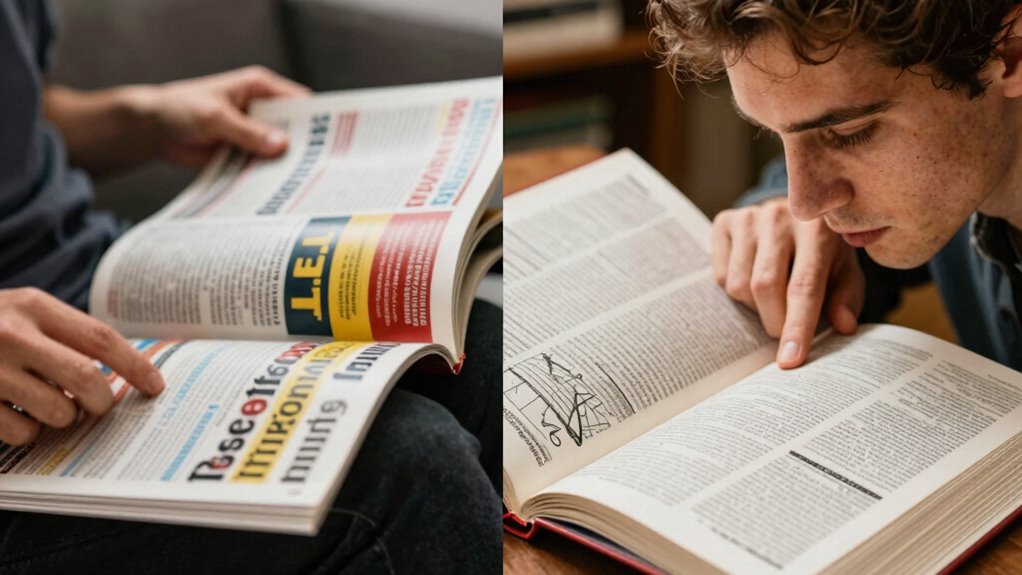

When deciding between skimming and deep reading, you should use skimming for quick overviews and relevance checks, saving time to find key ideas fast. Deep reading is better when you need thorough understanding, retain details, or analyze complex material. Combining these strategies helps you be efficient and effective. Keep exploring, and you’ll discover how to master the timing for each approach to boost your learning success.

Prime made for students and young adults
- Fast, free delivery for dorm and study essentials
- Prime Video and Amazon Music included
- Member-only deals
Key Takeaways
- Skimming is ideal for quick assessment of relevance and identifying main ideas rapidly.
- Deep reading is necessary for thorough understanding, complex concepts, and long-term retention.
- Use skimming to prioritize content, then deep read critical sections for detailed comprehension.
- Skimming offers time efficiency but may limit understanding; deep reading enhances retention and nuance.
- Mastering both techniques and switching between them optimizes reading effectiveness and comprehension.

When deciding how to approach a text, understanding the difference between skimming and deep reading can considerably impact your comprehension and efficiency. Both strategies serve different purposes, and knowing when to use each can help you manage your time and grasp essential information more effectively. Skimming involves quickly glancing through a text to get the general idea, while deep reading requires focused, deliberate attention to understand details thoroughly. If your goal is to quickly assess whether an article is relevant or worth your in-depth focus, skimming is your best bet. It allows you to identify headings, keywords, and main ideas rapidly, saving you time and helping you decide what to prioritize.
However, when it comes to reading comprehension and information retention, deep reading plays a vital role. This method fosters a deeper connection with the material, enabling you to process complex concepts and remember details more effectively. Deep reading encourages active engagement, where you pause to analyze, question, and reflect on what you’re reading. For academic texts, technical documents, or material that requires critical thinking, deep reading is essential. It helps you build a solid understanding, making it easier to recall details later and apply the knowledge in practical situations.
While skimming is excellent for initial surveys of content, it’s often insufficient for mastering intricate or layered information. Relying solely on skimming can lead to superficial understanding, which hampers long-term retention and the ability to synthesize ideas. On the other hand, deep reading demands more time and mental effort but results in better comprehension and more durable memory of the material. It allows you to connect ideas, recognize nuances, and develop a thorough grasp that often slips through when skimming.
Knowing when each technique wins depends on your objectives. If you need a quick overview or are screening for relevance, skimming is your go-to. But if you’re aiming for mastery, retention, and thorough understanding, deep reading is indispensable. Ideally, you’ll use both strategies in tandem: start with skimming to filter and prioritize, then switch to deep reading for critical sections. This balanced approach optimizes your efficiency while maximizing your ability to retain and understand information. Ultimately, mastering the art of choosing between skimming and deep reading will enhance your overall reading comprehension and help you become a more effective, thoughtful reader. Additionally, developing skills in reading techniques can improve your ability to adapt your approach based on the complexity of the material.
Frequently Asked Questions
How Do I Choose Between Skimming and Deep Reading?
You should choose between skimming and deep reading based on your reading speed and comprehension balance. If you need to quickly grasp main ideas for an overview, skim the material to save time. However, when understanding complex concepts or details is essential, engage in deep reading to improve comprehension. Adjust your approach depending on your goals, ensuring you maintain a key balance between speed and understanding.
Can I Switch Seamlessly Between Skimming and Deep Reading?
Like a skilled jazz musician, you can switch seamlessly between skimming and deep reading, adapting to your reading stamina and cognitive load. Focus on the material’s importance and complexity to decide when to shift. Practice mindfulness to recognize fatigue and switch modes efficiently. With time, you’ll develop an intuitive rhythm, allowing you to navigate texts effortlessly, maximizing comprehension while conserving mental energy—just like a seasoned performer.
What Are the Key Indicators for Choosing Each Method?
You choose skimming when your reading speed needs to be quick, like scanning for main ideas or specific details, and comprehension accuracy isn’t critical. Opt for deep reading when you’d benefit from thorough understanding, complex analysis, or critical thinking, even if it slows you down. Pay attention to the material’s complexity and your purpose—if accuracy and retention matter most, deep reading is best; for efficiency, skimming works better.
How Does My Purpose Influence the Reading Style?
Your purpose shapes your reading style more than anything else, so you’re not just reading—you’re on a mission. If your goal is quick understanding or locating specific info, skimming fuels your reading motivation and saves time. But if you need deep comprehension, you’ll plunge into thorough reading, applying comprehension strategies to truly grasp details. Knowing your purpose guides you to choose the right method, making every word count like a treasure chest.
Are There Digital Tools That Facilitate Both Reading Techniques?
Yes, many digital tools help you facilitate both reading techniques. You can use highlighting techniques to quickly mark key points during skimming, then switch to annotation tools for deeper engagement during thorough reading. Apps like Kindle, Adobe Acrobat, and specialized note-taking software let you seamlessly highlight, annotate, and organize your thoughts, making it easier to adapt your reading style based on your purpose.
Conclusion
In the dance between skimming and deep reading, each has its moment to shine. Think of skimming as your swift breeze through a storm, catching essentials quickly. Deep reading, however, is the anchor that grounds you in understanding. When you choose the right approach, you harness the power to navigate any text with purpose. After all, isn’t it true that wisdom lies not just in what you read, but in how you read it?
Halloween Picks
halloween
As an affiliate, we earn on qualifying purchases.
![Terence Tao: Math 2.0 [Pdf]](https://haltmal.com/wp-content/uploads/2026/10/terence-tao-math-2-0-pdf-featured-560x300.jpg)