For most first-time buyers, I’d start with the UNISTELLAR Odyssey 85 mm, which pairs a guided smart-telescope approach with a larger aperture than the compact options here. The ZWO Seestar S30 Pro stands out for beginners who want an automated imaging workflow, while the Celestron StarSense Explorer LT 114AZ suits those who prefer a phone-guided telescope they operate at the eyepiece. The main tradeoffs are guided automation versus hands-on observing, and portability versus aperture and viewing comfort. Simpler screens and remote controls may feel approachable, but they do not automatically provide the same observing experience as a telescope built around astronomy software. Read on for the full comparison, the ranking logic, and help matching a model to your first observing goals.

Prime made for students and young adults
- Fast, free delivery for dorm and study essentials
- Prime Video and Amazon Music included
- Member-only deals
Key Takeaways
- The lineup splits into two different experiences: smart scopes such as the Odyssey and Seestar emphasize app-guided imaging, while the StarSense Explorer LT 114AZ uses a smartphone to help you aim a conventional telescope.
- Premium smart features do not mean the same thing across brands: UNISTELLAR’s Odyssey PRO adds a Nikon electronic eyepiece to the Odyssey approach, while the Seestar S30 Pro is a more compact automated imaging alternative.
- Several 4K-labeled models emphasize screens, autofocus, remotes, or bundled storage. Those conveniences may simplify operation, but buyers should not treat a camera resolution claim as a guarantee of better astronomical images.
- Portability and aperture pull in different directions: the Dwarf Mini is the compact choice, while the 85 mm Odyssey and 114 mm StarSense offer larger stated apertures but call for more thought about carrying and setup.
- The best beginner choice depends on what ‘easy’ means to you: app automation favors the smart scopes, a live display favors the Temodu and other screen-equipped designs, and guided manual aiming favors the Celestron.
| UNISTELLAR Odyssey Smart Telescope, 85 mm |  | Best Overall for Automated Observing | Aperture: 85 mm | Focal length: 320 mm | Mount: Altazimuth | VIEW LATEST PRICE | See Our Full Breakdown |
| FASHIONARI 70mm Aperture, 300mm Focal Length Digital Refractor Telescope |  | Best for Built-In Screen Viewing | Optical design: Refractor | Objective lens diameter: 70 mm | Focal length: 300 mm (f/5.6) | VIEW LATEST PRICE | See Our Full Breakdown |
| DWARFLAB Dwarf Mini Smart Telescope |  | Best Compact Travel Pick | Weight: 1.85 lb (840 g) | Objective lens diameter: 30 mm | Focal length: 150 mm | VIEW LATEST PRICE | See Our Full Breakdown |
| FASHIONARI Auto-Focus Digital Refractor Telescope with 4K Camera |  | Best for 4K Capture | Optical design: Refractor | Objective lens diameter: 80 mm | Focal length: 300 mm | VIEW LATEST PRICE | See Our Full Breakdown |
| Celestron StarSense Explorer LT 114AZ Smartphone-Guided Newtonian Telescope |  | Best for Learning the Night Sky | Optical design: Newtonian reflector | Aperture: 114 mm (4.5 in) | Focal length: 1000 mm | VIEW LATEST PRICE | See Our Full Breakdown |
| YOTOMIGUO Smart Refractor Telescope with 4K Camera and Foldable Display |  | Best for Screen-First Viewing | Telescope type: Refractor | Objective lens: 80 mm | Focal length: 300 mm (f/8.89) | VIEW LATEST PRICE | See Our Full Breakdown |
| UNISTELLAR Odyssey PRO Smart Telescope with Nikon Electronic Eyepiece |  | Best for Guided Observing | Objective lens: 85 mm | Focal length: 320 mm | Mount: Altazimuth | VIEW LATEST PRICE | See Our Full Breakdown |
| ZWO Seestar S30 Pro Smart Telescope |  | Best Compact Deep-Sky Imaging Pick | Mount: Alt-azimuth; supports equatorial mode | Focal length: 160 mm | Field of view: 4.6 degrees | VIEW LATEST PRICE | See Our Full Breakdown |
| Smart Digital Telescope with Autofocus and 4K Astrophotography |  | Best for Flexible Screen and Remote Control | Telescope type: Digital refractor | Objective lens: 80 mm | Focal length: 300 mm | VIEW LATEST PRICE | See Our Full Breakdown |
| FASHIONARI Smart Refractor Telescope with Autofocus, 4K Camera, App and Remote Control |  | Best for Mixed Sky and Daytime Use | Telescope type: Refractor | Aperture: 80 mm | Focal length and ratio: 300 mm; f/8.89 | VIEW LATEST PRICE | See Our Full Breakdown |
| FASHIONARI 350X Digital Refractor Telescope with Autofocus |  | Best for Autofocus and Flexible Viewing | Telescope type: Digital refractor | Aperture: 80 mm | Focal length: 300 mm | VIEW LATEST PRICE | See Our Full Breakdown |
| Temodu Refracting Telescope with 4.5-Inch HD LCD, 70mm Aperture and 400mm Focal Length |  | Best for Direct, Phone-Free Viewing | Telescope type: Refracting | Aperture: 70 mm | Focal length: 400 mm | VIEW LATEST PRICE | See Our Full Breakdown |
| JVAXS 4K Digital Astrophotography Telescope with 3-Inch Flip Screen, App Control, Remote, and 64GB Card |  | Best for Included Storage and Adjustable Eyepiece | Objective lens diameter: 78 mm | Focus: Manual | Display: 3-inch flip-out screen | VIEW LATEST PRICE | See Our Full Breakdown |
| digital smart telescopes for beginner | Focal length |
|---|---|
| UNISTELLAR Odyssey Smart Teles | 320 mm |
| FASHIONARI 70mm Aperture | 300 mm (f/5.6) |
| DWARFLAB Dwarf Mini Smart Tele | 150 mm |
| FASHIONARI Auto-Focus Digital | 300 mm |
| Celestron StarSense Explorer L | 1000 mm |
| YOTOMIGUO Smart Refractor Tele | 300 mm (f/8.89) |
| UNISTELLAR Odyssey PRO Smart T | 320 mm |
| ZWO Seestar S30 Pro Smart Tele | 160 mm |
| Smart Digital Telescope with A | 300 mm |
| FASHIONARI Smart Refractor Tel | — |
| FASHIONARI 350X Digital Refrac | 300 mm |
| Temodu Refracting Telescope wi | 400 mm |
| JVAXS 4K Digital Astrophotogra | — |
More Details on Our Top Picks
UNISTELLAR Odyssey Smart Telescope, 85 mm
The Odyssey is my strongest all-around pick for beginners who want the telescope to handle the fiddly parts of finding and following a target. Its autofocus, integrated star finder, and motorized tracking reduce the need to learn manual alignment, while live image stacking can bring out color and detail as an observation builds. Compared with the Celestron StarSense Explorer LT 114AZ, it tracks targets automatically but gives up direct eyepiece viewing and asks you to use a compatible phone or tablet. Its 85 mm aperture also gathers less light than the Celestron’s 114 mm reflector. The five-hour stated battery life and included tripod make it a self-contained setup, though actual runtime can vary with conditions. Choose it for guided, app-based observing; skip it if you want a traditional eyepiece experience.
Pros:- Autofocus and an integrated star finder simplify locating and focusing on catalog targets.
- Motorized tracking follows targets without polar alignment.
- Live image stacking can reveal additional color and detail during viewing.
- Includes a tripod and rechargeable battery for a ready-to-use setup.
Cons:- Viewing and control require a compatible smartphone or tablet and the UNISTELLAR app.
- No eyepiece is provided for direct optical viewing.
- Its 85 mm aperture is smaller than the Celestron StarSense Explorer LT 114AZ’s 114 mm aperture.
Best for: Beginners who want automated target finding, tracking, and app-based views of planets and deep-sky objects.
Not ideal for: Observers who want to look through an eyepiece, avoid app dependence, or prioritize a larger aperture for faint objects.
- Aperture:85 mm
- Focal length:320 mm
- Mount:Altazimuth
- Focus:Autofocus
- Viewing method:Compatible smartphone or tablet app; no eyepiece
- Tracking:Motorized automatic target tracking
- Battery life:Up to 5 hours
- Optical tube weight:8.8 lb
Our verdict“Choose the Odyssey if you want an automated, app-driven beginner telescope and do not need an eyepiece.”
FASHIONARI 70mm Aperture, 300mm Focal Length Digital Refractor Telescope
This FASHIONARI takes a different route from fully app-led scopes: its 2.8-inch display lets beginners view and record without relying on a separate phone screen. The included 25 mm and 10 mm eyepieces, 3× Barlow, and finderscope also leave room to learn basic telescope use, unlike the eyepiece-free UNISTELLAR Odyssey. Its 70 mm aperture and 300 mm focal length suit introductory viewing, while the listed 48 MP photos and 1080p video add a simple capture option. The tradeoff is a more modest set of astronomy automation features than the Odyssey’s tracking and integrated star finding. You’ll also need to supply a microSD card, and the stated battery runtime is up to three hours. I’d pick it for screen-based viewing and included optics, not for long unattended sessions or advanced tracking.
Pros:- Built-in 2.8-inch display allows viewing without an external phone.
- Includes two eyepieces, a 3× Barlow lens, and a 5×24 finderscope.
- Captures listed 48 MP photos and 1080p video.
- USB-C charging and an adjustable tripod support portable setup.
Cons:- Up to three hours of stated battery runtime may limit longer observing sessions.
- A microSD card for storage is not included.
- The product data does not specify motorized tracking or the automated sky-finding features found on the UNISTELLAR Odyssey.
Best for: Beginners and families who want a built-in viewing screen, included eyepieces, and basic photo and video capture.
Not ideal for: Observers seeking automatic target tracking, long sessions between charges, or a complete setup that includes a memory card.
- Optical design:Refractor
- Objective lens diameter:70 mm
- Focal length:300 mm (f/5.6)
- Magnification:16×–120×
- Display:2.8-inch HD screen
- Eyepieces:25 mm and 10 mm
- Photo and video:48 MP photos; 1080p video
- Battery runtime:Up to 3 hours
- Storage:Supports microSD cards up to 128 GB; card not included
Our verdict“Choose this FASHIONARI if you want a built-in screen and eyepiece kit more than automated tracking.”
DWARFLAB Dwarf Mini Smart Telescope
At 1.85 lb and roughly 7.23 inches long, the Dwarf Mini is the clear portability choice in this group. Its smartphone app combines an interactive sky atlas with automated target finding and tracking, while the altazimuth and equatorial modes give imaging-focused beginners more flexibility than the manual Celestron StarSense Explorer LT 114AZ. The Sony IMX662 sensor, included light-pollution filter, and exposures up to 90 seconds point toward compact astrophotography rather than the larger-aperture visual experience the Celestron’s 114 mm reflector is better suited to. That compact size comes with a 30 mm objective, so it is not the pick for maximizing light collection. Focus may also call for manual adjustment, and the included battery is nonstandard. I’d choose it for travel and app-guided imaging, not as a substitute for a larger visual telescope.
Pros:- Compact 1.85 lb body is easy to pack and carry.
- Interactive sky atlas and automated target finding support app-guided use.
- Altazimuth and equatorial modes provide different tracking options.
- Includes a light-pollution filter and supports single-frame exposures up to 90 seconds.
Cons:- The 30 mm objective gathers less light than the 70 mm and 85 mm options in this group.
- Focus may require manual adjustment despite app control.
- Uses a nonstandard included battery.
Best for: Traveling beginners who want a lightweight, app-controlled telescope for experimenting with tracked astrophotography.
Not ideal for: Buyers prioritizing larger-aperture visual observing, simple standard-battery replacement, or fully hands-off focusing.
- Weight:1.85 lb (840 g)
- Objective lens diameter:30 mm
- Focal length:150 mm
- Sensor:Sony IMX662, 1/2.8-inch, 2.9 μm pixels
- Mount modes:Altazimuth and equatorial
- Field of view:2.45 degrees
- Maximum single-frame exposure:90 seconds
- Dimensions:2.39 × 3.95 × 7.23 in
Our verdict“Choose the Dwarf Mini if portability and app-based imaging matter more to you than aperture or eyepiece viewing.”
FASHIONARI Auto-Focus Digital Refractor Telescope with 4K Camera
This FASHIONARI is the capture-first option here: its 4K camera, autofocus, and dual screens put recording at the center of the experience. The 80 mm objective is larger than the 70 mm lens on the FASHIONARI 70300, giving this model a light-gathering advantage on paper, while the 70300 supplies more clearly listed beginner accessories, including two eyepieces and a Barlow lens. The advertised maximum of 350× magnification is not enough by itself to predict useful detail, so I would focus more on the camera and aperture than on that headline figure. The main uncertainty is power: it requires nonstandard batteries, but the provided information does not identify their type or runtime. Compared with the UNISTELLAR Odyssey, it also lacks stated automated target tracking. This makes more sense for recording than for hands-off object finding.
Pros:- 80 mm objective lens is larger than the 70 mm aperture on the FASHIONARI 70300.
- Autofocus camera supports 4K photo and video capture.
- Dual screens and separate photo and video modes support recording-focused use.
Cons:- Requires nonstandard batteries, with battery type and runtime not specified in the product data.
- The listed 350× maximum magnification does not establish how much useful detail is visible.
- Product data does not list eyepieces or the automated tracking features offered by the UNISTELLAR Odyssey.
Best for: Beginners who prioritize 4K photo and video capture, dual-screen operation, and an 80 mm objective.
Not ideal for: Buyers who need clearly specified battery details, automated target tracking, or a complete eyepiece kit.
- Optical design:Refractor
- Objective lens diameter:80 mm
- Focal length:300 mm
- Maximum magnification:350×
- Focus:Autofocus
- Camera:4K photo and video
- Screens:Dual screens
- Warranty:1 year
Our verdict“Choose this model if 4K capture and dual screens outrank documented battery details and automated tracking.”
Celestron StarSense Explorer LT 114AZ Smartphone-Guided Newtonian Telescope
The Celestron is the most traditional beginner telescope in this set, with an important assist: its StarSense app uses sky recognition to guide you toward selected objects. Its 114 mm Newtonian reflector has a larger aperture than the UNISTELLAR Odyssey’s 85 mm optics, making it the stronger choice here for light gathering and direct views through an eyepiece. That comes with more hands-on work: the manual altazimuth mount requires you to point and track targets yourself, unlike the Odyssey’s motorized tracking. The included 10 mm and 25 mm eyepieces let you observe without a screen, while the phone dock and on-screen directions help reduce the guesswork of finding a target. Choose this if learning the sky and viewing through optics are the priority. Skip it if you want automated tracking or a fully digital viewing experience.
Pros:- StarSense sky recognition guides users toward objects with on-screen directions.
- 114 mm aperture is larger than the UNISTELLAR Odyssey’s 85 mm aperture.
- Two eyepieces support direct optical viewing at different magnifications.
- Includes a full-height tripod, smartphone dock, and red dot finderscope.
Cons:- Manual altazimuth mount requires the user to point and track targets.
- Guided sky tours require a compatible smartphone.
- Manual focus and pointing involve more setup and practice than the UNISTELLAR Odyssey’s automated system.
Best for: Beginners who want to learn star-hopping with app guidance while observing directly through a traditional telescope.
Not ideal for: Buyers who want motorized tracking, app-only digital viewing, or a hands-off telescope that follows targets automatically.
- Optical design:Newtonian reflector
- Aperture:114 mm (4.5 in)
- Focal length:1000 mm
- Mount:Manual altazimuth
- Focus:Manual
- Eyepieces:10 mm and 25 mm
- Field of view:2.04 degrees
- Smartphone compatibility:Android 12 or later; iOS 18 or later, including iPhone XR and newer
- Warranty:2-year US warranty
Our verdict“Choose the Celestron if you want a larger-aperture, eyepiece-based telescope with app guidance rather than motorized automation.”
YOTOMIGUO Smart Refractor Telescope with 4K Camera and Foldable Display
The YOTOMIGUO makes sense for beginners who want to see a live view without relying on a phone: its foldable 3-inch screen gives it a more self-contained feel than the app-dependent UNISTELLAR Odyssey PRO. The 80 mm refractor and autofocus keep setup approachable, while 4K capture and the included 64 GB card make it easy to save early observing sessions. Its advertised 350× maximum magnification sounds versatile, but high magnification can make views harder to keep steady and is not a guarantee of useful detail. Unlike the Odyssey PRO, the listing does not specify a tripod or mount, so buyers may need to sort out support separately. The YOTOMIGUO is a straightforward screen-and-camera choice, but it offers less clarity about the complete observing setup.
Pros:- Foldable 3-inch screen supports direct viewing without a phone or tablet.
- Captures 4K photos and videos with one-touch mode switching.
- Includes a 64 GB memory card and supports external storage up to 512 GB.
- ±6 diopter adjustment accommodates a broad range of eyesight correction.
Cons:- The product information does not specify whether a tripod or mount is included.
- The stated 350× maximum magnification may be difficult to use steadily.
- The 300 mm focal length and 80 mm aperture provide less reach than longer-focal-length options.
Best for: Beginners who want a built-in viewing screen, autofocus, and included storage for casual Moon and sky sessions.
Not ideal for: Buyers who want a clearly specified, ready-to-use telescope-and-tripod package or who expect steady views at the stated maximum magnification.
- Telescope type:Refractor
- Objective lens:80 mm
- Focal length:300 mm (f/8.89)
- Maximum magnification:350×
- Display:3-inch foldable external screen
- Camera:4K photo and video
- Storage:64 GB card included; supports external storage up to 512 GB
- Focus and diopter:Autofocus; ±6 diopter adjustment
- Warranty:1 year
Our verdict“Choose the YOTOMIGUO if a built-in screen and included memory matter more than a clearly documented mount package.”
UNISTELLAR Odyssey PRO Smart Telescope with Nikon Electronic Eyepiece
For a beginner who wants help finding objects rather than a screen-first camera scope, the Odyssey PRO is the most guided option in this group. Automatic target finding, tracking, and autofocus reduce the manual steps that can frustrate a first observing session, and its Nikon electronic eyepiece allows viewing through the telescope as well as through a compatible phone or tablet. That makes it a different proposition from the ZWO Seestar S30 Pro, which leans harder into app-led imaging and portability. The Odyssey PRO includes a tripod and runs on a rechargeable battery rated for up to five hours, but its 6.5 kg weight makes it less casual to carry than the 3.64 lb Seestar. Operation also depends on the UNISTELLAR app and a device running Android 10 or later or iOS 18 or later.
Pros:- Automatic target finding and tracking reduce manual aiming and keep objects in view.
- Autofocus removes the need for repeated manual focus adjustments.
- Nikon electronic eyepiece supports direct viewing alongside phone or tablet use.
- Tripod and rechargeable battery are included, with up to five hours of stated runtime.
Cons:- Requires the UNISTELLAR app and a compatible smartphone or tablet for operation.
- At 6.5 kg, it is substantially heavier than the ZWO Seestar S30 Pro.
- Battery runtime can vary with temperature and use.
Best for: New observers who want automated target finding and tracking, plus the choice of an electronic eyepiece or compatible mobile device.
Not ideal for: Buyers seeking a lightweight travel telescope, a phone-free setup, or an app that works with older operating systems.
- Objective lens:85 mm
- Focal length:320 mm
- Mount:Altazimuth
- Eyepiece:Nikon electronic eyepiece
- Field of view:45 arcminutes
- Weight:6.5 kg
- Battery life:Up to 5 hours
- App compatibility:Android 10+ or iOS 18+
- Warranty:2 years
Our verdict“Pick the Odyssey PRO if guided target finding and an electronic eyepiece matter more than low weight or phone-free operation.”
ZWO Seestar S30 Pro Smart Telescope
The Seestar S30 Pro is the clearest fit here for beginners whose main goal is automated deep-sky imaging, not conventional eyepiece observing. GoTo targeting and tracking help locate and follow objects, while AI noise reduction and mosaic stitching handle processing steps that can otherwise feel like a second hobby. Its apochromatic optics and built-in light-pollution filters support imaging in a wider range of conditions, and the 3.64 lb body is far easier to transport than the 6.5 kg UNISTELLAR Odyssey PRO. The tradeoff is a narrower purpose: this model is not intended for planetary observation, so buyers focused on planets should look at a different design. Deep-sky imaging also calls for a stationary setup, and app control means a compatible phone or tablet remains part of the experience.
Pros:- Automatic GoTo targeting and tracking simplify locating and following imaging targets.
- Apochromatic optics and built-in light-pollution filters support deep-sky capture.
- AI noise reduction and automatic mosaic stitching reduce image-processing work.
- Compact 3.64 lb design includes anti-dew protection for longer sessions.
Cons:- Not intended for planetary observation.
- Deep-sky imaging requires the telescope to remain stationary during tracking.
- App control requires a compatible smartphone or tablet.
Best for: Beginners who want a lightweight, app-controlled system for automated deep-sky and wide-field imaging, including travel use.
Not ideal for: Planetary observers or buyers who want a traditional eyepiece experience instead of app-led imaging.
- Mount:Alt-azimuth; supports equatorial mode
- Focal length:160 mm
- Field of view:4.6 degrees
- Imaging:Dual-camera, 4K-quality
- Focus:Automatic and manual
- Weight:3.64 lb
- Power:Battery powered; one included nonstandard battery
- Controls:App control, auto tracking, EQ mode, plan mode, and one-tap Milky Way imaging
Our verdict“Choose the Seestar S30 Pro for portable, automated deep-sky imaging, but skip it if planets are your main targets.”
Smart Digital Telescope with Autofocus and 4K Astrophotography
This digital refractor suits beginners who want several ways to frame and capture a view without building a separate camera setup. A digital eyepiece and flip-out screen offer more viewing flexibility than the YOTOMIGUO’s foldable screen alone, while the remote and app controls let users trigger captures without touching the telescope. That can help avoid shake during a shot, and the 30 MP photo and 4K video modes provide room to experiment with different formats. Its 80 mm aperture and 300 mm focal length are close to the YOTOMIGUO’s, so neither should be chosen on the basis of a 350× zoom claim alone. The tradeoffs are less settled storage details—the listing does not specify the external media—and a nonstandard battery type, despite the stated runtime of up to six hours.
Pros:- Digital eyepiece and flip-out screen provide two ways to view the image.
- Remote and mobile app controls allow capture without touching the telescope.
- Supports 30 MP still photos, 4K video, and external storage up to 512 GB.
- Rechargeable 4500 mAh battery is rated for up to six hours of runtime.
Cons:- The battery is listed as a nonstandard type.
- External storage is supported, but the included storage media is not specified.
- The stated 350× maximum zoom may not translate to steady, useful views.
Best for: Beginners who want both a digital eyepiece and flip-out screen, remote capture, and the option to view through a phone, tablet, or computer.
Not ideal for: Buyers who want storage media clearly included or who prefer a telescope with a standard, easy-to-replace battery.
- Telescope type:Digital refractor
- Objective lens:80 mm
- Focal length:300 mm
- Maximum zoom:350×
- Sensor and capture:Starlight CMOS; 30 MP photos and 4K video
- Display:Digital eyepiece and flip-out external screen
- Controls:Remote and mobile app; remote range up to 85 ft
- Battery:4500 mAh; up to 6 hours
- Storage:External storage supported up to 512 GB
Our verdict“Choose this model if you value dual viewing options and remote capture, and can confirm storage needs before buying.”
FASHIONARI Smart Refractor Telescope with Autofocus, 4K Camera, App and Remote Control
The FASHIONARI is the most flexible pick here for a beginner who wants one autofocus refractor for sky sessions and distant daytime subjects. Its 80 mm aperture, autofocus, and 4K camera make operation approachable, while app and wireless remote control give it a hands-off capture option similar to the Smart Digital Telescope with Autofocus. The feature sets are close, but this listing clearly states a 4500 mAh battery rated for up to six hours and specifies eyepiece adjustment from ±4 diopters. That does not make it a better choice for deep-sky imaging than the ZWO Seestar S30 Pro, whose tracking and imaging tools are more specialized. Buyers should also note that the supplied product information gives conflicting optical-tube and dimension measurements in millimeters, making physical fit and packing decisions harder.
Pros:- Autofocus and app or wireless remote control simplify viewing and capture.
- Eyepiece and foldable external screen provide two viewing options.
- 4500 mAh battery is rated for up to six hours of operation.
- Supports 4K video and up to 30 MP still images.
Cons:- Product information gives conflicting optical-tube and dimension measurements in millimeters.
- External memory is needed for storage beyond the built-in capacity.
- Its feature set is less specialized for automated deep-sky imaging than the ZWO Seestar S30 Pro.
Best for: Beginners who want an autofocus digital refractor for casual sky viewing, recording, and distant daytime subjects, with app or remote control.
Not ideal for: Buyers prioritizing dedicated deep-sky automation or those who need reliable, consistent dimensions before choosing a storage or carrying setup.
- Telescope type:Refractor
- Aperture:80 mm
- Focal length and ratio:300 mm; f/8.89
- Maximum magnification:350×
- Focus and diopter:Autofocus; ±4 diopter adjustment
- Camera:4K video; up to 30 MP still images
- Controls:Mobile app and wireless remote; remote range up to 85 ft
- Display:Eyepiece and foldable external screen
- Battery and storage:4500 mAh; up to 6 hours; external memory supported up to 512 GB
Our verdict“Choose the FASHIONARI for mixed daytime and casual sky use with remote capture, but look elsewhere for dedicated deep-sky imaging.”
FASHIONARI 350X Digital Refractor Telescope with Autofocus
Autofocus is the main beginner-friendly advantage here: it reduces the work of getting a view into focus compared with the manually focused JVAXS 4K Digital Astrophotography Telescope. The FASHIONARI also pairs a flip-out screen with an adjustable digital eyepiece, so you can choose between screen viewing and a more eyepiece-like setup. Its 30 MP photos, 4K video, app control, and remote that works up to 85 feet give beginners several ways to capture or share what they see.
The tradeoff is that the listed 350x maximum magnification does not by itself promise useful detail, particularly with an 80 mm aperture and 300 mm focal length. Its up-to-six-hour battery life is longer than the Temodu’s listed 4.5 hours, but external storage requires a compatible card, and the product data flags nonstandard batteries. I’d choose it for easier focusing and remote operation, not as a guarantee of high-magnification results.
Pros:- Autofocus removes a manual focusing step for beginners.
- Flip-out screen and ±4-diopter eyepiece adjustment provide more than one viewing approach.
- App and wireless remote offer control from up to 85 feet away.
- Captures 30 MP photos and 4K video, with up to six hours of stated battery life.
Cons:- The 350x maximum magnification may not translate into clear detail across targets.
- Requires nonstandard batteries, which may be less convenient to replace.
- External storage requires a compatible card, sold separately.
Best for: Beginners who want autofocus, a built-in viewing screen, and remote operation for shared sessions or capturing images without staying beside the telescope
Not ideal for: Buyers who prioritize straightforward, standard battery replacement or who expect the 350x figure to deliver sharp detail on every target
- Telescope type:Digital refractor
- Aperture:80 mm
- Focal length:300 mm
- Focus:Autofocus
- Maximum magnification:350x
- Image capture:30 MP photos; 4K video
- Battery:4500 mAh; up to 6 hours
- Remote range:Up to 85 feet
- External storage:Supports up to 512 GB
Our verdict“Choose this FASHIONARI if autofocus and flexible screen-based viewing matter more to you than simple battery replacement or dependable detail at the maximum magnification.”
Temodu Refracting Telescope with 4.5-Inch HD LCD, 70mm Aperture and 400mm Focal Length
The Temodu is the most straightforward choice here for a beginner who wants to look at a screen without setting up a phone: its 4.5-inch HD LCD provides direct viewing, and the included wireless remote lets you operate it from a short distance. Compared with the FASHIONARI 350X, it has manual focus and much lower listed magnification, so it asks more of the user and is less oriented around high-magnification digital capture. Its 70 mm aperture, fully multi-coated optics, and 90° zenith mirror make it better framed for simple lunar and daytime landscape viewing than for ambitious astrophotography.
The metal tripod adjusts to 1.3 m and needs no tools to assemble, a practical help for family sessions. Image capture reaches 48 MP for stills and 1080p video, but the modest 16x magnification limits distant detail. Its 4.5-hour battery life is shorter than the FASHIONARI’s stated six hours, and a memory card must be purchased separately. I’d pick it for accessible screen viewing, not for extensive magnification or storage out of the box.
Pros:- Built-in 4.5-inch HD LCD allows direct viewing without a phone or computer.
- Fully multi-coated optics are designed to improve light transmission and reduce glare.
- Adjustable metal tripod reaches 1.3 m and assembles without tools.
- Includes a wireless remote and a 90° zenith mirror.
Cons:- Manual focus requires the beginner to adjust focus by hand.
- Listed 16x magnification may limit detail on distant subjects.
- A compatible memory card is sold separately, and onboard memory is only 32 MB.
Best for: First-time observers and families who want a built-in screen for lunar or daytime viewing without relying on a phone
Not ideal for: Beginners seeking autofocus, high magnification, or a ready-to-use setup for saving many images without buying a memory card
- Telescope type:Refracting
- Aperture:70 mm
- Focal length:400 mm
- Focal ratio:f/5.6
- Display:4.5-inch HD LCD
- Focus and magnification:Manual focus; 16x
- Image capture:48 MP photos; 1080p video
- Battery:2000 mAh; up to 4.5 hours
- Storage:32 MB onboard; supports memory cards up to 128 GB
Our verdict“Choose the Temodu for simple, phone-free screen viewing of the Moon and daytime scenes, but skip it if you want autofocus or more reach for distant targets.”
JVAXS 4K Digital Astrophotography Telescope with 3-Inch Flip Screen, App Control, Remote, and 64GB Card
The JVAXS suits beginners who want to start recording without first sourcing a memory card: it includes a 64 GB card and supports expansion up to 512 GB. Its 3-inch flip screen, app-based viewing and transfers, and remote control out to 85 feet make sharing and capturing easier than on a phone-dependent setup alone. Compared with the Temodu, it offers 30 MP photos and 4K video rather than 48 MP stills and 1080p video, while the Temodu’s larger 4.5-inch screen is more comfortable for direct viewing.
The JVAXS’s manual focus is a meaningful hurdle beside the autofocus FASHIONARI 350X, especially when a target shifts or the image needs fine adjustment. Its ±6-diopter eyepiece adjustment gives a wider adjustment range than that FASHIONARI’s ±4 diopters, but the available specs do not list aperture or focal length, making optical comparisons harder. I’d favor this model for included storage, app transfers, and adjustable viewing—not for buyers who want autofocus or a clearly documented optical setup.
Pros:- Includes a 64 GB memory card and supports storage up to 512 GB.
- Flip-out screen and electronic eyepiece support shared viewing.
- App enables live viewing and transferring photos and videos to a smartphone.
- Wireless remote works up to 85 feet, and the warranty is two years.
Cons:- Manual focus requires hands-on adjustment, unlike the autofocus FASHIONARI 350X.
- The 3-inch screen is smaller than the Temodu’s 4.5-inch display.
- Aperture and focal length are not provided in the listed product specifications.
Best for: Beginner astrophotography hobbyists who want a flip screen, phone-based image transfers, an included memory card, and remote control
Not ideal for: Buyers who want autofocus, a larger built-in display, or aperture and focal-length figures to compare optical capability before choosing
- Objective lens diameter:78 mm
- Focus:Manual
- Display:3-inch flip-out screen
- Image capture:30 MP photos; 4K video
- Eyepiece adjustment:±6 diopters
- Remote range:Up to 85 feet
- Included storage:64 GB card
- Supported storage:Up to 512 GB
- Warranty:2 years
Our verdict“Pick the JVAXS if included storage and app-based sharing are priorities, but choose an autofocus model if reducing setup effort matters more.”
How We Picked
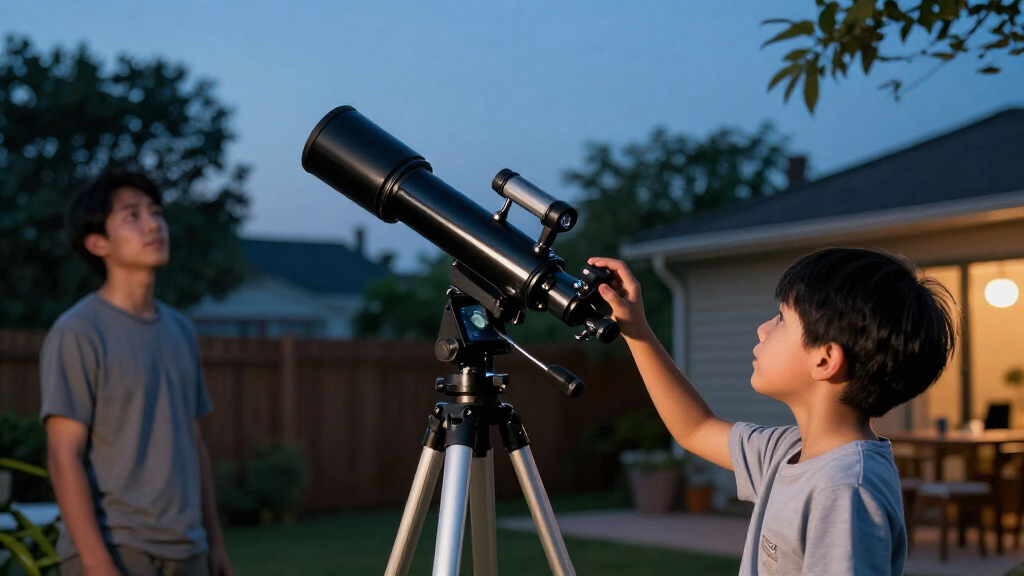
I ranked these digital smart telescopes for beginners by how clearly each product’s design supports a first-time observer: setup and aiming, the role of its app or screen, portability, stated aperture, and the gap between advertised digital features and practical observing needs. I also considered whether a telescope’s controls seem to support a coherent observing workflow or mainly add convenience features such as autofocus, remote operation, or a display. Where product names provide limited information, I avoid treating headline claims like “4K” or high magnification as proof of image quality.
The order favors models with a recognizable astronomy-focused approach and a clear use case, then separates compact or premium alternatives from screen-led refractors and models with fewer details available. This is not a claim that every buyer needs the same telescope: an automated imaging system ranks ahead for someone who wants app-guided sessions, while a phone-guided manual scope may suit someone who wants to learn the sky. I also weighed tradeoffs directly, including cost-independent value, reliance on a phone or app, portability, and whether the product’s advertised controls match a beginner’s likely priorities.
Factors to Consider When Choosing Digital Smart Telescopes For Beginners
Before choosing a model, decide what you want to do during a typical session. A telescope that captures images automatically can reduce aiming work, but it may not teach you how to find objects at the eyepiece; a display can make viewing feel immediate, but it is not the same as a well-supported sky-guidance system. These broader questions help separate useful beginner features from a long list of specifications.
Choose Between Automated Imaging and Learning to Aim
“Smart telescope” can describe very different levels of automation, so check what happens after you power the instrument on. Some systems use an app to locate targets and manage image capture, while smartphone-guided designs help you point a telescope that you operate yourself. The first route can make observing feel less like troubleshooting, but it may keep you more dependent on software. The second asks you to participate in aiming and can make the sky easier to learn over time. A common mistake is buying the most automated model when the real goal is learning constellations, or choosing a manual scope when you want images with minimal setup. Decide which activity you want the telescope to make easier before comparing camera claims.
Read Aperture Alongside Portability
Aperture is the opening that gathers light, so it is a more useful starting point than a dramatic magnification number when comparing telescopes. A larger aperture can help with dimmer targets, but it may also mean a bulkier setup that is less likely to travel with you. Compact instruments such as the Dwarf Mini make spontaneous sessions easier, while larger-aperture options may suit a fixed patio or dark-sky trip. Do not assume a high advertised magnification will produce a sharper view; usable magnification depends on optics, atmospheric conditions, and the target. Think about where the telescope will live and how often you will carry it. The best specification is the one that fits the observing conditions you can actually reach.
Treat Camera Labels as One Part of the Imaging Chain
A 4K camera label does not describe the whole quality of an astronomy image. Optics, sensor performance, tracking, exposure controls, software processing, and sky conditions all affect the final result. A model with autofocus or a flip screen may feel friendly for daytime or casual use, but those features alone do not tell you how it handles faint celestial targets. Ask whether the product explains its app workflow, target support, image storage, and sharing options. Avoid comparing products by resolution alone, especially when their underlying telescope designs differ. For beginners, a clear capture process can matter more than a larger number on the camera specification.
Check App, Phone, and Display Dependencies
Digital telescopes often depend on a phone or tablet for setup, control, or viewing, but the exact role varies. Before buying, check device compatibility, whether an internet connection is needed at the observing site, and whether core functions remain available when the connection is limited. A built-in display can reduce reliance on a phone, though it may add bulk and still offer fewer controls than a companion app. Also consider battery needs across both the telescope and your mobile device; cold nights can shorten usable battery time. Do not assume “app control” means the same thing from one product to another. A short review of the control workflow can prevent a frustrating first session.
Separate Useful Beginner Aids From Spec Sheet Extras
Autofocus, remote controls, foldable screens, and included memory cards can make a setup feel accessible, but each solves a different problem. A remote may help with simple shutter or recording control, while a guided app can help with target selection and positioning. An included card saves a separate purchase, but it does not tell you how much storage your sessions will use or how files are organized. Check which features are built for astronomy and which are general digital-camera conveniences. Beginners often overvalue a long feature list and undervalue clear instructions, stable support, and a repeatable setup process. Favor the aids that remove a task you genuinely do not want to manage.
Plan for the Whole Observing Setup
The telescope is only one part of a usable beginner kit. A stable mount, power supply, suitable observing location, and a way to protect equipment from dew can shape a session as much as a camera feature. A portable scope may be easier to carry but still need a steady surface and open sky; an electronic system may need charging and app setup before you leave home. Check what is included rather than assuming a mount, power source, or carrying case comes with the telescope. City light pollution also limits what faint objects you can see or capture, regardless of advertised capability. Planning for location and power can save more frustration than choosing a model based on headline magnification.
Frequently Asked Questions
Should a first telescope be a fully automated smart scope or a phone-guided manual model?
Choose a fully automated smart scope if your main goal is finding targets and capturing images with less manual aiming. A phone-guided manual model such as the StarSense Explorer approach makes more sense if you want to learn how pointing and sky navigation work. Neither style is automatically easier for every beginner: automation can introduce app and power dependencies, while manual aiming takes practice. Think about whether you want your first sessions to focus on observing results or learning the mechanics. That choice matters more than whether a product uses the word “smart.”
Does a 4K label mean a digital telescope will take better astronomy photos?
No, the label describes a camera resolution claim, not the quality of the complete telescope system. The optics, sensor, tracking, exposure options, processing, and observing conditions all affect the image. In this roundup, several models highlight 4K alongside screens, autofocus, or remote controls, but those features do not establish how well faint objects will be captured. Compare the stated workflow and astronomy-specific capabilities rather than selecting by resolution alone. If a listing does not explain how the telescope locates and tracks targets, treat the camera label as only one piece of information.
Is a larger aperture worth choosing over a more portable telescope?
A larger aperture gathers more light, which can help when observing dimmer targets, but it does not make a telescope the right choice if it is too inconvenient to set up. The 85 mm Odyssey and 114 mm StarSense illustrate why aperture should be weighed against the size and style of the whole system. A compact option such as the Dwarf Mini may be easier to take along and use spontaneously. Consider where you will observe, how far you will carry the equipment, and whether you have a stable setup area. For many beginners, a telescope that gets used regularly is a better fit than one chosen only for its larger opening.
Can I use a smart telescope without reliable internet at my observing site?
Possibly, but the answer depends on the telescope’s app and which functions need a network connection. Before buying, check whether setup, target selection, telescope control, and image saving work offline or require an online account or connection. A phone may still communicate locally with the telescope even when the site has no internet, but product documentation should confirm that workflow. Download any required apps, maps, or updates before leaving home. Also plan for phone and telescope battery life, since remote locations may not offer convenient charging.
Which telescope style is the best choice if I want both live viewing and saved images?
Start by distinguishing a live electronic display from app-based image capture: a screen can show a view directly, while an imaging-focused smart scope may be designed around collecting and processing files. The Temodu’s named LCD and the UNISTELLAR Odyssey PRO’s electronic eyepiece point to different ways of viewing digitally, while the Seestar and other smart scopes emphasize app-led use. Check whether the product supports both the kind of live viewing you want and the file-saving workflow you expect. Also review how images can be transferred and whether viewing requires a separate phone or tablet. Choosing by your preferred session style will be more reliable than assuming every digital telescope handles both tasks equally well.
Conclusion
For the best overall fit, I’d choose the UNISTELLAR Odyssey 85 mm for its astronomy-focused smart approach and stated aperture. The ZWO Seestar S30 Pro is my pick for a compact, automated imaging workflow, while the UNISTELLAR Odyssey PRO is the best premium choice for buyers drawn to its Nikon electronic eyepiece. If you want to learn manual aiming with phone guidance, the Celestron StarSense Explorer LT 114AZ is the clearest beginner match; for portability, look at the Dwarf Mini. The best value depends on which features you will use: compare the simpler guided telescope experience with screen-led models before paying for autofocus, remotes, or 4K claims. Choose the model that matches how you want to observe, then verify app compatibility, power needs, and included equipment before ordering.