For most students, the AmScope M150C1000X is my best overall pick: its straightforward compound design and LED illumination suit everyday slide work. The Wevision M2 stands out for dual-power flexibility, while the AmScope M30-ABS-KT2-W is a strong starting point for younger beginners who benefit from a bundled STEM kit. The main tradeoff is between a traditional microscope that teaches slide-based observation and a screen-based digital model that is easier to share but serves a different purpose. Kit size and advertised magnification can also distract from practical details such as focus control, lighting, and stage stability. Read on for the full comparison and guidance on matching a microscope to a student’s age, coursework, and workspace.

Prime made for students and young adults
- Fast, free delivery for dorm and study essentials
- Prime Video and Amazon Music included
- Member-only deals
Key Takeaways
- The AmScope M150C1000X leads for routine school slide work because its conventional compound format and LED lighting prioritize hands-on observation over extra accessories.
- The Wevision M2 stands out for flexible placement: dual-power operation can help students work where a dependable outlet is not convenient.
- The AmScope M30-ABS-KT2-W and Emarth 52-piece kit suit guided beginners, but a large accessory count matters less than whether the student can set up and focus a sample independently.
- The BMDSAE handheld digital microscope fills a different role with its built-in screen, making it better for viewing and sharing surface details than for replacing a compound microscope used with prepared slides.
- High advertised magnification is not a reliable ranking shortcut; illumination, focusing, stage control, and the intended sample type matter more to a student’s day-to-day results.
| JECONE Compound Microscope with Slides and Phone Holder, White | 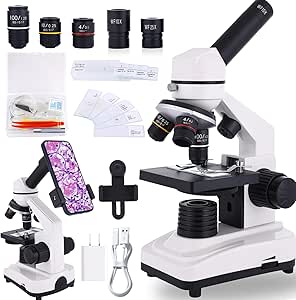 | Best for Versatile Specimen Viewing | Magnification: 40x–2500x | Eyepieces: WF25x and 10x | Objective lenses: 4x, 10x, and 100x | VIEW LATEST PRICE | See Our Full Breakdown |
| Compound Microscope, 40X-2500X, WF10x and WF25x Eyepieces, Dual LED Lighting and Two-Layer Mechanical Stage | 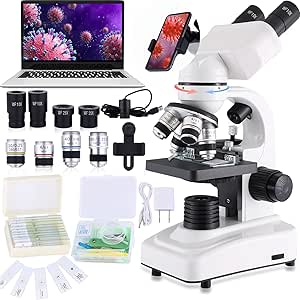 | Best for Slide Positioning | Listed magnification: 40x–2500x in title and description; maximum also listed as 40x in product details | Eyepieces: WF10x and WF25x | Objective lenses: 4x, 10x, and 40x | VIEW LATEST PRICE | See Our Full Breakdown |
| PalliPartners Compound Microscope for Adults and Students |  | Best Student Starter Kit | Magnification: 100X–2000X | Objective lenses: 4X, 10X, and 40X | Eyepiece: WF25X | VIEW LATEST PRICE | See Our Full Breakdown |
| BMDSAE 1000X Handheld Digital Microscope for Kids with 2.0-Inch IPS Screen |  | Best Portable Digital Pick | Magnification: Up to 1000X | Screen: 2.0-inch IPS | Camera: 2MP | VIEW LATEST PRICE | See Our Full Breakdown |
| AmScope M30-ABS-KT2-W Beginner Microscope STEM Kit, White |  | Best for Guided First Experiments | Magnification: 120x–1200x listed; 300x, 600x, and 1200x in product description | Viewing head: Monocular | Focus: Coaxial coarse focus | VIEW LATEST PRICE | See Our Full Breakdown |
| PALOBIL Compound Microscope Kit, 100x–2000x |  | Best for Hands-On Experimenting | Magnification: 100x, 200x, 250x, 500x, 1000x, 2000x | Eyepiece: WF25X with optional 2x lens | Objective lenses: 4x, 10x, 40x | VIEW LATEST PRICE | See Our Full Breakdown |
| AmScope M150C1000X Compound Biological Microscope with LED Illumination |  | Best for Classroom Fundamentals | Model: M150C | Microscope type: Compound biological, monocular | Magnification: 40x, 100x, 250x, 400x, 1000x | VIEW LATEST PRICE | See Our Full Breakdown |
| Emarth Compound Microscope for Kids and Beginners, 40x–1000x with 52-Piece Kit |  | Best for Beginner-Friendly Variety | Model: 1405 | Magnification: 40x–1000x | Kit contents: 52 pieces | VIEW LATEST PRICE | See Our Full Breakdown |
| Wevision M2 Dual Power Compound Monocular Microscope, 40×–2000× |  | Best for Portable Slide Work | Microscope type: Compound monocular | Magnification: 40×–2000× | Eyepieces: 10× and 25× | VIEW LATEST PRICE | See Our Full Breakdown |
| HUTACT 40–2000X Compound Microscope for Kids and Adults |  | Best Lightweight Pick | Model: NHKJ-3J5-893 | Maximum magnification: 2000X | Eyepieces: H10X, H25X | VIEW LATEST PRICE | See Our Full Breakdown |
| PalliPartners 40x–2000x Biological Compound Trinocular Microscope |  | Best for Student Imaging | Microscope type: Compound trinocular | Magnification range: 40x–2000x | Camera: 5MP | VIEW LATEST PRICE | See Our Full Breakdown |
| Uarzt 58-Piece Kids Microscope Kit, 100X–1200X Magnification |  | Best for Young Beginners | Kit pieces: 58 | Maximum magnification: 1200X | Light source: LED | VIEW LATEST PRICE | See Our Full Breakdown |
| PalliPartners Compound Binocular Microscope with 28-Slide Kit |  | Best Complete Classroom-Style Kit | Magnification: 100X–2000X | Objective lenses: 4X, 10X, 40X | Eyepiece: WF25X | VIEW LATEST PRICE | See Our Full Breakdown |
| TOMLOV CM101 Compound Microscope with Coarse and Fine Focus |  | Best for Learning Focus and Lighting | Model: CM101 | Magnification: 40X–2000X | Objectives: 4X, 10X, 40X achromatic | VIEW LATEST PRICE | See Our Full Breakdown |
| BEBANG 100X–2000X Compound Microscope Kit |  | Best for Portable Student Projects | Model: YW-3006 | Magnification settings: 100X, 200X, 250X, 500X, 1000X, 2000X | Eyepiece: WF25X | VIEW LATEST PRICE | See Our Full Breakdown |
| microscopes for student | Magnification |
|---|---|
| JECONE Compound Microscope wit | 40x–2500x |
| Compound Microscope | — |
| PalliPartners Compound Microsc | 100X–2000X |
| BMDSAE 1000X Handheld Digital | Up to 1000X |
| AmScope M30-ABS-KT2-W Beginner | 120x–1200x listed; 300x, 600x, and 1200x in product description |
| PALOBIL Compound Microscope Ki | 100x, 200x, 250x, 500x, 1000x, 2000x |
| AmScope M150C1000X Compound Bi | 40x, 100x, 250x, 400x, 1000x |
| Emarth Compound Microscope for | 40x–1000x |
| Wevision M2 Dual Power Compoun | 40×–2000× |
| HUTACT 40–2000X Compound Micro | — |
| PalliPartners 40x–2000x Biolog | — |
| Uarzt 58-Piece Kids Microscope | — |
| PalliPartners Compound Binocul | 100X–2000X |
| TOMLOV CM101 Compound Microsco | 40X–2000X |
| BEBANG 100X–2000X Compound Mic | — |
More Details on Our Top Picks
JECONE Compound Microscope with Slides and Phone Holder, White
The JECONE suits students who want one microscope for both prepared slides and larger opaque objects. Its incident and transmitted LED lighting lets them switch between those specimen types, while the coarse and fine focus controls offer more adjustment than the AmScope M30-ABS-KT2-W, which uses coarse focus. A phone holder and starter slides also make it easier to document observations and begin without assembling a separate kit.
The listed 40x–2500x range is broad, but the maximum figure does not guarantee useful extra detail, and the 100x objective takes careful focusing. The five-color filter wheel adds options for contrast, though students mainly seeking a straightforward introduction may find the AmScope kit’s included hatchery and larger accessory set more guided. I’d choose JECONE for mixed specimens and phone capture, with patience for fine focusing.
Pros:- Incident and transmitted LEDs accommodate opaque and transparent specimens.
- Coarse and fine focus allow more controlled image adjustment.
- Includes a phone holder, prepared slides, and tools to start exploring.
- Five-color filter wheel gives students options for changing specimen contrast.
Cons:- The 100x objective requires careful focusing to produce clear details.
- The listed 2500x maximum may exceed the useful detail available in typical viewing setups.
Best for: Students who want to view both transparent slides and opaque samples and save observations with a phone.
Not ideal for: Younger beginners who need a highly guided kit or anyone expecting the 2500x setting to reveal reliably useful extra detail.
- Magnification:40x–2500x
- Eyepieces:WF25x and 10x
- Objective lenses:4x, 10x, and 100x
- Illumination:Incident and transmitted LED
- Focusing:Coarse and fine focus
- Filters:Yellow, red, blue, green, and purple
- Included accessories:Phone holder, 5 prepared slides, 5 blank slides, tweezers, droppers, coverslips, toolkit, and manual
- Dimensions:2.95 × 4.8 × 8.15 in
- Weight:1.59 kg
Our verdict“Choose the JECONE if you want flexible lighting and phone documentation and are comfortable taking time to focus carefully.”
Compound Microscope, 40X-2500X, WF10x and WF25x Eyepieces, Dual LED Lighting and Two-Layer Mechanical Stage
The listed two-layer mechanical stage gives this model a distinct classroom use: students can position a slide with controlled movement instead of nudging it by hand. That can make it easier to follow a small area during a lesson. Its dual LEDs also support viewing with light from above or below, much like the JECONE, while WF10x and WF25x eyepieces offer alternate viewing magnifications.
The product data is less complete than for the PalliPartners Compound Microscope for Adults and Students, which specifies its objective lenses and includes slides and phone accessories. This listing names 4x, 10x, and 40x objectives, but its description is inconsistent about maximum magnification, and it does not provide a documented accessory kit. I’d shortlist it for slide movement, but students who need a clear starter package should favor a model with specified included supplies.
Pros:- Two-layer mechanical stage is designed for controlled slide positioning.
- Top and bottom LED lighting supports different specimen setups.
- Includes WF10x and WF25x eyepieces for different viewing magnifications.
Cons:- The listing gives conflicting magnification information, making the maximum unclear.
- Included slides and other starter accessories are not specified.
- The available product details provide limited information for comparing classroom readiness.
Best for: Students working through slide-based lessons who value mechanical slide positioning and dual illumination.
Not ideal for: Families who need a clearly documented starter kit or buyers who want consistent, detailed specifications before choosing.
- Listed magnification:40x–2500x in title and description; maximum also listed as 40x in product details
- Eyepieces:WF10x and WF25x
- Objective lenses:4x, 10x, and 40x
- Illumination:Top and bottom LED
- Stage:Two-layer mechanical stage
- Focusing:Coarse and fine focus
- Power source:Corded electric
- Dimensions:14.37 × 11.41 × 6.49 in
- Real angle of view:45 degrees
Our verdict“Pick this model for its mechanical stage if slide control matters most, but choose PalliPartners for a better-specified student kit.”
PalliPartners Compound Microscope for Adults and Students
With 28 slides and a phone clip adapter, this PalliPartners model gives students more to work with out of the box than the JECONE, which includes five prepared and five blank slides. Its 10 prepared and 18 blank slides support both guided viewing and making samples, while the Bluetooth camera shutter can help capture observations without touching the phone during a shot. Adjustable top and bottom LEDs also let students switch between opaque objects and light-through slides.
The 100x–2000x range and 4x, 10x, and 40x objectives fit introductory and intermediate study, but this is not positioned as a research instrument. Compared with the BMDSAE handheld digital microscope, it offers conventional eyepiece viewing and prepared slides rather than a built-in screen and portable photo storage. Its strengths are hands-on slide practice and basic documentation; students who primarily want to inspect objects on the move may prefer the BMDSAE.
Pros:- Includes 10 prepared and 18 blank slides for guided and self-made samples.
- Adjustable top and bottom LEDs accommodate opaque and translucent specimens.
- Phone clip adapter and Bluetooth shutter support image capture.
- Coarse and fine focus offer more adjustment than a basic single-control setup.
Cons:- The listing positions it for educational use rather than advanced research.
- Conventional slide viewing is less convenient for inspecting objects away from a desk than the BMDSAE handheld model.
Best for: Students at home or in classrooms who want prepared and blank slides plus basic phone-based documentation.
Not ideal for: Advanced users seeking research-grade equipment or children who want a handheld microscope with a built-in screen.
- Magnification:100X–2000X
- Objective lenses:4X, 10X, and 40X
- Eyepiece:WF25X
- Illumination:Adjustable top and bottom LED
- Included slides:10 prepared and 18 blank
- Included accessories:Phone clip adapter, Bluetooth camera shutter, and power adapter
- Model number:SWXWJ-1
- Safety certification:SGS certified
Our verdict“Choose this PalliPartners kit for slide-based learning and phone documentation, rather than advanced lab work or portable screen viewing.”
BMDSAE 1000X Handheld Digital Microscope for Kids with 2.0-Inch IPS Screen
The BMDSAE is the most portable option in this group: at 200g, with a built-in screen, it lets a student inspect objects without setting up a compound microscope and separate display. Eight adjustable LEDs and three brightness modes give some control over illumination, while photo and video storage can make it easier to revisit an observation. Unlike the PalliPartners Compound Microscope for Adults and Students, it is built around handheld inspection and a screen rather than eyepiece-based slide study.
That convenience comes with limits for school biology work. The listing specifies a 2MP camera and manual focus, but does not include prepared slides or describe compound objectives, so it is less suited to structured cell viewing than the AmScope M30-ABS-KT2-W. Battery life is listed at up to two hours, and the product’s image-quality and safety claims are not independently substantiated in the supplied details. I’d choose it for casual, portable exploration.
Pros:- Built-in 2.0-inch screen supports handheld viewing without a separate computer.
- Lightweight 200g body and lanyard suit portable exploration.
- Stores photos and videos and connects to Windows and Mac computers by USB-C.
- Eight LEDs offer adjustable brightness across three modes.
Cons:- Battery life is listed at up to two hours per charge.
- The listing does not include prepared slides or describe compound microscope objectives.
- Claims of lab-quality imaging and safety certifications are not independently substantiated in the product details.
Best for: Young students who want to inspect everyday objects, view results on a screen, and save occasional photos or videos.
Not ideal for: Students following slide-based biology lessons who need prepared samples and a conventional compound microscope.
- Magnification:Up to 1000X
- Screen:2.0-inch IPS
- Camera:2MP
- Lighting:8 adjustable LEDs with 3 brightness modes
- Battery:600mAh; up to 2 hours
- Storage:32M; supports 200+ photos or AVI videos
- Connectivity:USB-C
- Compatible systems:Windows XP/Vista/7/8/10/11 and Mac 11.0+
- Weight:200g
Our verdict“Choose the BMDSAE for portable, screen-based exploration, while students focused on prepared slides should choose the AmScope or PalliPartners.”
AmScope M30-ABS-KT2-W Beginner Microscope STEM Kit, White
The AmScope M30-ABS-KT2-W makes a strong case for students who learn by doing: its 52-piece kit includes brine shrimp eggs and a hatchery, alongside slides, tools, and a hard carrying case. That gives a beginner a concrete experiment to follow, whereas the JECONE includes a smaller set of slides and tools and places more emphasis on flexible specimen viewing and phone capture. The metal frame and battery-powered LED also make this a self-contained choice for a desk or a classroom demonstration.
Its 120x–1200x magnification is more modest than the broad ranges listed for the JECONE and PalliPartners, but that can keep expectations closer to the included beginner activities. The tradeoff is a monocular head and coarse-only focus; students wanting finer adjustment should look to JECONE or PalliPartners. I’d put this first for a guided introduction, not for extended work that benefits from fine focusing.
Pros:- 52-piece kit includes brine shrimp eggs, hatchery, slides, and specimen tools.
- Hard-sided carrying case keeps the microscope and accessories together.
- Metal frame and battery-powered LED support a self-contained setup.
- Color filter wheel gives beginners a simple way to adjust specimen contrast.
Cons:- Coarse-only focus offers less image adjustment than the JECONE and PalliPartners.
- Monocular viewing may be less comfortable for longer sessions than binocular options.
- 120x–1200x range is narrower than the ranges listed for several alternatives in this roundup.
Best for: Young beginners who want a guided first microscope activity, especially families or classrooms interested in raising brine shrimp.
Not ideal for: Students who need fine focus controls, a binocular viewing head, or higher listed magnification for varied slide work.
- Magnification:120x–1200x listed; 300x, 600x, and 1200x in product description
- Viewing head:Monocular
- Focus:Coaxial coarse focus
- Illumination:LED and mirror illumination
- Stage:Plain stage with stage clips
- Power:Two AA batteries, included
- Included accessories:52-piece kit with brine shrimp hatchery, eggs, slides, specimen tools, and hard plastic case
- Weight:3.7 pounds
- Frame:Metal
Our verdict“Pick the AmScope for a guided, accessory-rich first experience, and choose JECONE or PalliPartners if fine focus matters more.”
PALOBIL Compound Microscope Kit, 100x–2000x
The PALOBIL is a good match for students who want a microscope plus materials to start using it right away. Its six magnification settings and top-and-bottom LED lighting support lessons with both translucent samples and objects viewed from above, while the included prepared and blank slides, tools, and experiment accessories invite practice beyond a single viewing session. Compared with the AmScope M150C, PALOBIL offers a broader stated magnification range and more kit contents, but the AmScope specifies achromatic objectives and a five-year warranty. The PALOBIL’s metal frame and included AC adapter are practical for a regular study spot; battery operation adds flexibility, though the three AA batteries are not supplied. The number of prepared slides is also unspecified, so buyers who need a known slide count may prefer a kit that spells that out.
Pros:- Six listed magnification settings give students several viewing steps to explore.
- Top and bottom LED illumination suit different kinds of specimens.
- Prepared and blank slides, tools, and experiment accessories support hands-on practice.
- Metal frame and included AC adapter suit regular desk-based study.
Cons:- Three AA batteries are not included for battery-powered use.
- The product information does not state how many prepared slides are included.
Best for: Students and families who want a ready-to-start home science kit with lighting for both translucent and opaque samples.
Not ideal for: Students who need a clearly stated prepared-slide quantity or want the reassurance of a specified long warranty.
- Magnification:100x, 200x, 250x, 500x, 1000x, 2000x
- Eyepiece:WF25X with optional 2x lens
- Objective lenses:4x, 10x, 40x
- Lighting:Adjustable top incident and bottom transmitted dual LED
- Frame:Metal
- Power:Included AC adapter or 3 AA batteries (not included)
- Included accessories:Phone adapter, prepared and blank slides, droppers, tweezers, beginner experiment kit
Our verdict“Choose PALOBIL for a versatile, accessory-rich student kit, but pick the AmScope M150C if a stated warranty and achromatic objectives matter more.”
AmScope M150C1000X Compound Biological Microscope with LED Illumination
The AmScope M150C is the most straightforward pick here for students learning standard biological microscopy. Its five magnification settings from 40x to 1000x, achromatic objective, optical glass elements, and LED illumination focus the setup on core slide work rather than a large accessory bundle. The 360-degree rotating monocular head can make it easier to share a view at a desk without moving the whole microscope. Compared with the PALOBIL, it gives up the higher listed magnification and the included slide-and-experiment kit, but it supplies clearer information about its achromatic optics and carries a stated five-year warranty. The metal frame and choice of outlet or battery power suit school or home use. Its main compromise is the single-eyepiece design, which may feel less comfortable during longer sessions than a binocular microscope.
Pros:- Five magnification settings cover common introductory biological microscopy tasks.
- Achromatic objective and optical glass elements are specified.
- Rotating monocular head makes sharing the microscope easier.
- Metal frame, two power options, and a stated five-year warranty suit regular student use.
Cons:- Monocular viewing may be less comfortable during extended sessions than binocular designs.
- Three AA batteries are needed for battery operation and are not listed as included.
- The listed product information does not include a slide or experiment kit.
Best for: Students learning slide-based biology who want a sturdy, conventional microscope with clearly specified optical features.
Not ideal for: Learners who want a large starter accessory kit, magnification beyond 1000x, or the comfort of binocular viewing.
- Model:M150C
- Microscope type:Compound biological, monocular
- Magnification:40x, 100x, 250x, 400x, 1000x
- Head rotation:360 degrees
- Objective lens:Achromatic
- Illumination and power:LED; outlet adapter or 3 AA batteries
- Frame:Metal
- Dimensions and weight:10 x 7 x 15 in; 4 lb
- Warranty:5 years
Our verdict“Pick the AmScope for dependable classroom fundamentals and a stated warranty, rather than PALOBIL’s higher magnification range and bundled experiment accessories.”
Emarth Compound Microscope for Kids and Beginners, 40x–1000x with 52-Piece Kit
For a first student microscope, the Emarth’s strongest argument is the 52-piece kit, which gives beginners slides and tools to try rather than asking them to assemble supplies separately. Its top-and-bottom LED lighting lets students compare opaque objects with light-through specimens, and six color filters offer another way to explore how illumination changes what is visible. Compared with the PALOBIL, Emarth has a similarly broad beginner-kit approach but lists a 40x starting magnification and a maximum of 1000x rather than PALOBIL’s 2000x. That makes this a sensible choice for introductory activities where a large magnification figure is less important than varied materials. The achromatic objective and metal-and-plastic construction add useful structure, but the battery-powered design has a practical catch: batteries are not included.
Pros:- 52-piece kit supplies slides and tools for a range of beginner activities.
- Top and bottom LED illumination supports viewing different specimen types.
- Six color filters encourage experiments with lighting and contrast.
- Achromatic objective and metal components provide useful features for student work.
Cons:- Batteries are not included.
- Maximum listed magnification is 1000x, below the PALOBIL and Wevision M2 ranges.
- The enclosure combines metal and plastic rather than using an all-metal body.
Best for: Young beginners and families who want a broad set of slides and tools for guided home science activities.
Not ideal for: Students who need AC operation, a metal-only body, or magnification settings above 1000x.
- Model:1405
- Magnification:40x–1000x
- Kit contents:52 pieces
- Lighting:LED, top and bottom illumination
- Power source:Battery powered
- Objective lens:Achromatic
- Filters:6 color filters
- Enclosure material:Metal and plastic
Our verdict“Choose Emarth for a broad beginner kit and lighting variety, but choose PALOBIL or Wevision M2 if a higher stated magnification range is a priority.”
Wevision M2 Dual Power Compound Monocular Microscope, 40×–2000×
The Wevision M2 pairs a high stated magnification range with the most travel-ready package in this group: a hard-shell carrying case, prepared and blank slides, basic tools, and a smartphone adapter. That combination can help students move between home, classroom, and field activities while keeping small accessories together. Its dual LED lighting and achromatic objectives support routine slide viewing, and the 10x and 25x eyepieces offer different magnification routes. Compared with the HUTACT, Wevision includes more explicitly listed lab accessories and a hard case, while HUTACT is lighter at 0.76 kg and also reaches a stated 2000x. The tradeoff is that Wevision is a monocular model and weighs 2951 g, so it is not especially light to carry. Its 120 V specification may also limit use where local power differs.
Pros:- Hard-shell case helps protect and organize the microscope and accessories for transport.
- Prepared and blank slides, tweezers, dropper, and cleaning tissues support student practice.
- Smartphone adapter supports recording or sharing microscope views.
- Dual LED lighting and achromatic objectives are suited to slide-based study.
Cons:- At 2951 g, it is heavier than the HUTACT listed at 0.76 kg.
- Monocular viewing may be less comfortable for longer study sessions.
- The listed 120 V power specification may not suit every location.
Best for: Students who carry a microscope between home and class and want a case, slides, tools, and phone-based image capture.
Not ideal for: Buyers seeking a lightweight kit, binocular viewing, or power compatibility beyond the listed 120 V specification.
- Microscope type:Compound monocular
- Magnification:40×–2000×
- Eyepieces:10× and 25×
- Objectives and additional lens:4×, 10×, 40× objectives; 2× additional lens
- Objective lens:Achromatic
- Lighting and power:Dual LED; corded or battery; 120 V listed
- Included accessories:Prepared and blank slides, tweezers, dropper, lens-cleaning tissues, smartphone adapter, hard-shell carrying case
- Dimensions and weight:6.3 × 3.9 × 11.7 in; 2951 g
- Warranty:2 years
Our verdict“Choose Wevision M2 if an organized portable kit and phone adapter matter more than low carry weight or binocular comfort.”
HUTACT 40–2000X Compound Microscope for Kids and Adults
At 0.76 kg, the HUTACT is the lightest clearly specified option in this set, making it appealing for students who need to store or carry their microscope between lessons. Its achromatic glass lenses, LED light, and included prepared-slide set cover the basics without the larger supply bundle found with Emarth or the hard-shell case and accessory selection included with Wevision. The H10X and H25X eyepieces, 4X, 10X, and 40X objectives, and additional 2X lens produce a stated maximum of 2000X. That headline range resembles Wevision’s, but the provided HUTACT details offer fewer accessories and do not specify top-and-bottom lighting or dual power. The storage bag helps with keeping the set together, though a soft bag offers less stated protection than Wevision’s hard case. Its narrow 23.6-degree real angle of view may also feel less expansive.
Pros:- Listed weight of 0.76 kg makes it easier to carry and store than the Wevision M2.
- Achromatic glass lenses are specified.
- Prepared glass slides provide a starting point for viewing.
- Storage bag and user manual are included.
Cons:- Accessory list is smaller than the Emarth and Wevision kits.
- Power options and whether batteries are included are not specified in the provided details.
- The listed real angle of view is 23.6 degrees.
Best for: Students who need a lightweight microscope for occasional home study, easy storage, or carrying between learning spaces.
Not ideal for: Students who want a large experiment kit, a hard-shell case, specified dual lighting, or detailed power options.
- Model:NHKJ-3J5-893
- Maximum magnification:2000X
- Eyepieces:H10X, H25X
- Objective lenses:4X, 10X, 40X
- Magnifying lens:2X
- Lens type and light source:Achromatic glass; LED
- Real angle of view:23.6 degrees
- Body material and weight:Aluminum alloy; 0.76 kg
- Included accessories and warranty:5-piece prepared glass slide set, storage bag, user manual; 1 year
Our verdict“Choose HUTACT when low weight and basic prepared-slide viewing matter more than a larger kit or the Wevision M2’s hard-shell case and listed accessories.”
PalliPartners 40x–2000x Biological Compound Trinocular Microscope
For students who want to document observations as well as view them, the trinocular head sets this microscope apart from the monocular TOMLOV CM101 and BEBANG YW-3006. It supports connecting a camera or imaging device, and the listed 5MP camera makes image capture part of its student-focused appeal. Its 40x–2000x range, coarse and fine focus, and top-and-bottom LED illumination cover both slide work and some surface specimens, giving learners room to explore more than one specimen type.
The tradeoff is a less complete out-of-box picture: the product details do not specify what accessories are included or explain the camera connection, so buyers should check compatibility before planning a digital workflow. It is described for foundational inspection, not advanced research. Compared with the more accessory-rich PalliPartners binocular kit, this pick favors imaging potential over a supplied slide-and-tool collection.
Pros:- Trinocular head supports connection to an imaging device
- Listed 5MP camera supports image capture
- Top and bottom LED illumination suits translucent and surface specimens
- Coarse and fine focus give students more control when sharpening a view
Cons:- Included accessories are not specified, so buyers cannot tell what is ready to use
- Camera connection details and compatibility are not described
- Positioned for foundational viewing rather than advanced laboratory work
Best for: Students and families who want to capture microscope observations digitally and are prepared to verify camera compatibility.
Not ideal for: Beginners seeking a clearly listed, ready-to-use slide and tool kit, or advanced users needing research-grade specifications.
- Microscope type:Compound trinocular
- Magnification range:40x–2000x
- Camera:5MP
- Illumination:Top and bottom LED
- Focus controls:Coarse and fine
- Stage:Double-layer
- Enclosure material:Metal
- Warranty:1 year
Our verdict“Choose this model if student image capture matters more than having a fully specified starter kit.”
Uarzt 58-Piece Kids Microscope Kit, 100X–1200X Magnification
The Uarzt kit makes the strongest case for younger students who need activities and guidance, not just a microscope. Its 58-piece set combines 13 prepared specimens, 31 blank slides, lab tools, and a colorful guide, so children can start with known samples before trying their own. That practical learning path is a better fit for ages 5–12 than the more capable PalliPartners 40x–2000x trinocular model, which emphasizes imaging and foundational inspection rather than a child-oriented activity bundle.
The compromise is a lower 1200X maximum magnification than several compound options here, including the TOMLOV CM101 and BEBANG kit. It is also battery powered and needs two AA batteries that are not included. This is a hands-on introduction, not the pick for students who want more headroom for detailed slide work or a long-term classroom instrument.
Pros:- Includes 13 prepared specimens and 31 blank slides
- Lab tools and a colorful guide support guided hands-on learning
- Compact dimensions suit a child’s desk or activity area
- Smartphone compatibility offers an option for sharing observations
Cons:- Maximum magnification is lower than the 2000X options in this roundup
- Requires two AA batteries, which are not included
- The child-focused kit is less suited to students seeking a more advanced instrument
Best for: Children ages 5–12 who are beginning STEM activities and benefit from prepared samples, blank slides, and a guided introduction.
Not ideal for: Older students seeking magnification up to 2000X, or families who want a kit that can be used immediately without sourcing batteries.
- Kit pieces:58
- Maximum magnification:1200X
- Light source:LED
- Power:Two AA batteries, not included
- Prepared specimens:13
- Blank slides:31
- Dimensions:4.6 × 2.75 × 8.15 inches
- Recommended age:5–12 years
Our verdict“Pick the Uarzt for a child’s first microscopy activities, but choose a 2000X model for more room to grow.”
PalliPartners Compound Binocular Microscope with 28-Slide Kit
This PalliPartners binocular model stands out for students who want a full set of materials alongside a compound microscope. The 28-slide collection includes 10 prepared and 18 blank slides, and the package adds dissecting tools, collection bottles, a hatching box, and phone-photo accessories. Compared with the PalliPartners trinocular microscope, this one trades a dedicated camera port for binocular viewing and a broader listed accessory set; compared with the TOMLOV CM101, it supplies more slides and specimen-handling tools.
Its 100X–2000X range, glass optics, adjustable top and bottom LEDs, and coaxial coarse and fine focus give students a useful setup for biological specimens and basic projects. The tradeoffs are that the description recommends adult guidance for younger learners and provides no warranty details. Buyers should also note that its phone clip and Bluetooth remote are accessories for phone photography, not a stated built-in camera.
Pros:- Binocular head supports viewing with both eyes
- Includes 10 prepared and 18 blank slides
- Collection and dissecting tools broaden hands-on project options
- Adjustable top and bottom LED illumination accommodates different specimens
Cons:- Adult guidance is recommended for younger users
- No warranty details are provided in the product information
- Phone photography relies on included accessories rather than a stated built-in camera
Best for: Students and families who want binocular viewing, a wide range of slide materials, and tools for guided specimen projects.
Not ideal for: Younger children working without adult help, or buyers who require clearly stated warranty coverage or a built-in camera.
- Magnification:100X–2000X
- Objective lenses:4X, 10X, 40X
- Eyepiece:WF25X
- Barlow lens:2X
- Illumination:Adjustable top and bottom LED
- Focus:Coaxial coarse and fine
- Slides:10 prepared and 18 blank
- Included accessories:Collection bottles, hatching box, dissecting tools, phone clip adapter, Bluetooth remote shutter, power adapter
Our verdict“Choose this kit for a student who wants binocular viewing and a generous set of materials for specimen projects.”
TOMLOV CM101 Compound Microscope with Coarse and Fine Focus
The TOMLOV CM101 is a good match for students learning how specimen preparation, focus, and illumination change what they can see. Its coaxial coarse and fine controls give learners separate ways to make broad and precise adjustments, while the six-position disc diaphragm offers a hands-on way to vary contrast and light. Dual LEDs illuminate transparent slides from below and surface details from above. Compared with the BEBANG YW-3006, the CM101 lists more lighting-control detail and achromatic objectives; the BEBANG instead includes a carrying bag and phone adapter.
It reaches 40X–2000X and includes prepared and blank slides, coverslips, and power accessories, making it more ready for basic lessons than a microscope with unspecified supplies. The main compromise is its monocular head, which may be less comfortable during extended viewing than the binocular PalliPartners kit. Its accessory bundle is useful, but it is smaller than that kit’s slide and specimen-tool collection.
Pros:- Coaxial coarse and fine controls support staged focusing
- Six-position disc diaphragm provides multiple lighting and contrast settings
- Top and bottom LEDs handle transparent slides and surface details
- Includes prepared and blank slides, coverslips, and a power adapter
Cons:- Monocular viewing may be less comfortable during extended sessions
- Included slide and tool selection is smaller than the PalliPartners 28-slide kit
- The listing does not include a phone adapter for sharing images
Best for: Students learning how focus, illumination, and contrast affect a specimen, especially those who want a starter set of slides and coverslips.
Not ideal for: Students who expect long viewing sessions with both eyes or want a larger collection of specimen tools and slides.
- Model:CM101
- Magnification:40X–2000X
- Objectives:4X, 10X, 40X achromatic
- Eyepieces:WF10X, WF25X
- Focus:Coarse and fine coaxial controls
- Illumination:Dual LED, top and bottom
- Disc diaphragm:Six positions
- Included slides:5 prepared and 5 blank
- Warranty:1 year
Our verdict“Choose the CM101 for students who want hands-on control over focus and lighting in a supplied starter setup.”
BEBANG 100X–2000X Compound Microscope Kit
The BEBANG kit is the portable option for students who want to move their microscope between home, school, or a club activity. At 2.4 pounds, it is lighter than a stationary classroom setup, and the included carrying bag gives the slides, phone adapter, and other accessories a place to travel. It offers six listed magnification settings up to 2000X, coarse and fine focus, and top-and-bottom LEDs. Compared with the TOMLOV CM101, it prioritizes portability and phone photography; the TOMLOV gives students more detailed diaphragm controls and achromatic objective information.
The BEBANG’s 100X starting magnification is less flexible for lower-power scanning than the 40X-starting TOMLOV and PalliPartners trinocular models. Its monocular head may also tire students during longer sessions, and operation requires AC or battery power. The accessory set helps with projects on the go, but buyers should plan for a power source wherever it is used.
Pros:- Lightweight 2.4-pound body and carrying bag suit portable projects
- Includes a phone adapter and wire shutter for image capture
- Top and bottom LED illumination supports different specimen types
- Coarse and fine focus controls support more precise adjustment
Cons:- Starts at 100X rather than the 40X available on several alternatives
- Monocular viewing may be less comfortable during extended use
- Requires AC or battery power, so a power source must be available
Best for: Students who carry their microscope between home, school, and activities and want a bag and phone adapter included.
Not ideal for: Learners who need lower-power scanning from 40X, prefer binocular viewing, or need a setup independent of AC or batteries.
- Model:YW-3006
- Magnification settings:100X, 200X, 250X, 500X, 1000X, 2000X
- Eyepiece:WF25X
- Objective lenses:4X, 10X, 40X
- Lighting:Top and bottom LED
- Focus:Coarse and fine adjustment
- Power source:AC or battery
- Dimensions:5.51 × 3.94 × 11.42 inches
- Weight:2.4 pounds
Our verdict“Pick the BEBANG for students who value a portable, phone-friendly kit more than low-power scanning or binocular comfort.”

How We Picked
I compared the 15 options through the needs of students and the adults helping them: how readily each design supports learning, whether its controls and lighting suit repeated observation, and how well its format matches common school and home tasks. I gave more weight to practical features such as stage control, focus setup, power flexibility, and a usable learning kit than to the largest magnification number in a listing. A microscope that makes it easier to prepare and study a slide can be a better school tool than one with a bigger accessory bundle or a screen built for a different kind of viewing.
The ranking reflects those differences rather than treating every product as interchangeable. The M150C1000X takes the lead as a conventional student microscope; the M30-ABS-KT2-W and Emarth kit earn beginner appeal through bundled materials; and the Wevision M2 is set apart by dual-power operation. The BMDSAE is included for students who specifically want a handheld screen-based viewer, not as a direct substitute for a compound microscope. Binocular and trinocular PalliPartners models, along with the other broad-range compound kits, may fit particular preferences, but their format and extra features do not automatically make them a better first choice for every student.
Factors to Consider When Choosing Microscopes For Students
Before choosing from these student microscopes, start with the work the student will actually do. A school assignment involving prepared slides calls for a different tool from casual inspection of leaves, fabric, or small objects on a screen. The factors below can help you avoid paying attention to impressive-sounding specs while overlooking the parts that shape the learning experience.
Match the microscope format to the samples
A compound microscope is generally the more suitable format for thin, translucent samples placed on slides, which makes it a sensible starting point for biology coursework. A handheld digital microscope such as the BMDSAE has a screen and is designed around a different viewing routine, often making it convenient for inspecting surfaces or sharing a live view. Neither format replaces the other for every task. Before buying, check what the class is studying and whether assignments require looking through an eyepiece at prepared slides. Choosing by sample type can prevent the common mistake of buying a digital viewer when the student needs a conventional slide microscope.
Treat magnification claims as only one part of the decision
A stated magnification range does not tell you by itself how clear, bright, or useful an image will be. The eyepiece and objective combination, focus control, illumination, and sample preparation all shape what the student can see. Larger numbers can be less useful if the image becomes difficult to focus or the lighting does not suit the specimen. Compare the complete optical setup and basic operating controls rather than picking the largest range on the page. For school use, a dependable experience at commonly used magnifications may matter more than an impressive maximum.
Prioritize focus and stage control for independent learning
Students need to move from finding a sample to keeping it centered and bringing it into focus. A mechanical stage can make controlled slide movement easier than repositioning a slide by hand, while coarse and fine focus serve different parts of focusing. Younger learners may need an adult to help with setup regardless of how many accessories a kit includes. If the student will work alone, favor clear controls and a stable arrangement over a long feature list. A short trial with a prepared slide can reveal whether the controls feel manageable before a microscope becomes part of regular homework.
Choose a kit for useful learning materials, not its piece count
Included slides, tools, and preparation materials can give a student a faster start, especially when the family has not gathered supplies yet. But a large number of pieces can also mean more small parts to sort and store, and not every item will serve the student’s lessons. Check which materials are actually included and whether they match the intended age and coursework. A smaller, relevant set can be more useful than a crowded kit that makes setup harder. Plan for storage too, since slides and accessories are easier to use when they remain organized.
Consider power, portability, and where the student will work
A microscope that stays on a desk can prioritize a stable setup, while students moving between rooms or working away from an outlet may value flexible power. The Wevision M2’s dual-power design gives it a distinct advantage for placement flexibility within this lineup. Handheld digital models are easier to carry, but their use case differs from a full compound microscope for slide study. Think about where the microscope will live, how often it will be moved, and whether batteries or a nearby outlet fit the routine. Portability is only useful if the microscope still suits the samples and tasks the student needs to study.
Pay more for capabilities the student will actually use
Extra viewing ports, binocular eyepieces, elaborate kits, and screen features can be useful, but only when they support the student’s work. A binocular design may appeal to someone who expects regular, longer viewing sessions; a trinocular model is more relevant when a camera connection is part of the plan. A beginner may gain more from simple controls and guided materials than from advanced features that need extra setup. Check whether any camera, adapter, or accessory needed for a desired function is included rather than assuming compatibility. Spending on a feature with a clear purpose is more sensible than choosing a microscope simply because its listing has more specifications.
Frequently Asked Questions
Should I choose a compound microscope or the BMDSAE digital model for schoolwork?
Start with the samples and methods required by the student’s class. A compound microscope is the more direct fit for prepared slides and conventional biology activities, while the BMDSAE’s built-in screen offers a different way to view and share close-up details. A digital screen can make group viewing convenient, but it does not automatically replace eyepiece-based slide work. Check whether assignments ask students to use prepared slides or identify translucent specimens. If both kinds of activities matter, decide which one is the priority rather than assuming one device will cover them equally well.
Does a 2000X or 2500X microscope give a student a better view?
Not by the number alone. A high stated maximum does not guarantee a clear image, and practical results depend on the optics, lighting, focus, and quality of the prepared sample. Students may spend more time learning if they can locate and focus a specimen reliably than if they have a larger advertised range. Compare the controls and illumination alongside the magnification claims, and check what the manufacturer says about the optical setup. For regular coursework, ease of use at the magnifications the student will actually use is a more helpful priority.
Is a microscope kit worth choosing over a microscope sold with fewer accessories?
A kit can make sense when it includes relevant slides or tools the student would otherwise need to source separately. The AmScope M30-ABS-KT2-W and Emarth kit appeal to beginners partly because they bundle learning materials, while a larger piece count alone does not prove that a kit is more useful. Check whether the contents fit the student’s age, storage space, and planned activities. If the student already has prepared slides or school supplies, extra accessories may add clutter rather than value. Focus on the materials that will support repeatable practice.
When should I pick binocular or trinocular viewing for a student?
For occasional home study, a conventional monocular model may be simpler and less feature-heavy. Binocular viewing can be appealing for students expecting longer sessions, while a trinocular design makes the most sense when camera use is part of the plan. Do not assume a trinocular model includes every camera or adapter needed for image capture; check the package and compatibility details. The student’s comfort and actual observation routine should guide the decision. If the extra viewing or imaging features will rarely be used, a simpler microscope may be the more practical school choice.
What should I prioritize for a younger student using a microscope at home?
Look for a setup the student can operate with appropriate adult help: understandable focus controls, manageable slide handling, and a stable place to work. A starter kit can help supply learning materials, but it may also contain small pieces that need organization and supervision. Decide whether the student’s activities call for prepared slides or casual inspection of objects before choosing a compound or digital format. Set aside a well-lit, uncluttered workspace and plan where the microscope and accessories will be stored. A usable routine is more likely to support learning than a feature-heavy model that is difficult to set up.
Conclusion
For most students who need a traditional tool for slide-based biology, I recommend the AmScope M150C1000X as the best overall choice in this group. The Wevision M2 is my pick for flexible placement thanks to its dual-power design, while the AmScope M30-ABS-KT2-W is the best beginner fit for families who want a bundled STEM starting point. For a screen-first way to inspect and share close-up views, choose the BMDSAE handheld digital microscope, recognizing that it serves a different role from a compound slide microscope. My value recommendation is to compare the PALOBIL, HUTACT, and BEBANG compound kits by included materials, controls, and fit for the student’s coursework instead of relying on magnification claims alone. If you want a more advanced viewing arrangement, look at the PalliPartners binocular or trinocular models only when their added viewing or imaging format matches a specific need.
Halloween Picks
halloween
As an affiliate, we earn on qualifying purchases.