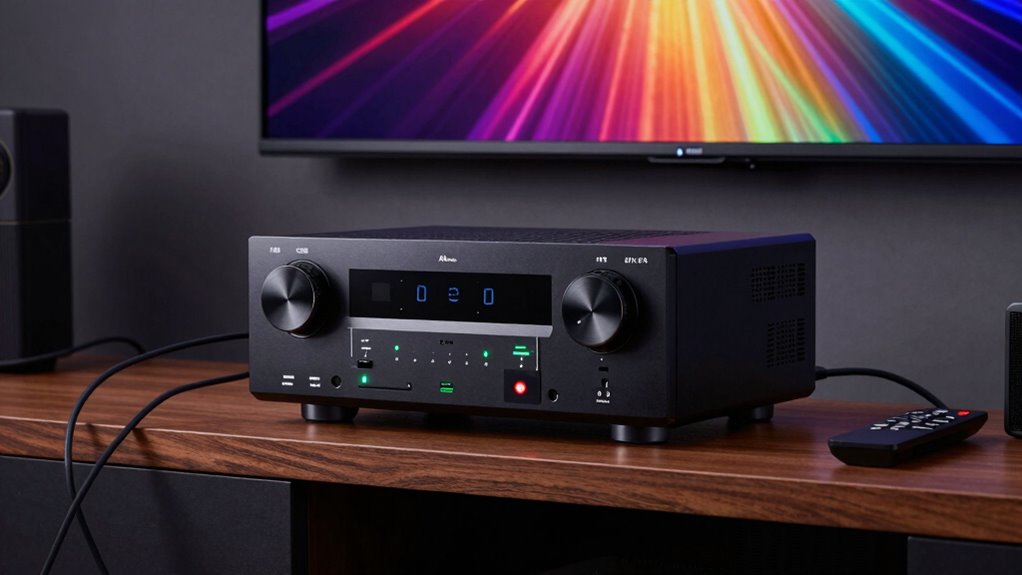

Finding the right AV receiver under $1500 can feel overwhelming with so many options offering advanced features and power. The Onkyo TX–NR5100 stands out for its robust 7.2-channel setup and 8K support, making it the best overall choice for most users. The Sony STRDH590 offers a straightforward, budget-friendly experience, while the Denon AVR-X1700H balances power and smart features at a compelling price. Readers should weigh the tradeoffs: more features often mean higher complexity or cost, while simpler models may lack future-proofing. Keep reading for a detailed breakdown of these options to find the best fit for your home theater upgrade.
Key Takeaways
- Powerful multi-channel options like the Onkyo TX–NR5100 excel for larger or more complex setups.
- Built-in streaming and smart features are more common in higher-tier models like the Denon AVR-X1700H.
- Compact and slimline models like the Marantz NR1510 are ideal for limited spaces but sacrifice some power.
- Support for latest formats like 8K and Dolby Atmos varies widely, influencing future-proofing.
- Pricing often correlates with features, but fundamental performance remains consistent across the lineup.
| Onkyo TX–NR5100 7.2-Channel 8K Smart AV Receiver – Black |  | Best Overall for Future-Proofing and Gaming | Channels: 7.2 | Resolution Support: 8K | Features: HDMI 2.1, VRR, ALLM, QFT, eARC | VIEW ON AMAZON | See Our Full Breakdown |
| Sony STRDH590 5.2 Channel Surround Sound Home Theater Receiver |  | Best for Budget-Friendly 4K Streaming | Channels: 5.2 | Power: 725W | Supported Video: 4K HDR, HDCP 2.2 | VIEW ON AMAZON | See Our Full Breakdown |
| Marantz NR1510 Slimline 5.2 Channel AV Receiver with HEOS and 50W |  | Best for Compact Spaces and High-Quality Sound | Power: 50 W per channel | Channels: 5.2 | HDMI Inputs: 6 | VIEW ON AMAZON | See Our Full Breakdown |
| Yamaha RX-V385 5.1-Channel 4K Ultra HD AV Receiver with Bluetooth |  | Best for Beginners and 4K Video Enthusiasts | Channels: 5.1 | Video Support: 4K Ultra HD, HDR10, Dolby Vision | Bluetooth: Yes | VIEW ON AMAZON | See Our Full Breakdown |
| Denon AVR-S570BT 5.2 Channel AV Receiver – 8K Ultra HD Audio & Video |  | Best for Latest HDMI and Gaming Features in a Budget | Channels: 5.2 | Power Output: 70W x 5 | HDMI Inputs: 4 HDMI 2.1 8K | VIEW ON AMAZON | See Our Full Breakdown |
| Onkyo TX-NR6100 7.2 Channel THX Certified Network AV Receiver – Black |  | Best Overall for Future-Proofing & High-End Features | Power Output: 210 watts | Channels: 7.2 | HDMI Ports: 8 | VIEW ON AMAZON | See Our Full Breakdown |
| Denon AVR-X1700H 7.2 Channel AV Receiver – 80W/Channel, Built-in HEOS |  | Best Value for Versatile Connectivity & Multi-Room Streaming | Power Output: 80W per channel | Channels: 7.2 | HDMI Inputs: 6 | VIEW ON AMAZON | See Our Full Breakdown |
| Yamaha RX300A 5.2-Channel Home Theater AV Receiver with Dolby Atmos, 4K120/8K HDMI, Bluetooth Multipoint |  | Best for Easy Setup & Compact Home Theater | Channels: 5.2 | Power: 70W per channel | HDMI Support: 4K120/8K60, HDMI eARC/ARC | VIEW ON AMAZON | See Our Full Breakdown |
| av receiver under 1500 | Channels | HDMI Inputs |
|---|---|---|
| Onkyo TX–NR5100 7.2-Channel 8K | 7.2 | — |
| Sony STRDH590 5.2 Channel Surr | 5.2 | — |
| Marantz NR1510 Slimline 5.2 Ch | 5.2 | 6 |
| Yamaha RX-V385 5.1-Channel 4K | 5.1 | 4 |
| Denon AVR-S570BT 5.2 Channel A | 5.2 | 4 HDMI 2.1 8K |
| Onkyo TX-NR6100 7.2 Channel TH | 7.2 | — |
| Denon AVR-X1700H 7.2 Channel A | 7.2 | 6 |
| Yamaha RX300A 5.2-Channel Home | 5.2 | — |
More Details on Our Top Picks
Onkyo TX–NR5100 7.2-Channel 8K Smart AV Receiver – Black
The Onkyo TX–NR5100 stands out for supporting 8K resolution and advanced gaming features like HDMI 2.1, VRR, and ALLM, making it a strong choice for gamers and home theater enthusiasts looking for the latest video standards. Compared with the Denon AVR-S570BT, it offers higher-resolution support but comes with a more complex setup and a higher price point. Its immersive sound capabilities, including Dolby Atmos and DTS support, make it a versatile option for cinematic audio. However, the setup process can be daunting for those less comfortable with technology, and its higher cost may be a barrier for some. This pick makes the most sense for users prioritizing future-proofing and gaming performance, willing to handle a slightly more involved setup.
Pros:- Supports 8K resolution for future-proof content
- Enhanced gaming features like VRR, ALLM, and QFT
- Immersive audio with Dolby Atmos and DTS support
Cons:- Complex setup process for non-technical users
- Higher price compared to some competitors
Best for: Gamers and home theater enthusiasts who want 8K support and the latest HDMI features
Not ideal for: Casual users or those on a tight budget, as setup complexity and price may be drawbacks
- Channels:7.2
- Resolution Support:8K
- Features:HDMI 2.1, VRR, ALLM, QFT, eARC
- Color:Black
Our verdict“Ideal for users seeking cutting-edge video and gaming features who don’t mind a more involved setup.”
Sony STRDH590 5.2 Channel Surround Sound Home Theater Receiver
The Sony STRDH590 provides a solid upgrade for those wanting better sound and 4K HDR support without breaking the bank. Its 5.2 channels and virtual surround sound deliver a cinematic experience, similar to the Yamaha RX-V385, but with slightly more straightforward setup options. While it lacks Wi-Fi, its Bluetooth connectivity allows wireless streaming from smartphones, making it convenient for casual listening. Its limited power output and 5.2 configuration mean it’s better suited for smaller rooms or less demanding setups. This receiver is a good choice for entry-level buyers who prioritize simple 4K video and wireless streaming over extensive surround sound or high wattage.
Pros:- Supports 4K HDR and HDCP 2.2 for high-quality video
- Bluetooth for wireless streaming from mobile devices
- Multiple HDMI inputs for versatile device connection
Cons:- Limited to 5.2 channel setup, less immersive than 7.2 systems
- No built-in Wi-Fi for streaming apps
Best for: Budget-conscious users wanting 4K HDR support and Bluetooth streaming for small to medium rooms
Not ideal for: Large rooms or users seeking extensive surround sound or integrated Wi-Fi streaming
- Channels:5.2
- Power:725W
- Supported Video:4K HDR, HDCP 2.2
- Connectivity:Bluetooth, HDMI
Our verdict“A practical choice for budget buyers focusing on 4K support and wireless audio in smaller spaces.”
Marantz NR1510 Slimline 5.2 Channel AV Receiver with HEOS and 50W
The Marantz NR1510 excels in environments where space is limited, thanks to its slimline design, yet it offers high-quality sound tuning by Marantz’s Sound Master. It supports high-resolution formats and includes six HDMI inputs, making it versatile for multiple sources. Compared to the Yamaha RX-V385, it provides a more refined audio experience, especially in smaller rooms, though its 50W per channel may fall short for larger spaces or demanding audio. Its support for HEOS streaming adds convenience for whole-home audio, but setup and calibration are needed to unlock its full potential. It’s best suited for users who want excellent sound quality in a compact form factor without needing extensive power.
Pros:- Slimline design fits in tight spaces
- High-quality sound tuning with Marantz expertise
- Supports high-resolution surround sound formats
Cons:- Limited to 50W per channel, less suitable for large rooms
- Requires setup and calibration for best sound
Best for: Apartment dwellers or small room owners wanting high-fidelity sound and multi-source connectivity
Not ideal for: Large rooms or users needing high wattage for demanding audio setups
- Power:50 W per channel
- Channels:5.2
- HDMI Inputs:6
- Supports:Dolby TrueHD, DTS-HD Master Audio
Our verdict“Perfect for users who prioritize audio quality and space-saving design over high power levels.”
Yamaha RX-V385 5.1-Channel 4K Ultra HD AV Receiver with Bluetooth
The Yamaha RX-V385 offers a straightforward entry point into home theater, supporting 4K Ultra HD, HDR10, and Dolby Vision with YPAO auto-calibration for easy setup. Its 5.1 channel configuration makes it suitable for smaller rooms or those new to surround sound, but it doesn’t support more advanced formats like Dolby Atmos. Compared with the Sony STRDH590, it includes Yamaha’s auto-calibration technology, which simplifies the setup process. Its Bluetooth capability adds wireless convenience, though it lacks Wi-Fi and additional streaming integrations. This model is well-suited for beginners who want reliable 4K support with minimal fuss and limited expansion needs.
Pros:- Supports 4K Ultra HD, HDR10, Dolby Vision
- Auto-calibration for easy sound setup
- Bluetooth for wireless streaming
Cons:- Limited to 5.1 channels, less immersive
- No Wi-Fi or advanced streaming features
Best for: New home theater users seeking simple 4K setup and auto-calibration
Not ideal for: Large rooms or those wanting full surround sound with more channels
- Channels:5.1
- Video Support:4K Ultra HD, HDR10, Dolby Vision
- Bluetooth:Yes
- HDMI Inputs:4
Our verdict“Ideal for beginners who want straightforward 4K support and automatic calibration without complexity.”
Denon AVR-S570BT 5.2 Channel AV Receiver – 8K Ultra HD Audio & Video
The Denon AVR-S570BT combines budget-friendly pricing with support for 8K HDMI inputs, making it a compelling choice for gamers and future-proofing. Its 70W per channel provides ample power for most small to medium rooms, and its support for HDR, Dolby Vision, and gaming-specific features like VRR and QFT makes it stand out among similarly priced options. Compared with the Marantz NR1510, it offers more power per channel and newer HDMI standards, but it lacks the high-end tuning and compact design of Marantz. Its simple setup and on-screen guide make it accessible, though it doesn’t include voice control or Wi-Fi streaming, which could be limitations for some users. This receiver targets those wanting the latest video features at a reasonable price.
Pros:- Supports 8K HDMI inputs for high-quality video
- Compatible with latest HDR formats and gaming features
- Built-in Bluetooth for wireless streaming
Cons:- Limited to 70W per channel, may not suit large or demanding spaces
- No built-in voice control or Wi-Fi
Best for: Gamers or movie lovers seeking 8K HDMI support and advanced gaming features
Not ideal for: Large rooms or users who want integrated voice control and Wi-Fi streaming
- Channels:5.2
- Power Output:70W x 5
- HDMI Inputs:4 HDMI 2.1 8K
- Supports:HDR, HLG, Dolby Vision, VRR, QFT, ALLM
Our verdict“Best suited for users wanting high-resolution video and gaming features in a budget-friendly package.”
Onkyo TX-NR6100 7.2 Channel THX Certified Network AV Receiver – Black
The Onkyo TX-NR6100 stands out for its robust support of 8K HDMI 2.1, making it an excellent choice for those planning to upgrade their home theater over time. Its THX certification promises high-quality sound and image clarity, setting it apart from less advanced models like the Yamaha RX300A. The receiver’s multiple HDMI outputs and game-enhancing features like VRR and ALLM cater to dedicated home theater enthusiasts and gamers. However, its complex setup and large size may deter casual users or those with limited space. Compared with the Denon AVR-X1700H, the Onkyo’s higher power output and future-ready HDMI support justify the higher price for a premium experience, but this overkill might be unnecessary for smaller or less tech-savvy setups.
Pros:- Supports 8K HDMI 2.1 with high bandwidth for future upgrades
- THX certification ensures high-quality sound and visuals
- Advanced gaming features for seamless gameplay
- Multiple HDMI outputs for flexible setup
Cons:- Setup process can be complex for beginners
- Large size requires ample installation space
- Premium features may be overkill for casual use
Best for: Tech-savvy home theater enthusiasts who want future-proof features and immersive audio
Not ideal for: Casual users or those with limited space who prefer simple, plug-and-play solutions
- Power Output:210 watts
- Channels:7.2
- HDMI Ports:8
- Supported Video Resolution:8K with HDMI 2.1
- Supported Audio Formats:Dolby Atmos, DTS:X
- Connectivity:Bluetooth, Wi-Fi
Our verdict“This receiver is best suited for those seeking a high-end, future-proof home theater experience and willing to handle a more demanding setup.”
Denon AVR-X1700H 7.2 Channel AV Receiver – 80W/Channel, Built-in HEOS
The Denon AVR-X1700H offers a compelling balance of high-quality video support and multi-room streaming with built-in HEOS, making it ideal for users who want a versatile home theater system. Its support for 8K/60Hz and 4K/120Hz pass-through ensures compatibility with the latest gaming consoles and streaming devices, similar to the Onkyo TX-NR6100 but at a slightly lower power level. The integration of voice control options like Alexa and Google Assistant adds convenience, yet its higher price point and weight might challenge those with limited space or budget. Compared to the Yamaha RX300A, the Denon’s superior connectivity and multi-room features make it more adaptable for integrated home setups, though it may be more complex for beginners to configure.
Pros:- Supports 8K and 4K/120Hz for future-proof video performance
- Built-in HEOS for seamless multi-room audio streaming
- Multiple HDMI inputs and outputs for versatile connectivity
- Voice control compatible with popular assistants
Cons:- Setup can be complex for those unfamiliar with AV systems
- Heavier and requires more space for installation
- Higher price compared to some entry-level options
Best for: Homeowners seeking a flexible, multi-room capable receiver with advanced video support
Not ideal for: Users with very large rooms needing high power output or simple plug-and-play operation
- Power Output:80W per channel
- Channels:7.2
- HDMI Inputs:6
- HDMI Outputs:1
- Supports:8K/60Hz, 4K/120Hz, HDR10+, Dolby Vision
- Built-in:HEOS for wireless streaming
Our verdict“This model suits those wanting a feature-rich, multi-room capable receiver that handles the latest video standards with ease.”
Yamaha RX300A 5.2-Channel Home Theater AV Receiver with Dolby Atmos, 4K120/8K HDMI, Bluetooth Multipoint
The Yamaha RX300A offers an approachable option for users who prioritize simplicity and room calibration, making it well-suited for smaller spaces or less tech-savvy owners. Its support for Dolby Atmos and DTS Virtual:X delivers immersive sound, comparable to the more complex Denon or Onkyo models, but with a more straightforward setup process. Limited to 70W per channel, it may struggle in very large rooms or for users seeking higher volume and power. Unlike the Onkyo or Denon, this Yamaha model doesn’t specify built-in Wi-Fi, relying instead on Bluetooth for streaming, which might limit multi-room flexibility. The automatic room calibration simplifies installation but sacrifices some customization options found in higher-end receivers.
Pros:- Supports Dolby Atmos and DTS Virtual:X for immersive audio
- Supports 4K/120Hz and 8K/60Hz video with HDMI eARC/ARC
- Automatic room calibration simplifies setup
- Bluetooth Multipoint for wireless streaming
Cons:- Limited power output may not suit large rooms
- Lack of built-in Wi-Fi reduces multi-room flexibility
- Features might seem limited compared to higher-end models
Best for: Users seeking an easy-to-use, space-efficient home theater with immersive sound
Not ideal for: Large rooms or audiophiles requiring high power and extensive customization
- Channels:5.2
- Power:70W per channel
- HDMI Support:4K120/8K60, HDMI eARC/ARC
- Dolby Atmos:Yes
- DTS Virtual:X:Yes
- Bluetooth:Multipoint
Our verdict“This receiver is ideal for users wanting straightforward installation and immersive sound without the complexities of high-power systems.”
How We Picked
The products in this roundup were selected based on performance, usability, build quality, and value for under $1500. We prioritized models that offer a balance of power, modern connectivity, and future-proof features like 8K support and Dolby Atmos compatibility. Ease of setup and user interface were also considered, as these impact everyday use. The ranking reflects how well each receiver meets the needs of different types of buyers—whether they prioritize raw power, smart features, or compact design—while remaining within the budget range.Factors to Consider When Choosing Av Receiver Under 1500
Choosing an AV receiver under $1500 involves balancing several key factors. While higher-priced models might offer more bells and whistles, many features are unnecessary for average users. Understanding your specific needs—such as room size, speaker configuration, and streaming preferences—can help you avoid overpaying or ending up with features you won’t use. This guide highlights the most important considerations to keep in mind when selecting a receiver that offers the best value and performance for your setup.Power and Channel Count
Power output and the number of channels determine how large and immersive your audio experience can be. For larger rooms or multi-speaker setups, a 7.2-channel receiver like the Onkyo TX–NR5100 provides ample power and flexibility. Smaller spaces or simpler setups may do well with 5.1 or 5.2 channel models, which tend to be more affordable and easier to manage. Remember, more channels and higher wattage don’t automatically mean better sound if your speakers or room size don’t support it. Consider your room dimensions and speaker configuration when evaluating power needs.
Video and Audio Format Support
Future-proofing your home theater means supporting the latest formats like 8K video and Dolby Atmos surround sound. Not all receivers in this price range support 8K, so if you want to future-proof your setup, look for models like the Denon AVR-S570BT or Yamaha RX300A that do. However, keep in mind that supporting these formats often comes with increased complexity and sometimes higher costs. Make sure your other equipment, such as your TV and speakers, can leverage these formats to justify the investment.
Connectivity and Smart Features
Built-in streaming services, Wi-Fi, Bluetooth, and app control are increasingly standard but vary in quality and ease of use. Models like the Marantz NR1510 and Denon AVR-X1700H excel in providing seamless smart features, ideal for users who want quick access to streaming platforms. Simpler models such as the Sony STRDH590 are straightforward but lack advanced features, making them suitable for those who prioritize ease over versatility. Consider your preferred sources—wired, wireless, or both—and how intuitive the interface is for everyday use.
Build Quality and User Experience
Durability and ease of setup influence long-term satisfaction. While most AV receivers in this range are well-built, some, like the Yamaha RX-V385, focus on user-friendly controls and straightforward installation. Others, like the Onkyo TX-NR6100, offer more refined interfaces and more durable construction, better suited for heavy daily use. Think about your comfort with technology and whether you’ll need detailed setup options or prefer plug-and-play simplicity.
Price and Value Balance
While under $1500 provides plenty of options, it’s important to match features with your actual needs. Spending more on bells and whistles you won’t use can be wasteful, but underinvesting might limit your experience. Look for models that strike a good balance—offering essential features, power, and future-proofing without unnecessary extras. Often, paying slightly more yields significant gains in performance and usability, especially if you plan to expand your system later.
Frequently Asked Questions
Can I upgrade my existing speakers with a receiver under $1500?
Absolutely. Most AV receivers in this price range support common speaker configurations and power levels. However, compatibility depends on your speakers’ impedance and power handling. It’s best to verify your speaker specifications and compare them with the receiver’s output ratings. Upgrading to a more powerful or feature-rich receiver can improve overall sound quality and expand your system’s capabilities, especially if you’re planning to add more speakers or advanced formats in the future.
Is 8K support necessary in a receiver under $1500?
While 8K support isn’t essential for immediate use, it offers future-proofing as content and devices evolve. If you plan to keep your system for several years, investing in an 8K-capable receiver ensures compatibility with upcoming TVs and streaming sources. However, if your current setup is 4K and you don’t anticipate upgrading soon, you can prioritize other features like power, surround sound formats, or smart connectivity instead. The decision depends on your long-term home theater plans.
How important is Dolby Atmos support in this price range?
Dolby Atmos can significantly enhance spatial audio immersion, and many receivers under $1500 support it. If your speakers are configured for Atmos—such as upward-firing or ceiling speakers—it can provide a noticeable upgrade in sound realism. However, to truly benefit, your entire system needs to support Atmos, including compatible speakers and content. If you’re new to home theater or have a limited setup, Atmos may be less critical than basic surround sound features or power.
Should I prioritize built-in streaming over power or surround sound features?
It depends on your usage. If streaming services are your primary source, built-in Wi-Fi and app control become more valuable. However, for larger or more demanding setups, power and multi-channel support should take precedence to ensure your system can handle the volume and surround sound experience you desire. Many receivers now combine both, so aim for a balanced approach that matches your specific entertainment habits and room size.
Is a slim or compact AV receiver worth considering under $1500?
Compact models like the Marantz NR1510 are excellent for limited spaces or wall mounting, offering good value and features without bulk. However, they typically provide fewer channels and less power compared to larger units. If your room is small or you prefer a minimalist setup, these models are practical. If you need a more immersive experience in a larger space, investing in a full-sized receiver with more channels and power makes more sense.




![Terence Tao Explains 6 Essential Mathematical Concepts [Video]](https://haltmal.com/wp-content/uploads/2026/09/terence-tao-explains-6-essential-mathematical-concepts-video-featured-260x140.jpg)