
To guarantee your notes stay useful months later, organize them systematically using digital tools like Notion or OneNote that let you categorize and search easily. Incorporate visual aids such as diagrams or mind maps to boost recall, and embed multimedia to enrich content. Regularly review your notes using spaced repetition, and develop a consistent system for capturing and revisiting information. Keep these strategies in mind, and you’ll be surprised how well your notes hold up over time.
Listen free for 30 days with Audible
Thousands of audiobooks and originals — cancel anytime.
As an affiliate, we earn on qualifying purchases.
Key Takeaways
- Use digital tools with strong search and organizational features to categorize and easily retrieve notes later.
- Incorporate visual aids like diagrams and mind maps to reinforce memory and clarify complex concepts.
- Maintain a consistent and structured organization system to prevent data scattering and ensure quick access.
- Apply spaced repetition and systematic review techniques to reinforce long-term retention.
- Develop a disciplined, systematic note-taking process that facilitates ongoing review and pattern recognition.
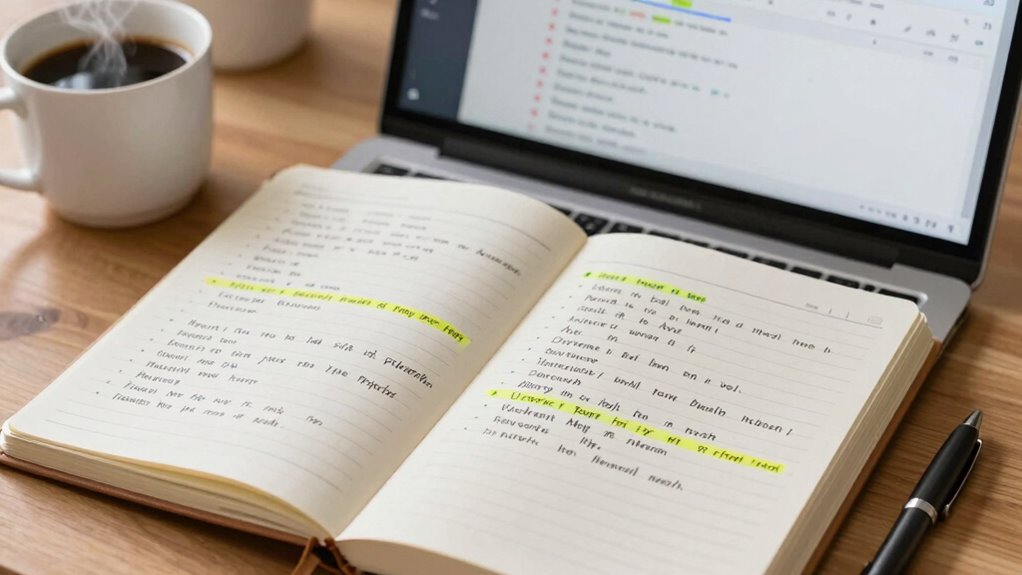
Taking effective notes isn’t just about jotting down information in the moment; it’s about creating a system that keeps that knowledge accessible and useful months later. To do this, you need to leverage the right tools and techniques from the start. Digital tools are your best allies in this effort. They offer flexibility, searchability, and organization that paper notes simply can’t match. Apps like Evernote, Notion, or OneNote allow you to categorize notes by topics, projects, or deadlines, making it easy to locate specific information long after you took it. Using digital tools also enables you to embed links, audio recordings, or images directly into your notes, enriching the content and creating a detailed resource you can revisit anytime.
Digital tools enhance note organization, searchability, and multimedia integration for long-term knowledge retention.
In addition to digital tools, incorporating visual aids into your note-taking process can markedly boost retention and understanding. Visual aids—such as diagrams, mind maps, charts, and infographics—help you transform complex information into digestible visuals. When you sketch out a concept, it becomes easier to remember and connect with related ideas later on. Tools like Canva or Miro can help you create engaging visuals that complement your notes, or you can draw simple sketches by hand and digitize them. The key is to make your notes more than just text; make them visually stimulating so that they stand out in your memory. Additionally, understanding how to organize your notes effectively can serve as a security strategy for safeguarding your knowledge, ensuring it remains accessible and protected over time. Establishing a consistent note organization system also helps prevent information from becoming scattered or lost, making future reviews more efficient. Incorporating long-term retention techniques, such as spaced repetition, can further solidify your understanding and memory of the material. Developing a structured approach to note-taking can also help you identify patterns in your learning process, making it easier to adapt and improve your methods over time. Moreover, adopting a systematic review process can significantly enhance your ability to retain information for months or even years.
As an affiliate, we earn on qualifying purchases.
Frequently Asked Questions
How Often Should I Review My Notes to Keep Them Useful?
You should review your notes regularly, ideally within 24 hours of initial learning, to boost memory retention. Then, revisit them every few days, gradually spacing out your reviews to reinforce understanding. Consistent review is key to developing strong study habits and keeping information fresh. By actively engaging with your notes on this schedule, you’ll strengthen your memory retention and make your notes more useful long-term.
What Tools Are Best for Long-Term Note Organization?
Think of your notes as a garden needing the right tools to flourish. Digital tools like Evernote or Notion are like vibrant trellises, helping you organize sprawling ideas with ease. Paper methods, such as indexed notebooks or color-coded tabs, act as sturdy trellises for tactile growth. Combining these options provides flexibility and long-term clarity, so your notes stay accessible and meaningful, even months down the line.
How Can I Make My Notes More Visually Memorable?
You can make your notes more visually memorable by using color coding to highlight key ideas and categorize information. Incorporate visual symbols like icons or diagrams to quickly convey concepts and make your notes easier to scan. These visual cues create mental associations, helping you recall details faster. Experiment with different colors and symbols to find what sticks best, making your notes not only functional but also engaging and memorable.
Should I Rewrite or Revise My Notes Over Time?
Yes, you should revise your notes over time. Revising allows you to practice note condensation, making information more concise and easier to recall. Use color coding to highlight key ideas during revisions, which boosts visual memory and makes important details stand out. Regularly revisiting and refining your notes helps reinforce learning, keeps them organized, and guarantees they remain useful months later.
How Do I Integrate Notes Into Daily Long-Term Planning?
Research shows that visual cues boost memory retention by 40%. To integrate notes into your daily planning, think of your notes as a colorful map guiding your journey. Use color coding to categorize tasks, deadlines, and ideas, making them easy to spot. Creative analogies, like comparing your goals to stepping stones, help connect notes to daily priorities, ensuring they’re not just stored but actively shape your long-term plans.
As an affiliate, we earn on qualifying purchases.
Conclusion
So, next time you’re scribbling down notes, remember: don’t just make them look pretty or sound profound in the moment. Because months later, when you’re desperately searching for that one key insight, you’ll wish you’d taken notes that actually stick. Unless, of course, you enjoy the thrill of sifting through chaos. So, be smarter than your past self—take notes that serve you, not just your ego. Your future self will thank you (probably).
As an affiliate, we earn on qualifying purchases.
As an affiliate, we earn on qualifying purchases.
Back to school Picks
back to school
As an affiliate, we earn on qualifying purchases.