

The “Busy Household” Test helps you choose home automation gear that performs well under hectic conditions. Focus on devices that respond reliably to voice commands, even when multitasking or noisy. Check if energy monitoring updates accurately without extra effort. Make certain systems stay connected and quick to respond during busy moments. Look for seamless integration with your existing devices to avoid frustration. Need tips on how to pick the best gear to simplify your daily routine? Keep exploring for more insights.

Prime made for students and young adults
- Fast, free delivery for dorm and study essentials
- Prime Video and Amazon Music included
- Member-only deals
Key Takeaways
- Prioritize devices with reliable voice command performance in noisy or multitasking environments.
- Ensure energy monitoring features provide real-time, accurate data for quick decision-making.
- Test system connectivity and response speed during busy, distraction-filled moments.
- Choose gear that integrates seamlessly with existing devices for effortless daily routines.
- Focus on automation that functions smoothly without requiring constant user intervention.
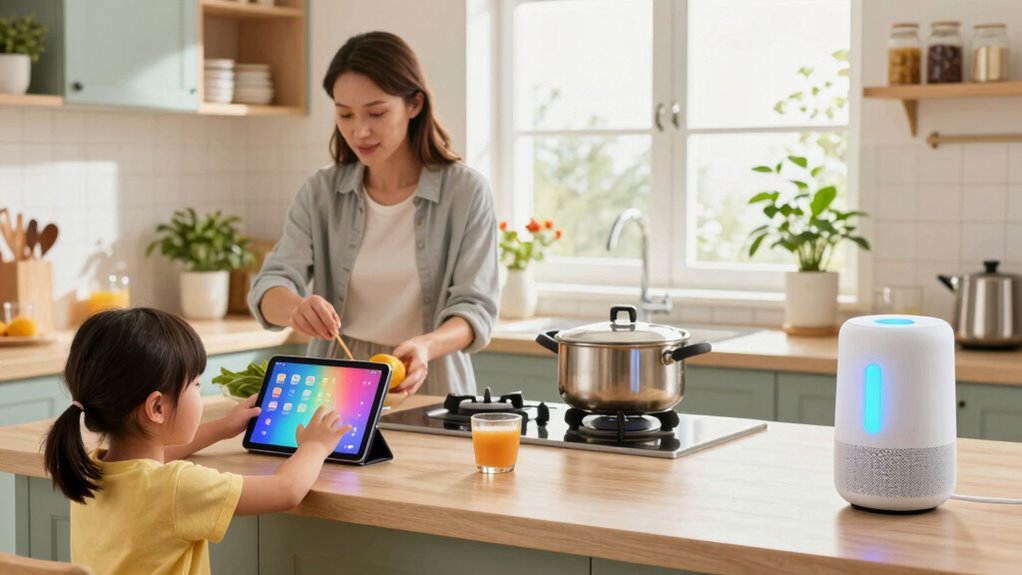
When it comes to upgrading your home with smart technology, testing different home automation gear is essential to find what works best for your needs. The “Busy Household” test is a practical way to evaluate how well various devices perform under real-life conditions. The goal is to find smart devices that make your daily interactions effortless, allowing you to control your home without stopping what you’re doing. Your daily routine can be hectic, so you want gear that simplifies, not complicates, your life. Focus on how seamlessly the devices integrate into your routine, especially features like voice command and energy monitoring, which are crucial for efficiency and convenience.
Start by trying out voice command functions. You need devices that respond reliably to your voice, even when you’re multitasking or distracted. Test different voice-activated assistants and see how accurately they understand your commands in various scenarios—whether you’re talking from across the room, in a noisy environment, or with multiple people. Does the device recognize your voice commands to turn on lights, play music, or adjust the thermostat? If not, it’s a sign that the gear might not be suitable for your busy household. The goal is to find smart devices that make your daily interactions effortless, allowing you to control your home without stopping what you’re doing. Additionally, consider the importance of system reliability to ensure your automation continues to work smoothly even during busy days. Incorporating robust connectivity can also enhance the responsiveness and stability of your smart home system during hectic schedules.
Test voice commands in noisy or multitasking scenarios to ensure your devices respond reliably and effortlessly.
Energy monitoring is another critical aspect. During your busy days, you want to keep tabs on energy consumption without adding extra work. Set up devices that provide real-time insights into how much power your appliances and systems use. Check if the energy monitoring features give clear, helpful data that let you identify high-energy-consuming devices or times of peak usage. If you find that monitoring is confusing or the data isn’t updated frequently enough, you might need a more responsive system. Devices with robust energy monitoring help you make smarter decisions about conserving energy, which can save money and reduce your household’s environmental impact. Incorporating smart home technology that is compatible with your existing devices can also simplify the setup process and improve overall system performance. Additionally, selecting gear with reliable connectivity ensures your home automation system remains responsive and effective throughout your busy schedule.
Throughout the test, pay attention to how quickly and accurately the gear responds during your hectic schedule. Do the devices work reliably when you need them most? Are they responsive to voice commands even when you’re juggling multiple tasks? Do energy monitoring features give you useful, up-to-date information without requiring extra effort? If a device consistently fails to meet these needs, it’s a sign it might not be suitable for your busy household. Considering factors like system integration can help you choose gear that works seamlessly with your current setup.
Ultimately, your goal is to find home automation gear that integrates smoothly into your daily routine, making life easier rather than adding complexity. By rigorously testing voice command and energy monitoring functionalities during your busy days, you’ll identify the smart devices that truly enhance your home’s efficiency and convenience. This “Busy Household” test ensures that the gear you choose can keep up with your pace, providing reliable, intuitive support every day.
smart home voice assistant with noise cancellation
As an affiliate, we earn on qualifying purchases.
As an affiliate, we earn on qualifying purchases.
Frequently Asked Questions
How Do I Assess My Household’s Specific Automation Needs?
To assess your household’s automation needs, start by identifying daily routines that could benefit from voice control, making tasks easier and hands-free. Consider areas where energy saving is a priority, like smart thermostats or lighting. Think about which devices you use most often and how automation can improve convenience and efficiency. This way, you’ll choose gear that fits your busy lifestyle, enhances comfort, and helps save energy effectively.
What Are Common Compatibility Issues With Different Smart Devices?
Compatibility issues can feel like trying to fit a square peg in a round hole. You might face device interoperability problems, where gadgets don’t communicate smoothly. Manufacturer compatibility is also a concern; some devices work perfectly within their ecosystems but struggle outside them. To avoid frustration, always check if your devices support common standards like Zigbee or Z-Wave, and verify they’re compatible with your existing smart home hub before making a purchase.
How Secure Is My Data With Various Automation Systems?
Your data security varies across automation systems, but many use data encryption to protect your information. However, privacy concerns remain, especially if the manufacturer shares data or has weak security practices. To stay safe, choose reputable brands with strong encryption, regularly update firmware, and review privacy policies. Being vigilant helps guarantee your smart home remains secure and your data stays private, even in busy households.
Can I Upgrade My System Easily Over Time?
Yes, you can upgrade your system easily over time, especially if it supports voice control and energy monitoring. Modern home automation gear is designed to be modular, allowing you to add new devices or features without replacing the entire system. Look for systems with open platforms and regular firmware updates, so you can seamlessly integrate new technology, optimize energy use, and enhance voice command capabilities as your needs evolve.
What’s the Average Cost of Setting up a Household Automation System?
Think of setting up your home automation system like assembling a superhero team—cost varies. On average, you might spend $500 to $2,000, depending on your gadgets and complexity. Voice control devices like smart speakers add to the budget but boost convenience. Plus, investing in energy-efficient gear can save you money long-term. While it’s an investment, the convenience and savings make it worth the initial cost.
As an affiliate, we earn on qualifying purchases.
Conclusion
In the end, choosing home automation gear is like selecting your own Excalibur—your trusty sword for modern living. If it can seamlessly fit into your busy household, streamlining routines and easing stress, then you’ve found your magic. Remember, the true test isn’t just tech specs but how effortlessly it becomes part of your daily legend. So, trust your instincts, and let your home’s new gear turn everyday chores into a story worth telling.
As an affiliate, we earn on qualifying purchases.
As an affiliate, we earn on qualifying purchases.
Halloween Picks
halloween
As an affiliate, we earn on qualifying purchases.