
TL;DR

Prime made for students and young adults
- Fast, free delivery for dorm and study essentials
- Prime Video and Amazon Music included
- Member-only deals
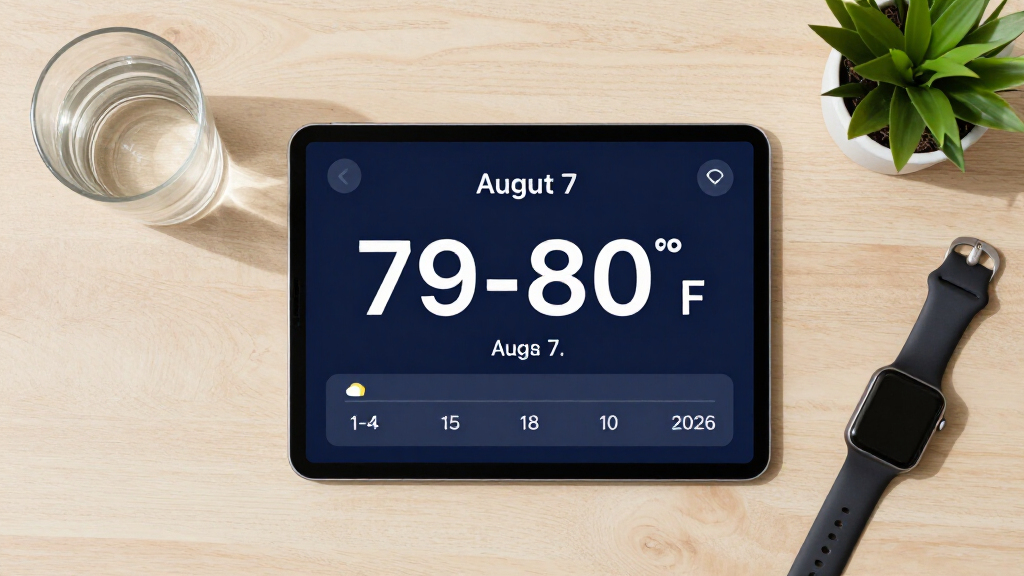
A prediction market is currently active asking whether the maximum temperature in a specific location will be 79-80°F on August 7, 2026. The forecast is based on recent trades, but no official meteorological forecast confirms this yet.
Recent trading activity on a prediction market indicates interest in whether the maximum temperature will reach 79-80°F on August 7, 2026. No official weather forecast or climate model currently confirms this specific temperature range for that date, but the market reflects public and investor speculation about future climate conditions.
The prediction market, operated by Kalshi, has seen nine recent trades related to the temperature forecast for August 7, 2026. These trades suggest that some participants believe the temperature could fall within the 79-80°F range, although no authoritative meteorological agency has issued a forecast for that specific date or temperature.
Experts caution that long-term weather predictions beyond a few days are inherently uncertain. Climate models typically provide broader trends rather than precise daily temperatures that far in advance. For example, you can check future temperature predictions. The market’s activity appears to be based on speculation rather than scientific forecasts.
Implications of Market-Based Climate Predictions
This development highlights how prediction markets are increasingly used to gauge public sentiment and speculative forecasts about future climate conditions. While they are not substitutes for scientific models, such markets can influence perceptions of climate risk and inform discussions about climate change and weather forecasting reliability.
For the public and policymakers, understanding the difference between market speculation and scientific certainty is crucial. The active trading indicates interest but does not confirm any scientific projection about the specific temperature on that date.
As an affiliate, we earn on qualifying purchases.
Long-Term Weather Forecasting and Market Speculation
Forecasting the weather more than a few days ahead is standard practice for meteorologists, but predicting specific temperatures several years into the future is not currently feasible with existing climate models. The use of prediction markets for long-term climate events is a relatively new phenomenon, reflecting both public interest and the limitations of scientific prediction at such timescales.
Market activity related to climate forecasts has increased in recent years, often driven by concerns over climate change impacts. However, these markets are primarily speculative and should not be interpreted as scientific forecasts.
“Long-term weather predictions several years in advance are highly uncertain. Prediction markets reflect public sentiment but do not replace scientific climate modeling.”
— Dr. Emily Chen, Climate Scientist
As an affiliate, we earn on qualifying purchases.
Unconfirmed Nature of the Temperature Forecast
It is not yet clear whether the market activity accurately reflects a genuine scientific forecast or is primarily speculative. No official weather agencies or climate models currently support a specific temperature range for August 7, 2026. The predictions are based on trading patterns rather than meteorological data, and the actual weather could differ significantly.
As an affiliate, we earn on qualifying purchases.
Monitoring Scientific Forecasts and Market Trends
Meteorologists and climate scientists will continue to refine long-term climate models, but accurate temperature predictions for August 2026 remain unlikely at this stage. The prediction market activity will likely persist as a reflection of public interest and speculative behavior. Observers should watch for official forecasts closer to the date for reliable information.
As an affiliate, we earn on qualifying purchases.
Key Questions
Can prediction markets accurately forecast weather several years in advance?
No, prediction markets are primarily based on trader sentiment and are not reliable for precise long-term weather forecasts. Scientific climate models do not currently support specific daily temperature predictions for years ahead.
Does recent market activity mean the temperature will definitely be 79-80°F on August 7, 2026?
No, market activity reflects speculation and does not constitute scientific evidence. The actual weather on that date could be higher, lower, or different entirely.
Why are people trading on this temperature forecast now?
Participants may be speculating on climate trends, betting on future climate conditions, or testing the predictive power of the market platform. It also indicates public interest in climate futures.
Will official weather agencies provide forecasts for August 2026?
Typically, official forecasts are reliable only up to about two weeks in advance. Long-term climate projections focus on trends rather than specific daily temperatures, especially several years ahead.
Source: kalshi
Fall Picks
fall essentials
As an affiliate, we earn on qualifying purchases.