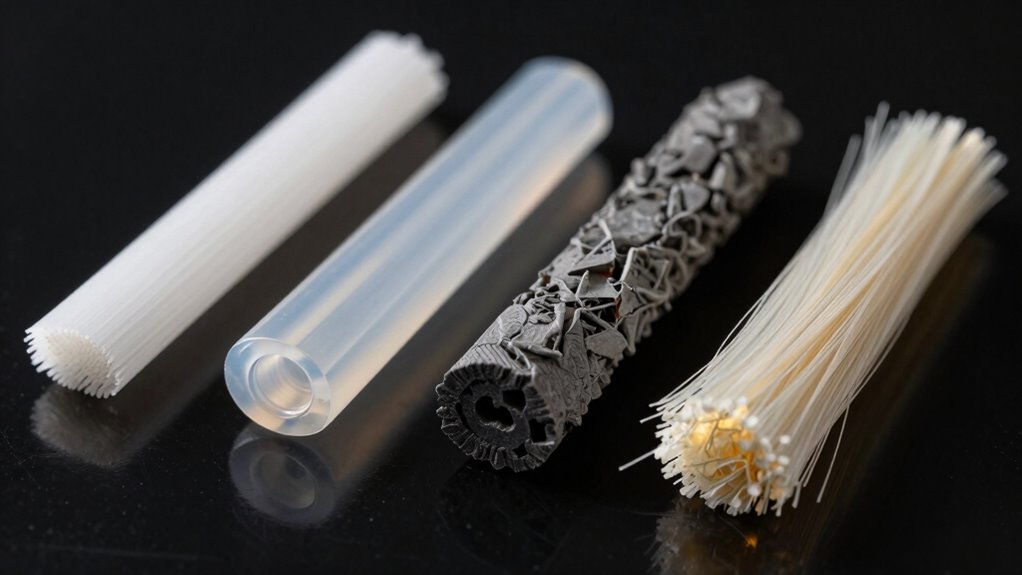

When choosing filament, you’ll find PLA easy to use, eco-friendly, and great for beginners, but it isn’t very heat-resistant. PETG offers a balance of durability and slightly more challenge during printing, with recyclability benefits. ABS is tough and heat-resistant but requires precise conditions and produces fumes. Understanding these tradeoffs helps you pick the right filament for your project’s needs—stick around to learn how each material’s features can shape your prints.
Key Takeaways
- PLA is beginner-friendly, biodegradable, and produces minimal warping, but less durable for high-stress applications.
- PETG offers a balance of ease of printing, strength, and chemical resistance, with some stringing and warping challenges.
- ABS is tough and heat-resistant but requires precise temperature control and emits harmful fumes during printing.
- Material choice impacts environmental impact: PLA is eco-friendly, PETG is recyclable, while ABS is non-biodegradable and less sustainable.
- Tradeoffs involve balancing printability, mechanical properties, environmental considerations, and post-processing options.
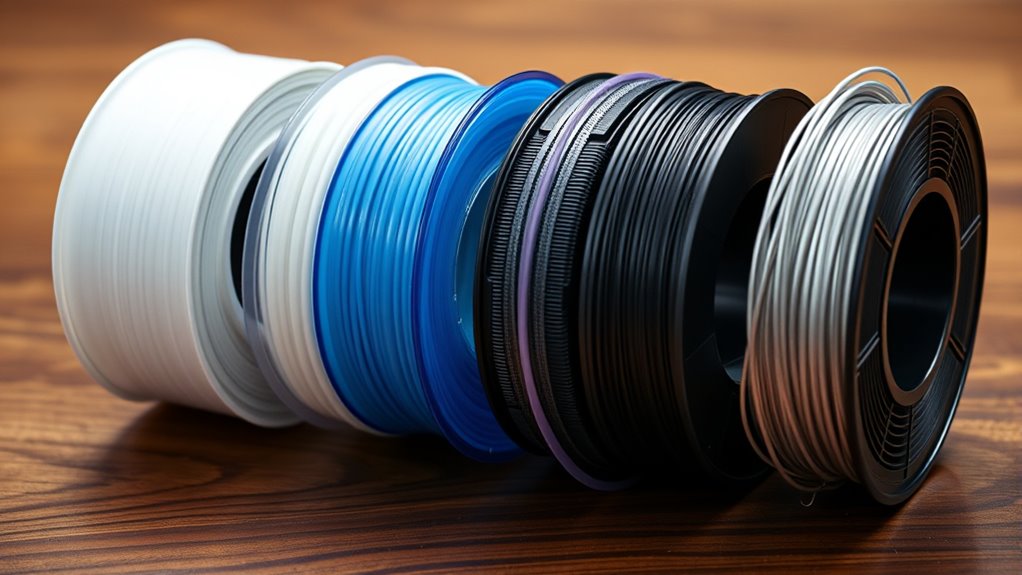
When choosing a 3D printer filament, understanding the different types is essential because each offers unique properties suited to specific projects. One of the first considerations is how well the filament prints, known as printability, which can vary greatly depending on the material. For example, PLA is renowned for its ease of use, low printability challenges, and minimal warping, making it ideal for beginners. Its smooth extrusion and good layer adhesion mean fewer failed prints and less frustration. However, despite its convenience, you should consider its environmental impact. PLA is biodegradable and derived from renewable resources like cornstarch, making it one of the more eco-friendly options. Still, it’s not perfect—its biodegradability only kicks in under industrial composting conditions, and it can produce microplastics if not disposed of properly.
In contrast, PETG offers a balance between ease of printing and durability. It’s slightly more challenging to print than PLA, with some printability challenges like stringing and warping, especially at higher speeds or temperatures. However, once dialed in, PETG produces strong, flexible parts with excellent layer adhesion. Environmentally, PETG is also considered more sustainable than ABS because it emits fewer fumes during printing and is more resistant to chemical degradation. While it isn’t biodegradable like PLA, PETG can sometimes be recycled, reducing its environmental footprint if managed responsibly.
ABS, on the other hand, presents notable printability challenges. It tends to warp and crack if not printed on a heated bed or in a controlled environment. Its higher melting point requires more precise temperature control, making it less beginner-friendly. Despite these hurdles, ABS is favored for its toughness, heat resistance, and ability to be post-processed with sanding or acetone smoothing. When evaluating environmental impact, ABS is less eco-friendly due to its petroleum-based origin and the fumes it emits during printing, which can be harmful if proper ventilation isn’t maintained. Disposal is also more problematic, as ABS does not biodegrade easily, raising concerns about long-term waste.
As an affiliate, we earn on qualifying purchases.
Frequently Asked Questions
How Does Filament Color Affect Print Quality and Strength?
Filament color can impact your print quality and strength through color consistency and its influence on layer adhesion. Bright or dark colors may contain additives that affect how layers bond, potentially leading to weaker spots or surface imperfections. Choose high-quality, consistent filament colors to guarantee smooth, strong prints, and consider testing different shades to see how they affect adhesion and overall finish.
Can Different Filament Types Be Mixed in a Single Print?
Mixing multiple filament types in a single print can be tricky, but it’s feasible if you prioritize proper filament compatibility and plan for multi-material printing. You’ll want to guarantee the filaments have similar melting points and adhesion qualities to prevent issues like warping or delamination. By carefully coordinating materials, you can create complex, colorful, and functional prints with diverse properties, turning simple printing into spectacular, multi-material masterpieces.
What Are the Environmental Impacts of Various Filament Materials?
You should consider the environmental impacts of filament materials by examining their biodegradability comparison and eco-friendly filament options. PLA, for example, is biodegradable and derived from renewable resources, making it a greener choice. In contrast, ABS and PETG are less biodegradable and produce more pollution during production and disposal. Opting for eco-friendly filament options helps reduce your carbon footprint and promotes sustainability in 3D printing.
How Do Filament Storage Conditions Influence Print Results?
Think of filament storage as keeping your plant happy; moisture sensitivity can turn your print garden into a wilted mess. If you don’t store your filament in airtight storage containers, it absorbs humidity, leading to poor print quality like bubbles, stringing, or weak layers. To guarantee top results, keep your filament dry and sealed, especially in humid environments. Proper storage is your secret weapon for consistent, high-quality 3D prints.
Are There Filament Types Suitable for Flexible or Specialty Applications?
Yes, flexible filaments like TPU and TPE are perfect for flexible or specialty applications, offering elasticity and durability. These materials are great for making things like grips, wearable accessories, or custom joints. They require careful storage to prevent moisture absorption, which can affect print quality. Using the right settings and compatible nozzles guarantees you get the best results from these specialty materials, making your projects more functional and innovative.
As an affiliate, we earn on qualifying purchases.
Conclusion
Choosing the right filament depends on understanding each type’s strengths and tradeoffs. PLA, PETG, and ABS each serve different needs, so consider your project’s requirements. Remember, “A wise man learns more from his mistakes than from his successes.” Don’t be afraid to experiment and refine your approach—your perfect print is just a learning experience away. Keep exploring, and you’ll master the art of filament selection in no time.
As an affiliate, we earn on qualifying purchases.
eco-friendly 3D printing filament
As an affiliate, we earn on qualifying purchases.
As an affiliate, we earn on qualifying purchases.