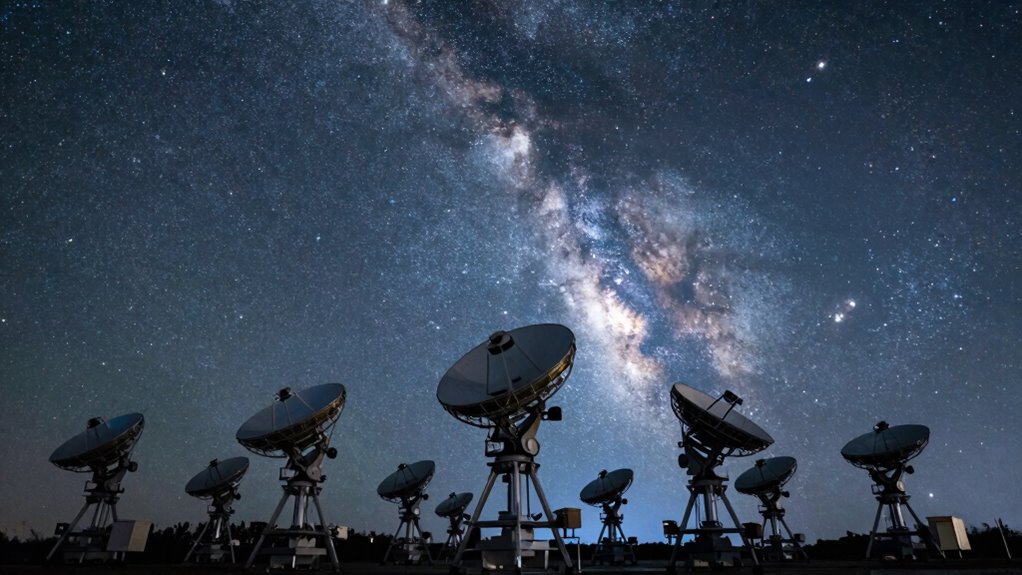

If you’re looking for the best telescopes for deep space viewing in 2026, I recommend options suitable for beginners and enthusiasts alike. Models like the Gskyer 70mm refractor, Celestron StarSense explorers, and larger Newtonian reflectors provide excellent light-gathering and user-friendly features. Many include smartphone adapters, accessories, and advanced tracking to enhance your experience. Keep exploring, and you’ll uncover even more details to help you choose the perfect telescope for stellar adventures ahead.
Key Takeaways
- Prioritize telescopes with larger apertures (130mm to 150mm) for brighter, detailed deep space object views.
- Look for models with stable equatorial or computerized mounts for precise tracking and long-exposure astrophotography.
- Select telescopes with advanced digital features like app integration, Wi-Fi, or Bluetooth for easier object locating.
- Consider portable, lightweight designs that facilitate outdoor and field use without sacrificing optical performance.
- Opt for future-proof options supporting firmware updates and high-resolution imaging capabilities for longevity.



More Details on Our Top Picks
Gskyer 70mm Refracting Telescope with Accessories
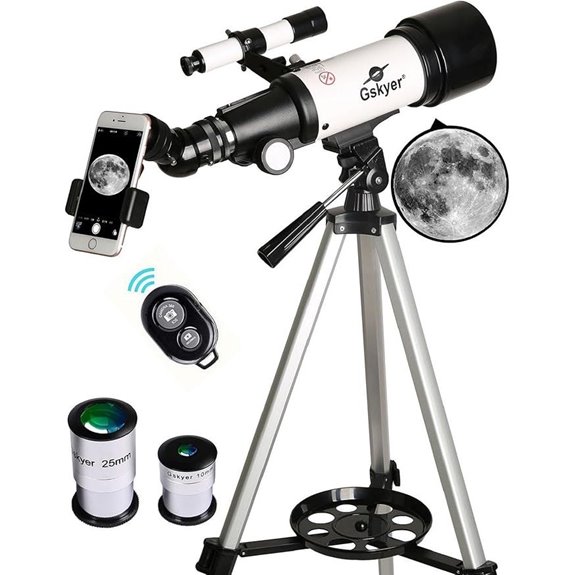
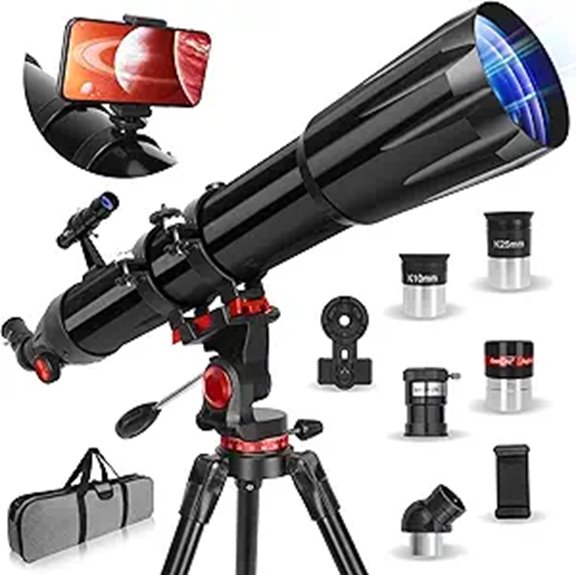
If you’re a beginner or exploring astronomy with kids, the Gskyer 70mm Refracting Telescope is an excellent choice because it combines straightforward usability with impressive optical quality. Its 70mm aperture and 400mm focal length deliver sharp, clear images of the moon and planets. The fully coated glass lens enhances light transmission, safeguarding your eyes while providing stunning views. It comes with two eyepieces and a 3x Barlow lens to triple magnification. Plus, the smartphone adapter and wireless remote make capturing images easy. Its adjustable aluminum tripod and portable carry bag ensure flexible viewing and convenient transport, perfect for novice stargazers.
- Aperture:70mm
- Focal Length:400mm
- Mount Type:Altazimuth (manual)
- Connectivity/Accessories:Smartphone adapter, remote capture
- Included Eyepieces / Magnification Range:2 eyepieces, 3x Barlow
- Portability:Portable carry bag
- Additional Feature:Wireless remote control
- Additional Feature:Smartphone photo adapter
- Additional Feature:Portable carry bag
150EQ Newtonian Reflector Telescope for Beginners
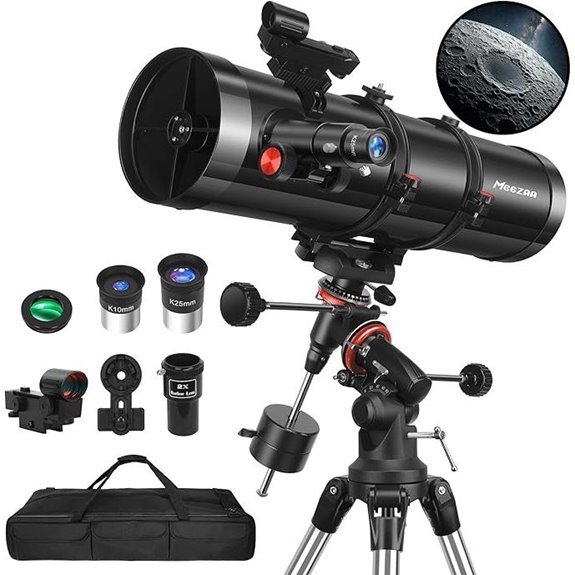
Looking for a beginner-friendly telescope that delivers impressive deep space views? The 150EQ Newtonian Reflector Telescope is perfect. It has a large 150mm aperture and 650mm focal length, providing bright, detailed images of planets, the Moon, and distant galaxies. With a versatile magnification range from 26X to 130X, it’s great for various celestial targets. The stable German equatorial mount ensures smooth tracking, while the heavy-duty tripod keeps vibrations at bay. Setup is quick and tool-free, and it comes with helpful accessories like two eyepieces, a Barlow lens, and a moon filter. It’s ideal for beginners enthusiastic to explore the night sky.
- Aperture:150mm
- Focal Length:650mm
- Mount Type:German Equatorial
- Connectivity/Accessories:Phone adapter, included accessories
- Included Eyepieces / Magnification Range:2 eyepieces, 2X Barlow
- Portability:Large carry bag
- Additional Feature:Heavy-duty stainless steel tripod
- Additional Feature:Large accessory tray
- Additional Feature:No tools assembly
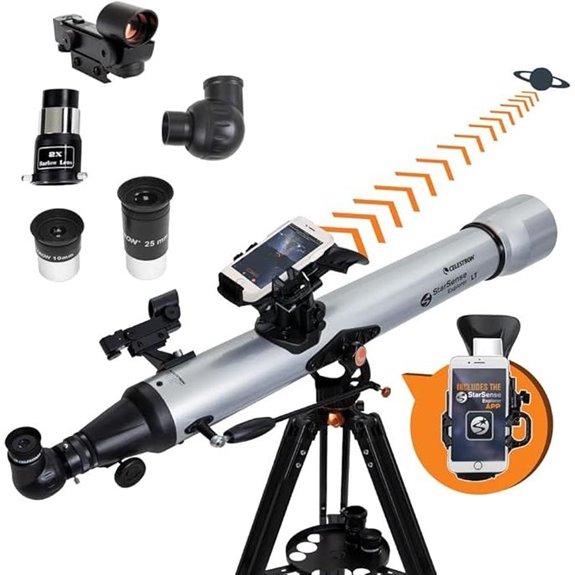
Celestron StarSense Explorer LT 114AZ Telescope
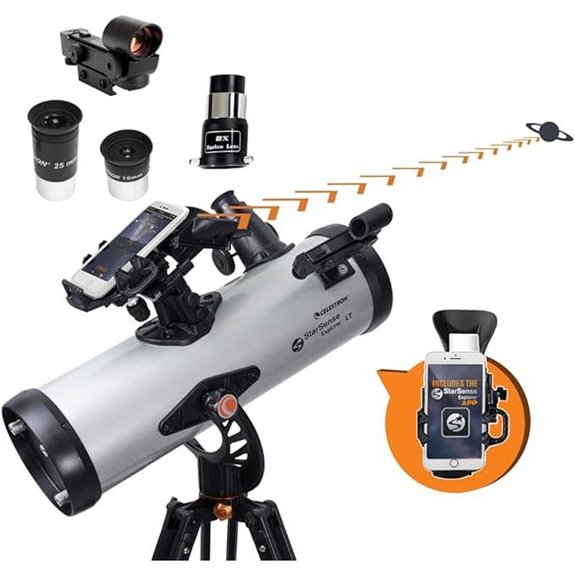
The Celestron StarSense Explorer LT 114AZ Telescope stands out as an excellent choice for beginners seeking an easy-to-use, app-enabled telescope. Its 114mm Newtonian reflector offers sharp, vivid views of the Moon, planets, and deep-sky objects like the Orion Nebula and Andromeda Galaxy. The manual altazimuth mount with slow-motion controls makes tracking straightforward. The StarSense Explorer app guides me by analyzing star patterns, helping to locate objects effortlessly. Just dock my phone, follow on-screen arrows, and enjoy clear, guided views. Backed by a 2-year warranty and US-based support, this telescope simplifies astronomy for newcomers and city sky watchers alike.
- Aperture:114mm
- Focal Length:114mm (Focal length not specified, but implied with 114mm aperture)
- Mount Type:Altazimuth
- Connectivity/Accessories:Smartphone dock, app-guided
- Included Eyepieces / Magnification Range:Not specified
- Portability:Compact, portable setup
- Additional Feature:App-guided sky tour
- Additional Feature:Patented StarSense technology
- Additional Feature:Real-time celestial navigation
Celestron StarSense Explorer DX 130AZ Telescope with App
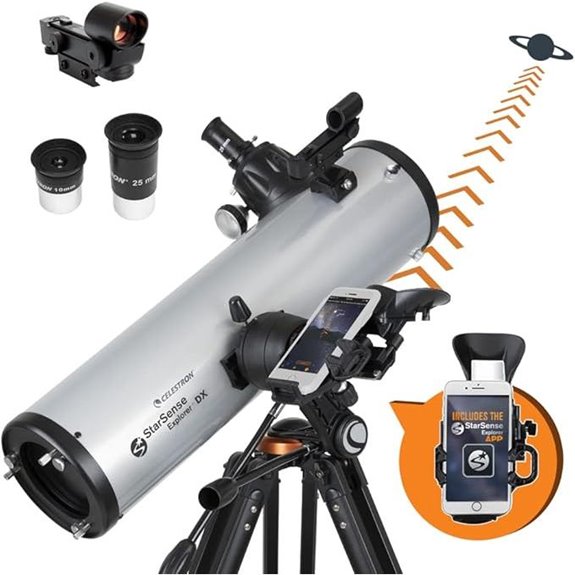
Wondering how beginners can easily find and enjoy deep-sky objects? The Celestron StarSense Explorer DX 130AZ makes it simple. Its 130mm Newtonian reflector provides bright, sharp views of the Moon, planets, and deep-sky targets like the Orion Nebula and Andromeda Galaxy. The StarSense app turns your smartphone into a navigation tool, guiding you to objects with on-screen arrows and star pattern analysis. Its intuitive interface and smooth manual controls help you quickly locate and track objects, making stargazing accessible and enjoyable. Plus, with Celestron’s reliable 2-year warranty and US-based support, you can explore confidently.
- Aperture:130mm
- Focal Length:Not specified
- Mount Type:Altazimuth
- Connectivity/Accessories:Smartphone app, star recognition
- Included Eyepieces / Magnification Range:Not specified
- Portability:Compact design
- Additional Feature:Curated celestial list
- Additional Feature:Green bullseye alignment
- Additional Feature:Dual-axis slow-motion controls
130EQ Newtonian Reflector Telescope with Accessories
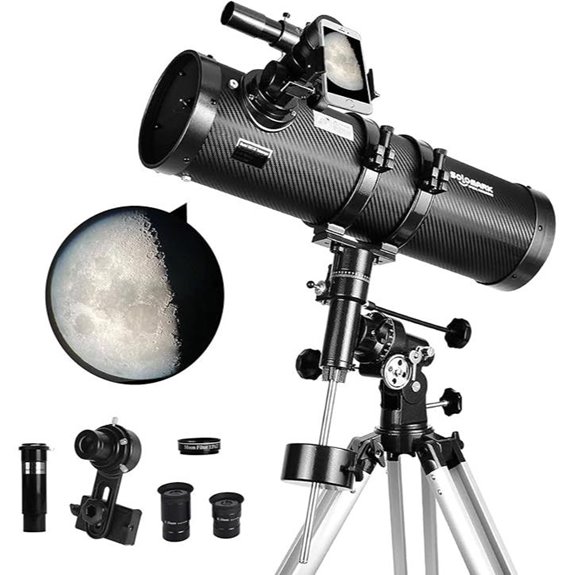
If you’re an amateur astronomer or a professional seeking precise and detailed deep space observations, the 130EQ Newtonian Reflector Telescope with Accessories stands out as an excellent choice. Its 130mm aperture delivers bright, high-resolution images, perfect for deep space viewing. The fully-coated glass optics enhance clarity, revealing intricate details of planets and celestial objects. The German Equatorial mount offers smooth tracking with fine control, making it easier to follow objects as they move across the sky. The sturdy aluminum tripod ensures stability. Plus, it comes with two eyepieces, a Barlow lens, a Moon filter, and a smartphone adapter, providing everything you need for thorough observations.
- Aperture:130mm
- Focal Length:130mm (implying focal length around that range)
- Mount Type:Equatorial
- Connectivity/Accessories:Smartphone adapter, accessories
- Included Eyepieces / Magnification Range:2 eyepieces, 1.5X Moon filter
- Portability:Carrying case included
- Additional Feature:Adjustable height tripod
- Additional Feature:Included smartphone adapter
- Additional Feature:Aluminum alloy tripod
90mm Aperture Astronomical Refractor Telescope with Mount
A 90mm aperture refractor telescope with a sturdy mount offers an excellent balance of portability and powerful viewing capabilities, making it ideal for amateur astronomers and outdoor enthusiasts alike. Its 900mm focal length and 36X to 270X magnification let you explore the moon, planets, and distant landscapes with clarity. The full multi-layer coating enhances light transmission, resulting in brighter, sharper images. The stable stainless steel AZ mount with 360° rotation and adjustable height ensures smooth tracking and easy operation. Plus, it’s quick to assemble, and the included smartphone adapter allows you to capture images or videos effortlessly, making it perfect for outdoor adventures.
- Aperture:90mm
- Focal Length:900mm
- Mount Type:AZ mount
- Connectivity/Accessories:Smartphone adapter, included accessories
- Included Eyepieces / Magnification Range:2 eyepieces, 3X Barlow
- Portability:Carry bag, lightweight
- Additional Feature:36X to 270X mag range
- Additional Feature:Fully multi-coated optics
- Additional Feature:Smartphone adapter compatible
Dianfan 90mm Aperture Refractor Telescope with Tripod
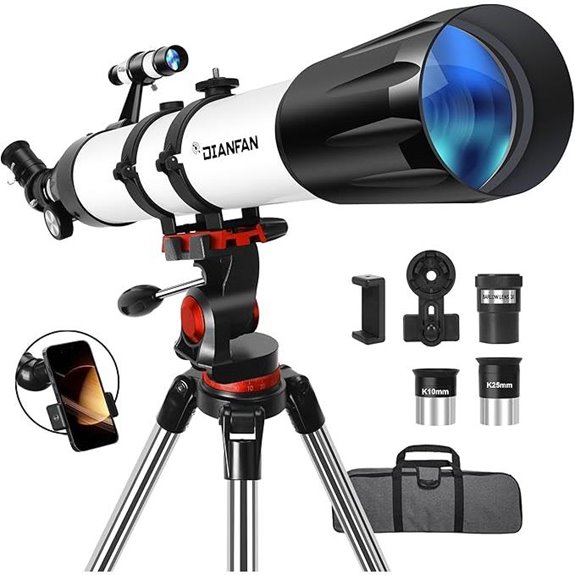
The Dianfan 90mm Aperture Refractor Telescope with Tripod is an excellent choice for beginners and hobbyists looking to explore both deep space and terrestrial objects. Its 90mm aperture and 800mm focal length provide bright, clear images, perfect for lunar craters, seas, and land features. The included two eyepieces and 3× Barlow lens offer magnifications from 32× to 240×. Its lightweight, stainless steel tripod guarantees stability, while the quick setup makes outdoor viewing easy. With accessories like a phone adapter and carry bag, it’s versatile for stargazing, birdwatching, and cityscape exploration, all in a user-friendly package.
- Aperture:90mm
- Focal Length:800mm
- Mount Type:Gimbal (rough adjustment)
- Connectivity/Accessories:Phone adapter, carry bag
- Included Eyepieces / Magnification Range:2 eyepieces, 3X Barlow
- Portability:Carry bag, lightweight
- Additional Feature:45° zenith mirror
- Additional Feature:Bright, vivid images
- Additional Feature:Versatile outdoor use
Celestron NexStar 130SLT Computerized Reflector Telescope
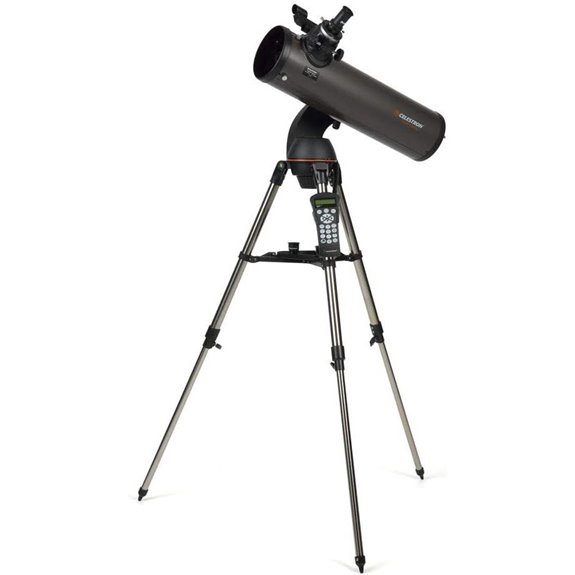
Designed for amateur astronomers seeking a powerful yet user-friendly experience, the Celestron NexStar 130SLT offers a 130mm Newtonian reflector that delivers bright, detailed views of planets, moons, and deep-sky objects. Its SkyAlign technology enables precise object location and automatic tracking, making astrophotography and observation easier. The telescope is lightweight and portable, perfect for dark sky trips and quick setup. Compatible with 2-inch eyepieces and bundled with astronomy software, it enhances viewing options and planning. Backed by Celestron’s two-year warranty and US-based support, this telescope combines power, convenience, and reliability for budding stargazers.
- Aperture:130mm
- Focal Length:Not specified
- Mount Type:Computerized (GoTo)
- Connectivity/Accessories:Software, manual controls
- Included Eyepieces / Magnification Range:Multiple eyepieces, software
- Portability:Compact, portable
- Additional Feature:Over 4,000 object database
- Additional Feature:Compact, portable design
- Additional Feature:Interactive sky software
SVBONY SV48P 102mm Refractor Telescope for Beginners
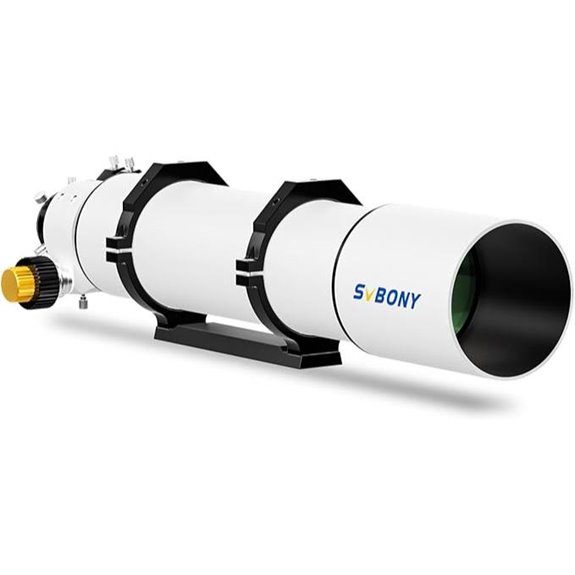
If you’re just starting out in amateur astronomy, the SVBONY SV48P 102mm Refractor Telescope stands out as an excellent choice due to its user-friendly features and high-quality optics. Its 102mm fully multi-coated achromatic lens offers bright, sharp images of the Moon, nebulae, and deep-space objects. The dual-speed focuser allows quick focusing and fine-tuning, making setup straightforward. Lightweight at 7 pounds, it’s easy to transport and assemble without tools. The 360-degree rotatable design and stable tube rings help keep everything aligned during observation. Overall, the SV48P provides a versatile, high-performance entry-level telescope perfect for beginners enthusiastic to explore the cosmos.
- Aperture:102mm
- Focal Length:Not specified
- Mount Type:Dual-axis mount
- Connectivity/Accessories:Camera compatible, remote control
- Included Eyepieces / Magnification Range:Not specified
- Portability:Carry bag, lightweight
- Additional Feature:Dual-speed focuser
- Additional Feature:360° rotatable tube
- Additional Feature:AR anti-reflective coatings
Smart Telescope with 4K Camera and Dual Screens
For astronomy enthusiasts who want quick, high-quality observations, the smart telescope with a 4K camera and dual screens stands out as an excellent choice. Its 80mm aperture and 300mm focal length deliver bright, crystal-clear images, supporting up to 350X magnification for detailed viewing. The starlight-grade sensor captures stunning high-resolution images, even in low-light conditions. The foldable external screen and adjustable eyepiece make real-time observation easy, while the one-touch photo and video functions simplify capturing celestial moments. With a portable design and a 4500mAh battery lasting up to six hours, it’s perfect for outdoor adventures and astrophotography.
- Aperture:80mm
- Focal Length:300mm
- Mount Type:No specific mount; likely fixed or simple mount
- Connectivity/Accessories:Dual screens, camera support
- Included Eyepieces / Magnification Range:Not specified
- Portability:Tripod included, portable
- Additional Feature:Dual 4K screens
- Additional Feature:Built-in moonshade
- Additional Feature:512GB external storage
HSL 150EQ Reflector Telescope with Filters and Barlow Lens
The HSL 150EQ Reflector Telescope stands out as an excellent choice for amateur astronomers enthusiastic to explore deep space with precision. Its 150mm aperture and 750mm focal length deliver sharp, detailed views of planets, moons, and distant celestial objects. The included 5-color filters enhance planetary imaging, revealing intricate surface features. The 3X Barlow lens offers triple magnification options, making it versatile for different observing needs. With a manual German equatorial mount and smooth tracking, it’s easy to follow celestial bodies. Plus, the adjustable phone holder and remote control make astrophotography accessible, providing both an immersive and detailed stargazing experience.
- Aperture:150mm
- Focal Length:750mm
- Mount Type:Equatorial
- Connectivity/Accessories:Smartphone mount, filters
- Included Eyepieces / Magnification Range:3 color filters, 3X Barlow
- Portability:Carry bag, lightweight
- Additional Feature:5 color planetary filters
- Additional Feature:Wireless remote control
- Additional Feature:Precise slow-motion mount
Portable 80mm Astronomical Refractor Telescope with Backpack
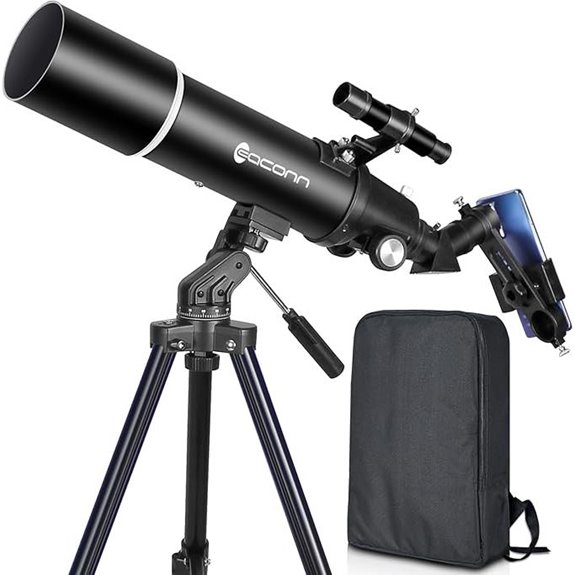
A portable 80mm astronomical refractor telescope with a backpack offers an excellent combination of light-gathering power and ease of transport, making it ideal for beginners and casual observers alike. Its 80mm aperture captures more light, providing brighter, clearer images of the Moon, planets, and deep-sky objects. The fully coated green optics glass lens enhances light transmission, ensuring sharp views. It features simple altitude and azimuth adjustments with a gimbal for smooth targeting. The package includes two eyepieces, a finder scope, a mobile phone adapter, and a carrying bag, making setup quick and travel convenient. It’s perfect for outdoor adventures and family stargazing.
- Aperture:80mm
- Focal Length:Not specified
- Mount Type:Gimbal
- Connectivity/Accessories:Mobile adapter, carry bag
- Included Eyepieces / Magnification Range:2 eyepieces, 3X Barlow
- Portability:Carry bag, portable
- Additional Feature:Adjustable tripod height
- Additional Feature:Carrying travel bag
- Additional Feature:Crosshair finder scope
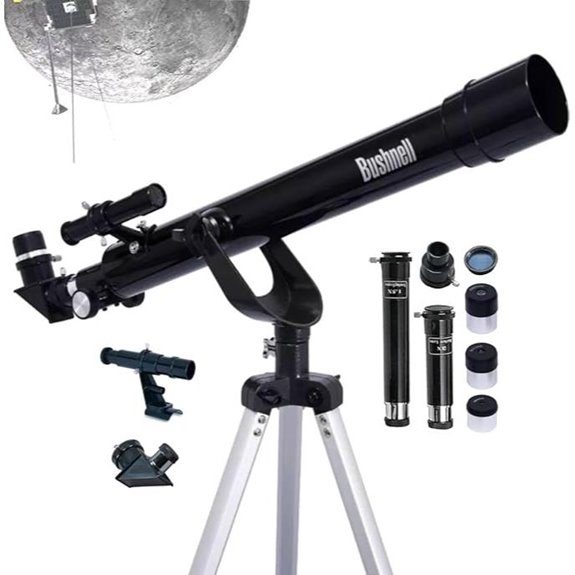
Bushnell Refractor 600x50mm Telescope Deep Space Viewing Telescope 181561
If you’re an amateur astronomer seeking an affordable yet capable telescope for deep space viewing, the Bushnell Refractor 600x50mm stands out as a solid choice. With a 50mm aperture, it offers bright, clear images of distant celestial objects. Its impressive 600x magnification helps you explore deep space in detail, making it suitable for enthusiasts enthusiastic to observe planets, nebulae, and star clusters. At just under 7 pounds, it’s lightweight and easy to handle. The compact design and straightforward setup make it ideal for beginners who want reliable performance without breaking the bank. This telescope truly balances affordability and functionality for deep space exploration.
- Aperture:50mm
- Focal Length:Not specified
- Mount Type:Not specified
- Connectivity/Accessories:Not specified
- Included Eyepieces / Magnification Range:Not specified
- Portability:Compact, portable
- Additional Feature:High magnification (600x)
- Additional Feature:Deep space focus
- Additional Feature:Compact design
High Power 90mm Telescope with Tripod and Phone Adapter
Designed for beginners and experienced stargazers alike, the High Power 90mm Telescope with Tripod and Phone Adapter offers impressive optical performance and versatility. Its 90mm aperture gathers ample light for bright, clear lunar and planetary views, while the fully multi-coated lenses reduce reflections and protect your eyes. With magnification options from 36X to 450X, you can explore celestial details in detail. The sturdy, adjustable tripod provides smooth movement and comfortable viewing angles, and the included phone adapter makes astrophotography simple. Easy to set up with clear instructions, this telescope is perfect for fostering a deeper interest in astronomy.
- Aperture:90mm
- Focal Length:900mm
- Mount Type:Adjustable tripod (likely altazimuth)
- Connectivity/Accessories:Phone adapter, tripod
- Included Eyepieces / Magnification Range:3 eyepieces, 3X Barlow
- Portability:Carry bag, lightweight
- Additional Feature:3 eyepieces included
- Additional Feature:900mm focal length
- Additional Feature:Mechanical elevation adjustment
Celestron StarSense Explorer LT 80AZ Telescope
The Celestron StarSense Explorer LT 80AZ Telescope stands out as an excellent choice for beginners who want an easy-to-use, smartly integrated telescope. Its 80mm refractor lens delivers sharp, vibrant images of the Moon, planets like Jupiter and Saturn, and deep-sky objects such as the Orion Nebula and Andromeda Galaxy. The manual altazimuth mount with slow-motion controls makes tracking objects simple. Plus, the StarSense Explorer app turns your smartphone into a navigation tool, helping you find celestial objects effortlessly. Setup is straightforward, and Celestron’s 2-year warranty and US-based support give added confidence, making this telescope perfect for novice astronomers.
- Aperture:80mm
- Focal Length:300mm
- Mount Type:Altazimuth
- Connectivity/Accessories:Smartphone dock, app-guided
- Included Eyepieces / Magnification Range:Not specified
- Portability:Portable with tripod
- Additional Feature:Curated top targets
- Additional Feature:Easy smartphone setup
- Additional Feature:City and dark sky use
Factors to Consider When Choosing a Telescope for Deep Space Viewing
When selecting a telescope for deep space viewing, I focus on key factors like aperture size, which influences how much light I can gather. I also consider optical quality, mount stability, and ease of setup to guarantee a smooth viewing experience. Understanding these points helps me choose a telescope that fits my needs and maximizes my stargazing enjoyment.
Aperture Size Importance
Choosing a telescope with a larger aperture is essential for deep space viewing because it directly affects how much light the instrument can gather. The more light a telescope collects, the brighter and more detailed faint objects like galaxies and nebulae appear. Larger apertures also improve resolving power, allowing me to distinguish closely spaced features in celestial objects. Telescopes with bigger apertures can gather up to four times more light than smaller ones, making dim objects much easier to see. Additionally, increased aperture size supports higher magnification levels without sacrificing image quality. However, it’s important to remember that larger apertures often mean more robust mounts and less portability. Overall, aperture size is a critical factor in choosing a telescope for deep space observation, directly impacting visibility and detail.
Optical Quality Features
Optical quality features play a essential role in ensuring sharp, detailed images during deep space viewing. High-quality, fully multi-coated lenses boost light transmission, making faint objects brighter and clearer. A larger aperture, like 90mm or more, gathers more light, revealing distant celestial phenomena. Reflectivity coatings on mirrors and lenses enhance contrast and detail, indispensable for deep space observations. Precise optical alignment and premium glass reduce distortions and aberrations, delivering crisp, accurate images. Features such as adjustable focus help fine-tune views, especially important when observing faint or intricate objects. Low chromatic aberration minimizes color distortions, ensuring clarity across the spectrum. Overall, these optical quality features considerably improve viewing experiences, allowing us to explore the depths of space with greater detail and precision.
Mount Stability and Ease
A stable mount is essential for clear, steady views of faint deep-sky objects, especially during long observation sessions. It minimizes vibrations and shakiness, giving you sharp, steady images. Equatorial mounts with slow-motion controls are ideal because they allow precise tracking as objects drift across the sky, reducing the need for constant adjustments. The quality of the tripod matters too; heavy-duty materials like aluminum or stainless steel provide better stability and reduce flex. Ease of setup is important; features like quick-lock clamps and smooth altitude or azimuth controls make operation comfortable and efficient. A well-designed mount with high stability and minimal flex enhances accuracy and prevents image distortion, ensuring you get the most out of your deep space observations without frustration or unnecessary adjustments.
Magnification Capabilities
Magnification plays a crucial role in deep space viewing because it determines how much detail you can see in distant objects like galaxies and nebulae. It’s achieved by combining the telescope’s focal length with the eyepiece’s focal length—longer focal lengths give higher magnification. However, more isn’t always better; excessive magnification can cause blurry images and lower quality if your telescope’s aperture or atmospheric conditions aren’t ideal. Typically, an effective range for deep space objects is between 26x and 130x, depending on your equipment and conditions. Remember, magnification alone doesn’t guarantee clear images. The key is balancing magnification with aperture size and stability to get the best possible view of distant, faint objects in deep space.
Ease of Setup
When selecting a telescope for deep space viewing, ease of setup can make a significant difference in your overall experience. I recommend choosing models with simple, user-friendly assembly that require minimal tools and time. Look for telescopes with clear, detailed instructions or automated alignment features, which help you get started quickly. Adjustable mounts that allow easy altitude and azimuth adjustments make targeting celestial objects more straightforward. Integrated smartphone adapters or digital alignment aids are also valuable, streamlining the initial setup and object locating process. Finally, prioritize designs that offer stable, vibration-free positioning, ensuring precise tracking during long observation sessions. This focus on ease of setup allows you to spend more time exploring the cosmos and less time fussing with equipment.
Technological Integration
Technological integration has become a key factor in choosing a telescope for deep space viewing, as it can dramatically enhance your observing experience. Modern models often feature smartphone or app connectivity, making target identification and sky navigation simpler and more accurate. Digital tools like star mapping, object tracking, and automated positioning cut down setup time and help you find objects faster. Wireless remote controls and camera compatibility allow astrophotographers to capture high-resolution images with minimal effort. Built-in software or companion apps provide real-time star charts, extensive object databases, and sky tour functions, making deep space exploration more accessible. Additionally, firmware updates and connectivity options like Wi-Fi or Bluetooth guarantee your telescope stays current with the latest features, improving longevity and overall performance.
Frequently Asked Questions
How Does Light Pollution Affect Deep Space Viewing Quality?
Light pollution really hampers my ability to see deep space objects clearly. It causes the night sky to glow, washing out faint stars and distant galaxies. When there’s too much artificial light, my telescope’s view becomes washed out, making it harder to spot faint objects. To get the best views, I try to observe from dark, rural areas away from city lights. It’s amazing how much clearer the universe looks without light pollution!
What Maintenance Is Required for Long-Term Telescope Use?
Imagine you’re observing the stars, and your telescope suddenly loses clarity. I recommend regular cleaning of lenses and mirrors, checking for alignment, and storing it properly. For long-term use, I perform annual collimation and keep it in a dry, dust-free environment. This helps prevent corrosion and dust buildup, ensuring peak performance. Proper maintenance keeps your telescope in top shape, so your cosmic adventures never have to pause.
Can These Telescopes Track Fast-Moving Celestial Objects?
Yes, many modern telescopes can track fast-moving celestial objects like satellites or asteroids. I find that those with advanced computerized mounts and tracking systems do a great job, automatically adjusting to keep objects centered. If you’re interested in observing or studying such objects, I recommend choosing a telescope with precise motorized tracking and enough stability to handle rapid movements, ensuring smooth, clear views even of swift targets.
Are There Specific Eyepieces Best for Deep Space Observation?
Oh, absolutely, because the eyepiece makes all the difference, right? I swear by wide-angle, high-quality Plössl or Nagler eyepieces for deep space viewing—they give me those expansive, crisp views of nebulae and galaxies. Low magnification with plenty of eye relief is my secret weapon for comfort and clarity. Honestly, investing in good eyepieces transforms your experience, making those distant wonders feel just a little closer.
How Does Aperture Size Influence Deep Space Detail Resolution?
Aperture size greatly impacts deep space detail resolution because larger apertures gather more light, revealing fainter objects and finer details. With a bigger aperture, I can see dimmer galaxies, nebulae, and star clusters clearly, improving the overall image quality. It also enhances contrast and resolution, making it easier to distinguish subtle features. So, if you’re serious about deep space viewing, investing in a telescope with a larger aperture will pay off considerably.
Conclusion
Choosing the right telescope feels a bit like finding a new friend for stargazing. Each option offers a unique way to explore the cosmos, and with a little guidance, you’ll discover the perfect match. Remember, the journey into deep space is all about curiosity and wonder—so don’t worry if your first choice isn’t perfect. Embrace the adventure, and soon enough, the stars will become your closest companions.