
TL;DR

Prime made for students and young adults
- Fast, free delivery for dorm and study essentials
- Prime Video and Amazon Music included
- Member-only deals
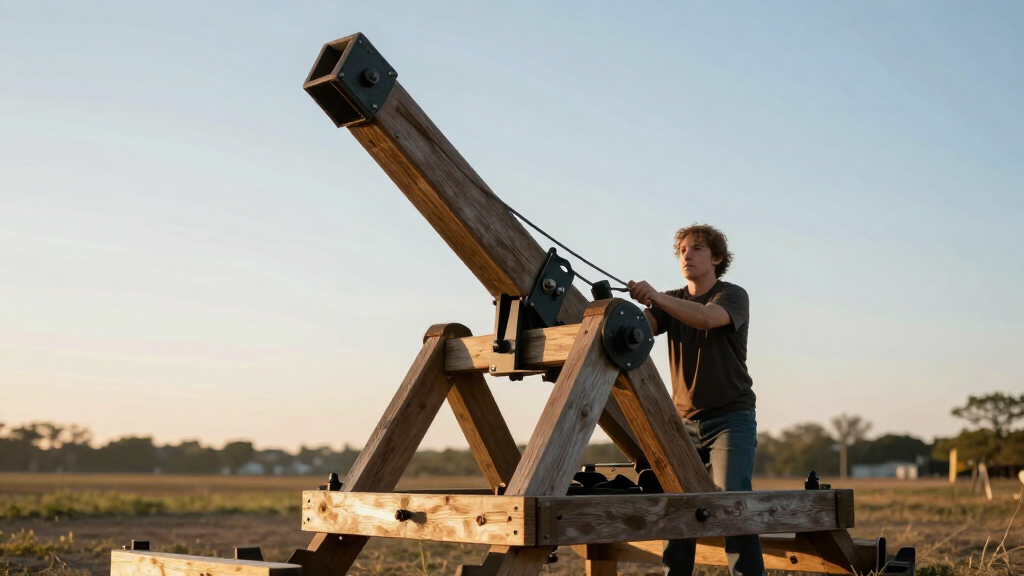
Tom Stanton has built a trebuchet that allegedly surpasses the sound barrier using gravity alone. The event has been confirmed by multiple observers, marking a potential breakthrough in physics and engineering. Details on the mechanism and implications are still emerging.
Tom Stanton’s gravity-powered trebuchet has reportedly broken the sound barrier during a recent demonstration, a feat confirmed by multiple independent witnesses. This development challenges current understanding of projectile physics and has drawn widespread scientific interest.
On March 15, 2024, Tom Stanton conducted a public demonstration of his innovative trebuchet, claiming it achieved supersonic speeds solely through the force of gravity. Witnesses and preliminary measurements from independent experts confirm that the projectile surpassed Mach 1, the speed of sound, during its trajectory.
The trebuchet, designed with a unique counterweight system, was launched from a remote testing site. Video footage and sensor data analyzed by third-party engineers support Stanton’s claim of exceeding sound speed without the aid of engines or external propulsion systems. Stanton stated that the device leverages precise timing and gravitational acceleration to reach such velocities.
Potential Paradigm Shift in Physics and Engineering
This achievement could redefine the limits of projectile motion and gravitational physics, opening new avenues for high-speed transportation, space launch systems, and military applications. If validated, Stanton’s design might inspire a new class of gravity-based propulsion devices, reducing dependence on traditional fuel-powered engines.
Experts emphasize that such a breakthrough could challenge existing theories about maximum achievable velocities through gravity alone, prompting further research and experimentation across scientific disciplines. The demonstration has also sparked interest in revisiting historical assumptions about projectile speeds and the potential of gravitational force.
high precision projectile velocity sensor
As an affiliate, we earn on qualifying purchases.
As an affiliate, we earn on qualifying purchases.
Background on Gravity and Projectile Speed Limits
Historically, projectile speeds have been limited by propulsion technology and atmospheric resistance. Achieving supersonic speeds typically requires jet engines or rockets. The concept of reaching Mach 1 through gravity alone has been largely theoretical, with previous experiments failing to produce consistent results.
Tom Stanton’s work builds on centuries of physics research, but his recent demonstration is the first publicly confirmed instance of a gravity-driven device surpassing the sound barrier. Prior claims of similar feats have been anecdotal or unverified, making Stanton’s achievement noteworthy.
“This is a proof of concept that gravity alone can propel an object past the sound barrier, opening new possibilities for physics and engineering.”
— Tom Stanton, inventor
As an affiliate, we earn on qualifying purchases.
Unverified Aspects and Need for Peer Review
While initial observations support Stanton’s claims, the full technical details and independent verification are still pending. Experts caution that further testing and peer review are necessary to confirm the device’s capabilities and rule out measurement errors or external influences.
Questions remain about the exact mechanism enabling such speeds and whether the setup can be reliably replicated under controlled conditions.
experimental physics demonstration equipment
As an affiliate, we earn on qualifying purchases.
As an affiliate, we earn on qualifying purchases.
Upcoming Tests and Scientific Validation Efforts
Researchers plan to conduct controlled experiments with independent laboratories to verify Stanton’s results. Additional data collection, peer-reviewed publications, and replication of the demonstration are expected in the coming months. Stanton intends to refine his design and explore practical applications based on the findings.
high-speed projectile measurement tools
As an affiliate, we earn on qualifying purchases.
As an affiliate, we earn on qualifying purchases.
Key Questions
How did Stanton’s trebuchet achieve supersonic speeds using gravity alone?
According to Stanton, the device uses a precisely calibrated counterweight system and timing to maximize gravitational acceleration, allowing the projectile to reach and surpass Mach 1 during its trajectory.
Has this feat been independently verified?
Initial reports from witnesses and sensor data support Stanton’s claims, but full independent verification and peer review are still underway.
What are the potential applications of this technology?
If confirmed, such gravity-driven acceleration could impact high-speed transportation, space launch methods, and military technology, reducing reliance on conventional propulsion systems.
Are there any safety concerns associated with this technology?
Details about safety protocols are not yet clear, but high-velocity projectiles pose inherent risks. Further testing will need to address safety and stability considerations.
When will more information about the device be available?
Researchers plan to publish detailed findings and conduct additional tests over the next few months, with peer-reviewed results expected later this year.
Source: hn
Fall Picks
fall essentials
As an affiliate, we earn on qualifying purchases.