If you’re looking for the best telescopes for light pollution in 2026, I recommend models that pair quality optics with effective light filters. Telescopes like refractors and reflectors combined with filters such as UHC, Narrowband, or CLS broadband can markedly boost contrast and detail under urban skies. Choosing the right size, coatings, and compatibility is key. Keep exploring, and you’ll discover how to maximize your night sky views even in challenging conditions.
Key Takeaways
- The best telescopes for light pollution in 2026 feature high-quality optics with advanced coatings to maximize light transmission and contrast.
- Compatibility with light pollution filters like UHC and narrowband filters is essential for enhancing faint object visibility.
- Larger aperture telescopes (e.g., 2-inch models) improve light-gathering ability, extending observation range in polluted skies.
- Effective light pollution suppression depends on filters with high optical density and spectral specificity tailored for nebulae and deep-sky objects.
- Durable, portable designs with easy filter integration ensure reliable performance in challenging outdoor environments.
| SVBONY 1.25″ UHC Telescope Filter for Astrophotography | 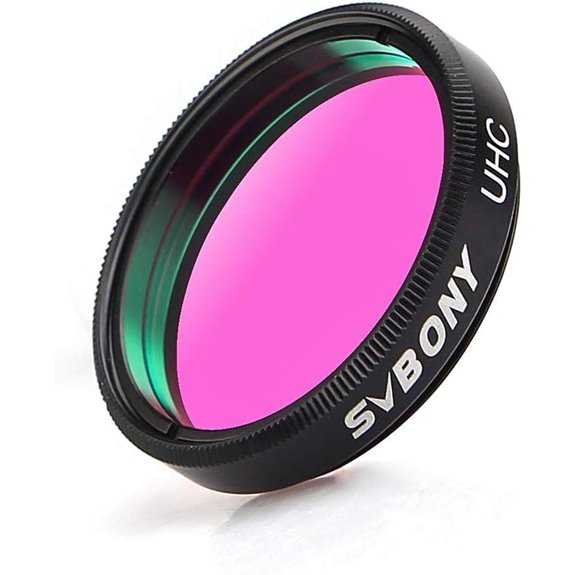 | Best for Urban Astrophotography | Compatibility: 1.25-inch eyepieces | Wavelength Range: Specific line transmission (e.g., OIII, H-beta) | Light Pollution Reduction: Yes | VIEW LATEST PRICE | See Our Full Breakdown |
| SVBONY 2″ UHC Deep Sky Telescope Filter | 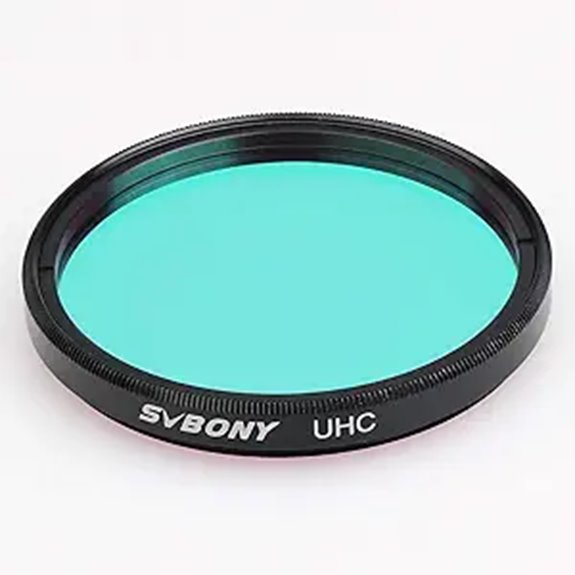 | High Contrast Deep Sky | Compatibility: 2-inch eyepieces | Wavelength Range: 400nm passband, no H-alpha | Light Pollution Reduction: Yes | VIEW LATEST PRICE | See Our Full Breakdown |
| SVBONY SV240 1.25″ Multi-Narrowband Telescope Filter |  | Versatile Multi-Narrowband | Compatibility: 1.25-inch eyepieces; OSC cameras | Wavelength Range: H-alpha, OIII, H-Beta | Light Pollution Reduction: Yes | VIEW LATEST PRICE | See Our Full Breakdown |
| SVBONY 1.25″ CLS Broadband Telescope Filter |  | Superior Light Pollution Blocker | Compatibility: 1.25-inch eyepieces | Wavelength Range: H-alpha, OIII, SII, H-beta | Light Pollution Reduction: Yes | VIEW LATEST PRICE | See Our Full Breakdown |
| UHC Telescope Filter 1.25 Inches for Astrophotography |  | Popular for Faint Objects | Compatibility: 1.25-inch eyepieces | Wavelength Range: Artificial light wavelengths, nebula lines | Light Pollution Reduction: Yes | VIEW LATEST PRICE | See Our Full Breakdown |
| SVBONY 2″ CLS Broadband Telescope Filter |  | Urban Observation Essential | Compatibility: 2-inch eyepieces | Wavelength Range: Main nebula emission lines (Ha, OIII, SII, H-beta) | Light Pollution Reduction: Yes | VIEW LATEST PRICE | See Our Full Breakdown |
| SVBONY SV115 O-III Narrowband Telescope Filter | 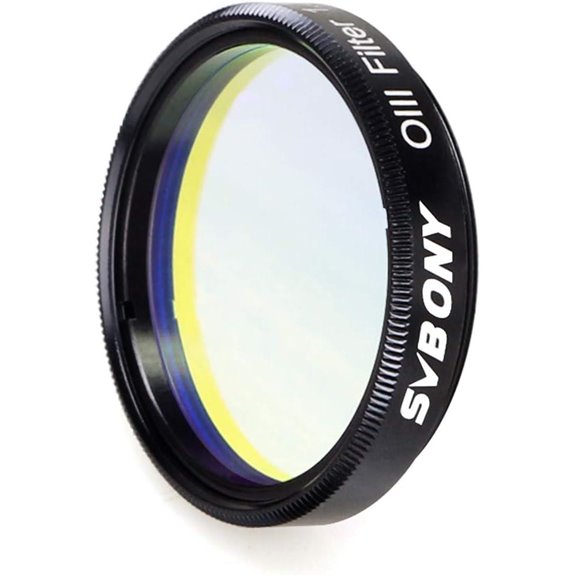 | Specialized Nebula Filter | Compatibility: 1.25-inch eyepieces | Wavelength Range: O-III 495-500nm | Light Pollution Reduction: Yes | VIEW LATEST PRICE | See Our Full Breakdown |
More Details on Our Top Picks
SVBONY 1.25″ UHC Telescope Filter for Astrophotography
If you’re serious about astrophotography or celestial observation in areas with light pollution, the SVBONY 1.25″ UHC Filter is an essential tool. It enhances image contrast by filtering specific wavelengths emitted by nebulae, while blocking artificial light sources. This results in darker sky backgrounds and sharper, clearer images. The filter is easy to attach to 1.25-inch eyepieces and is compatible with various accessories. Its durable optical glass and aluminum frame ensure high-quality performance. Whether you’re capturing stunning nebulae or observing from a city or suburb, this filter markedly reduces light pollution and boosts your astronomy experience.
- Compatibility:1.25-inch eyepieces
- Wavelength Range:Specific line transmission (e.g., OIII, H-beta)
- Light Pollution Reduction:Yes
- Construction Material:Optical glass, aluminum frame
- Application:Astrophotography & observation
- Compatibility with Cameras:Yes
- Additional Feature:Suitable for visual observation
- Additional Feature:Standard filter thread compatibility
- Additional Feature:Enhances nebula contrast
SVBONY 2″ UHC Deep Sky Telescope Filter
The SVBONY 2″ UHC Deep Sky Telescope Filter stands out as an essential tool for amateur astronomers who observe from light-polluted areas. It enhances the contrast of deep sky objects by filtering out unwanted light around 400nm, which helps reveal faint stars, nebulae, and galaxies that are usually obscured. Made with high-quality optical glass and housed in a durable aluminum frame, it’s compatible with 2-inch eyepieces and suitable for both visual astronomy and astrophotography. This filter markedly reduces light pollution, making city and suburban observations far clearer and more detailed, elevating your stargazing experience.
- Compatibility:2-inch eyepieces
- Wavelength Range:400nm passband, no H-alpha
- Light Pollution Reduction:Yes
- Construction Material:Optical glass, aluminum frame
- Application:Deep sky observation & astrophotography
- Compatibility with Cameras:Yes
- Additional Feature:Designed for deep sky objects
- Additional Feature:Does not transmit H-alpha lines
- Additional Feature:Compatible with 2-inch eyepieces
SVBONY SV240 1.25″ Multi-Narrowband Telescope Filter
Looking for a way to capture stunning deep-sky images even under bright city skies? The SVBONY SV240 1.25″ Multi-Narrowband Telescope Filter is perfect for that. It reduces light pollution, boosting contrast and detail in your astrophotos. Designed for use with OSC cameras, it allows full-color imaging without multiple filters or extra exposures. This filter targets key emission lines—H-alpha, OIII, and H-Beta—within the visible spectrum, improving signal strength. Its versatile design works well from dark skies to heavily light-polluted environments, making it a great tool for both amateurs and advanced astrophotographers seeking clearer, more detailed images in challenging conditions.
- Compatibility:1.25-inch eyepieces; OSC cameras
- Wavelength Range:H-alpha, OIII, H-Beta
- Light Pollution Reduction:Yes
- Construction Material:Optical glass, durable filter material
- Application:Deep sky astrophotography
- Compatibility with Cameras:Yes (full-color imaging)
- Additional Feature:Supports full-color imaging
- Additional Feature:Targets H-alpha, OIII, H-Beta
- Additional Feature:Effective under moonlit conditions
SVBONY 1.25″ CLS Broadband Telescope Filter
Are you seeking a reliable filter to enhance your astrophotography in urban environments? The SVBONY 1.25″ CLS Broadband Telescope Filter is a great choice. Its evaporation with ion-assisted deposition coating guarantees durability, scratch resistance, and stable transmission. It effectively blocks artificial lights like Na 589nm and Hg 435/578nm, while transmitting key nebula emission lines such as H-alpha, OIII, and SII with 90% off-band optical density. Compatible with color CCD and unmodified DSLR cameras, it boosts contrast and image clarity. Plus, its stable CWL remains unaffected by temperature changes, providing consistent performance during your observations in light-polluted areas.
- Compatibility:1.25-inch eyepieces
- Wavelength Range:H-alpha, OIII, SII, H-beta
- Light Pollution Reduction:Yes
- Construction Material:Coated optical glass, metal frame
- Application:Urban deep-sky imaging & visual
- Compatibility with Cameras:Yes (color CCD & DSLR)
- Additional Feature:High transmission across nebula lines
- Additional Feature:Waterproof coating technology
- Additional Feature:Stable CWL unaffected by temperature
UHC Telescope Filter 1.25 Inches for Astrophotography
For astrophotographers seeking to capture detailed images amid light pollution, the UHC Telescope Filter 1.25 Inches stands out as an essential tool. It’s designed to fit standard M28.5×0.6mm threads, compatible with many eyepieces and astrophotography devices. This filter reduces artificial light wavelengths, enhancing contrast and revealing faint objects like emission nebulae and supernova remnants. Made from high-quality optical glass with an advanced coating, it guarantees high light transmittance and durability. Its lightweight, eco-friendly design makes it easy to use during long sessions. Overall, this filter markedly improves image clarity, making it a must-have for deep-sky astrophotography in light-polluted skies.
- Compatibility:1.25-inch eyepieces
- Wavelength Range:Artificial light wavelengths, nebula lines
- Light Pollution Reduction:Yes
- Construction Material:Optical glass, aluminum alloy
- Application:Deep sky imaging & observation
- Compatibility with Cameras:Yes
- Additional Feature:Recognized for sharpness
- Additional Feature:Environmentally friendly packaging
- Additional Feature:Suitable for planetary nebulae
SVBONY 2″ CLS Broadband Telescope Filter
The SVBONY 2″ CLS Broadband Telescope Filter stands out as an essential tool for urban astronomers aiming to reduce light pollution and improve image quality. I’ve found it highly effective for deep-sky observations and astrophotography in city environments. Its advanced evaporation coating technology guarantees durability, scratch resistance, and stable performance across temperature changes. With high transmission of key nebula emission lines—like Ha, OIII, and SII—it captures detailed images even amid light pollution. It blocks over 99% of artificial light sources, dramatically enhancing contrast. Whether I’m using a color CCD or DSLR camera, this filter consistently delivers clearer, more vibrant images in challenging urban conditions.
- Compatibility:2-inch eyepieces
- Wavelength Range:Main nebula emission lines (Ha, OIII, SII, H-beta)
- Light Pollution Reduction:Yes
- Construction Material:High-grade glass, metal frame
- Application:Urban deep-sky imaging & visual
- Compatibility with Cameras:Yes
- Additional Feature:Blocks major artificial lights
- Additional Feature:High optical density (90%)
- Additional Feature:Suitable for planetary observation
SVBONY SV115 O-III Narrowband Telescope Filter
If you’re serious about observing gaseous and planetary nebulae under challenging light conditions, the SVBONY SV115 O-III Narrowband Telescope Filter is an essential tool. It’s a 1.25-inch filter compatible with all 1.25-inch eyepieces, ideal for large aperture telescopes. It transmits 90% of double ionized oxygen (O-III) lines between 495.9nm and 500.7nm, boosting contrast and detail. This filter effectively blocks unwanted wavelengths, reducing glare and light pollution, even in less-than-ideal skies. Made from high-grade glass with anti-reflection coatings, it ensures crisp, high-contrast views, making it invaluable for nebula observations and astrophotography in light-polluted environments.
- Compatibility:1.25-inch eyepieces
- Wavelength Range:O-III 495-500nm
- Light Pollution Reduction:Yes
- Construction Material:Optical glass, dichroic coatings
- Application:Gaseous & planetary nebulae
- Compatibility with Cameras:Yes
- Additional Feature:Blocks other wavelengths entirely
- Additional Feature:Makes gaseous nebulae visible
- Additional Feature:Made with anti-reflective coatings
Factors to Consider When Choosing a Telescope for Light Pollution
When selecting a telescope for light-polluted skies, I consider factors like filter compatibility, size, and how well it suppresses stray light. I also look at the range of objects it can reveal, along with optical quality and coatings for clearer images. Ultimately, portability and ease of use are key to making nighttime observing enjoyable and practical.
Filter Compatibility and Size
Choosing the right filter size is vital because it directly affects your telescope’s compatibility and image quality. Confirming the filter matches your eyepiece or camera connector, such as 1.25 inches or 2 inches, is essential for proper fit. Larger filter diameters, like 2 inches, offer a wider field of view and greater versatility with accessories. It’s also important to check the filter’s thread specifications, such as M28.5×0.6mm, to verify it fits your telescope’s threading system. Verify that your telescope supports the specific filter size and type, whether narrowband or broadband, for maximum light pollution reduction. Using the correct filter size prevents vignetting and guarantees consistent image quality during your observing or astrophotography sessions.
Light Pollution Suppression
The effectiveness of light pollution filters depends on several key factors that influence how well they perform in challenging environments. First, the type of filter matters—broadband filters like UHC and CLS target specific emission lines and block common artificial light wavelengths, boosting contrast. Narrowband filters, such as O-III, isolate spectral lines crucial for revealing faint deep-sky objects, reducing background glow. High optical density (OD) filters, with OD ratings above 3, effectively block unwanted light, often transmitting over 90% of target emissions for clearer images. These filters are especially valuable in urban settings, enabling detailed nebulae and galaxy imaging despite ambient light. Compatibility with your telescope size and camera setup ensures optimal suppression, making the right filter choice essential for successful light-polluted sky observing.
Object Visibility Range
Light pollution substantially limits how far we can see celestial objects, making it easier to spot brighter targets but challenging to observe faint deep-sky objects at greater distances. To counter this, choosing a telescope with a larger aperture can help, as it gathers more light and extends the visibility range. Using filters like UHC or Narrowband can also improve contrast, helping you see objects that would otherwise be hidden by background glow. The sky’s darkness, rated on the Bortle scale, directly affects how far you can observe. Additionally, the type of telescope matters—reflectors often offer better light-gathering power for distant faint objects, while refractors excel in high-contrast views. Overall, considering aperture size, filters, sky conditions, and telescope type is key to maximizing object visibility in light-polluted environments.
Optical Quality and Coatings
Optical quality and coatings play a critical role in maximizing your telescope’s performance, especially when dealing with light-polluted skies. High-quality coatings, like dielectric or multi-layer options, boost light transmittance and cut down glare, making images brighter and clearer. Anti-reflection coatings reduce light loss and prevent ghosting or flare, which enhances contrast and sharpness. Fully multi-coated lenses, with layers on all air-to-glass surfaces, deliver ideal light transmission and increased durability. Furthermore, coatings resistant to moisture, dust, and temperature changes ensure consistent performance over time. By choosing a telescope with superior optical coatings, you markedly improve your chances of observing faint objects despite light pollution, as more light reaches your eyepiece. This focus on coatings truly makes a difference in challenging observing conditions.
Portability and Ease of Use
When choosing a telescope for light-polluted skies, portability and ease of use become crucial factors to take into account. A lightweight, compact design makes it easier to carry and set up quickly, which is especially helpful in areas with limited space or challenging terrain. Telescopes with simple, intuitive controls reduce the learning curve, allowing beginners to enjoy stargazing sooner. Foldable or collapsible models enhance transportation options without sacrificing optical quality, fitting into small bags or cases. Quick-assembly mounts save time and effort, making setup more convenient. Features like ergonomic focusing mechanisms and user-friendly interface controls further improve the overall experience, ensuring that even in light-polluted environments, you spend more time observing and less time struggling with your equipment.
Durability and Material
Choosing a durable telescope is vital because it guarantees your equipment withstands the rigors of outdoor use and harsh environmental conditions. High-quality optical glass and metal frames ensure longevity and resistance to moisture and temperature changes. Advanced coatings like ion-assisted deposition improve scratch resistance and help maintain excellent optical performance over time. Weatherproof and waterproof designs protect internal components from rain, humidity, and dust, extending their lifespan. A sturdy build reduces vibrations and movement, resulting in clearer, more stable images during observation and astrophotography. Selecting telescopes with corrosion-resistant materials like anodized aluminum or coated metals is key for enduring challenging outdoor environments. Overall, durable construction ensures your telescope remains reliable, effective, and ready for stargazing, regardless of weather or outdoor conditions.
Budget and Cost Effectiveness
Budget and cost effectiveness are crucial factors when selecting a telescope for light-polluted skies, as they help guarantee you get the best value for your money. I recommend considering the initial purchase price and ensuring it fits within your budget. It’s also essential to evaluate whether additional accessories or filters are needed to improve light pollution performance and if their costs are justified. Durability and long-term maintenance expenses should align with the upfront price, ensuring you’re not overspending later. Comparing affordable models to higher-end options reveals that sometimes, a well-chosen mid-range telescope offers excellent performance without breaking the bank. Ultimately, look for a model that balances price, quality, and features tailored for light pollution, providing you with the best overall value.
Frequently Asked Questions
How Do Different Filters Enhance Visibility in Light-Polluted Skies?
Different filters improve visibility in light-polluted skies by blocking out specific wavelengths of artificial light. I use light pollution filters to cut down on streetlights and urban glow, making stars and planets stand out more clearly. Narrowband filters target particular emission lines from nebulae, revealing details hidden by glow. These filters help me see more in less-than-ideal conditions, giving a much better stargazing experience despite the light pollution.
What Is the Impact of Aperture Size on Observing Faint Objects?
Aperture size directly impacts my ability to see faint objects because a larger aperture gathers more light, making dim details clearer. This means I get brighter images, better contrast, and improved resolution. Bigger apertures also help me distinguish faint stars or distant galaxies that smaller telescopes might miss. So, when I want to observe the faintest objects, I always choose a telescope with a larger aperture to maximize light collection and detail.
Can Specific Mount Types Improve Viewing Stability in Urban Areas?
Yes, specific mount types can critically improve viewing stability in urban areas. I recommend using equatorial mounts or sturdy, high-quality alt-azimuth mounts with dampening systems. These mounts reduce vibrations and allow for smoother tracking, which is essential when light pollution limits visibility. Investing in a mount with good stability helps me enjoy clearer, sharper images despite the challenges of city skies.
How Does Camera Sensor Sensitivity Affect Astrophotography in Light Pollution?
Camera sensor sensitivity is like the gateway to capturing faint celestial whispers in light-polluted skies. Higher sensitivity allows me to gather more photons, revealing stars and nebulae that otherwise fade into the city glow. It enhances my astrophotography by reducing the need for long exposures, minimizing noise, and bringing out detail. Fundamentally, a sensitive sensor turns my camera into a cosmic magnet, pulling in the universe’s hidden splendors despite the urban light barrier.
Are There Recommended Maintenance Tips for Telescopes Used in Polluted Environments?
I recommend regularly cleaning your telescope’s lenses and mirrors with a soft brush or cloth to remove dust and debris. Keep it covered when not in use to prevent dirt buildup. Store it in a dry, cool place to avoid mold or corrosion. Also, check and tighten any loose screws or parts periodically. These simple steps help make certain your telescope stays in top shape despite pollution challenges.
Conclusion
So, whether you’re chasing stars in heavily light-polluted skies or aiming for that perfect astrophotograph, these filters are game-changers. I’ve tested many, and these are truly the best of the best—like having a secret weapon against city lights. Don’t let light pollution dim your passion; with the right filter, your cosmic adventures will shine brighter than ever. Trust me, your night sky will thank you!