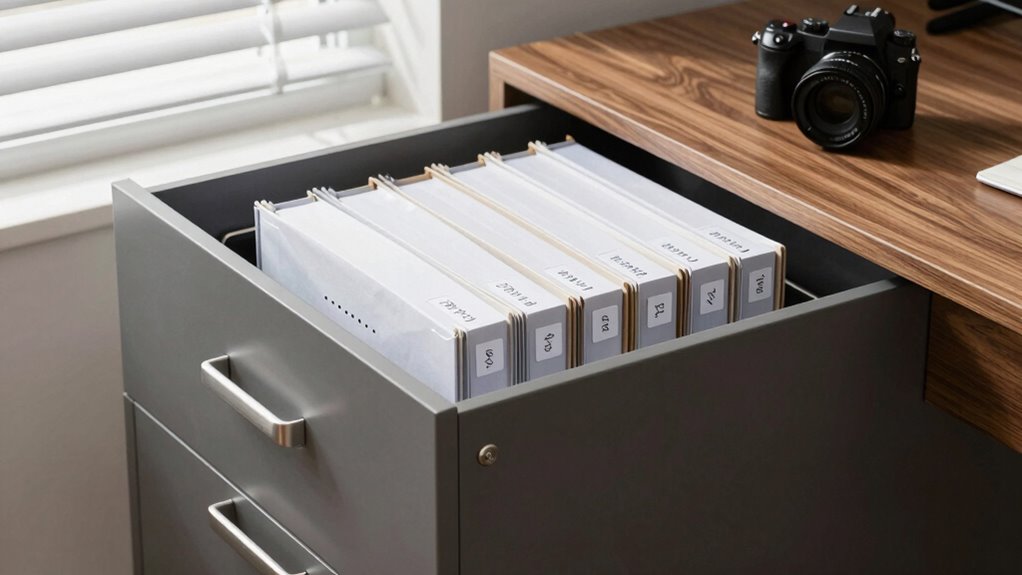

To perform the “Can I Find It Fast?” test for your home document system, try locating a critical file within two minutes. Check if your digital files are well-organized with clear, relevant keywords, and guarantee paper files are labeled and arranged logically. If you struggle or have to search extensively, it indicates more organization is needed. Keep exploring for effective tips to refine your system and make finding documents effortless.
Key Takeaways
- Attempt to locate a specific document within two minutes to assess search efficiency.
- Ensure digital files are properly named with relevant keywords for quick retrieval.
- Confirm paper files are clearly labeled and logically organized to reduce searching time.
- Identify if rummaging or scrolling is needed, indicating potential system improvements.
- Regularly review and update the system to maintain ease of access and minimize search delays.
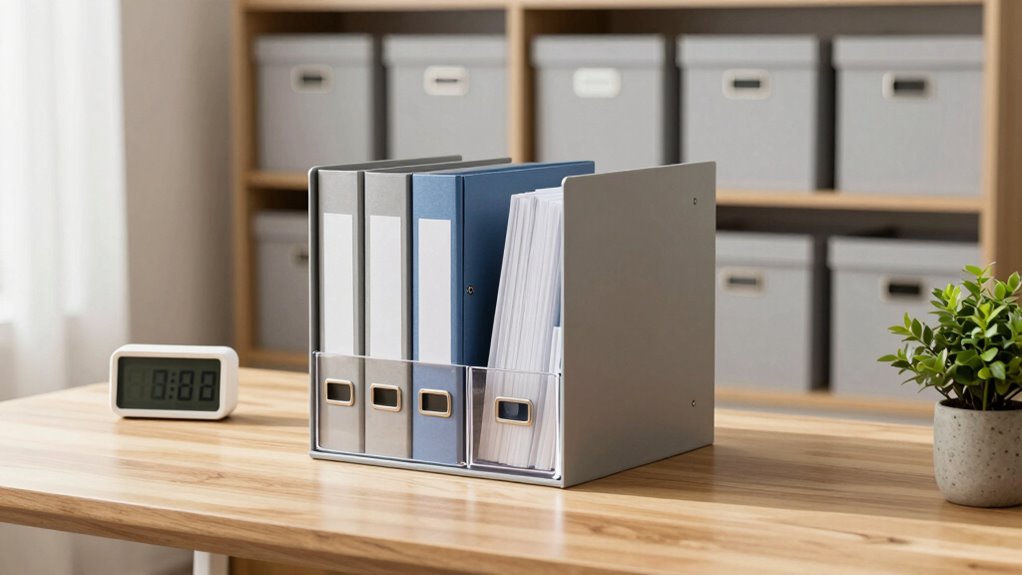
Have you ever spent valuable time searching for a vital document only to realize it’s buried beneath stacks or misplaced in a cluttered drawer? That frustrating moment highlights the importance of a home document system that works efficiently. The “Can I Find It Fast?” test can help you evaluate whether your current setup is effective or needs improvement. The goal is simple: you want to locate any document quickly and effortlessly, whether it’s a financial record, medical info, or important correspondence. To do this, you need a system that balances digital organization with paper filing, ensuring everything has a designated place.
Efficient home document systems help you find vital papers quickly and reduce daily stress.
When you think about digital organization, it’s about creating a structured, easy-to-navigate system on your devices. Use clear folder names, consistent naming conventions, and tagging features to categorize files. This way, you can locate digital documents at a glance, without sifting through countless folders. Digital organization complements paper filing by reducing clutter and freeing up physical space, but it requires discipline. Regularly updating and maintaining your digital files keeps the system functional and reliable. Incorporating effective file naming conventions can further streamline your ability to find documents quickly. Additionally, understanding home organization principles can help optimize your entire system, making sure your setup is both intuitive and sustainable. A well-structured file management system can make a significant difference in your efficiency. Maintaining a consistent filing hierarchy helps prevent confusion and makes the documents easier to find.
Paper filing, on the other hand, still plays a vital role in home document management. But if your paper filing system isn’t straightforward, it can become a disorganized maze. To pass the “Can I Find It Fast?” test, your paper files need clear labels, logical categories, and a designated filing cabinet or storage box. Avoid piling papers randomly; instead, create a filing hierarchy that makes sense for your needs. For example, separate financial documents, medical records, warranties, and personal correspondence into distinct folders, and keep them in a consistent order. Proper categorization helps streamline your access and reduces the time spent searching.
Now, take a moment to test your system. Pick a document you might need in an emergency—say, your insurance policy or a recent bank statement. Can you locate it within two minutes? If not, your system probably needs adjustments. Are your digital files well-organized, with relevant keywords and folders? Is your paper filing labeled clearly and arranged logically? If you find yourself rummaging or scrolling endlessly, it’s time to streamline.
Ultimately, a system that passes the “Can I Find It Fast?” test combines digital organization and paper filing into a seamless whole. Regularly review and update your setup, eliminate duplicates, and discard outdated papers. When your home document system is efficient, you save time, reduce stress, and gain peace of mind knowing you can access what you need, right when you need it.
As an affiliate, we earn on qualifying purchases.
Frequently Asked Questions
How Often Should I Perform the “Can I Find It Fast?” Test?
You should perform the “Can I Find It Fast?” test every three to six months. This helps you evaluate your document organization and refine your search strategies, ensuring quick access when needed. Regular testing keeps your system efficient and highlights areas needing improvement. Incorporate this routine into your home management to maintain a well-organized system, making it easier to locate important documents swiftly and confidently.
What Tools Can Help Improve My Document Search Efficiency?
You can improve your document search efficiency with tools like cloud storage, which offers organized, accessible files from anywhere. Using consistent file naming conventions helps you quickly identify documents without opening multiple files. Combining these tools allows you to locate what you need faster, reducing frustration and saving time. Regularly updating your system and maintaining clear, descriptive names guarantees your document system remains efficient and easy to navigate.
How Do I Categorize Documents for Quicker Retrieval?
You might think sorting everything randomly works, but it’s actually the quickest way to lose your mind—and your documents. Instead, categorize your files with clear labels and organize them into folders by topics, dates, or projects. Use consistent file labeling and folder organization to streamline retrieval. This way, when you need that important document, you’ll find it faster than you can say “where did I put that?”
What Are Common Mistakes to Avoid During the Test?
You should avoid misfiled documents and confusing labels during the test. Double-check that each document is in the correct category to prevent misfiling, which slows retrieval. Use clear, descriptive labels that are easy to understand, avoiding vague or similar titles. Regularly review your filing system to identify confusing labels or misplaced files, ensuring everything is organized logically. This minimizes errors and helps you find documents quickly when needed.
Can This Test Be Adapted for Digital Document Systems?
Yes, you can adapt this test for digital document systems, turning your digital space into a well-organized library. Consider your digital security and cloud storage as your shelves and vaults. Map out how easily you can locate files, ensuring they’re stored logically and securely. This approach helps identify gaps in your digital organization, making your cloud storage both accessible and safe, just like a neatly arranged, high-tech filing cabinet.
digital file organization software
As an affiliate, we earn on qualifying purchases.
As an affiliate, we earn on qualifying purchases.
Conclusion
Now that you understand the “Can I Find It Fast?” test, are you ready to put your home document system to the real challenge? Imagine a busy day where quick access is essential—will your system hold up? Taking this simple step can save you time and frustration, turning chaos into order. So, why wait? Start today and make sure your home documents are always just a moment away from your fingertips.
As an affiliate, we earn on qualifying purchases.
home filing system storage boxes
As an affiliate, we earn on qualifying purchases.
As an affiliate, we earn on qualifying purchases.