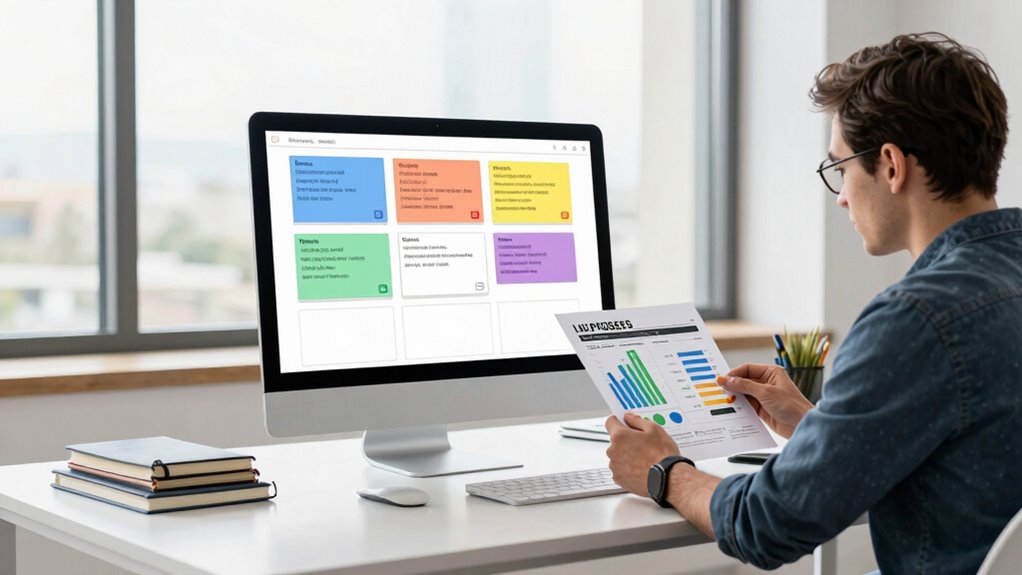

Implementing work-in-progress limits helps you finish more tasks by reducing multitasking and focusing on fewer items at once. This creates clearer workflow boundaries, quickly spots bottlenecks, and minimizes delays. As a result, your team becomes more efficient and motivated, moving tasks through stages faster. If you want to learn how to set these limits effectively and overcome common challenges, explore further steps that can transform your productivity.
Key Takeaways
- Limiting WIP reduces multitasking, allowing teams to focus and complete tasks faster.
- WIP caps help identify workflow bottlenecks early, accelerating overall project progress.
- Focusing on fewer tasks at once improves quality and prevents delays caused by task switching.
- Clear WIP boundaries promote better prioritization and resource allocation for quicker results.
- Constraints on work-in-progress foster continuous improvement and faster delivery cycles.
What Are WIP Limits and Why They Can Boost Your Productivity?

Have you ever felt overwhelmed by too many tasks at once? That’s where WIP limits come in. They help create Kanban clarity by setting clear boundaries on how many tasks you can work on simultaneously. This method encourages you to focus on completing tasks rather than starting new ones, which can lead to better workflow management. With WIP limits, task prioritization becomes easier because you’re forced to finish current work before taking on new tasks. Instead of juggling numerous things, you concentrate on completing what’s in progress. This approach reduces context switching and keeps your workflow smooth. Work-in-progress limits also help identify bottlenecks early, so you can address issues before they cause delays. Implementing these limits can be particularly effective in managing project timelines, ensuring timely completion of tasks. By limiting work in progress, you gain better control over your workload, stay organized, and boost your productivity. It’s a simple yet powerful way to make sure you’re working smarter, not harder.
How Do WIP Limits Help You Finish Tasks Faster?

Ever wonder how limiting your work in progress can speed up task completion? When you set WIP limits, you force yourself to focus on fewer tasks at once, improving task prioritization. Instead of juggling multiple tasks and risking mistakes, you dedicate your energy to completing each one efficiently. This reduces multitasking pitfalls, such as context switching delays and reduced quality. With clearer focus, you finish tasks faster and with better results. WIP limits help you identify bottlenecks early, so you can address issues promptly. By concentrating on fewer tasks, you avoid spreading yourself too thin, leading to quicker completions and less rework. Ultimately, limiting WIP keeps you productive, organized, and moving forward without unnecessary delays. Incorporating project management support can further streamline your workflow and enhance task completion. Additionally, understanding craftsmanship principles ensures that the quality of your work remains high despite increased speed. Recognizing the importance of self-sufficiency in managing resources can also help you maintain steady progress under constraints. An awareness of system thinking can improve how you identify and resolve workflow inefficiencies.
How to Implement WIP Limits Effectively in Your Workflow

To implement WIP limits effectively in your workflow, start by analyzing your current process to identify stages where tasks tend to pile up or slow down. Use prioritization strategies to determine which tasks are most critical, ensuring your team focuses on high-value work first. Clear team communication is essential—share WIP limits openly and encourage feedback to refine them. Set specific limits for each stage, and monitor how work flows through the system. Adjust limits as needed to prevent bottlenecks without stifling progress. Regularly review your process with your team, promoting transparency and collective ownership. By aligning WIP limits with your priorities and fostering open communication, you’ll streamline workflows, reduce multitasking, and improve overall productivity. Incorporating real-time monitoring of work progress can further enhance your ability to adapt WIP limits dynamically and maintain optimal flow.
What Common Challenges Might You Face With WIP Limits: and How to Overcome Them

Implementing WIP limits can present several challenges that might hinder your team’s progress. Resistance to change often surfaces, as team members may prefer familiar workflows. Misaligned priorities can also cause confusion, making it hard to determine which tasks to prioritize within limits. To address resistance to change, involve your team early and explain how WIP limits improve efficiency. Clarify priorities to prevent misunderstandings. Use this table to identify common issues and solutions:
| Challenge | Cause | Solution |
|---|---|---|
| Resistance to change | Fear of losing control | Communicate benefits clearly |
| Misaligned priorities | Lack of shared goals | Regularly review and realign priorities |
| Overcoming stagnation | Complacency or fear | Foster open feedback and transparency |
| Ignoring limits | Pressure to complete tasks | Reinforce WIP policies consistently |
| Poor visibility | Lack of tracking tools | Implement transparent dashboards |
| Lack of awareness of Piercing Care and Hygiene | Insufficient knowledge about proper piercing maintenance | Educate team members on cleaning and aftercare practices |
Real-World Examples of WIP Limits Improving Team Performance

Real-world examples show that applying WIP limits can considerably boost team performance. When teams set clear limits, they often experience increased motivation, as members feel less overwhelmed and more focused. For instance, a software development team reduced their work-in-progress, which helped identify process bottlenecks early. As a result, tasks moved faster, and team members felt more engaged and motivated to complete their work. WIP limits create a visual cue, encouraging collaboration and reducing multitasking, which improves flow. By limiting work in progress, teams prevent overload, streamline processes, and see tangible progress more quickly. This approach also promotes a clear workflow, making it easier to identify areas for improvement and adjust accordingly. Notably, implementing WIP limits fosters continuous improvement, leading to higher morale and a sense of accomplishment, ultimately driving better performance and faster project completion. Additionally, understanding the concept of Free Floating helps teams remain flexible and adapt their WIP limits based on current capacity and project needs.
Frequently Asked Questions
Can WIP Limits Be Customized for Different Team Sizes?
Yes, you can customize WIP limits for different team sizes. By adjusting limits based on team size, you guarantee workload remains manageable and productivity stays high. Implementing flexible limit strategies allows you to scale WIP limits up or down as your team grows or shrinks. This tailored approach helps prevent bottlenecks, enhances flow, and keeps everyone focused, regardless of team size or project complexity.
How Do WIP Limits Affect Team Morale?
WIP limits can boost your team’s morale by reducing stress and preventing overload. When you set clear limits, your team feels more motivated because they can focus on fewer tasks at once, leading to a sense of accomplishment. It also creates a more manageable workload, which lowers frustration and burnout. Overall, WIP limits foster a healthier work environment, encouraging your team to stay engaged and productive.
What Tools Best Support Implementing WIP Limits?
Coincidentally, the best tools for implementing WIP limits blend visualization techniques with seamless software integrations. Kanban boards like Trello or Jira help you visualize work flow clearly, making it easy to set and monitor WIP limits. These tools automatically update in real-time, so you can spot bottlenecks quickly. By using them, you support your team’s focus, improve flow, and ultimately finish more tasks efficiently.
Are WIP Limits Suitable for All Industries?
WIP limits aren’t suitable for all industries, but they can be adapted across sectors with the right industry adaptability. If your workflow benefits from reducing multitasking, managing bottlenecks, or increasing focus, then WIP limits may work well. Cross sector application is possible, especially in manufacturing, software development, and service industries. However, you should evaluate your specific processes to guarantee WIP limits enhance efficiency without causing unnecessary constraints.
How Often Should WIP Limits Be Reviewed and Adjusted?
You should review your WIP limits regularly, at least monthly, to keep process flexibility and team communication strong. As the saying goes, “Change is the only constant.” Regular reviews help identify bottlenecks, adapt to workflow shifts, and make certain your limits stay effective. Adjust them when your team faces new challenges or workload changes, making sure your process remains smooth and productive.
Conclusion
By embracing WIP limits, you’re planting seeds of focus in your workflow’s fertile ground. As you prune unnecessary tasks, you allow productivity to flourish like a well-tended garden. This counterintuitive approach may feel like steering against the current, but it’s the secret to sailing smoothly toward your goals. With each task you complete, you’re weaving a tapestry of efficiency—vivid, purposeful, and beautifully finished.