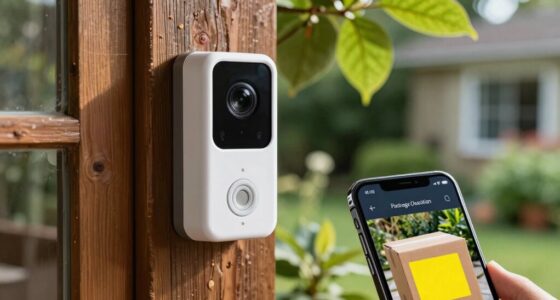
Night vision devices help you see in darkness using infrared (IR) illumination and image enhancement techniques. IR night vision relies on emitting invisible IR light that bounces off objects and becomes visible on your device, providing clear images even in total darkness. Color night vision, on the other hand, enhances images with natural colors in low-light conditions but struggles in complete darkness. Understanding how these systems work can improve your ability to choose the right technology for your needs. Keep exploring to discover more.
Listen free for 30 days with Audible
Thousands of audiobooks and originals — cancel anytime.
As an affiliate, we earn on qualifying purchases.
Key Takeaways
- Infrared night vision captures faint IR light reflected from objects, working effectively in total darkness, while color night vision uses image intensification to replicate natural colors.
- IR night vision emits invisible IR illumination and processes reflected light to create high-contrast images without ambient light.
- Color night vision relies on existing ambient light and enhances images to produce colors but is less effective in complete darkness.
- Infrared devices excel in pitch-black conditions, providing clearer images, whereas color systems perform better in low-light but not total darkness.
- Understanding the differences helps choose the right technology for stealth, security, or outdoor use depending on lighting conditions.
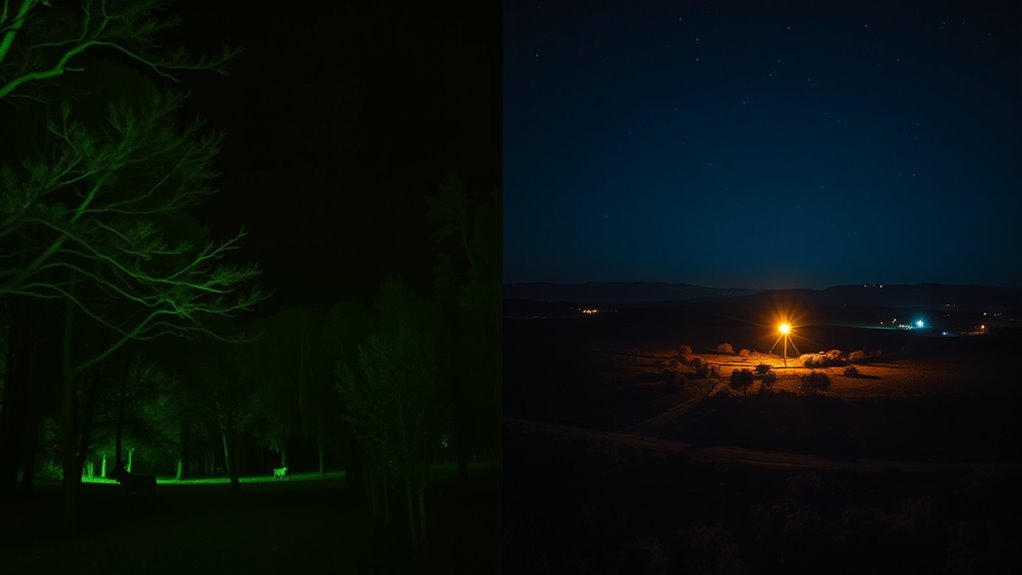
Have you ever wondered how some people see clearly in complete darkness? It’s a fascinating ability that relies on advanced technology, primarily infrared illumination and image enhancement. Night vision devices work by capturing faint light and transforming it into visible images, allowing you to see in conditions where your naked eye would be completely useless. The key to this process is infrared illumination, which emits invisible infrared light that illuminates the scene without alerting anyone nearby. This invisible glow bounces off objects and returns to the device’s sensor, which then processes the data and creates a clear image. The secret lies in the device’s ability to enhance these faint signals through image enhancement techniques, sharpening details and improving contrast to produce a usable picture.
When you use infrared night vision equipment, you’re essentially turning invisible infrared light into a visible image. The technology doesn’t rely on ambient light like moonlight or starlight, so it functions effectively even in total darkness. Infrared illumination is crucial because it provides a consistent light source without disturbing your surroundings or giving away your position. As the sensor captures the IR light reflected from objects, it amplifies the signal through sophisticated image enhancement algorithms. These algorithms improve clarity, reduce noise, and highlight essential details, ensuring you can distinguish objects, animals, or people with precision. This process makes infrared night vision highly effective in tactical, security, or outdoor scenarios where stealth and clarity are fundamental. Additionally, the integration of advanced sensor technology significantly boosts performance in low-light conditions, making these devices more reliable.
In contrast, color night vision systems attempt to replicate the natural colors of your environment, often using image intensification technology that amplifies existing light. While this provides a more familiar view, it’s typically less effective in complete darkness. Color night vision devices sometimes incorporate infrared illumination as well, but they rely heavily on ambient light to produce a detailed color image. When it’s very dark, they struggle to deliver the same level of detail and clarity that infrared-based monochrome systems can offer. Essentially, infrared illumination combined with advanced image enhancement allows infrared night vision devices to outperform color systems in pitch-black conditions, delivering sharper, clearer images that make it easier for you to navigate, observe, or monitor your surroundings without alerting others.
Understanding the differences between IR and color night vision helps you choose the right technology for your needs. Infrared illumination and image enhancement are at the core of effective night vision, offering a distinct advantage in darkness where natural or ambient light is absent. Whether you’re out in the wild, securing property, or engaging in tactical operations, these tools give you a visual edge that’s simply not possible with traditional night vision methods.

Knowledge Encyclopedia Science!, 2nd Edition
As an affiliate, we earn on qualifying purchases.
Frequently Asked Questions
Can IR Night Vision Be Detected by Enemies?
Yes, IR night vision can be detected by enemies through infrared detection devices, which sense the infrared light emitted by your device. When you use IR night vision, your enemy’s sensors may pick up the infrared glow, increasing their awareness of your position. To avoid detection, you should minimize IR use or utilize devices with stealth features, helping you stay hidden and reduce enemy awareness of your presence.
How Does Ambient Light Affect IR Night Vision Effectiveness?
Imagine you’re using IR night vision during a clear, moonlit night. Ambient illumination from moonlight substantially boosts your IR device’s effectiveness, making images sharper and brighter. Without enough ambient illumination, IR sensors struggle in darkness, relying solely on infrared emissions. Moonlight enhancement provides additional light, improving visibility and detail. So, your IR night vision works best when there’s some ambient illumination, like moonlight, to help enhance image clarity.
Are Color Night Vision Devices Suitable for All Weather Conditions?
Color night vision devices aren’t suitable for all weather conditions because weather impacts their performance. You might find that fog, rain, or snow reduce color accuracy and clarity, making it harder to see clearly. Additionally, consider device durability; harsh conditions can damage electronics or lenses. You should choose a device designed for specific weather conditions to guarantee reliable performance and longevity, especially in challenging environments.
What Is the Lifespan of Typical Night Vision Equipment?
Think of your night vision gear as a finely tuned engine that needs regular care. Typically, it lasts between 5 to 10 years with proper maintenance. To extend its life, follow maintenance tips like storing it in a dry, cool place and avoiding rough handling. Technological advancements continually improve durability, but regular checks guarantee your device stays sharp and reliable for years to come.
Can IR Night Vision Cause Eye Strain During Extended Use?
IR night vision can cause eye strain during extended use because it may lead to visual discomfort and eye fatigue. When you use infrared devices for a long time, your eyes work harder to process the images, especially in low-light conditions, which can cause headaches or blurry vision. To avoid this, take regular breaks and guarantee your equipment is properly adjusted to minimize strain and maximize comfort.

Encyclopedia of Science
- Condition: Used Book in Good Condition
As an affiliate, we earn on qualifying purchases.
Conclusion
By now, you’re practically a night vision superhero, capable of seeing through the darkest shadows like a blazing torch of light! Whether you choose infrared’s mysterious glow or vibrant color vision, you hold the power to reveal secrets hidden in the blackest night. So go ahead—embrace this incredible technology and turn midnight into your playground. With night vision, you’re not just seeing in the dark—you’re ruling it!

The Way Things Work: Newly Revised Edition: The Ultimate Guide to How Things Work
As an affiliate, we earn on qualifying purchases.

Science Book, The: Everything You Need to Know About the World and How It Works
As an affiliate, we earn on qualifying purchases.
College move-in / dorm season Picks
dorm essentials
As an affiliate, we earn on qualifying purchases.